

What do you think?
Architecture Briefs
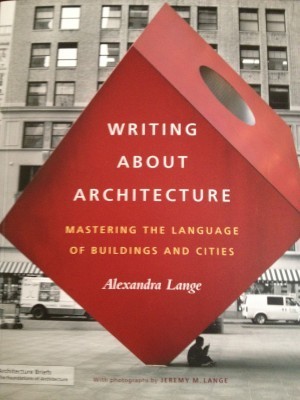
Writing About Architecture: Mastering the Language of Buildings and Cities
Writing About Architecture: Mastering the Language of Buildings and Cities , the latest addition to the Architecture Briefs series, is a handbook on how to write effectively and critically about the contemporary city. The book offers works by some of the best architecture critics of the twentieth century including Ada Louise Huxtable, Lewis Mumford, Herbert Muschamp, Michael Sorkin, Charles Moore, Frederick Law Olmsted, and Jane Jacobs to explains some of the most successful methods with which to approach architectural criticism. Each chapter opens with a reprint of a historically significant essay (and organized by typology such as the skyscraper, the museum, and parks) discussing a specific building or urban project. The author, Alexandra Lange, then offers a close reading of that essay, as well as her own analysis through contemporary examples, to further enlighten the reader about how to write an effective piece of architectural criticism.
This book, based on lessons learned from the author's courses at New York University and the School of Visual Arts, could serve as the primary text for a course on criticism for undergraduates or architecture and design majors. Architects covered include Marcel Breuer, Diller Scofidio + Renfro, Field Operations, Norman Foster, Frank Gehry, Frederick Law Olmsted, SOM, Louis Sullivan, and Frank Lloyd Wright.
This book, based on lessons learned from the author's courses at New York University and the School of Visual Arts, could serve as the primary text for a course on criticism for undergraduates or architecture and design majors. Architects covered include Marcel Breuer, Diller Scofidio + Renfro, Field Operations, Norman Foster, Frank Gehry, Frederick Law Olmsted, SOM, Louis Sullivan, and Frank Lloyd Wright.
192 pages, Paperback
First published March 11, 2008
About the author
Alexandra Lange
89 books75 followersNote: There is more than one author with this name in the Goodreads database.
Alexandra Lange is a journalist and an architectural historian. She is a contributing editor at New York Magazine and writes articles about architecture, design and urban planning for Metropolis, Domino and The New York Times. She received her PhD from the Institute of Fine Arts at New York University and has contributed essays and articles to peer-reviewed publications such as the Journal of Design History and the Journal of the Society of Architectural Historians. Alexandra has taught architectural criticism at New York University and delivered papers on her research at the Society of Architectural Historians 59th Annual Meeting and the 2005 Buell Dissertation Colloquium at Columbia University.
Alexandra Lange is a journalist and an architectural historian. She is a contributing editor at New York Magazine and writes articles about architecture, design and urban planning for Metropolis, Domino and The New York Times. She received her PhD from the Institute of Fine Arts at New York University and has contributed essays and articles to peer-reviewed publications such as the Journal of Design History and the Journal of the Society of Architectural Historians. Alexandra has taught architectural criticism at New York University and delivered papers on her research at the Society of Architectural Historians 59th Annual Meeting and the 2005 Buell Dissertation Colloquium at Columbia University.
Ratings & Reviews
Friends & Following
Create a free account to discover what your friends think of this book!
Community Reviews
Displaying 1 - 13 of 13 reviews
July 31, 2025
My third eye has opened. I must get more annoying about architecture to continue my endeavors.

March 23, 2018
It's very rare that you find a book that leaves you smarter than you were everytime you flip a page. Alexandra's work has been my saving grace at a time when I am trying to be better at something I've never done before.

February 1, 2024
I wish someone had recommended this book to me when I was in architecture college.
Read
June 6, 2016I enjoyed this book. It contains essays/excerpts from books which I had never read, yet thoroughly enjoyed. I especially enjoyed the essay by Charles Moore on Monumentality. The author presents essays using multiple perspectives or themes by various well-known architects and architecture critics and follows them up by explaining each particular theme and approach.
The book overall was an easy read, and is a great resource for students and professionals, alike. I plan to read it again and use the author's suggestions on how to write about buildings.
The book overall was an easy read, and is a great resource for students and professionals, alike. I plan to read it again and use the author's suggestions on how to write about buildings.

Want to Read
July 20, 2013The Kindle version of this book is nearly unreadable. They have incorporated well-intentioned links from the essays to the related criticism, but it results in extreme difficulty reading and navigating through the material. Can't take it; will have to get a hard copy from the library instead.

February 7, 2016
The concepts in Writing about Architecture are solid, but the prose is frequently abstract and dense. Clarity of message is compromised as a result. The essay selections give a cross section of criticism and approaches that is useful.

October 31, 2017
Well written book with an illustration of the deferent concepts of writing.
This is a must-read for architects who want to pursue or start to writing about architecture.
You will also read about the Guggenheim Museum in Bilbao, from a well-known architect, Frank Gehry. This work gave a life to a new concept called "Bilbao Effect", which means a famous or a starchitect design a building in a not famous city, and after that everyone will know about the city.
I was thinking about how many "Effect" we have in Armenia, besides Genocide, SOAD, Armenian wine and last but not least Kardashians )))).This "Effect" can really give benefit to our economy.
Maybe our government could support local investors to hire a famous architect to bring this "Effect".
This is a must-read for architects who want to pursue or start to writing about architecture.
You will also read about the Guggenheim Museum in Bilbao, from a well-known architect, Frank Gehry. This work gave a life to a new concept called "Bilbao Effect", which means a famous or a starchitect design a building in a not famous city, and after that everyone will know about the city.
I was thinking about how many "Effect" we have in Armenia, besides Genocide, SOAD, Armenian wine and last but not least Kardashians )))).This "Effect" can really give benefit to our economy.
Maybe our government could support local investors to hire a famous architect to bring this "Effect".

September 5, 2024
La autora, que enseña crítica de arquitectura en la NY University, toma cinco artículos de autores como Michael Sorkin, Charles Moore o Jane Jacobs para reflexionar sobre la ciudad y la arquitectura.
Lo mejor son los propios artículos.
Lo mejor son los propios artículos.

June 21, 2022
Enlightening. The book provide insights into how some of the great critics of architacture saw it, analyze it, reacted to it, and ultimately wrote about it. I believe most readres will react to architecture differently after reading it, with greater depth of understanding, more able to discuss or write about the subject from different perspetives.

September 3, 2021
Lo que más me ha gustado del libro es que Lange se centra en el lado humano de la arquitectura. Ella nos recuerda que la arquitectura es más que una cuestión de materiales y formas. Es también una expresión de la cultura, la historia y la sociedad.
Algunos ejemplos concretos de cómo Lange humaniza la arquitectura:
En el capítulo "The language of architecture", Lange explica que el lenguaje arquitectónico es una forma de comunicación. Los edificios hablan de nosotros y de nuestro mundo.
En el capítulo "Writing about buildings", Lange nos invita a pensar en los edificios como personajes. Cada edificio tiene su propia historia y personalidad.
En el capítulo "Writing about cities", Lange nos recuerda que las ciudades son lugares vivos. Están llenas de gente, historias y sueños.
En definitiva, Writing about architecture es un libro que nos ayuda a ver la arquitectura de una nueva forma. Es un libro que nos hace pensar sobre el papel de la arquitectura en nuestras vidas.
Algunos ejemplos concretos de cómo Lange humaniza la arquitectura:
En el capítulo "The language of architecture", Lange explica que el lenguaje arquitectónico es una forma de comunicación. Los edificios hablan de nosotros y de nuestro mundo.
En el capítulo "Writing about buildings", Lange nos invita a pensar en los edificios como personajes. Cada edificio tiene su propia historia y personalidad.
En el capítulo "Writing about cities", Lange nos recuerda que las ciudades son lugares vivos. Están llenas de gente, historias y sueños.
En definitiva, Writing about architecture es un libro que nos ayuda a ver la arquitectura de una nueva forma. Es un libro que nos hace pensar sobre el papel de la arquitectura en nuestras vidas.

June 9, 2012
This book was clear, concise, interesting, and exciting. There were a few bizarre oversights (I found the discussion of Los Angeles as a city where no one would know where to march for political change very strange), but overall, thought-provoking and a quick read.

March 9, 2013
Very helpful. A useful anthology of foundatîonal architectural criticism along with comments about each essay noting its organization and pointing it how the authors approached their topic. There are many writing guides out there, but this is one of the few specifically about architectural writing.

July 1, 2016
It's a good selection of architecture criticism, but I think I would have preferred that the space Lange gives to recapping each essay (why is it necessary to repeat something I just read in full??) to more full length quotations or criticism.
Displaying 1 - 13 of 13 reviews