

What do you think?
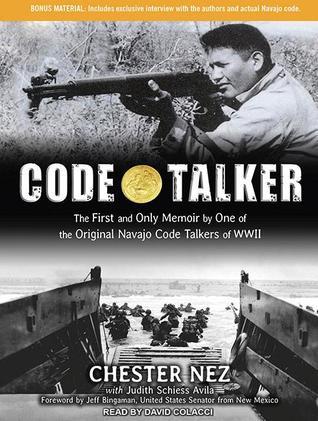
Code Talker: The First and Only Memoir by One of the Original Navajo Code Talkers of WWII
In the 1920s, growing up on the Checkerboard Area of the Navajo Reservation wasn't easy. There was no electricity or indoor plumbing. The New Mexico summers were hot and the winters harsh. But the beautiful mesas provided bountiful land on which to raise sheep and goats, and the Navajo celebrated their spiritual connection to nature.His name wasn't Chester Nez. That was the English name he was assigned in kindergarten. And in boarding school at Fort Defiance, he was punished for speaking his native language, as the teachers sought to rid him of his culture and traditions. But discrimination didn't stop Chester from answering the call to defend his country after Pearl Harbor, for the Navajo have always been warriors, and his upbringing gave him the strength-both physical and mental-to excel as a Marine.During World War II, the Japanese had managed to crack every code the United States used. But when the Marines turned to its Navajo recruits to develop and implement a secret military language, they created the only unbroken code in modern warfare-and helped assure victory for the United States over Japan in the South Pacific.Chester Nez is the only surviving member of the original twenty-nine code talkers-and this is his story.
Audio CD
First published September 6, 2011
About the author
Chester Nez
11 books18 followersChester Nez was an American veteran of World War II. He was the last original Navajo code talker who served in the United States Marine Corps during the war. (taken from Wikipedia)
Ratings & Reviews
Friends & Following
Create a free account to discover what your friends think of this book!
Community Reviews
Displaying 1 - 30 of 1,317 reviews

January 26, 2015
It is arguable whether the Japanese or the Nazis were the most cruel in WWII, neither showed the slightest mercy or even acknowledgement of their enemies' humanity. Far from it, they each went all out to exterminate from the earth those they felt didn't deserve even life. All in the name of some ugly character with a warped philosophy or an equally warped divine emperor both of whom inspired religious devotion as if they were God incarnate.
Now read this, from Code Talker:
"The Japanese who held Guadalcanal were trained not to surrender. Their war strategy revolved around the Bushido code, an ancient way of the warrior first developed by the Samurai. This code of conduct extolled loyalty and obedience. Soldiers were required to fight to the death and take as many of their enemy with them as they could. Even facing impossible odds, Japanese soldiers chose to blow themselves up hoping to blow American soldiers up rather than surrender. They would die for their Emperor."
Substitute a couple of words here and there, think of recent events, think of ISIS and their ilk. It seems that we learn of history so that we don't repeat it, but some of them learn history to take inspiration in evil. And what of the Japanese who didn't say anything, or the Germans neither of them got a free pass, but these days well you get my drift.
______________
This is really a 4 star book. But the author deserves the extra star. There was not enough about the code (in fact, almost nothing) and an awful lot about the battles for Guadacanal and Peleliu.
The worst thing about the book was the way the Navajos were treated after the war. Back to 'we don't serve Indians here'. As their jobs as code talkers and more importantly code-developers, were protected information, not declassified until 1968, the soldiers had to present themselves as very ordinary infantrymen rather than dedicated specialists which would have got them much better jobs, in fact it might have got them jobs.
______________
Now read this, from Code Talker:
"The Japanese who held Guadalcanal were trained not to surrender. Their war strategy revolved around the Bushido code, an ancient way of the warrior first developed by the Samurai. This code of conduct extolled loyalty and obedience. Soldiers were required to fight to the death and take as many of their enemy with them as they could. Even facing impossible odds, Japanese soldiers chose to blow themselves up hoping to blow American soldiers up rather than surrender. They would die for their Emperor."
Substitute a couple of words here and there, think of recent events, think of ISIS and their ilk. It seems that we learn of history so that we don't repeat it, but some of them learn history to take inspiration in evil. And what of the Japanese who didn't say anything, or the Germans neither of them got a free pass, but these days well you get my drift.
______________
This is really a 4 star book. But the author deserves the extra star. There was not enough about the code (in fact, almost nothing) and an awful lot about the battles for Guadacanal and Peleliu.
The worst thing about the book was the way the Navajos were treated after the war. Back to 'we don't serve Indians here'. As their jobs as code talkers and more importantly code-developers, were protected information, not declassified until 1968, the soldiers had to present themselves as very ordinary infantrymen rather than dedicated specialists which would have got them much better jobs, in fact it might have got them jobs.
______________

June 5, 2014
Veterans’ Honor Song
I read this book a while back, before I joined Goodreads. The author, the last of the original 29 Navajo Code Talkers, died yesterday. Before I read this book, I'd heard of him and the work this group of Marines did, but I had no understanding of the danger they endured.
The book not only tells of the development of the code, and the battles in which it was used, but shares the author’s life growing up on the Navajo reservation, and his life after the war. His humor, humility and wisdom make this worth reading. I’m not a war buff. That’s not why I read it. This is a human story that includes a war.
The author doesn’t make himself into a hero, though many people would say he was one, and he doesn’t glorify war or his part in it. His account of war tells of his friendships with his fellow code talkers, and shows compassionate awareness of the indigenous people of the Pacific islands where major WWII battles took place, destroying their homelands. For a reader not acquainted with Navajo culture and who has never heard that difficult language spoken, it’s still accessible, though if you have some familiarity with both the book will mean even more. I was the only member of my book club with that background when we read it, and all of us liked this book, and felt that in reading it we had met a man worth knowing.
Honor his memory and that of all the Code Talkers. Read this book.
I read this book a while back, before I joined Goodreads. The author, the last of the original 29 Navajo Code Talkers, died yesterday. Before I read this book, I'd heard of him and the work this group of Marines did, but I had no understanding of the danger they endured.
The book not only tells of the development of the code, and the battles in which it was used, but shares the author’s life growing up on the Navajo reservation, and his life after the war. His humor, humility and wisdom make this worth reading. I’m not a war buff. That’s not why I read it. This is a human story that includes a war.
The author doesn’t make himself into a hero, though many people would say he was one, and he doesn’t glorify war or his part in it. His account of war tells of his friendships with his fellow code talkers, and shows compassionate awareness of the indigenous people of the Pacific islands where major WWII battles took place, destroying their homelands. For a reader not acquainted with Navajo culture and who has never heard that difficult language spoken, it’s still accessible, though if you have some familiarity with both the book will mean even more. I was the only member of my book club with that background when we read it, and all of us liked this book, and felt that in reading it we had met a man worth knowing.
Honor his memory and that of all the Code Talkers. Read this book.

July 19, 2021
Code Talker has a marvelous story to tell. The code talkers played a large role in WWII by developing and using the difficult and impenetrable Navajo language as a code for military communications. There have been other books and a movie about this subject, but none by an original code talker.
Young Nez was born in the early part of the 20th century on the Rez/Checkerboard area of New Mexico. Like many Navajo at that time, he had to leave his family of sheepherders to get an Anglo education at boarding school. Having recently read about a small Hebridean island where the children had to board away from home, I knew it was not going to be a happy experience. In his case it was much worse. The Navajo children not only faced dislocation but cruelty, bullying and racial discrimination against their language and culture. As a determined young man he managed to hang in there and succeed. His determination stood him well in the war years ahead of him.
We follow him until the Japanese bomb Pearl Harbor and he willingly joins the Marines to defend his country, this in spite of how he and his people had been treated. The military had decided to try the Navajo language as a code for messages. Nez was fortunate enough to be selected in the first group of 29 Navajo Marines for this project. They were successful beyond all hopes. We are told of his experiences in the Pacific war from Guadalcanal until he finally earned enough points to return home. His experiences no doubt enabled him to successfully straddle the Navajo and standard American worlds.
Fans of Tony Hillerman novels would definitely find this book interesting. I think it confirms that Hillerman gave good information about the customs and religion of the Navajo. The “Navajo” parts of this book are far more interesting than the war. Unfortunately, the story could have been told much better. He has a co-author and there are many times that I doubt his voice is used. The co-author has shaped the story her way and the narrative is not always that interesting. This is not another Unbreakable or a Flags of Our Fathers by any means.
Mr. Nez is gone now, but I hope the recognition he got in later life was rewarding for him and his family.
Young Nez was born in the early part of the 20th century on the Rez/Checkerboard area of New Mexico. Like many Navajo at that time, he had to leave his family of sheepherders to get an Anglo education at boarding school. Having recently read about a small Hebridean island where the children had to board away from home, I knew it was not going to be a happy experience. In his case it was much worse. The Navajo children not only faced dislocation but cruelty, bullying and racial discrimination against their language and culture. As a determined young man he managed to hang in there and succeed. His determination stood him well in the war years ahead of him.
We follow him until the Japanese bomb Pearl Harbor and he willingly joins the Marines to defend his country, this in spite of how he and his people had been treated. The military had decided to try the Navajo language as a code for messages. Nez was fortunate enough to be selected in the first group of 29 Navajo Marines for this project. They were successful beyond all hopes. We are told of his experiences in the Pacific war from Guadalcanal until he finally earned enough points to return home. His experiences no doubt enabled him to successfully straddle the Navajo and standard American worlds.
Fans of Tony Hillerman novels would definitely find this book interesting. I think it confirms that Hillerman gave good information about the customs and religion of the Navajo. The “Navajo” parts of this book are far more interesting than the war. Unfortunately, the story could have been told much better. He has a co-author and there are many times that I doubt his voice is used. The co-author has shaped the story her way and the narrative is not always that interesting. This is not another Unbreakable or a Flags of Our Fathers by any means.
Mr. Nez is gone now, but I hope the recognition he got in later life was rewarding for him and his family.

February 2, 2025
Chester Nez was one of 29 Navajo who served in the marines as "code talkers," starting in WWII. As of the printing of this edition in 2011, he was the only surviving member (he died at 93 in 2014).
I don't really like war books as a genre. I didn't like the recounting of personal encounters with war in this book either. What I liked were the small history lessons about Japan, how/why he joined the marines, and what his life was like before and after. I also found it ironic that the boarding schools inflicted so much violence on the Indigenous to scrub their languages and cultures out (which, to me, is a form of emotional, psychological, and cultural genocide), yet it was their very language that was used to help win in WW2.
So I guess it was a good thing the schools didn't completely succeed. Those schools - the other half of the genocide being cultural and religious imperialism - make me so angry! But because the Navajo and others who survived the schools found a way to hold onto the essence of who they are, this story reminds me to keep fighting the forces that try to squash us down and strip away our multicultural identities that actually make this country great.
I was really saddened by the impact of the government oppression on his family and community, but I knew to expect that coming into the book - no surprise there.
Good read. About time the code talkers got their due recognition. Their story is something that should be shared and told throughout the generations as part of US history - all of it - their contributions, but also the before (i.e., the boarding schools), the after (e.g., the Congressional Gold Medal), and all the racism they've had to overcome in between - not to make anyone feel badly about our history, but to face it, learn from it, and grow from it to become a stronger nation.
Thank you to my Goodreads friend Theresa for recommending this book!
I don't really like war books as a genre. I didn't like the recounting of personal encounters with war in this book either. What I liked were the small history lessons about Japan, how/why he joined the marines, and what his life was like before and after. I also found it ironic that the boarding schools inflicted so much violence on the Indigenous to scrub their languages and cultures out (which, to me, is a form of emotional, psychological, and cultural genocide), yet it was their very language that was used to help win in WW2.
So I guess it was a good thing the schools didn't completely succeed. Those schools - the other half of the genocide being cultural and religious imperialism - make me so angry! But because the Navajo and others who survived the schools found a way to hold onto the essence of who they are, this story reminds me to keep fighting the forces that try to squash us down and strip away our multicultural identities that actually make this country great.
I was really saddened by the impact of the government oppression on his family and community, but I knew to expect that coming into the book - no surprise there.
Good read. About time the code talkers got their due recognition. Their story is something that should be shared and told throughout the generations as part of US history - all of it - their contributions, but also the before (i.e., the boarding schools), the after (e.g., the Congressional Gold Medal), and all the racism they've had to overcome in between - not to make anyone feel badly about our history, but to face it, learn from it, and grow from it to become a stronger nation.
Thank you to my Goodreads friend Theresa for recommending this book!

May 15, 2025
All Chester Nez wanted to do was follow the Navajo way and “walk in beauty.” But, fate had other plans and those include his leaving his homeland, becoming a Marine and fighting in the most difficult island battles of World War II.
"When I arrive home after this war, I promised myself, my father will be happy to learn how the Navajo language helped the troops. My family will be proud of my part in developing the top secret code. I just had to make it through, so I could see Chichiltah again."
This book is the result of many interviews/discussions between Chester Nez and Judith Schiess Avila. As Avila describes it: "Chester, eighty-six years old when I met him, now ninety, is the only living “original” code talker. These were the twenty-nine men who first devised the famous Navajo code and took it into battle against the Japanese."
The narrative begins off Guadalcanal Island as Nez and the other Marines prepare to land under extreme fire from the Japanese ground and air forces.
"A chaplain addressed us, reciting a blessing. I held the small buckskin medicine bag my father had sent and said my own silent prayer. Give me courage. Let me make my country proud. Please protect me. Let me live to walk in beauty. Around me the other Navajos seemed to be doing the same, each hoping to “walk in beauty” again in their native homes in Arizona and New Mexico."
But the scene quickly shifts back to the childhood of Chester Nez and we get some very helpful chapters on Navajo culture, beliefs, history and daily life. Having read the novels of Tony Hillerman, I felt that Nez’s narrative helped to flesh out much of what I had already understood.
"I felt good. Lighter. A sweat bath was not to be taken heedlessly, and I had prepared carefully, examining my life both at school and at home. I knew I’d entered into the sweat hut with the proper attitude. So I felt sure that the ceremony had provided me with what I sought—protection, strength against bad influences, and a cleansing of the soul."
Given their experiences it is amazing how 29 Navajos thrown together could quickly find the key to working together. "There was no dissension among us in that locked room. We focused. We worked as one. This was a talent long employed in Navajo culture—many working together to herd the sheep, plant the corn, bring in a harvest. When we were children, distant relatives visited for weeks at a time, strengthening the bond of family. Neighbors cared for one another’s livestock when someone was sick or had to travel, knowing their friend would someday do the same for them. The ability to live in unity, learned on the reservation and the Checkerboard, proved invaluable to our current assignment."
Their abilities were recognized early by their Marine Commandant: "Yours has been one of the outstanding platoons in the history of this Recruit Depot and a letter has gone to Washington telling of your excellence. You obey orders like seasoned and disciplined soldiers. You have maintained rugged health. You have been anxiouus [sic] to learn your new duties, and you have learned quickly. As a group you have made one of the highest scores on the Rifle Range. The Marine Corps is proud to have you in its ranks, and I am proud to have been the Commanding Officer of the Base while you were here. You are now to be transferred to a combat organization where you will receive further training. When the time comes that you go to battle with the enemy, I know that you will fight like true Navajos, Americans and Marines."
It took many years for the military to allow the American people access to what was Navajo code talking (see the book’s appendix).
"When we saw the letter C we had to think moasi. In battle, there would be no time to think: C, cat. That’s moasi. It had to be automatic, without a conscious thought process. We were to be living code machines."
And then we return to the battlefront at Guadalcanal: "Part of what was so hard on Guadalcanal was thinking that no one back home even knew what we Marines were doing. Or where we were fighting. And men were dying there. Thousands of men. We were all so tired and wrung out that we couldn’t think straight and could barely speak—except when we had no choice, sending the code."
This is a description of war that spares no sensibilities. "Still, our smell couldn’t begin to compete with the stench of dead bodies. In the heat, bodies began to decompose within a couple of hours, and despite liberal sprayings of DDT, the flies and maggots had a field day. Of course, the flies and maggots didn’t limit themselves to dead bodies. They’d attack the dead skin around a wound, too."
This is a remarkable book spanning decades with depth and insights that should interest anyone who has wondered about the relationship between Native Americans and the United States of America.
"The livestock reduction challenged this sense of community by pitting Navajo against Navajo. Those who kept livestock resented the Navajo exterminators who worked for the Bureau of Indian Affairs. Neighbors put up fences to enclose their pastures, saving them for the sheep that they had left. The year-round migration from one community grazing area to another that had always been the norm as I grew up became impossible. As a result, ties between neighbors weakened. The toll in self-respect was also huge. Families, unable to protect their own livestock, felt powerless. And nothing could have done more to erode the local work ethic. What was the point of working hard to build up wealth, a sizable herd, when the government just stepped in and destroyed it?"
It took the USA’s government many decades to actually provide any of the code talkers with a “Medal of Freedom,” something that finally spotlighted their sacrifice.
"In Window Rock, Arizona, however, the Navajo Tribal Council foresaw our country’s involvement. Rather than waiting for the American government to jump into the fray, in late spring of 1940 they passed a unanimous resolution: Whereas, the Navajo Tribal Council and the 50,000 people we represent, cannot fail to recognize the crisis now facing the world in the threat of foreign invasion and the destruction of the great liberties and benefits which we enjoy on the reservation, and Whereas, there exists no purer concentration of Americanism than among the First Americans, and Whereas, it has become common practice to attempt national destruction through the sowing of seeds of treachery among minority groups such as ours, and Whereas, we hereby serve notice that any un-American movement among our people will be resented and dealt with severely, and Now, Therefore, we resolve that the Navajo Indians stand ready as they did in 1918, to aid and defend our Government and its institutions against all subversive and armed conflict and pledge our loyalty to the system which recognizes minority rights and a way of life that has placed us among the great people of our race."
"When I arrive home after this war, I promised myself, my father will be happy to learn how the Navajo language helped the troops. My family will be proud of my part in developing the top secret code. I just had to make it through, so I could see Chichiltah again."
This book is the result of many interviews/discussions between Chester Nez and Judith Schiess Avila. As Avila describes it: "Chester, eighty-six years old when I met him, now ninety, is the only living “original” code talker. These were the twenty-nine men who first devised the famous Navajo code and took it into battle against the Japanese."
The narrative begins off Guadalcanal Island as Nez and the other Marines prepare to land under extreme fire from the Japanese ground and air forces.
"A chaplain addressed us, reciting a blessing. I held the small buckskin medicine bag my father had sent and said my own silent prayer. Give me courage. Let me make my country proud. Please protect me. Let me live to walk in beauty. Around me the other Navajos seemed to be doing the same, each hoping to “walk in beauty” again in their native homes in Arizona and New Mexico."
But the scene quickly shifts back to the childhood of Chester Nez and we get some very helpful chapters on Navajo culture, beliefs, history and daily life. Having read the novels of Tony Hillerman, I felt that Nez’s narrative helped to flesh out much of what I had already understood.
"I felt good. Lighter. A sweat bath was not to be taken heedlessly, and I had prepared carefully, examining my life both at school and at home. I knew I’d entered into the sweat hut with the proper attitude. So I felt sure that the ceremony had provided me with what I sought—protection, strength against bad influences, and a cleansing of the soul."
Given their experiences it is amazing how 29 Navajos thrown together could quickly find the key to working together. "There was no dissension among us in that locked room. We focused. We worked as one. This was a talent long employed in Navajo culture—many working together to herd the sheep, plant the corn, bring in a harvest. When we were children, distant relatives visited for weeks at a time, strengthening the bond of family. Neighbors cared for one another’s livestock when someone was sick or had to travel, knowing their friend would someday do the same for them. The ability to live in unity, learned on the reservation and the Checkerboard, proved invaluable to our current assignment."
Their abilities were recognized early by their Marine Commandant: "Yours has been one of the outstanding platoons in the history of this Recruit Depot and a letter has gone to Washington telling of your excellence. You obey orders like seasoned and disciplined soldiers. You have maintained rugged health. You have been anxiouus [sic] to learn your new duties, and you have learned quickly. As a group you have made one of the highest scores on the Rifle Range. The Marine Corps is proud to have you in its ranks, and I am proud to have been the Commanding Officer of the Base while you were here. You are now to be transferred to a combat organization where you will receive further training. When the time comes that you go to battle with the enemy, I know that you will fight like true Navajos, Americans and Marines."
It took many years for the military to allow the American people access to what was Navajo code talking (see the book’s appendix).
"When we saw the letter C we had to think moasi. In battle, there would be no time to think: C, cat. That’s moasi. It had to be automatic, without a conscious thought process. We were to be living code machines."
And then we return to the battlefront at Guadalcanal: "Part of what was so hard on Guadalcanal was thinking that no one back home even knew what we Marines were doing. Or where we were fighting. And men were dying there. Thousands of men. We were all so tired and wrung out that we couldn’t think straight and could barely speak—except when we had no choice, sending the code."
This is a description of war that spares no sensibilities. "Still, our smell couldn’t begin to compete with the stench of dead bodies. In the heat, bodies began to decompose within a couple of hours, and despite liberal sprayings of DDT, the flies and maggots had a field day. Of course, the flies and maggots didn’t limit themselves to dead bodies. They’d attack the dead skin around a wound, too."
This is a remarkable book spanning decades with depth and insights that should interest anyone who has wondered about the relationship between Native Americans and the United States of America.
"The livestock reduction challenged this sense of community by pitting Navajo against Navajo. Those who kept livestock resented the Navajo exterminators who worked for the Bureau of Indian Affairs. Neighbors put up fences to enclose their pastures, saving them for the sheep that they had left. The year-round migration from one community grazing area to another that had always been the norm as I grew up became impossible. As a result, ties between neighbors weakened. The toll in self-respect was also huge. Families, unable to protect their own livestock, felt powerless. And nothing could have done more to erode the local work ethic. What was the point of working hard to build up wealth, a sizable herd, when the government just stepped in and destroyed it?"
It took the USA’s government many decades to actually provide any of the code talkers with a “Medal of Freedom,” something that finally spotlighted their sacrifice.
"In Window Rock, Arizona, however, the Navajo Tribal Council foresaw our country’s involvement. Rather than waiting for the American government to jump into the fray, in late spring of 1940 they passed a unanimous resolution: Whereas, the Navajo Tribal Council and the 50,000 people we represent, cannot fail to recognize the crisis now facing the world in the threat of foreign invasion and the destruction of the great liberties and benefits which we enjoy on the reservation, and Whereas, there exists no purer concentration of Americanism than among the First Americans, and Whereas, it has become common practice to attempt national destruction through the sowing of seeds of treachery among minority groups such as ours, and Whereas, we hereby serve notice that any un-American movement among our people will be resented and dealt with severely, and Now, Therefore, we resolve that the Navajo Indians stand ready as they did in 1918, to aid and defend our Government and its institutions against all subversive and armed conflict and pledge our loyalty to the system which recognizes minority rights and a way of life that has placed us among the great people of our race."
March 22, 2023
Before reading Code Talker by Chester Nez, I knew of the Navajo Code Talkers of World War II, but I didn't know much about them. I learned so much from this book!
First, I must say the book starts out with a war scene straight away. Lots of statistics, dates and numbers are thrown out and I thought if the entire book was going to be like this, I was in deep trouble. But it didn't get very far before Chester flashes back to his childhood on the Checkerboard area just outside of the Navajo Nation. It was here that his story caught my attention and never let go.
Chester grew up in the 1920s (wow, a hundred years ago) tending his grandmother's sheep and goats. He loved his family, the animals, the land. He paints a beautiful picture of his childhood - until he is sent to boarding school, where things are much harsher for him. I want to share his story, but that would take away the enjoyment of reading the book for yourself so I'll let you discover the ups and downs of Chester's pre-war and post-war life if you decide to read the book. I will say that I was saddened to hear his first hand story of some of the horrible things that happened to him and his family because of their heritage.
I also learned volumes about World War II. My birthday falls on D-Day, so I've made it a point to learn quite a bit about the war in Europe. But I knew very little about what happened in the South Pacific. The stories he shares are harrowing. And the Code Talkers were right in the thick of things to get important information to and from the front lines. They were all incredibly brave. Chester served in the U.S. Marine Corps. Just hearing him talk about the Marines made my heart swell with pride. My father was a career Marine, serving 20 years, some of that time in Vietnam. To this day when I see a young person in a Marine uniform my eyes well up with tears. So there's just one more reason why I loved Chester's story.
The Code Talkers weren't permitted to share any details about what they did until the late 1960s. They were forced to spend more than 20 years keeping their accomplishment to themselves. During that time, they received no recognition for what they did. They weren't able to put the skills they used on a resume. Can you imagine? Many of the original Code Talkers died before they were ever able to tell anyone. That makes my heart ache. But once their work became declassified, the remaining Code Talkers began receiving the recognition they deserved. In fact, I didn't realize there was a memorial dedicated to them in the Pentagon in Washington, D.C. I would love to visit and see it in person.
The story and the history shared in the book are amazing. The writing is less than amazing - for example the flat statistics that opened the book and almost killed my enthusiasm to read it. I don't blame Chester Nez for this. Chester's story was penned by Judith Schiess Avila. It could have been better written, so it's not a perfect five star read. I'm still giving it 4 stars. I didn't want it to end. I wanted to hear more about Chester's life. I could have listened for days to his stories about his childhood, his friends in the war, and his years after the war.
First, I must say the book starts out with a war scene straight away. Lots of statistics, dates and numbers are thrown out and I thought if the entire book was going to be like this, I was in deep trouble. But it didn't get very far before Chester flashes back to his childhood on the Checkerboard area just outside of the Navajo Nation. It was here that his story caught my attention and never let go.
Chester grew up in the 1920s (wow, a hundred years ago) tending his grandmother's sheep and goats. He loved his family, the animals, the land. He paints a beautiful picture of his childhood - until he is sent to boarding school, where things are much harsher for him. I want to share his story, but that would take away the enjoyment of reading the book for yourself so I'll let you discover the ups and downs of Chester's pre-war and post-war life if you decide to read the book. I will say that I was saddened to hear his first hand story of some of the horrible things that happened to him and his family because of their heritage.
I also learned volumes about World War II. My birthday falls on D-Day, so I've made it a point to learn quite a bit about the war in Europe. But I knew very little about what happened in the South Pacific. The stories he shares are harrowing. And the Code Talkers were right in the thick of things to get important information to and from the front lines. They were all incredibly brave. Chester served in the U.S. Marine Corps. Just hearing him talk about the Marines made my heart swell with pride. My father was a career Marine, serving 20 years, some of that time in Vietnam. To this day when I see a young person in a Marine uniform my eyes well up with tears. So there's just one more reason why I loved Chester's story.
The Code Talkers weren't permitted to share any details about what they did until the late 1960s. They were forced to spend more than 20 years keeping their accomplishment to themselves. During that time, they received no recognition for what they did. They weren't able to put the skills they used on a resume. Can you imagine? Many of the original Code Talkers died before they were ever able to tell anyone. That makes my heart ache. But once their work became declassified, the remaining Code Talkers began receiving the recognition they deserved. In fact, I didn't realize there was a memorial dedicated to them in the Pentagon in Washington, D.C. I would love to visit and see it in person.
The story and the history shared in the book are amazing. The writing is less than amazing - for example the flat statistics that opened the book and almost killed my enthusiasm to read it. I don't blame Chester Nez for this. Chester's story was penned by Judith Schiess Avila. It could have been better written, so it's not a perfect five star read. I'm still giving it 4 stars. I didn't want it to end. I wanted to hear more about Chester's life. I could have listened for days to his stories about his childhood, his friends in the war, and his years after the war.

July 18, 2024
Our Japanese enemies, we were informed, had always managed to crack American communications codes. Past experience gave them a well-earned confidence that they could decipher any code devised by the United States. But they were unaware that a new era of wartime communications had begun.
Code Talker is the memoir of Chester Nez, one of the original 29 World War II “Code Talkers.” In 1942, the US Marines recruited a group of Navajos to enlist and serve in a special project. First, they were tasked with using the Navajo language—which is rarely written and essentially impossible to learn by someone not exposed to the sounds from birth—to develop a secret military code. Then, beginning in November of 1942 at the Battle of Guadalcanal, these Code Talkers served on every battlefield in the South Pacific, relaying messages between various units and helping the US turn the tide against Japan.
Chester Nez led a full life, which makes Code Talker an interesting read. As you’d expect from the above, part of the book is a combat memoir. He has a plain spoken style, and a deep humility, that shows his heroism without self-aggrandizement. And he covers how the Code Talkers were treated after the war, from being sworn to secrecy until 1968 (when computer encryption made their code obsolete) to finally receiving recognition for their sacrifices and accomplishments. But Mr. Nez also tells the story of his childhood, growing up on the Checkerboard Area of the Navajo Reservation in New Mexico, and how his experiences fit within the larger Native American experience in the first half of the 20th century. Recommended.

July 6, 2018
Code Talker is the biography of Navajo code talker, Chester Nez. Chester was one of the original Marine Code Talkers and he wrote a fairly interesting biography. I hadn’t realized just how important the Navajo code was to the Pacific War. Prior to the Navajo code, the Marines used a cumbersome code that took 4 hours to transmit, decode, and disseminate and the Japanese could break it. The Navajo code could be transmitted, decoded and disseminated in 4 minutes. Because of this, it was much easier to use to direct naval gunfire, for example. The best thing was that the Japanese could not break the Navajo code.
There was quite a burden on these young code talkers. They were not allowed to talk about the code until it was declassified in the 1960s. Also, they were so critical to the success of Marine operations that they could not be spared. They rarely received R&R like the other Marines. When a campaign was over and a Marine Division was sent to Australia for R&R, the Code Talkers did not get to go. Instead, they were sent to the staging area for the next invasion.
One thing that struck me was the sense of duty and patriotism that the Navajo demonstrated during the war. At the start of WWII the tribe made a statement that the Navajo would support the war effort just like they had done in WWI. Chester was aware of his heritage and the fact that he was a Navajo brave. He intended to fight. Also, unlike the very bad movie entitled Windtalkers, Chester didn’t dwell on any abject racism or bullying. In fact, it sounds like he fit in well with the Marine Corp. He was proud to serve.
This one was a quick easy read and didn’t feel too burdensome like some books. It’s a 3.5 star read and worth the effort. After further thought I am going to round up to 4. Chester Nez was a great man. He led an interesting life.
There was quite a burden on these young code talkers. They were not allowed to talk about the code until it was declassified in the 1960s. Also, they were so critical to the success of Marine operations that they could not be spared. They rarely received R&R like the other Marines. When a campaign was over and a Marine Division was sent to Australia for R&R, the Code Talkers did not get to go. Instead, they were sent to the staging area for the next invasion.
One thing that struck me was the sense of duty and patriotism that the Navajo demonstrated during the war. At the start of WWII the tribe made a statement that the Navajo would support the war effort just like they had done in WWI. Chester was aware of his heritage and the fact that he was a Navajo brave. He intended to fight. Also, unlike the very bad movie entitled Windtalkers, Chester didn’t dwell on any abject racism or bullying. In fact, it sounds like he fit in well with the Marine Corp. He was proud to serve.
This one was a quick easy read and didn’t feel too burdensome like some books. It’s a 3.5 star read and worth the effort. After further thought I am going to round up to 4. Chester Nez was a great man. He led an interesting life.

November 21, 2011
The use of Navajo "code talkers" by the Marine Corps in World War II makes for a marvelous tale, in the hands of a skilled writer; unfortunately, Ms. Avila doesn't fit the job description. With this kind of subject matter, Code Talker could, and should, have been a better read.
Perhaps, in the future, this story will find a more adept voice.
Perhaps, in the future, this story will find a more adept voice.
October 20, 2024
This is a very interesting book. It is the autobiography of one of the original Navaho code talkers. Charlie Nez describes his experiences growing up on the Checkboard reservation area of New Mexico and his experiences at boarding schools before joining the US Marines. He was one of 29 Navaho men chosen to create an unbreakable code to help defeat the Imperial Japanese forces. He describes the fighting on Guadalcanal, Guam, and Peleliu. Finally, we follow him home and see how he managed his PTSD though various Navaho ceremonies including the Good Way and the Enemy Way.
I have read several accounts of Navaho code talkers in WWII, but never one written by the code talker himself. If are interested in WWII or the Navaho tribe, this is a very good book to read.
I have read several accounts of Navaho code talkers in WWII, but never one written by the code talker himself. If are interested in WWII or the Navaho tribe, this is a very good book to read.

November 18, 2022
Wow...an absolute must read, and I highly recommend the audiobook so you can hear the beautifully spoken Navajo language. There have been many history books and documentaries written about the 29 Navajo Codebreakers of WWII that were instrumental in America's war in the Pacific theater. But this is the FIRST and ONLY actual memoir, an absolute one-of-a-kind. Here's what is so mesmerizing:
1) The fact that Chester Nez - a Navajo boy that was forced into American schools by our government in order to decimate the Native American way of life - CHOSE to fight for our country is beyond astounding. He volunteered. He had his land taken away by the U.S. His family's herds were slaughtered by the government. He was put into horrible boarding schools away from his family. His culture was slowly being obliterated. Nez recounts all this and more, and yet he is not bitter or resentful. He wore a Marine uniform but wasn't given the right to vote or drink. He wasn't even allowed in bars, but he was one of the finest soldiers our military had.
2) Nez recounts his training as a Marine, and with great detail, how the 29 Navajo from different tribes developed the Code that was never broken by the Japanese - so simple yet completely unbreakable - that saves countless thousands of American lives. The process is fascinating, the coding was painstaking, the Codebreakers were an incredibly close-knit group, and yet being only spoken, any written messages were nonexistent.
3) Nez tells the horrors of war, from alligators and crabs to brothers in arms being blown to bits all around them. He stresses the immense pressure of his job, knowing that one mistake would cost people their lives. He relives the Japanese bonzai attackers and of the ruthless soldiers who would brutally torture and have no compassion. The grinding exhaustion, lack of water, endless rains, and fear of waking in a foxhole every night with a samurai sword at their throat truly difficult to read. You will also get more history than you will ever find in a textbook.
4) Nez tells of his journey back home, of reliving the nightmares, of being unable to share with anyone the top-secret mission he was involved in, so he had no way of relieving the pressure. He speaks of his family's ceremonies to purge the evil spirits surrounding him, of the difficulties of adjusting to the quiet nature, and weirdly enough, having to go back to boarding school to finish high school where he took up wrestling and boxing. High school - after creating a world-class code and fought for 4 years in WWII. You'd think they would just give him the diploma already.
5) Nez eventually finishes college, gets married (which doesn't end well), has children, and finally gets honored and rewarded for his service decades after the war ended. And finally, he gets a promotional rank that didn't exist in WWII because his job had never any precedent or rules.
6) Most importantly, he looks fondly and proudly of his service to his country - a country that once hated him, tried to take away his way of life, was prejudiced against him, and paid him no respect. Yet if it wasn't for this small band of unlikely heroes, we easily could have lost the war.
7) As an American, you should read this book and fall in love with a culture that is found in the beauty of nature and begin to understand what true reslience and forgiveness truly looks like from the people who have every right to hate us.
This is one of the most important books you will read in your lifetime. Read this book.
1) The fact that Chester Nez - a Navajo boy that was forced into American schools by our government in order to decimate the Native American way of life - CHOSE to fight for our country is beyond astounding. He volunteered. He had his land taken away by the U.S. His family's herds were slaughtered by the government. He was put into horrible boarding schools away from his family. His culture was slowly being obliterated. Nez recounts all this and more, and yet he is not bitter or resentful. He wore a Marine uniform but wasn't given the right to vote or drink. He wasn't even allowed in bars, but he was one of the finest soldiers our military had.
2) Nez recounts his training as a Marine, and with great detail, how the 29 Navajo from different tribes developed the Code that was never broken by the Japanese - so simple yet completely unbreakable - that saves countless thousands of American lives. The process is fascinating, the coding was painstaking, the Codebreakers were an incredibly close-knit group, and yet being only spoken, any written messages were nonexistent.
3) Nez tells the horrors of war, from alligators and crabs to brothers in arms being blown to bits all around them. He stresses the immense pressure of his job, knowing that one mistake would cost people their lives. He relives the Japanese bonzai attackers and of the ruthless soldiers who would brutally torture and have no compassion. The grinding exhaustion, lack of water, endless rains, and fear of waking in a foxhole every night with a samurai sword at their throat truly difficult to read. You will also get more history than you will ever find in a textbook.
4) Nez tells of his journey back home, of reliving the nightmares, of being unable to share with anyone the top-secret mission he was involved in, so he had no way of relieving the pressure. He speaks of his family's ceremonies to purge the evil spirits surrounding him, of the difficulties of adjusting to the quiet nature, and weirdly enough, having to go back to boarding school to finish high school where he took up wrestling and boxing. High school - after creating a world-class code and fought for 4 years in WWII. You'd think they would just give him the diploma already.
5) Nez eventually finishes college, gets married (which doesn't end well), has children, and finally gets honored and rewarded for his service decades after the war ended. And finally, he gets a promotional rank that didn't exist in WWII because his job had never any precedent or rules.
6) Most importantly, he looks fondly and proudly of his service to his country - a country that once hated him, tried to take away his way of life, was prejudiced against him, and paid him no respect. Yet if it wasn't for this small band of unlikely heroes, we easily could have lost the war.
7) As an American, you should read this book and fall in love with a culture that is found in the beauty of nature and begin to understand what true reslience and forgiveness truly looks like from the people who have every right to hate us.
This is one of the most important books you will read in your lifetime. Read this book.

October 3, 2017
A (highly personal) memoir, in the truest sense of the word, but also an utterly fascinating peek into an extraordinary footnote in military (particularly WWII, Pacific Theater) history. The book contains more than enough informative history to satisfy military history buffs, the author's experiences make a cat's nine lives seem modest, and the author sprinkled the book with sufficient seasonings (or tastes and reminiscences) of Navajo culture, religion, philosophy, and ... well ... beauty and grace, to make the whole experience worthwhile.
An extraordinary tale of what could have been an incredibly ordinary, unobserved life ... that, instead, is remarkable not only for how far the author traveled, what he (and his colleagues) accomplished, how long he was (and his colleagues were) prohibited from telling his tale, and how the human condition - at a different time and place - in a different culture animated by different religious beliefs - filled with joy and sorrow and love and loss - makes for a remarkably compelling life story.
As for the book, the highly personal nature of the narrative is, arguably, its greatest strength and its most profound (and potentially distracting) weakness. First and foremost, I'm pretty sure that, if I had ever had the opportunity to meet Chester Nez, I would have like him and enjoyed sharing a meal with him. And there's no doubt that I came to respect him. But his remarkable life didn't prepare him to write history (let alone literature), and I fear his co-authors tried too hard to permit his voice and tone to ring true. It's admirable, to a certain extent, but it ultimately renders the book uneven with more neither-fish-nor-fowl (not quite history, not quite biography, not simply a memoir) for my tastes. In other words, if, for example, you're a serious military history (particularly academic military history) reader, this may drive you to distraction. But - to be fair, for better or worse - it is (transparently and accurately) billed as a memoir.
I remember hearing and reading about Nez a number of years back, when the book was first out - and I don't recall why I didn't buy/read the book at the time. Here's a taste of some of coverage: http://www.npr.org/2011/11/28/1428496.... Nor do I remember why I didn't read it after Nez passed away, and he was again in the mainstream media: http://www.cnn.com/2014/06/04/us/nava.... (OK, OK, I never saw the movie Windtalkers, and I understand I didn't miss anything.) In any event, I'm glad I finally got around to reading the book.
As an aside, if you're fascinated with the Nazi Enigma code, Alan Turing, Bletchley Park, Ultra, or, for example, the (nicely done) somewhat recent Imitation Game movie, this story, the author's life, and this book, represent the most polar opposite experience imaginable. That doesn't make it any more or less important or interesting - it's just completely different, in every conceivable way.
An extraordinary tale of what could have been an incredibly ordinary, unobserved life ... that, instead, is remarkable not only for how far the author traveled, what he (and his colleagues) accomplished, how long he was (and his colleagues were) prohibited from telling his tale, and how the human condition - at a different time and place - in a different culture animated by different religious beliefs - filled with joy and sorrow and love and loss - makes for a remarkably compelling life story.
As for the book, the highly personal nature of the narrative is, arguably, its greatest strength and its most profound (and potentially distracting) weakness. First and foremost, I'm pretty sure that, if I had ever had the opportunity to meet Chester Nez, I would have like him and enjoyed sharing a meal with him. And there's no doubt that I came to respect him. But his remarkable life didn't prepare him to write history (let alone literature), and I fear his co-authors tried too hard to permit his voice and tone to ring true. It's admirable, to a certain extent, but it ultimately renders the book uneven with more neither-fish-nor-fowl (not quite history, not quite biography, not simply a memoir) for my tastes. In other words, if, for example, you're a serious military history (particularly academic military history) reader, this may drive you to distraction. But - to be fair, for better or worse - it is (transparently and accurately) billed as a memoir.
I remember hearing and reading about Nez a number of years back, when the book was first out - and I don't recall why I didn't buy/read the book at the time. Here's a taste of some of coverage: http://www.npr.org/2011/11/28/1428496.... Nor do I remember why I didn't read it after Nez passed away, and he was again in the mainstream media: http://www.cnn.com/2014/06/04/us/nava.... (OK, OK, I never saw the movie Windtalkers, and I understand I didn't miss anything.) In any event, I'm glad I finally got around to reading the book.
As an aside, if you're fascinated with the Nazi Enigma code, Alan Turing, Bletchley Park, Ultra, or, for example, the (nicely done) somewhat recent Imitation Game movie, this story, the author's life, and this book, represent the most polar opposite experience imaginable. That doesn't make it any more or less important or interesting - it's just completely different, in every conceivable way.

September 2, 2013
Disappointing.
I guess I'm going to rate this differently than most. I thought the part about creating the Navajo code was interesting, but as a whole, it felt the book was more like reading a stranger's diary. Shortly after moving to AZ, I visited the Heard Museum, which is primarily dedicated to Native American culture. As part of their tour, you get a total indoctrination into the horrors of the White Man. After having heard enough of that I left. Maybe I'm hard-hearted, but I refuse to feel guilt for what previous generations did. I wasn't born and I don't feel that I need to bear that burden. I bring this up because about a quarter of this book is the same story of death marches and Indian schools. It was a horrible time and one we need to learn from, but I refuse to feel personally responsible.
I've read several novels about Pacific battles and basic training. Most of that was a repeat. I thought the Navajo coding was interesting, but reading chapter after chapter of it was pretty repetitive. I felt that the prose was way to journalistic. There was little emotion, and because it was a straight narrative, rather uninteresting.
Then there was the unevenness. Some paragraphs were written very simplistically. I'm assuming those were taken directly from Nez. Then there would be some dissertation about a ship or a battle or a history lesson that seemed to come off the internet or from some scholarly WWII research. So which was it? A history lesson or a memoir?
The rest of the story, while perhaps interesting to many, just didn't really interest me. While sometimes life is more exciting than fiction, it generally isn't...that's why we have novels. In this case, amateurish writing style and a story that would be more interesting to family and friends made for a rather boring read to an outsider.
I guess I'm going to rate this differently than most. I thought the part about creating the Navajo code was interesting, but as a whole, it felt the book was more like reading a stranger's diary. Shortly after moving to AZ, I visited the Heard Museum, which is primarily dedicated to Native American culture. As part of their tour, you get a total indoctrination into the horrors of the White Man. After having heard enough of that I left. Maybe I'm hard-hearted, but I refuse to feel guilt for what previous generations did. I wasn't born and I don't feel that I need to bear that burden. I bring this up because about a quarter of this book is the same story of death marches and Indian schools. It was a horrible time and one we need to learn from, but I refuse to feel personally responsible.
I've read several novels about Pacific battles and basic training. Most of that was a repeat. I thought the Navajo coding was interesting, but reading chapter after chapter of it was pretty repetitive. I felt that the prose was way to journalistic. There was little emotion, and because it was a straight narrative, rather uninteresting.
Then there was the unevenness. Some paragraphs were written very simplistically. I'm assuming those were taken directly from Nez. Then there would be some dissertation about a ship or a battle or a history lesson that seemed to come off the internet or from some scholarly WWII research. So which was it? A history lesson or a memoir?
The rest of the story, while perhaps interesting to many, just didn't really interest me. While sometimes life is more exciting than fiction, it generally isn't...that's why we have novels. In this case, amateurish writing style and a story that would be more interesting to family and friends made for a rather boring read to an outsider.

February 4, 2013
Open to the pictures section and look at the Chester Nez featured on the last page. The one with him sitting with his kids and grandkids. It becomes very easy to imagine this man sitting and engaging with the woman who interviewed him. This is the man whose voice enters your head and you see his shoulders move up and down. The occasional hand expression. The laughter when he remembers something funny. This book feels alive with his simple way of telling the story that is his life as he remembers it. I enjoyed listening to him tell me his tales. I felt a warm presence which I guess is a wonderful thing from a memoir, right?

December 19, 2025
During World War 1 the United States used the Choctaw and Cherokee languages to relay secret messages. The Germans discovered this and got themselves every published book they could on Native American languages. The Navajo language is more complex, and was never published. By WWII the United States decided to recruit Navajos and to use their language as a new code. Chester Nez, the author, volunteered for the marines, even though his state had not yet allowed Native Americans to vote. The final battle between Native Americans (Yaquis) and the US (Buffalo Soldiers) had taken place in Arizona in the 1920’s. Nevertheless, the Navajo in New Mexico were subject to the draft. Nez fought in the battles of Guadalcanal, Peleliu, Bougainville and Guam as a Code Talker. When other members of their units were released on leave, the Code Talkers were not. They were irreplaceable and critical to success. This is his story. There’s a lot to be learned from his example.

May 3, 2021
I knew *of* the code talkers of WWII, but really did not know the story. This book is much more than the story of the code talkers and is more an interesting memoir. This is a first person narrative synthesized from hours of interviews with Judith Schiess Avila.
In the early chapters, Chester Nez tells us how his family lived in the Checkerboard area in New Mexico which is just southeast of the Navajo reservation. The family owned its land but also lived a somewhat nomadic life, moving the sheep and goats from one pasture area to another. Navajo beliefs are included. His boarding school years are included. I could easily go off on a rant about missionaries, but I won't, or not as much as I could. I'll just say that we are very lucky - lucky almost beyond belief! - that Chester Nez and his fellow Navajos kept fluent in their language despite the missionaries trying to literally beat it out of them. Thus, they were fluent in both English and Navajo.
Nez was still in school when Pearl Harbor was attacked. He and several of his school mates decided to join the marines because their country needed them. They were at boot camp before they wrote to notify their parents they had enlisted! And then they were approached to write a secret code. Thirty of them were locked in a room and told to write it from scratch. One of their number had been in the reserves and suggested they start with the letters of the English alphabet and try to find a corresponding word in Navajo, an unwritten language. They did their duty, they saw action in the Pacific. Their code played an integral part in the US and allies winning against the Japanese in WWII. This is the only wartime code that was never broken.
Because this comes from interviews, the writing isn't as polished as it might be if this were a biography rather than a memoir. The writing is better than just the spoken word, however. Judith Schiess Avila did a good job mating the spoken and written language. I was very impressed with this, finding the story fascinating. There is a long appendix which includes the entire code. I suspect this memoir might not be actually worth the full 5-stars I'm giving it, but if not it is so close as to not be worth quibbling about the last star.
In the early chapters, Chester Nez tells us how his family lived in the Checkerboard area in New Mexico which is just southeast of the Navajo reservation. The family owned its land but also lived a somewhat nomadic life, moving the sheep and goats from one pasture area to another. Navajo beliefs are included. His boarding school years are included. I could easily go off on a rant about missionaries, but I won't, or not as much as I could. I'll just say that we are very lucky - lucky almost beyond belief! - that Chester Nez and his fellow Navajos kept fluent in their language despite the missionaries trying to literally beat it out of them. Thus, they were fluent in both English and Navajo.
Nez was still in school when Pearl Harbor was attacked. He and several of his school mates decided to join the marines because their country needed them. They were at boot camp before they wrote to notify their parents they had enlisted! And then they were approached to write a secret code. Thirty of them were locked in a room and told to write it from scratch. One of their number had been in the reserves and suggested they start with the letters of the English alphabet and try to find a corresponding word in Navajo, an unwritten language. They did their duty, they saw action in the Pacific. Their code played an integral part in the US and allies winning against the Japanese in WWII. This is the only wartime code that was never broken.
Because this comes from interviews, the writing isn't as polished as it might be if this were a biography rather than a memoir. The writing is better than just the spoken word, however. Judith Schiess Avila did a good job mating the spoken and written language. I was very impressed with this, finding the story fascinating. There is a long appendix which includes the entire code. I suspect this memoir might not be actually worth the full 5-stars I'm giving it, but if not it is so close as to not be worth quibbling about the last star.

January 31, 2024
Just for the pleasure of living for a while within Navajo culture, this book is a treasure. Chester Nez's life story takes us deep within life in the ''checkerboard,'' the Navajo lands in New Mexico and Arizona. Ranging from the years before WW2 to the present, ''Code Talkers'' is an engrossing, illuminating journey through one Native American's life. Unlike the dry and distant descriptions you might get from an anthropological account, the book ignites the senses. You see, smell, taste and feel daily life. You vividly experience Navajo culture.
It is startling to at long last learn of the experiences of the code talkers, which were finally declassified in 1968, 23 years after the close of WW2. Not too long into the narrative, it becomes clear that the code talkers were a major reason for the American victory in the Pacific. The author's account of the formation of the code, the training, and the years of almost unimaginable combat on Guadalcanal, Guam, Peleleiu - the most horrific battle of the Pacific conflict - and Iwo Jima are told with a modicum of graphic detail and with the calm humility and modesty characteristic of the Navajo warrior.
I did not expect this to be such an extraordinary reading experience. I quickly grew to admire and love the author, his fellow code talkers, and will not easily forget the indelible portraits of his family, friends, and life in Navajo land. This is an outstanding book, and I recommend it whole-heartedly.
richflandersmusic.com
UNDER THE GREAT ELM - A Life of Luck & Wonder
It is startling to at long last learn of the experiences of the code talkers, which were finally declassified in 1968, 23 years after the close of WW2. Not too long into the narrative, it becomes clear that the code talkers were a major reason for the American victory in the Pacific. The author's account of the formation of the code, the training, and the years of almost unimaginable combat on Guadalcanal, Guam, Peleleiu - the most horrific battle of the Pacific conflict - and Iwo Jima are told with a modicum of graphic detail and with the calm humility and modesty characteristic of the Navajo warrior.
I did not expect this to be such an extraordinary reading experience. I quickly grew to admire and love the author, his fellow code talkers, and will not easily forget the indelible portraits of his family, friends, and life in Navajo land. This is an outstanding book, and I recommend it whole-heartedly.
richflandersmusic.com
UNDER THE GREAT ELM - A Life of Luck & Wonder

February 10, 2022
Chester Nez's story is amazing, courageous, generous and outrageous.
My ignorance about so much that happened during WWII is large and feels bottomless, but books like this help remedy my lack, with every page I read. That he should be "allowed" to offer up his life for the US, but not vote. . .??!! what?! Yeah, that was true.
Their treatment at the hands of the government, and the US public. . . well, our indifference to the disparities in our society ever astonishes me, and I don't know why, since it is centuries old.
Thank all the Gods for Chester, his family, and those who fought alongside him. Our world would be different had he not given all he did for the opportunity for our indifferences and ignorance to be left to diminish at their own rates and speeds in freedom. . .rather than suffer consequences far darker had we not risen the victor (thanks to him and his).
I place a 5 star recommendation, with respect and honor, for the code talkers, and for Chester Nez.
My ignorance about so much that happened during WWII is large and feels bottomless, but books like this help remedy my lack, with every page I read. That he should be "allowed" to offer up his life for the US, but not vote. . .??!! what?! Yeah, that was true.
Their treatment at the hands of the government, and the US public. . . well, our indifference to the disparities in our society ever astonishes me, and I don't know why, since it is centuries old.
Thank all the Gods for Chester, his family, and those who fought alongside him. Our world would be different had he not given all he did for the opportunity for our indifferences and ignorance to be left to diminish at their own rates and speeds in freedom. . .rather than suffer consequences far darker had we not risen the victor (thanks to him and his).
I place a 5 star recommendation, with respect and honor, for the code talkers, and for Chester Nez.
November 11, 2014
Interesting story and good history, but it was so poorly written that it was hard to be engaged by this book. The author really had no voice - it was impossible to tell if the first-person account was that of Chester Nez (it definitely did not sound like a first-hand account) or the interviewer Judith Schuss Avila. She explains in the prologue that she started writing a biography based on interviewers, and then switched it to Chester's story. You are left with no-one's story. I really fault Avila for this. I contrast this book with the excellent book Unbroken by Laura Hildebrand. Both fascinating stories, but Hildebrand was not afraid to tell her own story.

September 17, 2020
This was a fascinating book. Chester Nez is a navajo, who has already seen many travesties brought on his people. But, when America was dragged into the war after Pearl Harbor, he stood alongside white man and fought for his/their country.
I couldn't help but really like Chester. He is so unassuming and he has led an amazing life.
The secret mission of creating the code and then using it in the theatre of war is not all this book is about. Chester has encapsulated everything that it means to be a navajo, and put it on paper for us all to read.
I would definitely recommend this book.
I couldn't help but really like Chester. He is so unassuming and he has led an amazing life.
The secret mission of creating the code and then using it in the theatre of war is not all this book is about. Chester has encapsulated everything that it means to be a navajo, and put it on paper for us all to read.
I would definitely recommend this book.
This entire review has been hidden because of spoilers.

November 24, 2024
Very good loved hearing from Chester Nez directly instead of the author’s original goal. Liked that they started with childhood and didn’t skip over the boarding school part. Liked the development of the code and the resilience the Navajos already had to endure that lengthy service. The full circle moment of the delayed recognition was also sweet. Read this for Houston Public Library’s native reading event. Enjoyed this one a lot.

October 19, 2024
Good story well told. The Navajo traditions and temperament are well showcased. The importance of the code talkers is explained. While I knew of these guys, I wasn’t aware of their constant work in the battlefield. I’m glad the remaining ones eventually got the recognition they deserved.
January 8, 2012
I really really liked this book. It's many books in one - a book on religion, a biography, and a history of Native Americans in the Pacific in World War 2. Nez provdes a large window into Navajo culture and the foundation of its belief system. With the strength and support of his family, Nez succeeded in the white man's world. As a small child, he was sent to an English-only boarding school far away from his homeland, run by an administration that had no interest in the children as people, but saw them only as inferior savages. But he made it through. In spite of this treatment (and the treatment of the Native Americans by white invaders), he still signed up to fight for "his country" in the Pacific. Time after time, as white battalions and troops were sent to R & R in Australia or Hawaii, Nez and his fellow code-talkers were kept on the front lines, for months at a time, being considered too important to the war effort to let them have rest & rehab. He made it through that too. Back home after the war, he succeeded in college, living in certain towns where he couldn't be served food or drink in some establishments because he wasn't white. Still, he made it through. He lived with nightmare of battles, Japanese banzai soldiers blowing themselves up before his eyes, remembrances of American soldiers decapitated and tortured after being held prisoner by the Japanese. His family and culture gave him therapy through two different "sings", years apart, and both were successful in relieving him of his nightmares. In our culture, veterans can go through years and years of psychological and psychiatric counseling, at great expense, and not often successful. In Nez's culture, the family, the people and the suffering person know that something in the sufferer's life is out of balance, and with faith and love, balance is regained. Now, I know that doesn't always work - some illnesses with physical causes or contributing causes, need medication to be cured. But it's amazing what faith and love will heal! Nez made it through!
Read
September 11, 2026Forced to go to a boarding school, punished for speaking his native language. Not allowed to vote in his home state at the time of WWII and ended up saving lives by helping to develop his native language into codes... incredible story.
November 19, 2023
This is not just a book about the Navajo code but also a story about Mr Nez’s life and customs he followed, horrors he witnessed and life lessons he went through. Thank you for this story. It’s ones like this that speak the truth in a positive way that inspires many. What a fantastic read!

May 27, 2013
Chester Nez was raised on 'the Rez'. As a young man he was taken miles from his home to the "White School". They cut his hair, changed his name, and like so many, had his language nearly beaten out of him.
During World War II, when the Japanese were breaking every code, when young American soldiers were dying at alarming rates in the South Pacific, a secret plan was formulated.
The United States Marine Corps sent men to the Navajo Reservations of the Southwest, looking for Native American's who were fluent in both English and Navajo. A few still existed. Chester Nez was one of those young men.
Navajo is a tonal language, but even Navajo men who have been raised away from the language, then return to their homes, do not speak the same as those who heard the language from birth. It could not be perfectly duplicated - what made it perfect for a Code.
This book is a fascinating look at a secret code that heavily impacted the United States winning the War in the Pacific. Until 1968, the code was top secret. These hero soldiers went back to their families, and could never tell anyone what they did during the war.
Chester Nez explains that even though what they broadcasted was their language, it was still Code - a tank might be a turtle.
Impressive to me, was the fact that as badly as they had been treated, the Navajo men who went to war, went as proud citizens of the United States of America (though denied many rights of citizenship), and as proud Navajo Warriors, protecting 'their' country.
On July 27, 2001, President Bush presented 4 of the 5 living Code Talkers with the Congressional Gold Medal. The backside of the medal reads, "We Used Our Language to Defeat The Enemy".
This is a wonderful, inspirational book about men of great honor and courage, written by the last surviving original Code Talker.
During World War II, when the Japanese were breaking every code, when young American soldiers were dying at alarming rates in the South Pacific, a secret plan was formulated.
The United States Marine Corps sent men to the Navajo Reservations of the Southwest, looking for Native American's who were fluent in both English and Navajo. A few still existed. Chester Nez was one of those young men.
Navajo is a tonal language, but even Navajo men who have been raised away from the language, then return to their homes, do not speak the same as those who heard the language from birth. It could not be perfectly duplicated - what made it perfect for a Code.
This book is a fascinating look at a secret code that heavily impacted the United States winning the War in the Pacific. Until 1968, the code was top secret. These hero soldiers went back to their families, and could never tell anyone what they did during the war.
Chester Nez explains that even though what they broadcasted was their language, it was still Code - a tank might be a turtle.
Impressive to me, was the fact that as badly as they had been treated, the Navajo men who went to war, went as proud citizens of the United States of America (though denied many rights of citizenship), and as proud Navajo Warriors, protecting 'their' country.
On July 27, 2001, President Bush presented 4 of the 5 living Code Talkers with the Congressional Gold Medal. The backside of the medal reads, "We Used Our Language to Defeat The Enemy".
This is a wonderful, inspirational book about men of great honor and courage, written by the last surviving original Code Talker.

May 23, 2022
Continuing on my trail of reading of Native American history.
Code Talker is a highly interesting account of Chester Nez's early childhood at Fort Defiance boarding school.
His account of those years matches what we are learning about government and religious run schools in current news accounts (2022), abuse and physical punishment for speaking his own language, to force him to give up his cultural background, and become a Christian by leaving his traditional religion.
I had never been taught (imagine that!) about the Long Walk or the Great Livestock Massacre (Federal Government with the assistance of BIA agents destroyed sheep and goats of Navajo herders, in the MOST gruesome way possible!)
When WWII came to America, upper military leaders decided that to defeat the Japanese they would "employ" Navajo speakers, as the Navajo language has never been a written language, and that the Japanese would not be able to understand the codes being transmitted.
Of course, this had to be highly secretive to everyone not involved in the training or the actual code talkers - they had to develop not only an alphabet, but words as well.
My favorite word from Navajo to English "hummingbird" meant "fighter plane"!
After WW II concludes, and most of the original Code Talkers returned to their homes, they were under strict orders to NEVER discuss what their mission had been.
Imagine that happening today!
It wasn't until 1968 that the mission of the Code Talkers was finally revealed to the American public, and family members could finally be told of what the Code Talkers had been through.
This is a book that SHOULD be taught in EVERY American High School history class for so many reasons!
Code Talker is a highly interesting account of Chester Nez's early childhood at Fort Defiance boarding school.
His account of those years matches what we are learning about government and religious run schools in current news accounts (2022), abuse and physical punishment for speaking his own language, to force him to give up his cultural background, and become a Christian by leaving his traditional religion.
I had never been taught (imagine that!) about the Long Walk or the Great Livestock Massacre (Federal Government with the assistance of BIA agents destroyed sheep and goats of Navajo herders, in the MOST gruesome way possible!)
When WWII came to America, upper military leaders decided that to defeat the Japanese they would "employ" Navajo speakers, as the Navajo language has never been a written language, and that the Japanese would not be able to understand the codes being transmitted.
Of course, this had to be highly secretive to everyone not involved in the training or the actual code talkers - they had to develop not only an alphabet, but words as well.
My favorite word from Navajo to English "hummingbird" meant "fighter plane"!
After WW II concludes, and most of the original Code Talkers returned to their homes, they were under strict orders to NEVER discuss what their mission had been.
Imagine that happening today!
It wasn't until 1968 that the mission of the Code Talkers was finally revealed to the American public, and family members could finally be told of what the Code Talkers had been through.
This is a book that SHOULD be taught in EVERY American High School history class for so many reasons!

October 6, 2011
This is the memoir of Chester Nez, the last surviving member of the original 29 Navajo code talkers. With so many books, information, and even a movie on the subject, some might argue that we already know all there is to know. Right? Wrong! Mr. Nez's book, along with co-author Judith Avila is a treasure trove of personal, firsthand information. He is the only one of the code talkers to write a memoir. That is what makes this a powerful memoir. Clearly in his own voice, we learn all about what it was like, beginning with his life with his Navajo family. To understand his service to his country, one must know where he was literally coming from. This background information is important to any story, but especially important for Mr. Nez' because his culture is one that is not known or understood by most Americans. He is a hero, though I'm sure he would balk at that. Read this memoir. It will live in your heart forever. Thank you, Mr. Nez and thank you, Judith Avila! This story is truly priceless!

July 13, 2017
The Japanese in WWII never did figure out the code used by the Navajo Codetalkers. The young Native American recruits straight off the reservation were the men who developed the code using their Navajo language as the base. Chester Nez was one of those recruits and this is his story. I was surprised they were so patriotic and wanted to defend the United States but they considered their desolate homes in the desert as part of the USA and were proud to serve. According to historians, their radio work in the heat of battle shortened the war in the Pacific by at least 2 years. Chester Nez's description of his childhood living in a hogan with no electricity or running water, herding goats and sheep, and being forced to attend boarding school to learn English was just as riveting a story as his description of the battles. His coauthor, Judith Schiess Avial, did a great job transforming his story into this book.

Read
November 13, 2024Chester Nez’s memoir of his life and experience as a Code Talker during WWII. The memoir stretches from his childhood in the Checkerboard reservation, his time as a Code Talker and his life after the war.
This was so interesting to read, as someone who had no previous knowledge of the language to read how they used everyday words of the Navajo language into the code. You can also tell Chester Nez was proud of the part he played in the war and that he felt welcome by his fellow marine, it was sad though to read of how they had to keep the secret of their work from their families after the war and how many suffered from it.
I think the book does suffer from having a lot of statistic thrown at you especially during the war section, but I really liked when chester just told his story and his little anecdotes and how despite of how bleak his life was he was always optimistic.
This was so interesting to read, as someone who had no previous knowledge of the language to read how they used everyday words of the Navajo language into the code. You can also tell Chester Nez was proud of the part he played in the war and that he felt welcome by his fellow marine, it was sad though to read of how they had to keep the secret of their work from their families after the war and how many suffered from it.
I think the book does suffer from having a lot of statistic thrown at you especially during the war section, but I really liked when chester just told his story and his little anecdotes and how despite of how bleak his life was he was always optimistic.
Displaying 1 - 30 of 1,317 reviews