

What do you think?

Axe Cop #3
Axe Cop, Vol. 3
Axe Cop returns with a collection of new, exciting, and unpredictable stories! Written by the endlessly inventive six-year-old Malachi Nicolle and drawn by his Eisner Award-nominated thirty-year-old brother Ethan Nicolle, Axe Cop joins his comrades UniBaby, Bat Warthog Man, and Dinosaur Soldier to fight bad guys and restore justice for kids - and grownups - everywhere!
160 pages, Paperback
First published April 3, 2012
Ratings & Reviews
Friends & Following
Create a free account to discover what your friends think of this book!
Community Reviews
Displaying 1 - 20 of 20 reviews

October 18, 2021
Axe Cop got a lot more bizarre and creepy in this one, but there are some real classic moments too. He's a terrible baby sitter.
I enjoyed the guest comic artists quite a bit.
I enjoyed the guest comic artists quite a bit.

May 25, 2012
As everyone in the world knows, I am obsessed with Axe Cop. So take my reviews with a grain of salt. But seriously.... with quotes like, "I'm inside the mouse's imagination. It's full of unicorns and cheese," how could you possibly possibly not like this stuff?
The only reason this gets docked down to four stars instead of three is that the non-Axe-Cop stuff is just not as funny (I am glad Malachai is branching out -- but he sure does know his character, and how to write him), and the guest strips were just ok.
I LOVED that this one is filled with tons of Ask Axe Cop. I love Ask Axe Cop. Axe Cop 4Ever.
The only reason this gets docked down to four stars instead of three is that the non-Axe-Cop stuff is just not as funny (I am glad Malachai is branching out -- but he sure does know his character, and how to write him), and the guest strips were just ok.
I LOVED that this one is filled with tons of Ask Axe Cop. I love Ask Axe Cop. Axe Cop 4Ever.
February 2, 2018
I really enjoy this extremely bizarre but tons o' fun series. Illustrated by Ethan Nicolle, the art is very clean and very iconic. The stories are the stuff of imagination. The imagination of a young 5-year old child; Ethan's brother, Malachi.
But like I told the owner of the comic book store in which I bought this collection, this series isn't going last forever. After a while, Malachi is going to get older and he's not going want to keep coming up with stories full of potty humor, axe wielding officers of the peace, and tons of other really silly stories. And I think I might be right about this.
Doing a search, there's not been a new Axe Cop series published since 2014. Going on to the Axe Cop website where this series began as a web comic, there hasn't been any new work added since September of last year.
This collection of shorts includes a number of Ask Axe Cop vignettes in which AC gives really bad advice. Plus, there's a fantastic crossover with another one of my favorite all-time web comics- Dr. McNinja!
Are Axe Cop's best days behind him? I hope not because I am such a fan of this series. But I would completely understand if the end of Axe Cop is at hand. Though if in about 15 years, Axe Cop returns with Malachi Noelle being the illustrator and Ethan's young son or daughter becomes the next mastermind of the Axe Cop universe, that would be so cool.
Talk about things going around in full circle.
But like I told the owner of the comic book store in which I bought this collection, this series isn't going last forever. After a while, Malachi is going to get older and he's not going want to keep coming up with stories full of potty humor, axe wielding officers of the peace, and tons of other really silly stories. And I think I might be right about this.
Doing a search, there's not been a new Axe Cop series published since 2014. Going on to the Axe Cop website where this series began as a web comic, there hasn't been any new work added since September of last year.
This collection of shorts includes a number of Ask Axe Cop vignettes in which AC gives really bad advice. Plus, there's a fantastic crossover with another one of my favorite all-time web comics- Dr. McNinja!
Are Axe Cop's best days behind him? I hope not because I am such a fan of this series. But I would completely understand if the end of Axe Cop is at hand. Though if in about 15 years, Axe Cop returns with Malachi Noelle being the illustrator and Ethan's young son or daughter becomes the next mastermind of the Axe Cop universe, that would be so cool.
Talk about things going around in full circle.

August 14, 2020
The premise for this series is pretty simple: what if a comic was written by child but drawn by an adult.
Well the result is confirmation that inside every eight year old boy is a genocidal, psychopath. Mass murder, child abuse, arrogance, gender bias, and a bit homicidal rage are the traits of the Heroes of Ethan's stories. The bad guys are mostly just stupid. And as expected from the imagination of an eight-year-old the stories are full of improbable plots, twist and turns, and the convenience of having the ability to create and magically wish away the problems and shortcomings as they appear in the natural arc of the storyline. Otherwise great stuff for an eight-year-old.
It was fun to see the world from an eight-year-old perspective. (As a side note: We have broken a generation of children with our recycling propaganda, in Ethan's stories there is literally specific trash for everything. Even the heads of bad guys get a specific trash bin; clown heads in one, general thugs in another.) It was also fun to relive some of those old imaginative stories I at least made up when I played with my action figures, full of the same plot holes and improbable twists as Ethan's stories. But they get old story after story, eventually, you want something that makes sense and isn't going to go sideways just because it can.
Well the result is confirmation that inside every eight year old boy is a genocidal, psychopath. Mass murder, child abuse, arrogance, gender bias, and a bit homicidal rage are the traits of the Heroes of Ethan's stories. The bad guys are mostly just stupid. And as expected from the imagination of an eight-year-old the stories are full of improbable plots, twist and turns, and the convenience of having the ability to create and magically wish away the problems and shortcomings as they appear in the natural arc of the storyline. Otherwise great stuff for an eight-year-old.
It was fun to see the world from an eight-year-old perspective. (As a side note: We have broken a generation of children with our recycling propaganda, in Ethan's stories there is literally specific trash for everything. Even the heads of bad guys get a specific trash bin; clown heads in one, general thugs in another.) It was also fun to relive some of those old imaginative stories I at least made up when I played with my action figures, full of the same plot holes and improbable twists as Ethan's stories. But they get old story after story, eventually, you want something that makes sense and isn't going to go sideways just because it can.

November 19, 2017
Good collection of Axe Cop comics, plus some great guest contributions in panels and artwork!

October 9, 2018
Some great moments.
July 21, 2019
As with the other Axe Cops, it's extremely funny and surprsiing and then it starts to grate a little because it's an overdose. Too much ice cream.

July 22, 2013
Last night when I was in the middle of reading this book:
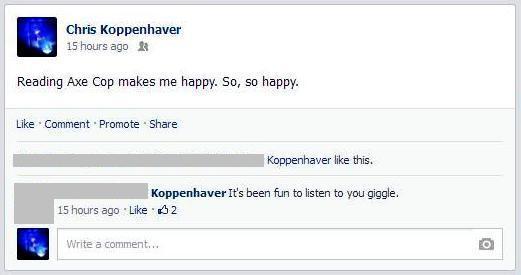
I'm not sure anything else really needs to be said, but I will say more anyway because I have so much fun with these stories. Every page, it seems, Malachai's chain of reasoning--as brilliantly illustrated by Ethan--goes somewhere outrageous that makes me laugh. I kept thinking to myself, That's the bit I'll quote in my review to capture the essence of Axe Cop, but then the next page I'd think it again, and again, until I now have too many to choose from and don't know how to pick just one. It's just so much fun watching him take concepts he's encountered in books and video games and the like then spin them into his own stories uninhibited by logic or the usual adult concerns.
As Ethan says in his introduction to the episode "The Power of Christmas" in this book: I think there are plenty of quintessential Axe Cop elements in this tale. Cuteness, monsters, magic, candy, tragedy, heroism, and of course mass genocide. I get warm fuzzies every time I re-read it.
In thinking about how to talk about Axe Cop, I'm reminded of a section from The Social Animal by David Brooks:
There are moments when my adult brain tries to step in and say, Whoa, that's awfully violent and disturbing, then I have to remind myself that for kids this imaginative pretend violence is something totally different than imagining actual violence, as I wrote about in my review of Axe Cop, Volume 1.
If you are new to the title and have no idea what my rambling analyses have been about, then I refer you to the descriptions and examples (I actually settled on some for that one) I used in my review of volume 2, Axe Cop: Bad Guy Earth.
Or you can just trust the Facebook image at the top; it makes me gigglingly happy.
I'm not sure anything else really needs to be said, but I will say more anyway because I have so much fun with these stories. Every page, it seems, Malachai's chain of reasoning--as brilliantly illustrated by Ethan--goes somewhere outrageous that makes me laugh. I kept thinking to myself, That's the bit I'll quote in my review to capture the essence of Axe Cop, but then the next page I'd think it again, and again, until I now have too many to choose from and don't know how to pick just one. It's just so much fun watching him take concepts he's encountered in books and video games and the like then spin them into his own stories uninhibited by logic or the usual adult concerns.
As Ethan says in his introduction to the episode "The Power of Christmas" in this book: I think there are plenty of quintessential Axe Cop elements in this tale. Cuteness, monsters, magic, candy, tragedy, heroism, and of course mass genocide. I get warm fuzzies every time I re-read it.
In thinking about how to talk about Axe Cop, I'm reminded of a section from The Social Animal by David Brooks:
We sometimes think that imagination is cognitively easy because children can use it better than adults. In fact, imagination is arduous and practical. People who possess imaginative talents can say, "If I were you, I would do this. . . . " Or they can think, "I'm doing it this way now, but if I tried to do it that way, things might go faster." These doublescope and counterfactual abilities come in quite handy in real life. . . .Reading Axe Cop is the chance to re-experience the joy of unrestrained childhood imagination and narrative thinking.
One Saturday afternoon, Harold had a few buddies over to the house for a playdate. . . . Each kid would assign himself a role in the master story. . . . They would have elaborate negotiations over what was legitimate to do in the world of pretend, in the shared space they had constructed. Even in the free-form world of their imaginations, it was apparently still necessary to have rules, and they spent so much time talking about the rules, Rob got the impression that they were more important than the story itself. . . .
After about twenty minutes playing Benjamin Spock and watching the kiddies, Rob got the urge to join in. He sat down with the boys, grabbed some figures, and joined Harold's team.
This was a big mistake. It was roughly the equivalent of a normal human being grabbing a basketball and inviting himself to play a pickup game with the Los Angeles Lakers.
Over the course of his adult life, Rob had trained his mind to excel at a certain sort of thinking. This is the kind that psychologist Jerome Brunner has called "paradigmatic thinking." This mode of thought is structured by logic and analysis. It's the language of a legal brief, a business memo, or an academic essay. It consists of stepping back from a situation to organize facts, to deduce general principles, and to ask questions.
But the game Harold and his buddies were playing relied on a different way of thinking, what Bruner calls the "narrative mode." Harold and his buddies had now become a team of farmers on a ranch. They just started doing things on it--riding, roping, building, and playing. As their stories grew and evolved, it became clear what made sense and what didn't make sense within the line of the story. . . .
Rob was like a warthog in a frolic of gazelles. Their imaginations danced while his plodded. They saw good and evil while he saw plastic and metal. After five minutes, their emotional intensity produced a dull ache in the back of his head. He was exhausted trying to keep up.
There are moments when my adult brain tries to step in and say, Whoa, that's awfully violent and disturbing, then I have to remind myself that for kids this imaginative pretend violence is something totally different than imagining actual violence, as I wrote about in my review of Axe Cop, Volume 1.
If you are new to the title and have no idea what my rambling analyses have been about, then I refer you to the descriptions and examples (I actually settled on some for that one) I used in my review of volume 2, Axe Cop: Bad Guy Earth.
Or you can just trust the Facebook image at the top; it makes me gigglingly happy.

April 24, 2012
ARC provided by NetGalley
I first started hearing people talk about Axe Copy just about a year ago and how it was a cool partnership between a 5 year old and his 29 year old brother, and just how entertaining and imaginative the stories were that the 5 year old was coming up with. And I felt like I was missing out on something great, so when I had a chance to review volume 3 I leapt at it and I wasn’t disappointed.
This 3rd collection contains:
- "Bat Warthog Man Can't Find His Friend" (Episodes #1-5, Episode #0)
- "Ask Axe Cop" #43-70
- Guest Episode Crossover Special (posted 7/26/10 - 8/6/10): Axe Cop and Dr. McNinja in "Stolen Pizza, Stolen Lives"
- "The Night Monster" (2010 Halloween Special, Episodes #71-74)
- "The Power of Christmas" (2010 Xmas Special)
- "The Funny Episode" (Episodes #99-101)
- "Axe Cop Babysits Uni-Baby" (Episodes #102-117)
- "The Moon Warriors Go Camping" - in this one-pager, Ethan writes, Malachai draws
- "Axe Cop Presents" - a series of stories about characters not related to AXE COP
- Guest Episodes - others in the webcomic community submit their takes on Axe Cop
For me Axe Cop and his friends remind me of what it was like when I was younger. Creating worlds and stories around the strangest things, but in which I would have the greatest adventures. And that’s what these two brothers do so well. The younger brother lets us be a part of his world and his imagination while the older brother brings these stories to life. It’s just the perfect collaboration to help remind us of what it was like to grow up and to remember our imaginations.
Is this the best writing in the world? No. Is it some of the funniest that you’ll read? Most definitely. Malachai has a very active imagination and takes the stories to the oddest places, I mean who else but a 5 year old would come up with Dinosaur Planet? Or that you can rent a chemist who can make any kinda of weapon that you need? And let’s not forget Ethan’s artwork (and we can probably also thank him for making sure the stories don’t go too far off the deep end.) It’s absolutely fantastic and brings the crazy to life in a semi-coherent manner.
One word of note since the stories are written by a 6 year old he’s in that period of his life where girls are yucky and can’t be fighters. Should you let it bother you? No. Enjoy the stories for what they are, an active and creative young kid sharing his world with us. You might just get a kick out of it.
I first started hearing people talk about Axe Copy just about a year ago and how it was a cool partnership between a 5 year old and his 29 year old brother, and just how entertaining and imaginative the stories were that the 5 year old was coming up with. And I felt like I was missing out on something great, so when I had a chance to review volume 3 I leapt at it and I wasn’t disappointed.
This 3rd collection contains:
- "Bat Warthog Man Can't Find His Friend" (Episodes #1-5, Episode #0)
- "Ask Axe Cop" #43-70
- Guest Episode Crossover Special (posted 7/26/10 - 8/6/10): Axe Cop and Dr. McNinja in "Stolen Pizza, Stolen Lives"
- "The Night Monster" (2010 Halloween Special, Episodes #71-74)
- "The Power of Christmas" (2010 Xmas Special)
- "The Funny Episode" (Episodes #99-101)
- "Axe Cop Babysits Uni-Baby" (Episodes #102-117)
- "The Moon Warriors Go Camping" - in this one-pager, Ethan writes, Malachai draws
- "Axe Cop Presents" - a series of stories about characters not related to AXE COP
- Guest Episodes - others in the webcomic community submit their takes on Axe Cop
For me Axe Cop and his friends remind me of what it was like when I was younger. Creating worlds and stories around the strangest things, but in which I would have the greatest adventures. And that’s what these two brothers do so well. The younger brother lets us be a part of his world and his imagination while the older brother brings these stories to life. It’s just the perfect collaboration to help remind us of what it was like to grow up and to remember our imaginations.
Is this the best writing in the world? No. Is it some of the funniest that you’ll read? Most definitely. Malachai has a very active imagination and takes the stories to the oddest places, I mean who else but a 5 year old would come up with Dinosaur Planet? Or that you can rent a chemist who can make any kinda of weapon that you need? And let’s not forget Ethan’s artwork (and we can probably also thank him for making sure the stories don’t go too far off the deep end.) It’s absolutely fantastic and brings the crazy to life in a semi-coherent manner.
One word of note since the stories are written by a 6 year old he’s in that period of his life where girls are yucky and can’t be fighters. Should you let it bother you? No. Enjoy the stories for what they are, an active and creative young kid sharing his world with us. You might just get a kick out of it.

January 18, 2013
Having grown up with an overly imaginative younger brother, the world of Axe Cop not only amuses and delights me, but seems logical. And by logical, I mean completely crazy in the way that can only be understood by someone who has come downstairs for breakfast to find their 4 year old brother in Superman pj's with towel tied around their neck, a striped headband and racket ball goggles on standing (and rocking violently) on a rocking chair trying to fly. Or, having the same brother jump out of a tree at you dressed completely like a ninja, except for a castoff 70s necktie... Or, having the same brother (now 32 and a parent) refuse to speak to you in anything but a bizarre mashup of a Russian/French accent for a whole week... Yeah, I get Axe Cop and love it because it reminds me of my whack job brother in his prime as a little kid.
January 16, 2016
Nutso bonkers tale of a cop and his axe. This continues the reprint of the online comic sensation that must be becoming a movie some time. Two brothers 6, and old, do up a comic together. This volume is mainly ask axe cop and some guest strips.
It is mainly death and girl hating and robots and dinosaurs. That doesn't do the manic imagination of kid justice. If you like those moments of absurd but internal logic then this is a fun read, otherwise you are dead inside and given up your soul to being an adult.
There are some great moments but, yes, it is a story told by a six year old boy. There may be poo jokes and blood.
It is mainly death and girl hating and robots and dinosaurs. That doesn't do the manic imagination of kid justice. If you like those moments of absurd but internal logic then this is a fun read, otherwise you are dead inside and given up your soul to being an adult.
There are some great moments but, yes, it is a story told by a six year old boy. There may be poo jokes and blood.

April 3, 2014
This is a lot better than the previous trades, both plot-wise and action-wise. Axe Cop quickly is becoming a favorite. I admit I didn’t give him much of a chance in the beginning, but of course the two were experimenting with the character and his friends.
The fact that Ethan keeps his little brother’s imagination alive while adding depth and plot is amazing, not to mention his fantastic sketching skills.
The fact that Ethan keeps his little brother’s imagination alive while adding depth and plot is amazing, not to mention his fantastic sketching skills.

April 2, 2012
Another classic, memorable year of the best web-comic, period. The guest-created pages don't hold a candle to Malachi and Ethan's work, which is a testament to the magic of Axe Cop - not just any kid-writer and artist can make something this special.

April 17, 2012
Seriously think I'm missing out on a lot by not starting at Volume 1.

May 11, 2012
Written by a 6 year-old, drawn by his 30 year-old brother. Nonsensical, hilarious, and awesome. Probably not for everyone.

August 4, 2013
Written by a hilarious hyper imaginative 7 year old kid!
October 2, 2014
Can't go wrong with Axe Cop.

March 6, 2016
It was really very amusing.

July 29, 2012
If you don't read Axe Cop, then there is something wrong with you.

April 24, 2017
Violent, illogical mayhem mingled with real humor and moments of sincerity - all through a child's perspective on life. It would be more unsettling if it wasn't written by a kid. This series continues to deliver and entertain as expected.
Displaying 1 - 20 of 20 reviews