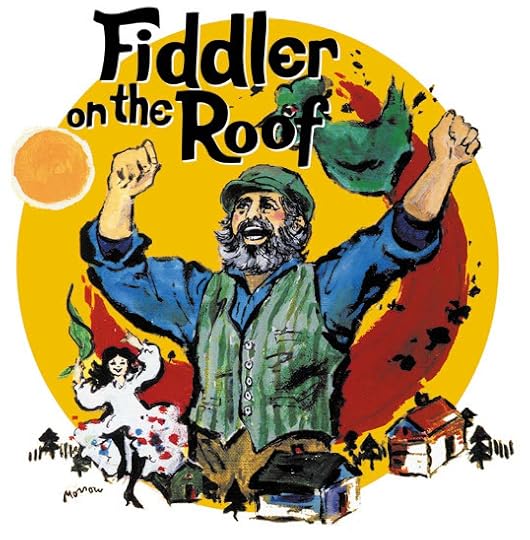
Fiddler on the Roof is a musical that I love but have yet to see a live stage performance. It was an original script when it first premiered on Broadway in 1964 and I do believe that it is a production that is very relevant to today’s current events, especially with the themes of tradition vs. progression and prejudice against religion and nationality.
Based on a series of stories by Sholom Aleichem, Fiddler on the Roof is set in a small Jewish village, Anatevka in Russia during the early 20th century. Tevye is a poor dairyman who lives in the town with his wife Golde and five daughters. Tevye faces many trials throughout the musical including persecution by Russian soldiers and his three older daughters defying the town’s tradition of arranged marriages. Each daughter challenges Tevye’s religious and cultural views while balancing his strong faith and family values until it is almost at a breaking point. The musical is mixed with drama, comedy, and history that there are a variety of theatrical elements that the reader/audience member can enjoy when reading or seeing the production performed live.
Fiddler is an easy read if the reader is patient with reading scripts, especially when music is involved as part of the production. But with the time period and its characters, I think the reader would really enjoy the script. The music would be highly recommended to give a listen when reading the play, obviously as a musical but it has a perfect blend of understanding the characters and getting the chance of hearing music inspired by the Jewish Russian culture. The ensemble of characters are also a lot of fun to read and/or see perform on stage. Tevye and Golde are two of my favorite characters in musical theatre history; both are quick-witted, stubborn and have great scenes together and apart. Tevye as the main protagonist and our guide throughout the story is also a very relatable character; as a father figure set in his ways, but is willing to accept certain changes, and holds his faith and family important to his everyday life. Even Tevye’s three eldest daughters are very well-rounded characters: girls becoming women in a time when it was unheard of for females to speak their minds or decide their future. The presentation of Judaism’s traditions in the 20th century is very respectfully and beautifully presented onto the stage. Along with reading the script, I would also insist one to watch the 1971 film adaptation of Fiddler on the Roof. In my mind, it is one of the musical film adaptations that is really faithful to the stage production plus a splendor to see on the screen. Whether you see the stage production or film, or read the script I highly recommend Fiddler on the Roof as a brilliant piece of musical theatre and a beautiful, honest representation of history.