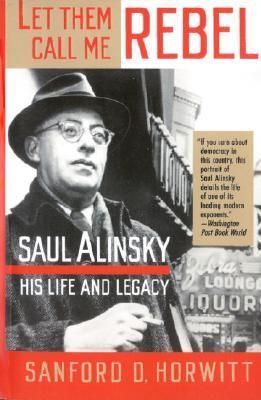
In the course of his flamboyant career as an all-purpose activist, Saul Alinsky went from organizing working-class ethnics in one of Chicago’s most blighted neighborhoods to mapping out strategies for the civil rights and antiwar movements of the 1960s. He enlisted allies—from Catholic clergymen to labor unionists and black activists, in battles waged against opponents from slumlords to the Eastman Kodak corporation. The range of Alinsky’s activities, the intensity of his beliefs, and his exhilarating mixture of crudeness and calculation almost vibrate off the pages of this passionate and inspiring biography.
This is an important account of a complex and idiosyncratic urban populist who insisted that power was the keystone of social change. Horwitt . . . produce[s] a comprehensive appraisal of Alinksy’s colorful confrontational tactics; as a community organizer and his influence on a succeeding generation of social activists . . . An insightful and well-written study.”— Library Journal
Sanford D. Horwitt is an author, book critic and policy advisor to foundations and nonprofit organizations concerned with promoting civic engagement and strengthening democratic institutions. He is the author of "Let Them Call Me Rebel," a biography of Saul Alinsky. His book reviews and essays have appeared in The New York Times, The Washington Post, San Francisco Chronicle, Chicago Tribune, and other publications. In Washington, he was a speech writer for Congressman Abner Mikva.
I approached this book having read Rules for Radicals two or three times over the past 15 years. What I knew of Alinsky, I knew from that book or from the fear and loathing he inspires to this day among reactionary corners of society. Neither of these sources are very reliable when it comes to finding out more about the nuts and bolts of community organizing through the depression on into the 1960s.
For one thing, Alinsky loved to talk himself up as a larger than life character. It's what made him so good at what he did. It's why people across the nation not only turned to him for help, but they organized themselves in order to bring him to California, or Rochester, NY or Kansas City. But as a primary source on himself, Alinsky's books require getting through some of the self promotion.
As for his critics, all I would say is this: to this day some claim Alinsky's tactics and his goals (fighting slumlords, free lunches for children, black people voting and being hired for good jobs proportionately, general self-empowerment) were somehow sinister and worthy of derision. These negative comments say more about his critics and where their intentions are at, and they ought to be ashamed.
Sanford Horwitt does a beautiful job breaking down the triumphs and tragedies of organizing in some very tough communities. He also takes a close look at the relationships required to actually bring about social change, touching on a vast network of allies from the Chicago Archdiocese to Stokely Carmichael to the founders of Marshall Field's Department Stores. When the romantic veneer that someone like Alinsky put on his own work is pushed away, Horwitt's biggest accomplishment is making the structure of community organizing absorbing and readable. That said, there are moments when I would have liked to have seen more about what the goals Alinsky fought for and won looked like in practice rather than just the process of getting there. But then, that was one of the subject's main contentions in life: the process of democracy is just as important as the end result.
One can't even begin looking into Saul Alinsky's life without finding some reference to his concept that "...power--not reason--was fundamental to the achievement of social change." While the idea isn't at all a surprise to anyone, there are still sectors of society that seem to reject it while trying to initiate change. Take the example of the Tea Party vs. the Occupy Wall Street movements. While it would be inaccurate to analogize the two too closely, the former did take power from the hands of conservative Republicans and reshape the party in furtherance of their cause by voting and contributing time/money (the sources of that money are irrelevant). The latter merely raised a ruckus and might very well be relegated to the status of an insignificant flare-up if they don't take the reins and command a bit of power for themselves at the ballot box or somewhere else. "Consciousness raising" and "awareness" of the issues means nothing if you don't have any tools to create change.
Lest anyone think Let Them Call Me Rebel is all nuts and bolts, there are some inspiring moments. One of the best ideas Alinsky actually went through with that I had never read before reading this book: African Americans who had been ignored for years by their local alderman (city councilman) raising funds throughout their own neighborhoods with cookouts and house parties, in order to load up a dozen buses full of black folks in 1960s Chicago to go downtown and register to vote at City Hall. It was a media circus, it was a shock to a complacent political system, it was fun for the participants, it was mischief making and productive, and it was people helping themselves. It was a close to a perfect Alinsky tactic as you could get.
This is an excellent, highly detailed, very readable biography of the great theorist and advocate of community organizing, Saul Alinsky. It's full of entertaining stories and anecdotes, all of which enhance the understanding of Alinsky's work; none is extraneous. Nor is the book uncritical. Admirers and critics have their say about him and both good and bad reviews of his books are cited. Among other things, I learned that Alinsky was not a community organizer himself, except maybe very early in his career. He was a trainer, recruiter and supervisor of organizers and a great tactician and strategist for both the organizers and their organizations, but he was rarely an on-the-ground organizer himself. He was also a prolific fundraiser for the organizations spawned through his Industrial Areas Foundation. Some of the money came from rich individuals, some of whom were close friends, or from other foundations, but most of it came from the churches (especially the Catholic church) and synagogues that were almost invariably the core of his community organizations. That's pretty much how all the IAF-affiliated community organizations work -- by building a coalition of churches and synagogues that could provide volunteers and money to fund the organizing. IAF is still doing that work in multiple communities, but the decline of participation in organized religion surely makes that model more tenuous. Alinsky's work was mainly from the 1930s to the 1970s (he died in 1972 in Carmel, of all places), when racial conflict was at a high in American cities and in the sorts of neighborhoods were IAF worked. His biggest disappointment and greatest failure was his inability--despite repeated efforts--to develop integrated community organizations. In that, he was a victim of his times, although it hasn't really gotten much easier. To his credit, he left a legacy of organizations and organizers that lives on.
Before "Act Up," there was Saul Alinsky. The Chicago-based labor and community organizer combined the non-violence of the civil rights era with big-city sarcasm to give rise to the "shit-in": occupying public toilet stalls at O'Hare Airport as protest tactic. His notorious "Reveille for Radicals" and "Rules" for the same remain Machiavellian treatises on non-violent insurrection, eschewing the moral heaviness of Gandhi or M. L. King for the sheer joy of incitement and irritation.
His legacy is still sorely recalled by his legion of Establishment/Rightist enemies, even as they steal his lines and tactics. Horwitt's biography does justice to Alinsky's career as professional agitator who welcomed attack and hysteria. Compare this to modern "progressives" who seek "consensus" and non-confrontation rather than "making injustice plain." Horwitt does includes critiques of Alinsky's "grandstanding," that without a political objective his tactics were little more than dead-end street theater: a warning to those who want to substitute community for political organization.
Ironic also is the fact that this very Jewish-American agitator should be closely backed by the Catholic Church, and as labor organizer by Chicago's major retailer Marshall Field's. This was in tandem with his WW II-era populist patriotism, separating him from the 1960's radicals he mentored and often dismissed..
Alinsky's shock tactics seem today more embodied in MAGAism than community leaders of the poor and marginalized or the liberals who venerate him. True too that in our neo-McCarthyite era Alinsky would be branded a terrorist and, as an immigrant, a target for denaturalization. Alinsky's response would be to fight fire with more of it, to march on DC to "throw the bum out" in a rerun of '21.
As it is, Horwitt's biography recalls a man of a bygone age before corporate consultants and social media and PACs neutered what was left of the American democratic community.
An excellent and accurate study of the life and career of the late, great community organizer Saul Alinsky. Having spent the best part of a decade of the seventies working as an Alinsky style lead organizer I can say that Horwitt provides a more than fair overview of Alinsky's theories and both his triumphs and failures.
Horwitt provides an excellent analysis of Alinsky's first, and some would say, seminal organizing efforts in Chicago's Back of the Yards. He also does a good job of explaining Alinsky's organizing philosophy and methodology and puts to rest the red baiting that plagued him throughout his career.
Alinsky was the exact antithesis of a communist. He was, if anything, an Athenian democrat with faith in the instincts or ordinary people and a real belief in broad based citizen participation in the political process. He was also an individualist and an iconoclast who loved saying outrageous things like his use of the classic quotation from Milton's Paradise Lost that the Right loves so much. Fact is, Alinsky would have been one of the first to be put up against the wall after a Communist takeover. In considering Alinsky it is important to separate his personal political views from his organizing methodology--and it was a methodology not an ideology. This is the reason why his most important book, Rules for Radicals is required reading for TeaParty activists at Freedomworks.
I'd call it a must read at Fox News as well where the constant drumbeat of criticism of the late activist ranges from totally incorrect to the just plain stupid. However, since it was published way back in 1989, I'd say, as with so many other issues, Fox News seems to be just avoiding the truth. You have to wonder, what is it about Alinsky and his method that frightens the right to the degree that they are still hammering away at his legacy some forty years after his death in 1971.
This book is a sympathetic but balanced portrait of the great community organizer and founder of the Industrial Areas Foundation (IAF). A greater deal of space was given to three of Alinsky's campaigns in the Back of the Yards in Chicago, Woodlawn in Chicago, and FIGHT in Rochester, NY. Alinsky is portrayed as a controversial, disruptive, sometimes crude but effective leader who believed in the ability of people to organize and gain power in their communities thru organizing. Bits and pieces of Alinsky's personal life are given but most of the book looks at this development of his work and his commitment to promoting "active citizenry" or what today is called "participatory democracy."
This book is the point of reference to get to know about Saul Alinsky's life, and also most of the community organizing movement in the US. In my opinion, it does not deserve 5 stars just because the book project was, at times, unfocused: is the book about Alinsky's life or the story of community organizing in the US? An example of this are Alinsky's travels to Europe, which are completely neglected just because... well, they were outside the US.
Not quite a Robert Caro book, neither in size nor in quality. Yet still an engaging portrait of a man whose democratic approach could really use a resurrection. And a great reminder that things have always been a mess.
Finally finished all 500+ pages of this wonderful book after many interruptions, which included travel and reading other books at the same time. Regardless, I thoroughly enjoyed this biography not only of the man, but of his history of organizing. As a VISTA Volunteer in 1971, we were trained in Alinsky organizing techniques. Although I read Reveille for Radicals years ago, I never knew much about the man whose work let to "Back of the Yards, "The Woodlawn Organization," and Fred Ross and César Chávez. This book not only took me back to Chicago, but gave me a better perspective on those two organizations and how they reflected the times and the politics. I didn't realize how much Alinsky aligned himself with the Catholic church or with Protestant denominations. While I see community organizing as "religious" with a small r, I didn't realize Alinsky's work had been religions with a capital R, at least in terms of the players and funders. This was a fascinating read. Glad I took the time to do this.
Although a biography on Saul Alinsky, there's a lot of great detail in this book on fundamentals of the community organization process and it's ties to neighborhood support institutions, e.g. churches, unions, and other community outreach organizations. You can see how this has progressed into the modern day with groups like ACORN. Very good insight into how Obama and Clinton see the world and use community groups to organize and get their message out.
I actually think that terming this a biography is a fairly loose term. The author centers less on his personal and more on his professional accomplishments, both ones he was involved directly in and ones he inspired. I found it fascinating though. I am a junkie for liberal politics though so that might have something to do with it. It does make you wonder if people cared as much as they used to, what kinds of change we could institute.
Alinsky is the founder of Chicago's Industrial Areas Foundation, and he helped organize the Back of the Yards, the neighborhoods around the meat packing houses. When Obama was community organizing in Chicago, he was affiliated with IAF.
Biography of social activist and organizer Saul Alinsky is objective well written. Focuses on his entire life sometimes at the expense of his organizing efforts, but is for that reason well rounded.