Imagine Plato as a wrestling superstar of ancient Greece, Nietzsche as the original ubermensch, and Bohidharma as the grand master of kung fu. These are not just great thinkers they also make great comics. Action Philosophers details the lives and thoughts of history's A-list brain trust in hip and humorous comic book fashion. All nine issues of the award-winning, best-selling comic book series have been collected into a single volume, making this a comprehensive cartoon history of ideas from pre-Socratics to Jacques Derrida, including four new stories. You'll never have more fun getting the real scoop on the big ideas that have made the world the mess we live in today! Tom Morris (Author of Philosophy for Dummies, If Aristotle Ran General Motors, and If Harry Potter Ran General Electric).
Fred Van Lente is the New York Times-bestselling author of comics as varied as Archer & Armstrong (Harvey Award nominee, Best Series), Taskmaster, MODOK's 11, Amazing Spider-Man, Conan the Avenger, Weird Detective, and Cowboys & Aliens (upon which the 2011 movie was based), as well as the novels Ten Dead Comedians and The Con Artist.
Van Lente also specializes in entertaining readers with offbeat histories with the help of his incredibly talented artists. He has written the multiple-award winning Action Philosophers!, The Comic Book History of Comics, Action Presidents! (all drawn by Ryan Dunlavey), and The Comic Book Story of Basketball with Joe Cooper (Ten Speed September 2020).
He lives in Brooklyn with his wife Crystal Skillman, and some mostly ungrateful cats.
RATS! I was kind of hoping they were all going to team up to fight crime . . .
This was last year's Christmas gift for my son, the philosophy major . . . who is also known as the soon-to-be Starbucks' barista. So, what does the future hold for my intrepid scholar in this time of high unemployment and general lack of a need for people who like to debate about EVERYTHING? Well, as his adviser explained, he can write and he can think, so that gives him a leg up on a lot of other college graduates. And boy, oh, boy, can he ever argue!
The authors of this tome do a great job of injecting gallons of humor into a rather dry subject, and they provide an excellent overview of the discipline.
And speaking of discipline . . .
They certainly make the most of the cartoon medium with fun visual jokes - example: The Oracle at Delphi is represented as a hotline psychic. Cute, eh? Then there's Rumi, channeling the yet-to-be-born Elvis, crooning to a cluster of adoring females.
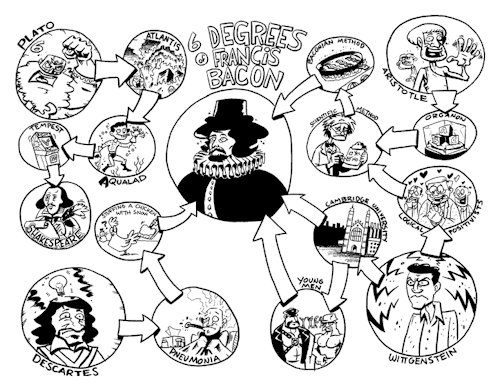
And who could forget Francis Bacon?
I also enjoyed learning about former playboy St. Augustine's quest to merge with the realm of light upon the body's demise. Imagine his dismay at hearing of the necessity of avoiding EVIL MATTER:
". . . never have SEX again! Hot, sweaty MATTER on top of hot, sweaty MATTER? That's like a WALMART OF EVIL!!!"
There's also a great section at the end on the proper way to argue. If only this could be required reading for trolls and sock puppets . . .
It took me most of the year to read this book, so I would describe it as being interesting, yet uncompelling.
And how can I possibly leave without mentioning Diogenes whose bite was worse than his bark?
Fantastic quick overview of some great philosophers. Fred Van Lente has a good grasp of the importance of each and is able to quickly give us some real things to chew on. There's a few guys here like Heidegger and Derrida where I've never understood a single word they've said, but Lente actually gives some clue as to why they were influential and what problems they were trying to solve.
From Wikipedia # 1: - Nietzsche, Bodhidharma, & Plato: "Wrestling Superstar of Ancient Greece!", featuring one of the series' most famous lines, "PLATO SMASH!" # 2: - The "All Sex Special", featuring Ayn Rand, Thomas Jefferson, & Saint Augustine. # 3: - "Self Help for Stupid Ugly Losers" featuring Sigmund Freud, Carl Jung, & Joseph Campbell. # 4: - "World Domination Handbook" featuring Karl Marx, Niccolò Machiavelli, & The Kabbalah. # 5: - "Hate the French" featuring René Descartes, Jean-Paul Sartre, & Jacques Derrida. # 6: - "The People's Choice" featuring Soren Kierkegaard, St. Thomas Aquinas, & Ludwig Wittgenstein. # 7: - "It's all Greek to you" featuring The Pre-Socratics, Aristotle, & Epictetus. # 8: - "Senseless Violence Special" featuring Kant, Schopenhauer, Hegel, & John Stuart Mill. # 9: - "The Lightning Round", the final issue featuring Diogenes the Cynic, Lao Tzu, Michel Foucault, David Hume, Confucius, George Berkeley, Francis Bacon, Jean-Jacques Rousseau, Thomas Hobbes, Mary Wollstonecraft, Baruch Spinoza and Gottfried Leibniz.
This edition reshuffles the original issues around and adds some new content like how to use philosophy in your daily life and some logical fallacies.
But as you can see it includes most of the usual Western philosophy crowd with some popular Eastern thinkers. I like that it goes into more modern stuff like Auguste Comte, psychology, Foucault, Derrida. I believe only Wollstonecraft and Rand for female thinkers, which is a shame especially since they are pretty critical of Rand.
Impulse buy bought during a routine stop at Lee's Comics.
As a dilettante's dilettante, I love any kind of popularization. So when I saw the work of the major philosophers summed up in convenient graphic novel form, I couldn't resist.
It didn't disappoint. Though I can't vouch for the accuracy of the overview of each philosopher covered, at least it jibed with all the other popularizations I remembered. The chapters on Decartes (represented as a light bulb) and Bodhidharma (who drilled two holes in a rock with his intense stare) were my favorites.
The jokes are pretty funny, and I'm sure I didn't get half of them. It gets dark in places, like when Marx explains his theories to a little boy as he kills capitalists like an action hero in a movie. When the little boy cries and asks why Marx killed his mom, he just shrugs and says, "You didn't mention she worked in a bank."
This probably makes most sense if you already know at least a little bit about the philosophers being described, and have at least a little experience with other comics. I have, and I enjoyed it immensely.
You won't get a complete understanding of any of these thinkers thoughts. That just isn't possible in a few comics pages per person. And the ideas are sometimes being mocked at the same time they are being described. But there is enough to refresh your mind on who's who, or to help you decide which ideas you want to explore further. And overall, it is just fun!
The art is often very literal. Example, the concept of "give them enough rope and they'll hang themselves" is drawn as words coming out of someones mouth and literally forming a rope and noose. (This is in a discussion of how to learn and how to engage in debates.) I often hate this sort of literal drawing, but I enjoyed it here. It helps a lot that the drawing style is very varied, imitating a wide range of comics creators and styles. (John Stuart Mill is drawn as Charlie Brown. Foucault as a character in Family Circus. Etc.)
[This edition is the full run of the comic, which was 9 individual issues, or 3 smaller collected editions.]
I read this for all the wrong reasons. 3 years ago, this caught my fancy, and I had just reconnected with G, and in a moment's weakness I told her I read this book and it was awesome. Now that everything's over, I was somehow drawn to this, some sort of squaring the circle, or closing the circle, or circling the vultures or something, all I know is it had something to do with circles. Like life itself. I'll stop now. I wish I hadn't ploughed through this in the space of 2 days. I will remember almost none of it, and really didn't take the time to appreciate the illustrations, I was entirely focused on the philosophy, which is a real shame because for the few sections where I was well-versed with the philosophy, I could really access how the illustrations added another beautiful layer and created very memorable memes that enhanced likelihood of recall.
Things of interest I haven't come across before:
Anaximenes (Air) supplants Anaximander (boundless infinity) supplants Thales (water) to inaugurate most common philosophical tradition: everyone who came before me was an idiot
Heraclitus was heir to throne of Ephesus, gave it off to brother so he could think.
Tao of stillness: Different from emptiness. Low-level phenomena are changing faster, transcendent more slowly. Disturbed mind pays too much attention to low-level changes, your energy, pain, heat, cold, hunger. Stillness means to open your mind to more transcendental phenomena. Knowing constancy in low-level, your brain can finally move to large-scale. You are one with the Tao now. Eternal.
Plato’s realm of forms is just the adaptation of Pythagorean school’s higher plane of numbers. Platonic relationship doesn’t mean friendship, but preferring idealized version instead of manifesting a flawed physical version.
King Dionysius of Syracuse fell out with Plato (after appointing as court philosopher) over his hedonism. Sold him as slave. But Plato’s benefactor let him set up a school, at the grove/gymnasium belonging to Akademos. Hence named after him as the Academy. Justinian shut it down in 529AD because too atheistic, this was the start of the Dark Ages
Republic: Children taken at birth and raised in schools with government as their parents. Performance at school determined their role in society – farmer, military, philosopher-king. All individuality would be eradicated because Plato prefers all to adhere to impossible abstract of forms.
Diogenes the original Sprite ad. What will you do Alexander..then? Relax? Just skip to that now. Maybe apocryphal, but died on same day as Alexander in 323BC.
Stoic: Never say ‘I lost it’ when you could instead say ‘I gave it back’ (Death of a loved one)
Just learned Manichean is not a follower of Maniche, from whom popular Portuguese footballer got his name, some Christian sect in 18th century. No it’s from Manichaeism, a pagan dualistic sect by Iraqi mystic Mani. Light vs Darkness eternal battle. In final battle, sons of darkness lost and their corpses made the earth, so we are all made of darkness. But sons of darkness had eaten first son of light, so within us all we have a few particles of good too. So matter is evil, trapping spirit of light. All imbuing or propagating of matter is therefore evil – eating, having children.
St.Augustine of Hippo, once a debauched hedonist, annoyed with all the million bickering Christian sects, took ideas of Manichaesm and with force of eloquence and debate skills, made catholic roman church the dominant Christianity.
Bodhidharma was from Kanchipuram! Entire philosophy based on single line from pali canon : all this is is based on mind, by the mind. Reality is strained through your unique consciousness, annihilation of self is needed to access objective reality. ‘If you see Buddha on the road, kill him.’ Instantaneous insight over rigorous study and discipline. Koans or absurd riddles not to be answered, but to ponder why they are unanswerable. All statements are language, therefore opinions. ‘Enter the silence’ through the only truth, the question mark lingering where an answer might have been if it existed, become one with objective reality – dhyaana or contemplation/meditation/concentration, which Chinese mispronounced as chen, and Zapanese made Zen. BD also started shaolin monks and ‘hard work, in Chinese - kung fu.
Rumi popularized sufi mysticism with his poetry. For last decade he’s been the most popular poet in US
Tomas Aquinas was a real fatty. Used Aristotelian logic to make Christian doctrine more scientific and prove existence of God from first principles (infinite regress of cause and effect, first mover). He’s the reason Greek philosophy became foundational cultural artifact through Christianity. Patron saint of catholic schools and universities.
Tree of Life by Isaac Luria, or Ari, Rabbi of Mystic Arts – thought of existence as a cosmic flowchart, with different stations, or sefirot. Keter or crown, first spark of possibility. Chokhmah, willpower to actualize potential. Binah, the mother of form. Chesed, the specific form. Gevurah, destroyer of old forms. Tiphereth, rationality of divine mind. Netzach, desire to create. Hod, abstract thinking. Yesod, generic forms. Malkuth – the output tray. These are all names of Hebrew characters, because Hebrew considered as divinely inspired as the scriptures themselves. Word for truth animates the Golem. Erasing first letter of Truth, gives Meth, or death. So Golem destructs. Rearranging Hebrew alphabet would decipher all secrets of universe, including true name of god. Cannot able, so restrict to ‘Tetragammaton’ or 4 letters YHWH. Judaism, unlike other religions, very accepting of mystic traditions of Kabbalah.
Decartesian proof of God. Mind exists. Principle of sufficient reason: say mind thinks of an infallible God. Mind is not infallible, that must mean the idea has come from outside, i.e one that knows those qualities, i.e an infallible God. God is perfect, so he would not deceive me, so my senses can after all be trusted. Given he had proved existence of God, he was considered a shoo-in for sainthood and over-eager pilgrims tore apart his corpse to keep as souvenirs.
Spinoza: God is immanent reality, i.e creates it by being it. His laws are laws of nature, non-transgressable.
Thomas Jefferson imagined USA as Agrarian paradise of farmer-intellectuals. Same as Marx? Lived in a land of plenty where the earth would provide for all, since there was not much of all to provide for.
Kant’s ‘Critique of Pure Reason’ should have tipped me off that he was against the dogma of pure reason and its offspring, science, and the creation of clockwork world without human freedom. He exposes the limitation of pure reason, as not objective but phenomenological, and therefore without access to the noumenal, beyond sensuous experience, so while not possible to prove existence of God, it is morally necessary to assume existence. Things in themselves (realm of forms?) were fundamentally unknowable. Kant’s ���act such that if everyone acted that way, would be good’ seems like a good answer to Marxist criticism of free-markets (example of car vs public transport). His 2 biggest fans were Hegel and Schopenhauer.
Hegel said um but why not knowable. Being (thesis) and non-being (antithesis) result in becoming (synthesis). All reality is in process of becoming. History is directed, so status-quo is excellent compared to all time before, but still evolving. Popular message.
Arthur said there is a small door to knowing things. An action is the objectification of will. Will is the manifestation of the thing-in-itself. Your mind is subject, all of world is represented to you as object. Hence, his famous work, world as will and representation. You are all puppets to the will. ‘What you call pessimism is objective recognition of folly and malevolence’. Fatalism was unpopular. Berlin university scheduled lectures at same time as Hegel, and he was humiliated. Hated Hegel ever after – a monument to German stupidity.
August Comte: Sociology. Religion defeated by Science (positivism), needs social structure and comfort of religion – humanism, a scientific form of religion. Invented ‘altruism’, moral obligation vis-à-vis individual rights of enlightenment,
Kierkegaard’s stages of human consciousness. Don Juan – aesthetics, impulses, emotions. Socrates – higher faculties of reason, ethics. Ultimately, the Wandering Jew, finding religion. As deeply religious, hard to reconcile Kierkegaard with his rediscovery in 1950s as father of existentialism because he was morbid and obsessed with choice. Thought church was only ‘playing’ at Christianity, so he went on the attack.
Mary Wollstonecraft had abusive father. Made waves with critique of anti-women stance of Rousseau, saying sentimental silliness was lack of education, impact of society and not innate nature, hence starting both feminism as well as structuralism. Kinda undoes her point by attempting suicide when her lover rejects her. Died while giving birth to Mary Shelley, maybe inspiration for creation killing creator?
Marx: continuing thread of breakdown of free-markets if labor supply is infinite. Creation of global proletariat, conditions in Chinese factories as bad as those from 150yrs ago in Marx’s Europe. His claim that capitalism is nimble and can absorb all movements, hence there can’t be part-capitalism, part-communism, capitalism will flow across the world creating a global-prole, which will undo it fully.
John Stuart Mill: Right actions increase happiness, wrong actions increase unhappiness. Happiness is maximum pleasure and minimum pain. Yet, it is better to be Socrates dissatisfied than a fool satisfied. Not an oppressive utilitarianism – if all but one had one opinion, and only one had another opinion, both have same weight. (seems to) agree with Marx, that pervading selfishness is shaped by current institutions
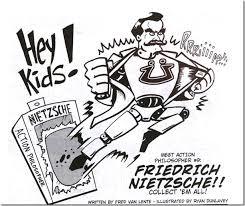
Nietzsche: Athenian drama as nationalist, unifying purpose. Anti-marx. Equality makes us hypocrites, following something we know to be a lie. Pre-religion societies had Ubermensch dominant alpha to rule. Aggression, competition, resentment follows. Religion makes everyone equal, under dominant alpha god. Science kills religion, so is Ubermensch back? Wagner for Germany what Aeschylus was for Athens. Wagner became Christian. Nietzsche totally unknown, except within circles of Nobility.
William James pragmatism: good philosophy, instead of dogma or doctrine, should just be about methods, whose application be used to determine maximum value.
Freud. Hystera means uterus. So how can men be hysterical. Talk therapy success of a patient Bertha made him think of problems with unconscious, not the uterus.
Jung piling on on alienation bandwagon: we used to be comfortable with the inexplicable images of the collective unconscious. But after science, we gained a sense of omnipotence and are alienated from these primordial manifestations, leading to neuroses.
Analytical Philosophy: Russell ‘true role of philosophy is eradication of error through clarification of language’ – logical notation of language. Vienna circle took Wittgenstein as their god, sole role of philosophy is to clarify scientific concepts, rejecting all metaphysics. Logical positivism – all statements either analytic (definition) or synthetic (verifiable). Everything else nonsense. Solved all problems of philosophy, declaring most of them null and void through his critique of language. Luki is only philosopher to have originated 2 entirely different schools of thought.
Sartre was respected by Nazis at his prisoner camp. Gave lectures, introduced to Heidigger who was forced to join the Nazis. Both influenced by Husserl’s phenomenology (no such thing as objective thought. You always think about something – phenomena). Extended Heidigger’s dasein to: existence precedes essence. Man condemned to be free.
For all the vicious fighting of Jung and Freud, Joseph Campbell showed up and reconciled their theories as same purpose applied to different stages of the hero’s journey of consciousness. Freudian psychoanalysis was same as initiation rites at threshold of adulthood. Jung’s analytical psychology was for old age.
Ferdinand de Saussure – father of structuralist linguistics, or semiotics, saying speech is superior to writing because latter is representation of former. Derrida rejected this superiority, all are representation. The true end of philosophy is the end of philosophy. His deconstruction of all great thinkers, marx, freud, decartes wanted to prove all their ideas had traces of what they called ‘other’. Derided as philosophy of nothing, but embraced by literary criticism. Deconstruction allows a text to explode into full range of possible meanings. Its paradoxes create meaning.
This book just didn't work for me, but it's so ambitious that I am giving it more stars than it would deserve for the average reader. I love the idea of a graphic work combining centuries of the greatest philosophers and presenting them as action heroes. But this is the problem - who is the main audience for this? Is it philosophy majors or is it comic book fans?
I could draw a Venn diagram where these two audiences overlap, but it would need to be a tiny overlap as in my experience of knowing many people from both groups I've never encountered someone from both.
I realize the author has put a ton of research into distilling many philosophers' key doctrines. But unless one is a philosophy major one won't have enough background knowledge to fully absorb the various short stories. Even if one does, the constant heavy exposition at points gets tediously talky.
The conceit of having each philosopher as a different action/super hero is funny and original and will appeal to diehard comics fans. But the conceit also gets tiresome as in trying to frame every philosopher this way results in being trapped into a storytelling device that limits the narrative potential. Plus it wears thin after awhile. I'd prefer this conceit was dropped and they just focused on the philosopher as they actually were as I think this would make the stories more engaging and meaningful (but granted, less funny and original).
There were some moments that were quite inspired, but these were too few to make this book work for the average reader. If you happen to meet a philosophy major who loves comics (many of the other reviewers seem to fall in this group) then this is definitely the book for them.
The More Than Complete Action Philosophers! re-orders Fred Van Lente ad Ryan Dunlavey's "popular history of philosophy" into a chronological framework and adds a few philosophers besides in what I might call an irreverent package. And yet, as silly as it can be at times, it nonetheless does the job of my Initiation to Philosophy course back at university, and a fraction of the time and much more memorably. Part of the trick is giving its subjects iconic cartoon appearances that help the reader parse them from one another. Another part is telling their stories in fun and unusual ways - John Stuart Mill as a Peanuts strip, for example, or Kant as a court case in which God's existence is on trial. Though the cartooning can sometimes be bro-ish (which ages the humor badly), the series and attendant trade paperback remains clever, amusing and instructive. For me, the early chapters are the most fun (because the theories are so wonky), while more modern philosophers tend to lose me in semantics, but it's all valuable.
A solid B+ work. The upside: anyone can understand the concepts. Each philosopher is presented succinctly and amusingly. The downside: while it may be in comic form, it's pretty much the same old, dead, white guy philosophy material. There's a grand total of two female philosophers (one of them being Ayn Rand-which hardly counts as philosophy) and the other is Mary Wollstonecraft (whose bio ends with a note that her granddaughter wrote Frankenstein). So, if you're into philosophy, it's a fun book to have and a good gateway book to share with those who otherwise wouldn't touch the topic. But if you're under the impression that you're going to get anything more than a familiarity with a name attached to a school of thought, you should consider reevaluating your expectations of the book.
A surprisingly in depth run down of three dozen philosophers, touching on the basics of some of their most fundamental philosophical contributions. Obviously, a lot is left out, but the overview is given in such a quick and light but obviously well-read manner. J.S. Mill is done in the style of Charlie Brown, and much is made of the Ubermensch of Nietzsche being related to a certain comic character, but Van Lente gives a fairly balanced introduction to a lot of philosophers I knew, and a number that I didn't.
Pretty highly recommended, if only for the double-page spread presentation of Joseph Campbell's journey of a hero as a board game.
A funny book that takes the reader through a crazy, silly, irreverent survey of "Dead White Guy" philosophers. It's not just the DWGs, but mostly, and that's okay--this book (and the smaller issues and volumes published previously) do exactly what they're supposed to do. Witty and informative, it helps some things stick in your mind better than just slumping down in a chair in an undergrad philosophy class. Well, it did for me, anyway. I loved it, and a teacher in the school where I used to teach loved it so much he actually "borrowed" Volume 1 and never returned it! Check it out. And ACTION PRESIDENTS is fun, too!
Hilarious and digestible exploration of most important Western philosophers, and a few Eastern ones, Action Philosophers both entertains and educates. A few problematic passages don't bog down the otherwise spot-on text. Perfect for philosophy hobbyists and academics alike.
A complete treat to read. These guys are so inventive with the philosophers of yore and their ideas. The complaints about oversimplification are fatuous. It's a fun comic book and you will learn something of the history of philosophy along the way.
This graphic introduction to the entire history of philosophy was originally published in (I think) ten parts starting in 2005, and this is the all-in-one Tenth Anniversary Edition. I remember reading a couple of the installments randomly when it first came out and I wasn’t overly impressed. I hoped reading the whole series in order would improve that reaction, but it hasn’t, really. The thing is, philosophy was one of my minors in college in the early 1960s (it sort of fitted in with my history major and my political science minor), so I tried to image learning about the subject from this book at anything like the level of my introductory courses, and the comparison is not encouraging.
The 350-page coverage begins, quite reasonably, with the pre-Socratics -- Thales, Anaximander, and all that crowd -- and follows the development of philosophical systems of thought right up through the mid-twentieth century, including important figures from India and China. But instead of using modern humorous commentary to explain things, as us common in other graphic treatment of non-fictional subjects I’ve read, there are just blocks of text taken directly from the writings of each thinker, with cartoons and random comments (mostly snarky) accompanying them -- but which do nothing to add context or explication. Not very helpful, or satisfying, especially when you get to highly abstract guys like Kant and Wittgenstein and Schoppenhauer. There are also a number of not-really-philosophers included, like Joseph Campbell and Jacques Derrida, which justconfuses things further. This could have been so much better.
This was very fast-paced. It reminded me of one of those introductory classes in college where you're trying to cram all of Biology or Chemistry or Computer Science all under one umbrella. In this case it's even more dizzying because they snuck some religion in there, too. I think there is a distinct difference between philosophy and religion but that's another topic for another time.
While this was entertaining, I would hope nobody would dive into this thinking that somehow they are going to learn anything. My head was spinning. Two pages of one person, ten of another, with very little space in between. This is not meant to read in one go, I think. You can literally have centuries go by just by turning the page. I love comics, but this comprehensive sweep of an entire topic is not the best way to do them. It was a fun read, but the only thing I learned was that this isn't for me.
(Also, I noticed they reused some of the frames -- check out page 52 for Epictetus. Some of those same drawings were used on pages 136 and 137 for Baruch Spinoza.)
I absolutely loved this book. The writers use irreverent humor and illustrations to make complex and abstract ideas accessible. They cover many different philosophers and tell those philosophers’ stories, which helps illuminate their theories and works.
My only quibble is with the mature content in some of the stories. I myself didn’t take much issue with the adult humor, but I wish I could recommend the book to younger kids or use it in teaching, which I can’t do considering the scattered nudity, masturbation jokes, profanity, etc. Many sections/issues are perfectly appropriate for all ages, but it’s a shame the whole book isn’t, considering how brilliant it is. I also don’t think the book would lose any crucial ideas or big laughs by omitting the more risqué content. All that being said, I think most kids high school age and up (and their parents) would be completely fine with it.
This is one of the best resources on philosophy I have found for casual learning and one of the most enjoyable comic books I have ever read.
I read something similar to this, that went through the history of medicine in comic form. Action philosophers was more in-depth, funny, better-conceptualized, etc etc etc. There are also nods to other comic strips. Some of the philosophers, despite the authors' best efforts, were still hard to follow, to the point that it sounds like nonsense, and might be, since most philosophy is ;) There are also a bunch of further reading recommendations at the end...some of which I'll actually find time for.
I've read most of this so far, and have given it (in parts) as gifts. That's certainly a sign that I like it, especially at the price. This is a collection of shorter books. The art is great, the subject is worthwhile, and the treatment is such that you want to read. As a treatment of philosophy, it has as much as you could rationally expect, and then some: not a deep dive into any of the philosophers, but an amusing introduction with pictures and a brief biography. What Voltaire said applies: the work is very clear because it's not very deep.
A peerless introduction to some of the most important ideas (and people) in history. On par perhaps only with Joostein Gardner's 'Sophie's World', both of which should be compulsory reading in High School.
I read this during a readathon which was not ideal. I think I would have appreciated it more if I had dipped into it, absorbed a couple of philosophers before moving on, that sort of thing. However, the writing was working and engaging and the illustrations were hilarious!
The text presents (as far as I can tell) recognized, historical facts, while the artwork sometimes pokes a bit of fun at them by being too literal. The result is a relatively fun read that can teach you a great deal about history from ancient to modern times, how empires rose and fell, how people were ostracized and shunned by society because of their not-yet-accepted views that we now take for granted and how life was viewed by some of the greatest thinkers in history.
Overall, it'a story of mankind maturing by asking itself questions, primarily of religious and existential nature. Still, it has too many facts and too litte fun for my taste.
The easiest thing to do here would be to get nitpicky with who they chose to focus on: too little Foucault, too much Ayn Rand, not enough Socrates, too much Jefferson. And I guess that's the danger of doing any incomplete list of anything: you're going to leave something out. So it probably wasn't worth my having said that.
Anyway, I thought this was cool. It's a relatively quick read, and some of the philosopher's are explained extremely well. My main complaint is that the fun comic book format didn't necessarily lend itself to esoteric philosophical language, and that they should probably have tried a little harder to make the language clearer. It's just too incongruous to have the silly pictures mixed with the language of Kant, and since the whole idea was to make it more accessible, I feel like, in some cases, an opportunity was missed.
Some part of this book are mad genius, others fell flat for me. Also, I didn't notice until nearly the end, but this could be just as easily called Boys' Own Philosophers - there are almost no women (I know, partly a problem with the discipline itself), and the few women included are MUCH more likely to be portrayed with more attention to their love affairs than their ideas, compared to the men - I mean, seriously, Ayn Rand's comic is all about the Nathaniel Branden thing, but the Sartre story doesn't even MENTION Simone de Beauvoir??? Once??? C'mon...
_You're a Good Man, John Stuart Mill_ still has me chuckling though.
From Thales of Miletus to Derrida, a kind of photo album of, as some blurbs say, "A List" philosophers with often funny illustrations and pithy statements and exchanges about the distinctive ideas, claims, insights and personalities of each. I wish there had been more of a sense of dialog, and because I had trouble keeping all those ideas in my head, also more cross referencing or review---though I gather the original comics weren't written in chronological order, so that might have been an impossibility without a lot of revision. Still, with study this creates a great intellectual scaffolding for further exploration of philosophy, politics, organized religion and science. Teen and up.
There's a lot to like in this book. It's a great and often hilarious dive into the lives and ideas of some of the greatest philosophers throughout history. But on the whole if you're already familiar with a majority of these figures, you'll find they often just go with half-truths common in other popularizations (for example that Nietzsche was a nihilist, or that Descartes' methodological doubt wasn't methodological). Still, for anyone who wants to learn about this stuff, it's a pretty great introduction, and well worth it. I think my personal favorite was Kant working as an epistemological attorney, trying to save God from a charge of being a transcendental illusion.
Have you read some of these people before? Philosophical texts can be dense, this book is not. Consequently, the comic can help you dreg up some of the ideas that have settled at the bottom of your mind.
The book helped me remember things I forgot about Mill and Hegel. I could compare these recollections to what I've distilled from reading Wittgenstein. I'm glad I just had to read a comic book to remind me instead of having to pick up the original text. Good time saver for cursory comparisons.
Had good intros to people I didn't know about too.
This was a witty and timeless joy to read. I heard about them for a while till a friend brought them over to read. Since then I wanted all of them in one comic collection extravaganza. I was not disappointed and found such a thing did exist and snatched it up at a local book store. There are still a lot of philosopher's left out but all the major ones seem available. If only the authors made a few more *sigh*. This isn't the best introduction to philosophy but it's by far the most entertaining one.
Does what it is supposed to do and does it well. A broad range of philosophy/philosophers in bite size chunks, delivered with humor, wit, and care. I found a couple of mistakes, but they were minor. Unlike most survey philosophy books, this one had a medieval section and a wee bit of renaissance thought. Most books go from Aristotle to Descartes as though nothing happened during the intervening years... Props for that. It's a fun read and I recommend it as a light way to brush up on who said what and when in the (mostly) Western Philosophical tradition.
If you want to learn about some of history's top philosophers, from Thales of Miletus! to Derrida!, then Action Philosophers! is for you!
It is a pretty good way to learn about the views of different philosophers in comic book form, but it is still, after all, Philosophy. It's about as painless as possible, but I still found myself sometimes reading a few panels, and not remembering what the guy was talking about. In that case, I could just look at the pictures.