

What do you think?

Flashman Papers #4
Flashman at the Charge: from The Flashman Papers, 1854-1855 (The Flashman papers) (Paperback) - Common
The fourth volume of memoirs in which Harry Flashman confronts destiny with Lord Cardigan and the Light Brigade. Part of the FLASHMAN series, comprising FLASHMAN, ROYAL FLASH and FLASH FOR FREEDOM, which explores the successful though scandalous later career of the bully in TOM BROWN'S SCHOOL DAYS.
336 pages, Paperback
First published January 28, 1973
About the author
George MacDonald Fraser
102 books705 followersGeorge MacDonald Fraser is best known for his Flashman series of historical novels, purportedly written by Harry Flashman, a fictional coward and bully originally created by Thomas Hughes in Tom Brown's School Days. The novels are presented as "packets" of memoirs written by the nonagenarian Flashman, who looks back on his days as a hero of the British Army during the 19th century. The series begins with Flashman, and is notable for the accuracy of the historical settings and praise from critics. P.G. Wodehouse said of Flashman, “If ever there was a time when I felt that ‘watcher-of-the-skies-when-a-new-planet’ stuff, it was when I read the first Flashman.”
Ratings & Reviews
Friends & Following
Create a free account to discover what your friends think of this book!
Community Reviews
Displaying 1 - 30 of 260 reviews

May 29, 2022
‘Half a league, half a league,
Half a league onward,
All in the Valley of Death
Rode the six hundred.
‘Forward, the Light Brigade!
Charge for the guns!’ he said:
Into the Valley of Death
Rode the six hundred.’
- Lord Alfred Tennyson
“I heard the words of the Light Brigade behind me”:
‘In the place of water we’ll drink ale,
And pay no reckoning on the nail,
No man for debt shall go to jail,
When he can Garryowen hail.’
- Irish drinking song widely used in English speaking military marches
“I’ve heard it from Afghanistan to Whitehall, from the African veldt to drunken parties in Rutland. I’ve heard it sounded in penny whistles by children and sounded out in a full throated chorus by Custer’s 7th on the day of Greasy Grass, and there were survivors of the Light Brigade singing it in their day too. It always sounds bitter to my ears when I think of the brave, deluded, pathetic bloody fools with their mangled bodies and lost limbs, all for a shilling a day and a pauper’s grave.”
- George MacDonald Fraser
“What I didn’t realize then was these people were slaves - bound European white slaves which isn’t easy to understand until you see it. Boris Godunov - whom most of you know as the fellow who takes an hour and a half to die in an opera - imposed serfdom on the Russian peasants, meaning they became the property of nobles and landowners who could buy and sell them, hire them out, starve, lash and imprison them, take their goods, beasts and women whenever they chose - anything short of maiming or killing them. They did those things too of course, but it was officially unlawful.”
- George MacDonald Fraser
************
Colonel Harry Flashman is relaxing in London ten years after being decorated as a hero and nearly sole survivor of the First Afghan War, and a stint as a slave trader in Africa and America. He sees trouble brewing in Turkey due to Russian expansionism and secures an office position in ordnance procurement to avoid combat duty. But as fate would have it he is selected by Lord Raglan, commanding officer for the Russian campaign to chaperone Wilhelm, a young nephew of Prince Albert, consort of Queen Victoria. Flash had met him in a bar earlier and abandoned him drunken in an alleyway.
War breaks out in 1853 and Wilhelm, who attends a military school, accompanies the expedition to Russia with Flash. As he is leaving he suspects his wife is having an affair with the 7th Earl of Cardigan, commander of the 11th Hussars cavalry, who later will lead the ill-fated Charge of the Light Brigade. Arriving at Varna in Bulgaria, British and French soldiers are sick with cholera and the generals don’t know why they have orders to attack Sevastopol in Crimea. Without good maps 60,000 men drift around the Black Sea in search of the siege location, landing in Alma where a great battle ensues.
In the fight Flash loses his royal charge and is sickened by champagne looted from Cossacks at Balaclava. At the next battle he’s nauseous and incontinent but ordered back to the front as Raglan’s messenger. He finagles the Light Brigade to recapture British cannon in hopes Cardigan will be killed, but is told to join in the charge. Raglan’s orders are jumbled and Cardigan leads the cavalry straight into Russian artillery. Famously they were shot to pieces, yet Flash and his rival survive. Reaching the gun battery he flees, only to be taken prisoner. The enemy is dumbfounded by the daring attack.
Flash enjoys passage as a privileged hostage across the frozen steppe on a horse drawn cart, reflecting on man’s precarious relationship to slavery. Hosted by a Count in a sprawling mansion he pursues his married daughter and sister. Beneath a civilized veneer the heart of a Cossack barbarian lurks. Flash describes scenes that belong in a Turgenev novel, and with his usual lingual facility is soon speaking Russian. Serf rebellions had begun, and Marx in London was known. Detained with Flash is a soldier and old classmate intent on learning military secrets of the house.
Apprised of Great Game intrigues that threaten the British Empire, a peasant uprising provides an opportunity for escape towards Sevastopol. However plans go awry, and Flash finds himself on a fraught expedition across the desert wastes of Central Asia in the clutches of a Russian cavalry unit. Only unforeseen events can save him and foil the Tsar’s plot. The author weaves Flashman within real life events and people. The historical background is credible in spite of the comical situations. He is a morally compromised character, but has a clear sense of the ironies during his time.
************
‘To learn the age old lesson day by day,
It is not in the bright arrival planned,
But in dreams men dream along the way,
They find the Golden Road to Samarkand.’
-James Elroy Flecker
Half a league onward,
All in the Valley of Death
Rode the six hundred.
‘Forward, the Light Brigade!
Charge for the guns!’ he said:
Into the Valley of Death
Rode the six hundred.’
- Lord Alfred Tennyson
“I heard the words of the Light Brigade behind me”:
‘In the place of water we’ll drink ale,
And pay no reckoning on the nail,
No man for debt shall go to jail,
When he can Garryowen hail.’
- Irish drinking song widely used in English speaking military marches
“I’ve heard it from Afghanistan to Whitehall, from the African veldt to drunken parties in Rutland. I’ve heard it sounded in penny whistles by children and sounded out in a full throated chorus by Custer’s 7th on the day of Greasy Grass, and there were survivors of the Light Brigade singing it in their day too. It always sounds bitter to my ears when I think of the brave, deluded, pathetic bloody fools with their mangled bodies and lost limbs, all for a shilling a day and a pauper’s grave.”
- George MacDonald Fraser
“What I didn’t realize then was these people were slaves - bound European white slaves which isn’t easy to understand until you see it. Boris Godunov - whom most of you know as the fellow who takes an hour and a half to die in an opera - imposed serfdom on the Russian peasants, meaning they became the property of nobles and landowners who could buy and sell them, hire them out, starve, lash and imprison them, take their goods, beasts and women whenever they chose - anything short of maiming or killing them. They did those things too of course, but it was officially unlawful.”
- George MacDonald Fraser
************
Colonel Harry Flashman is relaxing in London ten years after being decorated as a hero and nearly sole survivor of the First Afghan War, and a stint as a slave trader in Africa and America. He sees trouble brewing in Turkey due to Russian expansionism and secures an office position in ordnance procurement to avoid combat duty. But as fate would have it he is selected by Lord Raglan, commanding officer for the Russian campaign to chaperone Wilhelm, a young nephew of Prince Albert, consort of Queen Victoria. Flash had met him in a bar earlier and abandoned him drunken in an alleyway.
War breaks out in 1853 and Wilhelm, who attends a military school, accompanies the expedition to Russia with Flash. As he is leaving he suspects his wife is having an affair with the 7th Earl of Cardigan, commander of the 11th Hussars cavalry, who later will lead the ill-fated Charge of the Light Brigade. Arriving at Varna in Bulgaria, British and French soldiers are sick with cholera and the generals don’t know why they have orders to attack Sevastopol in Crimea. Without good maps 60,000 men drift around the Black Sea in search of the siege location, landing in Alma where a great battle ensues.
In the fight Flash loses his royal charge and is sickened by champagne looted from Cossacks at Balaclava. At the next battle he’s nauseous and incontinent but ordered back to the front as Raglan’s messenger. He finagles the Light Brigade to recapture British cannon in hopes Cardigan will be killed, but is told to join in the charge. Raglan’s orders are jumbled and Cardigan leads the cavalry straight into Russian artillery. Famously they were shot to pieces, yet Flash and his rival survive. Reaching the gun battery he flees, only to be taken prisoner. The enemy is dumbfounded by the daring attack.
Flash enjoys passage as a privileged hostage across the frozen steppe on a horse drawn cart, reflecting on man’s precarious relationship to slavery. Hosted by a Count in a sprawling mansion he pursues his married daughter and sister. Beneath a civilized veneer the heart of a Cossack barbarian lurks. Flash describes scenes that belong in a Turgenev novel, and with his usual lingual facility is soon speaking Russian. Serf rebellions had begun, and Marx in London was known. Detained with Flash is a soldier and old classmate intent on learning military secrets of the house.
Apprised of Great Game intrigues that threaten the British Empire, a peasant uprising provides an opportunity for escape towards Sevastopol. However plans go awry, and Flash finds himself on a fraught expedition across the desert wastes of Central Asia in the clutches of a Russian cavalry unit. Only unforeseen events can save him and foil the Tsar’s plot. The author weaves Flashman within real life events and people. The historical background is credible in spite of the comical situations. He is a morally compromised character, but has a clear sense of the ironies during his time.
************
‘To learn the age old lesson day by day,
It is not in the bright arrival planned,
But in dreams men dream along the way,
They find the Golden Road to Samarkand.’
-James Elroy Flecker

July 14, 2023
Fraser's #4 Flashman - and we take in the Crimean War, some time in Russia and a sojourn in Kazakhstan / Uzbekistan where Yakub Beg was leading resistance to Russia pushing in to Central Asia, the book covering the period 1854-55.
As usual, we are treated to Flashman being woven into accurate historical events and mixing with some well known historical figures. The Battle at Balaclava is the key in this novel.
There are various spoilers below, so it this is a Flashman novel you plan on reading in the near future, give this review a miss!
Flashman is back in London, but aware of pending trouble between the Ottoman Empire and Russia secures himself a position on the Board or Ordnance, to avoid being mixed up in it. Events conspire however, and he is appointed by Prince Albert to look after a young German cousin, Wilhelm of Celle, eventually accompanying him to Bulgaria where the British troops were massing for the advance, and then across the Black Sea to Crimea.
When Flashman fails to protect Willy, who is young and reckless and charges out onto the field of battle prematurely, he is attached to Raglan's staff, where is falls in with Lew Nolan - the famed deliverer of the battle commands who is largely blamed for the miscommunication that led to the charge. As well as Raglan and Nolan, Flashman mixes with all the other well known figures at Balaclava - Cardigan, Scarlett, Lucan, Campbell. As it turns out, Flashman plays a larger part than anyone, taking part not only in the Charge of the Light (cavalry) Brigade, but also present at Campbell's Thin Red Line with the 93rd Regiment and Scarlett's uphill charge with the Heavy Cavalry in their attach on Russian Cavalry.
But it is the Charge of the Light Brigade that Flashman breaks the enemy line and while looking for escape is captured by the Russians. There is now a passage of the novel where Flashman is taken to an estate beyond Sevastopol where he is the prisoner of Count Pencherjevsky – a Cossack Hetman who is now the feudal Russian lord of the large estate. Supposedly waiting until he can be exchanged for a Russian prisoner of equal standing, Flashman is here reunited with an old schoolmate, Scud East, from Rugby School, also a prisoner. While Flashman is bedding the daughter of the Count, Scud East is spying on a meeting of important Russian officers and they discover the Russian Plot to invade British India through Central Asia. The escape from the estate, East's escape to Crimea, and Flashman's recapture by Russians ends this part of the story and we join Flashman in Central Asia for the third part to this novel.
With his recapture, Flashman meets Nikolay Pavlovich Ignatieff again, having briefly encountered him before his time in the estate, and Ignatieff is cast as the violent villain of this story. Taken on the Russian advance into Central Asia, on the way to the attack on British India, circumstances again conspire to place Flashman in a prison cell with Yakub Beg and Izzat Kutebar, the former being a Tajik leader of the resistance fighting against Russia's advances into their lands, the latter an aging guerilla leader working with Yakub Beg. In a daring rescue the three are thrown together and Flashman is forced into a role in attacking the Russian ships coming down the Syr Darya river to deliver the masses of ammunition for the attack on India - the destruction of this not only stops the Russian attack on India but sets the Russians back on their advance through Central Asia.
Again Fraser is masterful in wrapping historic events around Flashman and some fictional supporting characters. The historic characters come to life (accurately or not, who can say) as they interact with Flashman, as he looks to minimise his involvement in risky business, events conspire to have him in the thick of it.
This book along with the original are perhaps the strongest of those I have read so far.
4.5 stars, rounded down to the typical 4 I have awarded each Flashman novel so far.
As usual, we are treated to Flashman being woven into accurate historical events and mixing with some well known historical figures. The Battle at Balaclava is the key in this novel.
There are various spoilers below, so it this is a Flashman novel you plan on reading in the near future, give this review a miss!
Flashman is back in London, but aware of pending trouble between the Ottoman Empire and Russia secures himself a position on the Board or Ordnance, to avoid being mixed up in it. Events conspire however, and he is appointed by Prince Albert to look after a young German cousin, Wilhelm of Celle, eventually accompanying him to Bulgaria where the British troops were massing for the advance, and then across the Black Sea to Crimea.
When Flashman fails to protect Willy, who is young and reckless and charges out onto the field of battle prematurely, he is attached to Raglan's staff, where is falls in with Lew Nolan - the famed deliverer of the battle commands who is largely blamed for the miscommunication that led to the charge. As well as Raglan and Nolan, Flashman mixes with all the other well known figures at Balaclava - Cardigan, Scarlett, Lucan, Campbell. As it turns out, Flashman plays a larger part than anyone, taking part not only in the Charge of the Light (cavalry) Brigade, but also present at Campbell's Thin Red Line with the 93rd Regiment and Scarlett's uphill charge with the Heavy Cavalry in their attach on Russian Cavalry.
But it is the Charge of the Light Brigade that Flashman breaks the enemy line and while looking for escape is captured by the Russians. There is now a passage of the novel where Flashman is taken to an estate beyond Sevastopol where he is the prisoner of Count Pencherjevsky – a Cossack Hetman who is now the feudal Russian lord of the large estate. Supposedly waiting until he can be exchanged for a Russian prisoner of equal standing, Flashman is here reunited with an old schoolmate, Scud East, from Rugby School, also a prisoner. While Flashman is bedding the daughter of the Count, Scud East is spying on a meeting of important Russian officers and they discover the Russian Plot to invade British India through Central Asia. The escape from the estate, East's escape to Crimea, and Flashman's recapture by Russians ends this part of the story and we join Flashman in Central Asia for the third part to this novel.
With his recapture, Flashman meets Nikolay Pavlovich Ignatieff again, having briefly encountered him before his time in the estate, and Ignatieff is cast as the violent villain of this story. Taken on the Russian advance into Central Asia, on the way to the attack on British India, circumstances again conspire to place Flashman in a prison cell with Yakub Beg and Izzat Kutebar, the former being a Tajik leader of the resistance fighting against Russia's advances into their lands, the latter an aging guerilla leader working with Yakub Beg. In a daring rescue the three are thrown together and Flashman is forced into a role in attacking the Russian ships coming down the Syr Darya river to deliver the masses of ammunition for the attack on India - the destruction of this not only stops the Russian attack on India but sets the Russians back on their advance through Central Asia.
Again Fraser is masterful in wrapping historic events around Flashman and some fictional supporting characters. The historic characters come to life (accurately or not, who can say) as they interact with Flashman, as he looks to minimise his involvement in risky business, events conspire to have him in the thick of it.
This book along with the original are perhaps the strongest of those I have read so far.
4.5 stars, rounded down to the typical 4 I have awarded each Flashman novel so far.

February 1, 2011
This is the first Flashman book i ever read, picked up at random in the school library. It led me to the whole series.
Having read them all I still think that this is the best one. I love the mix of history, caddishness and non PC - which is absolutely wonderful. It is certainly not highbrow literature, just a good rollicking read.
Flashman is sent to the Crimea and manages to join the Charge of the Light Brigade - there is a suggestion that he may have had a hand in starting it. A glorious piece of folly, 600 cavalry charge the whole Russian army.
Flashy is captured and manages to foil a Russian plot threatening India.
Recommend to all.
Having read them all I still think that this is the best one. I love the mix of history, caddishness and non PC - which is absolutely wonderful. It is certainly not highbrow literature, just a good rollicking read.
Flashman is sent to the Crimea and manages to join the Charge of the Light Brigade - there is a suggestion that he may have had a hand in starting it. A glorious piece of folly, 600 cavalry charge the whole Russian army.
Flashy is captured and manages to foil a Russian plot threatening India.
Recommend to all.

August 15, 2021
Outstanding retelling of the Crimean War as seen through the eyes of the incomparable Flashman. Was totally unfamiliar with this chunk of British/Russian history, other than a vague awareness of Tennyson's poem, but now I have at least a layman's understanding of the Charge of the Light Brigade (as well as the difference between Light and Heavy Cavalry), the legendary Thin Red Line, and where we gets both the balaclava and the cardigan.
The book does hit a bit of a lull with Flashy held prisoner in Russia, but then picks up again when he meets Yakub Beg and gets back into the Great Game. (As far as I know, the whole last battle at Fort Raim is fictional, although the fort itself is not.) And then there is a surprisingly touching postlude when Flashy passes through Kabul on his way back to India...very nice semi-sentimental ending to an otherwise rousing yarn.
As in his other books, Fraser has his most fun when describing rascals. Flashy himself, of course, but also folks like Yakub Beg and Izzat Kutebar, the fictional Count Pencherjevsky, and (in Flashman) Wazir Akbar Khan; (although his villains - such as Count Ignatiev here and Gul Shah in Flashman come off as more two-dimensional caricatures.)
But that said, I think I'm Flashed out for a while, and so will take a breather before returning to the third book in Fraser's unofficial "Great Game trilogy," the aptly titled Flashman In The Great Game.
The book does hit a bit of a lull with Flashy held prisoner in Russia, but then picks up again when he meets Yakub Beg and gets back into the Great Game. (As far as I know, the whole last battle at Fort Raim is fictional, although the fort itself is not.) And then there is a surprisingly touching postlude when Flashy passes through Kabul on his way back to India...very nice semi-sentimental ending to an otherwise rousing yarn.
As in his other books, Fraser has his most fun when describing rascals. Flashy himself, of course, but also folks like Yakub Beg and Izzat Kutebar, the fictional Count Pencherjevsky, and (in Flashman) Wazir Akbar Khan; (although his villains - such as Count Ignatiev here and Gul Shah in Flashman come off as more two-dimensional caricatures.)
But that said, I think I'm Flashed out for a while, and so will take a breather before returning to the third book in Fraser's unofficial "Great Game trilogy," the aptly titled Flashman In The Great Game.

Read
August 16, 2011As everybody knows, there are only two types of people in the world, those who share your sense of humour and those who don't. I had expected this book to be funny, or at least humorous, and maybe it was a mistake reading it when I was sober, but in any case through reading this book I established that the author and I aren't kin by humour.
It is divided into three awkward, distinct parts, staring with a plot sequence set during the Crimean War with Flashman taking part in the Charge of the Light Brigade. Then there is a section set in Russia and finally the third part takes place in Central Asia. The transition from the first part to the second is mildly plausible but the transition to the third part is bad with a genuine hero-wakes-up- in-a-dungeon-to-find-himself-imprisoned-with-useful-allies-who-conveniently- then-get-rescued scene.
Neither serious nor demanding, this is a good rainy day novel.
It is divided into three awkward, distinct parts, staring with a plot sequence set during the Crimean War with Flashman taking part in the Charge of the Light Brigade. Then there is a section set in Russia and finally the third part takes place in Central Asia. The transition from the first part to the second is mildly plausible but the transition to the third part is bad with a genuine hero-wakes-up- in-a-dungeon-to-find-himself-imprisoned-with-useful-allies-who-conveniently- then-get-rescued scene.
Neither serious nor demanding, this is a good rainy day novel.

March 11, 2018
FLASHMAN: NERVOUS FLATULENCE UNDER FIRE
“Cannon to right of them,
Cannon to left of them,
Cannon behind them
Volleyed and thundered;
Stormed at with shot and shell,
While horse and hero fell.
They that had fought so well
Came through the jaws of Death,
Back from the mouth of hell,
All that was left of them,
Left of six hundred.
When can their glory fade?
O the wild charge they made!
All the world wondered.
Honour the charge they made!
Honour the Light Brigade,
Noble six hundred!”
- Taken from ‘The Charge of the Light Brigade’, by Alfred Tennyson
The not wholly untalented Alfie certainly had an uncanny knack for turning a phrase, making the hearts of his fellow countrymen collectively swell with pride for their boys’ comportment during the lowest point in the Crimean debacle. But!
Would he still have put it this way, had he hypothetically been afforded the opportunity to catch up on the memoirs - however fictitious they might be - of that highly decorated British horseman, Harry Flashman? Why, that, my friends, would take some doing.
For while the gent was whistling Dixie like nobody’s business, everyone’s favorite scoundrel is considerably less concerned with putting an ennobling sheen on the often tawdry reality of military engagements. In fact, he does his utmost to shatter any and all illusions, not in the least the ones about himself, a man who's viewed as a valiant hero by all back in Albion:
A coward’s honesty, even if repellent at first glance and yes, even when we are firmly aware these memoirs were only meant to be found after Flashy’s death, is honesty nonetheless. It’s this that makes the character so absolutely refreshing, even if he’s a scumbag of the highest order, drenched in sleaze. He’s a callous, lecherous egotist, but at least he knows it, intimately so, and doesn’t mind categorically telling us, over and over again.

To more critical readers, the Flashman novels would soon appear formulaic, and they'd be right, but by God are they masterfully put together little pleasures. Fraser’s control of this particular flavour of fast-paced, high-octane, fun adventure writing with romantic flourishes is undeniable, and -thus far - reaches something of a high note with ‘Flashman at the Charge’. A seemingly impossible task to achieve, given what a triumph ‘Flash for Freedom’ was. Could it get even better, I wonder?
Harkening back to the very beginning of the Flashman saga, actual warfare – as always vividly rendered, making you smell the cordite drifting in the air- once again makes up a substantial part of the book, and introduces a great antagonist for Flashman, the particularly vicious Count Ignatieff, a thoroughly bad egg even by his standards, which to be sure he will be forced to"break" at a later time. Perhaps it will involve Ignatieff's preferred instrument for the torture/execution of his "useless" serfs, a rather nasty piece of equipment called the Russian knout.

"I'd be hard pressed to call myself a man who abides by moral principles, but few things are sweeter than poetic justice, don't you find?", I can already hear Flashman exclaim, while he's enthusiastically swinging to-and-fro.
There's a void of sorts in my life, left after our haughty hussar ( oh, how he utterly redefined the very concept of a bastard in that first book.. ) was somewhat softened by Fraser, most likely to make him more palatable to audiences.
However, without any reservations I’ll gallop along with him, to whatever realm, whatever historical conflagration he decides to plunge Flashman into next.
Lead the way, old bean.
“Cannon to right of them,
Cannon to left of them,
Cannon behind them
Volleyed and thundered;
Stormed at with shot and shell,
While horse and hero fell.
They that had fought so well
Came through the jaws of Death,
Back from the mouth of hell,
All that was left of them,
Left of six hundred.
When can their glory fade?
O the wild charge they made!
All the world wondered.
Honour the charge they made!
Honour the Light Brigade,
Noble six hundred!”
- Taken from ‘The Charge of the Light Brigade’, by Alfred Tennyson
The not wholly untalented Alfie certainly had an uncanny knack for turning a phrase, making the hearts of his fellow countrymen collectively swell with pride for their boys’ comportment during the lowest point in the Crimean debacle. But!
Would he still have put it this way, had he hypothetically been afforded the opportunity to catch up on the memoirs - however fictitious they might be - of that highly decorated British horseman, Harry Flashman? Why, that, my friends, would take some doing.
For while the gent was whistling Dixie like nobody’s business, everyone’s favorite scoundrel is considerably less concerned with putting an ennobling sheen on the often tawdry reality of military engagements. In fact, he does his utmost to shatter any and all illusions, not in the least the ones about himself, a man who's viewed as a valiant hero by all back in Albion:
“It was an inferno of bursting shell and whistling fragments, of orange flame and choking smoke; a trooper alongside me was plucked from his saddle as though by an invisible hand, and I found myself drenched in a shower of blood. My little mare went surging ahead, crazy with pain. […] even in that hell of death and gunfire, I remember, my stomach was asserting itself again, and I rode yelling with panic and farting furiously at the same time. I couldn't hold my horse at all; it was all I could do to stay aboard as we raced onwards, and as I stared wildly ahead I saw that we were a bare few hundred yards from the Russian batteries.
The great black muzzles were staring me in the face, smoke wreathing up around them, but even as I saw the flame belching from them I couldn't hear the crash of their discharge—it was all lost in the fearful continuous reverberating cannonade that surrounded us. There was no stopping my mad career, and I found myself roaring pleas for mercy to the distant Russian gunners, crying stop, stop, for God's sake, cease fire, damn you, and let me alone.”
A coward’s honesty, even if repellent at first glance and yes, even when we are firmly aware these memoirs were only meant to be found after Flashy’s death, is honesty nonetheless. It’s this that makes the character so absolutely refreshing, even if he’s a scumbag of the highest order, drenched in sleaze. He’s a callous, lecherous egotist, but at least he knows it, intimately so, and doesn’t mind categorically telling us, over and over again.
To more critical readers, the Flashman novels would soon appear formulaic, and they'd be right, but by God are they masterfully put together little pleasures. Fraser’s control of this particular flavour of fast-paced, high-octane, fun adventure writing with romantic flourishes is undeniable, and -thus far - reaches something of a high note with ‘Flashman at the Charge’. A seemingly impossible task to achieve, given what a triumph ‘Flash for Freedom’ was. Could it get even better, I wonder?
Harkening back to the very beginning of the Flashman saga, actual warfare – as always vividly rendered, making you smell the cordite drifting in the air- once again makes up a substantial part of the book, and introduces a great antagonist for Flashman, the particularly vicious Count Ignatieff, a thoroughly bad egg even by his standards, which to be sure he will be forced to"break" at a later time. Perhaps it will involve Ignatieff's preferred instrument for the torture/execution of his "useless" serfs, a rather nasty piece of equipment called the Russian knout.
"I'd be hard pressed to call myself a man who abides by moral principles, but few things are sweeter than poetic justice, don't you find?", I can already hear Flashman exclaim, while he's enthusiastically swinging to-and-fro.
There's a void of sorts in my life, left after our haughty hussar ( oh, how he utterly redefined the very concept of a bastard in that first book.. ) was somewhat softened by Fraser, most likely to make him more palatable to audiences.
However, without any reservations I’ll gallop along with him, to whatever realm, whatever historical conflagration he decides to plunge Flashman into next.
Lead the way, old bean.

October 11, 2012
Flashman at the Charge is the fourth entry in George Macdonald Fraser's Flashman series, detailing the dastardly Harry Flashman's adventures in the Crimean War and beyond. Flashman is thrilled when he's appointed an aide to Lord Raglan in lieu of a combat role, but finds himself in the front lines anyway, up to and including the Charge of the Light Brigade (with his old nemesis Lord Cardigan). Captured by the Russians, he winds up imprisoned at an estate with a boorish landowner and his comely female relations, only to stumble across a dastardly plot to invade British India which only Flashman can thwart. Fraser delivers his usual mixture of bawdy humor, high adventure and exquisite historical detail, but the story strains to accommodate its exorbitant twists and turns, which seems an excuse for Fraser to move from the well-trod ground of the Crimea to examining the brutality of Tsarist Russia, then back to Flashman's old stomping grounds in Central Asia. The book's most readable, as often the case, for Fraser's lively caricatures of historical figures, from the grotesque Cardigan (who tries, and fails to bed Flashman's wife) and senile Lord Raglan to Nicholas Ignatief, a Russian spymaster envisioned by Fraser as a Machiavellian dastard with a multicolored eyeball and a penchant for knouting. The novel climaxes with the funny-thrilling scene of a doped-up Flashman sabotaging a Russian fleet with help from Afghan allies, a sequence which encapsulates everything enjoyable about these books.

Read
July 21, 2013This was pretty fun, but i'm disappointed that dear old Flashman seems to be softening up somewhat. The particular charm of the first book was that he truly is a true scumbag, but ends up a hero because he's a member of an enterprise so corrupt, incompetent and immoral that lying, cheating, stealing, murdering, raping and betraying his way through it is a natural course of action. You end up feeling sympathy neither for Flashman nor for the British Empire, but do gain a certain satisfaction from seeing them end up together, in a those-two-deserve-eachother sort of way.
Here, however, Flashman isn't nearly as despicable, and he mostly just comes off as the only sane man in the asylum. He sensibly tries to wriggle out of doing insanely dangerous life threatening things, fails, and then does them fairly commendably anyway, and spends the rest of his time feeling bad for downtrodden peasants and common soldiers. It's not nearly as interesting.
Here, however, Flashman isn't nearly as despicable, and he mostly just comes off as the only sane man in the asylum. He sensibly tries to wriggle out of doing insanely dangerous life threatening things, fails, and then does them fairly commendably anyway, and spends the rest of his time feeling bad for downtrodden peasants and common soldiers. It's not nearly as interesting.

August 6, 2013
George MacDonald Fraser’s agent believed Flashman at the Charge to be the best of the Flashman novels, and it’s an awfully good selection. This fourth Flashman book has it all: gripping suspense, hilarious (and raunchy) humor, and well-researched historical elements that make the story as informative as it is entertaining. While personally I would put the first and third Flashman novels ahead of this one in pride of place, this is definitely one of the stronger entries in a series full of excellent books.
Per the Flashman formula, the story starts with our hero (or anti-hero, if you will) trying desperately to avoid a dangerous situation, in this case the Crimean War. I thought this was one of the very best opening sections in the entire series, featuring a funny situation where Flashman’s bullying behavior results in a very appropriate comeuppance. But the fireworks really begin when Flashy is shipped off to the Crimea. Now, I’ll admit that when I started this book I couldn’t pick the Crimea out from Croatia on a map, and I had no idea who the participants in the Crimean War were or what they were fighting about. I actually ended up learning quite a lot about 19th century history during the course of Flashy’s adventures here, thanks to Fraser’s meticulous historical research, which is one of my favorite things about this series. Flashman finds himself embroiled in some of the war’s most famous campaigns, from the Battle of Alma to the Charge of the Heavy Brigade and The Thin Red Line. This is all building to the main event, the famous Charge of the Light Brigade. Suffice to say Fraser does this major scene full justice, although Flashman's recollection is quite different from Tennyson's version of the event.
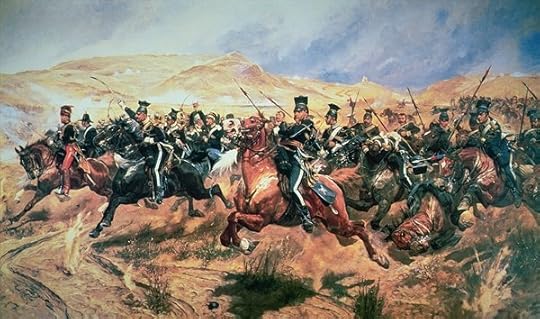
Somehow Flashman manages to survive the slaughter and is taken as a prisoner of war. This sets the stage for the second part of the book, a very funny story (with some great suspense mixed in) about Flashman’s life as a POW. There’s less specific history to be learned here, although readers get a good look at what life must have been like in Czarist Russia. I won’t spoil the plot by going into what happens from here; I’ll just note that there are some twists and turns which lead into a rather unexpected third act. While I thought this book was 5-star material up to this point, the last third didn’t quite click with me and was enough to dock it a half-star. Not bad, but didn’t completely fit with the story leading up to it (it almost felt like another story mashed onto the back half of the main plot).
Still, it’s easy to see how readers could pick this book as their favorite from the series. This is classic Flashman, and I thoroughly enjoyed it from start to (mostly) finish. 4.5 stars, highly recommended!
Per the Flashman formula, the story starts with our hero (or anti-hero, if you will) trying desperately to avoid a dangerous situation, in this case the Crimean War. I thought this was one of the very best opening sections in the entire series, featuring a funny situation where Flashman’s bullying behavior results in a very appropriate comeuppance. But the fireworks really begin when Flashy is shipped off to the Crimea. Now, I’ll admit that when I started this book I couldn’t pick the Crimea out from Croatia on a map, and I had no idea who the participants in the Crimean War were or what they were fighting about. I actually ended up learning quite a lot about 19th century history during the course of Flashy’s adventures here, thanks to Fraser’s meticulous historical research, which is one of my favorite things about this series. Flashman finds himself embroiled in some of the war’s most famous campaigns, from the Battle of Alma to the Charge of the Heavy Brigade and The Thin Red Line. This is all building to the main event, the famous Charge of the Light Brigade. Suffice to say Fraser does this major scene full justice, although Flashman's recollection is quite different from Tennyson's version of the event.
Somehow Flashman manages to survive the slaughter and is taken as a prisoner of war. This sets the stage for the second part of the book, a very funny story (with some great suspense mixed in) about Flashman’s life as a POW. There’s less specific history to be learned here, although readers get a good look at what life must have been like in Czarist Russia. I won’t spoil the plot by going into what happens from here; I’ll just note that there are some twists and turns which lead into a rather unexpected third act. While I thought this book was 5-star material up to this point, the last third didn’t quite click with me and was enough to dock it a half-star. Not bad, but didn’t completely fit with the story leading up to it (it almost felt like another story mashed onto the back half of the main plot).
Still, it’s easy to see how readers could pick this book as their favorite from the series. This is classic Flashman, and I thoroughly enjoyed it from start to (mostly) finish. 4.5 stars, highly recommended!

January 15, 2013
It was PG Wodehouse who likened his first reading of Flashman to Keats' experience of reading Homer in Chapman's translation, although I can safely say that Flashy is unlikely to ever hold his silence, even on a peak in Darien - he'd be looking for a likely woman or an escape route. The whole point of Flashman is that, despite his being a cad, a bounder, a coward and a cheat, yet, in the madness of the Crimean War, his cowardice takes on a certain honesty. Indeed, given the fact that Flashman contrives to take part in the charges of both the Heavy and the Light brigades - the latter with his bowels erupting in a fanfare of farts - there is a case for calling him the bravest man there: one who knows fear and yet still carries on. Thankfully, just when it seems like Flashy might be turning into a proper hero, he does something truly appalling and the reader breaths a huge sigh of relief.

July 31, 2022
Harry Flashman: the unrepentant bully of Tom Brown's schooldays, now with a Victoria Cross, has three main talents - horsemanship, facility with foreign languages and fornication. A reluctant hero, Flashman plays a key part in most of the defining military campaigns of the 19th century, despite trying his utmost to escape them all.
This fourth chronicle deals with the Crimea, Balaclava and Russian expansion into the East. As usual our anti-hero Flashman is right at the heart of events. Very politically incorrect, his desire for self-preservation, along with his usual amusing insights, make the book a pleasure to read. Definitely one of the stronger entries in the series.
This fourth chronicle deals with the Crimea, Balaclava and Russian expansion into the East. As usual our anti-hero Flashman is right at the heart of events. Very politically incorrect, his desire for self-preservation, along with his usual amusing insights, make the book a pleasure to read. Definitely one of the stronger entries in the series.

July 13, 2013
From BBC Radio 4:
Renowned cad Sir Harry Flashman is sent terrified to the frozen wastes of the Crimea.
Riding onwards, cowardly cad Sir Harry Flashman must face the might of Imperial Russia.
Stars Angus Wright and Joss Ackland.
Renowned cad Sir Harry Flashman is sent terrified to the frozen wastes of the Crimea.
Riding onwards, cowardly cad Sir Harry Flashman must face the might of Imperial Russia.
Stars Angus Wright and Joss Ackland.

February 18, 2017
A very good book of a genre that I don't usually care much for. If you're the sort of person who enjoys military fiction, this is easily five stars. Anyway, of Fraser's many virtues as a writer, I shan't comment -- they're well known.
Instead, I'll talk a little about something more in my wheelhouse, which is how Fraser uses history. Namely, he uses it very, very well. He takes a piece of history that in the US is rather less known (the Crimean War), combines it with another piece of history that is virtually unknown all over (Yakub Beg), and spins a fascinating and insightful look into the past out of it. I suppose that, as a Russian-American, I ought to be slightly offended at how Fraser talks about Russia, but his critiques are entirely just, and it's not as if Flashman isn't hilariously bigoted against every single color, creed, and country under the sun.
Anyway, very fun book.
Instead, I'll talk a little about something more in my wheelhouse, which is how Fraser uses history. Namely, he uses it very, very well. He takes a piece of history that in the US is rather less known (the Crimean War), combines it with another piece of history that is virtually unknown all over (Yakub Beg), and spins a fascinating and insightful look into the past out of it. I suppose that, as a Russian-American, I ought to be slightly offended at how Fraser talks about Russia, but his critiques are entirely just, and it's not as if Flashman isn't hilariously bigoted against every single color, creed, and country under the sun.
Anyway, very fun book.

February 17, 2018
The continuing adventures of Harry Flashman in which he joins the charge of the Light Brigade and has adventures in Russia and Afghanistan. This novel (the fourth in the series) is definitely a contender for my favorite book thus far. Fast-paced and enjoyable even if I can't really recommend it in good moral conscience.
September 9, 2025
Una novela más del impresentable de Flashman. La primera parte del libro que trata de la carga de la brigada ligera contra la artillería rusa en Balaclava, me ha parecido interesante. La segunda parte no me gustó tanto. Trata de como trataban los rusos a sus siervos. Quizás demasiada crueldad, cuando he leído un par de libros que indican que está demostrado que los rusos trataban a sus siervos como el resto de los nobles occidentales trataban a los suyos unos siglos antes. La tercera parte es la lucha de los pueblos asiáticos musulmanes para evitar que Rusia los dominara que tampoco estuvo mal. Hubo un detalle que me hizo gracia y es que una muchacha logró convertir al cobarde de Flashman en un valiente por el método de hacerle consumir una buena cantidad de hachis, entonces desconocido en el mundo occidental

October 23, 2012
This is probably the best of the series so far, but I’ve been a bit disappointed with these books and no change here.
This one starts quite slow, lots of build up in England to set up how Flash ends up in the Crimea. Almost a bedroom farce at times and about as funny.
Once he gets to the Crimea, there’s a lot of detail (and I mean A LOT) on that particular conflict, from how the soldiers behaved, how they acted, the geography, the politics, the way messages were sent from one platoon to another, the weapons and manoeuvres used and on and on. The charge of the Light Brigade itself is presented in quite a realistic and plausible manner, i.e. not much fun. If you’re a military history buff you might enjoy it. The author certainly is and he wants you to know it. He’s practically bursting at the seams to show-off his great knowledge.
This is one of the problems I have with his style of writing. At least the use of “nigger” is kept to under double figures in this one, and no rapes (hooray!). It often feels like he goes out of his way to use that kind of language and behaviour to make a point, and once the point is made, he keeps making it. In a word, he comes across a smug.
Who me? Politically incorrect? No, no, that’s just how it was in those days. I’m just being honest.
Frankly I just don’t like Flashman. I wanted to, I like anti-heroes, cads and dark humour (Terry-Thomas FTW!), and I’ve given him a bloody good go of it, but the writer’s so pleased with himself, both for his historical knowledge and his ‘daring’ to fly in the face of good taste, that I ended up more tired than amused. And his adventures don’t satisfy, Flashy is far too reliant on luck (every book so far has hinged on events miraculously leaving him alive and all those that know what a coward he is dead).
Having said that, the third part of the book is where it shows a glimpse of what could have been. Flashy’s capture and imprisonment by the Russians, and his consequent escape and saving India for the Empire is both very exciting and very funny. Unburdened by having to conform to historical fact (and his own hubris) things move along at a much more entertaining clip. Sadly it didn’t make up for the tedious first two-thirds.
My expectations may have been set too high, but they’re mine to place where I wish, and to judge harshly those that fall short (unfairly or otherwise), so won’t be reading the rest of the series.
This one starts quite slow, lots of build up in England to set up how Flash ends up in the Crimea. Almost a bedroom farce at times and about as funny.
Once he gets to the Crimea, there’s a lot of detail (and I mean A LOT) on that particular conflict, from how the soldiers behaved, how they acted, the geography, the politics, the way messages were sent from one platoon to another, the weapons and manoeuvres used and on and on. The charge of the Light Brigade itself is presented in quite a realistic and plausible manner, i.e. not much fun. If you’re a military history buff you might enjoy it. The author certainly is and he wants you to know it. He’s practically bursting at the seams to show-off his great knowledge.
This is one of the problems I have with his style of writing. At least the use of “nigger” is kept to under double figures in this one, and no rapes (hooray!). It often feels like he goes out of his way to use that kind of language and behaviour to make a point, and once the point is made, he keeps making it. In a word, he comes across a smug.
Who me? Politically incorrect? No, no, that’s just how it was in those days. I’m just being honest.
Frankly I just don’t like Flashman. I wanted to, I like anti-heroes, cads and dark humour (Terry-Thomas FTW!), and I’ve given him a bloody good go of it, but the writer’s so pleased with himself, both for his historical knowledge and his ‘daring’ to fly in the face of good taste, that I ended up more tired than amused. And his adventures don’t satisfy, Flashy is far too reliant on luck (every book so far has hinged on events miraculously leaving him alive and all those that know what a coward he is dead).
Having said that, the third part of the book is where it shows a glimpse of what could have been. Flashy’s capture and imprisonment by the Russians, and his consequent escape and saving India for the Empire is both very exciting and very funny. Unburdened by having to conform to historical fact (and his own hubris) things move along at a much more entertaining clip. Sadly it didn’t make up for the tedious first two-thirds.
My expectations may have been set too high, but they’re mine to place where I wish, and to judge harshly those that fall short (unfairly or otherwise), so won’t be reading the rest of the series.

April 5, 2013
Just about all of George MacDonald Fraser's "Flashman" books are magnificently entertaining, and really you can safely pick up any of them and be assured of a great read. Fraser's cowardly, lecherous, cynical anti-hero seems to have been present at just about every significant event in 19th century history, usually looking for a place to hide trembling in terror or get it on with some beautiful, willing woman. However, he is not entirely without virtues - his total honesty about his own shortcomings and his ability to make present a cynical twist on just about every "heroic" event or person in British history make these books highly entertaining reading.
This time the reluctant Flashy is dragged out of retirement to babysit a certain royal personage through the disastrous Crimean campaign, and resplendent in the pink breeches of Lord Cardigan's ill-fated Light Dragoons manages to take part in the "Charge of the Heavy Brigade" "The Thin Red Line" and the famous, ill-fated "Charge of the Light Brigade", while letting off gigantic farts the whole time. But that's just the start of Flashy's problems... by the end of it, he's on the North-west frontier of her majesty's Indian possessions, saving the empire yet again, as usual more by luck than judgement!
A hilarious story, featuring walk-on parts by some of the most fascinating real-life figures of the times, this - or any Flashman book, really - should be compulsive reading. History boring? Not when Flashy gets hold of it!
This time the reluctant Flashy is dragged out of retirement to babysit a certain royal personage through the disastrous Crimean campaign, and resplendent in the pink breeches of Lord Cardigan's ill-fated Light Dragoons manages to take part in the "Charge of the Heavy Brigade" "The Thin Red Line" and the famous, ill-fated "Charge of the Light Brigade", while letting off gigantic farts the whole time. But that's just the start of Flashy's problems... by the end of it, he's on the North-west frontier of her majesty's Indian possessions, saving the empire yet again, as usual more by luck than judgement!
A hilarious story, featuring walk-on parts by some of the most fascinating real-life figures of the times, this - or any Flashman book, really - should be compulsive reading. History boring? Not when Flashy gets hold of it!

April 14, 2011
This is the best Flashman by far, for my money: fast, funny, outrageous. Flashy is at the top of his game, surviving not only the Charge of the Light Brigade (and the Heavy Brigade, for that matter) but also a hashish-fuelled berserker raid to blow up two barges loaded with weapons and ammunition to prevent the "Ruskis" from taking India away from the British. I laughed until I cried at his account of farting his way through the hail of bullets and cannon at Balaclava, and I have absolutely no doubt that Count Ignatieff will surface someday like a bad penny, and probably try to kill him again :D
I'm reminded of Capt. Edmund Blackadder's attempt to get out of "the big push" during WWI by calling in a favor owed him by Field Marshal Sir Douglas Haig, for having saved Haig's life from a pygmy Watusi woman armed with "a viciously sharp slice of mango." Heh heh. I can just picture old Flashy sticking pencils up his nose and going "Wibble."
I'm reminded of Capt. Edmund Blackadder's attempt to get out of "the big push" during WWI by calling in a favor owed him by Field Marshal Sir Douglas Haig, for having saved Haig's life from a pygmy Watusi woman armed with "a viciously sharp slice of mango." Heh heh. I can just picture old Flashy sticking pencils up his nose and going "Wibble."

June 26, 2011
OK, I'm going to stop protesting about how disturbed I am by Flashman and all of his terrible, terrible behavior, because obviously something is keeping me reading the series. I can't tell if Fraser has toned down Flashman's terribleness, or if I'm just getting used to him. Flashman at the Charge finds our (anti-)hero in the Crimean war and eventually at the battle immortalized in Tennyson's The Charge of the Light Brigade. And when I say immortalized, you know of course that I mean I'd heard of the poem and assumed it referred to a battle, but had never read the whole thing nor really knew that much about that whole war, so if nothing else these books are getting me somewhat educated.

July 9, 2014
Flashman at the Charge is the fourth book in the Flashman series. This time he takes part in the Crimean War including the battle of Balaclava, gets captured and spends time as a prisoner in Russia and gets dragged along through Central Asia for a failed Russian invasion of British India, they never get farther than Tajikistan.
I’m a bit split about this book, I found the retelling of the battle of Balaclava to be mostly confusing and hard to follow, yet I loved the later parts of the book where Flashman describes and comments on Russian society and especially Russian serfdom. With his background as a slave trader and a member of the English aristocracy he has some interesting opinions on how Russia works.
I’m a bit split about this book, I found the retelling of the battle of Balaclava to be mostly confusing and hard to follow, yet I loved the later parts of the book where Flashman describes and comments on Russian society and especially Russian serfdom. With his background as a slave trader and a member of the English aristocracy he has some interesting opinions on how Russia works.

June 1, 2012
Originally published on my blog here in January 2000.
The fourth Flashman novel tells of his involvement in the Crimean War, with the Charge of the Light Brigade as its centrepiece. Great play is made on the contrast between Tennyson's heroic poem and Flashman on the back cover ("Was there a man dismay'd? Yes, one - Flashman"). It is one of the most fun of the series, though it does have a darker side in the stupidity of the commanders at Balaclava and the Russian brutality towards their serfs.
The fourth Flashman novel tells of his involvement in the Crimean War, with the Charge of the Light Brigade as its centrepiece. Great play is made on the contrast between Tennyson's heroic poem and Flashman on the back cover ("Was there a man dismay'd? Yes, one - Flashman"). It is one of the most fun of the series, though it does have a darker side in the stupidity of the commanders at Balaclava and the Russian brutality towards their serfs.

July 19, 2008
One of the most magnificent cad/bounder scenes in literary history takes place during an "escape by sleigh" scene. Bravissimo, you despicable wretch!
And, as always for the Flashman books, a very well drawn look at a place and time: Russia, in this case.
Additional goodness: the Charge of the Light Brigade section was quite thrilling. It's hard to adequately portray chaos in prose, but this was well done. My favorite Flashman book to date (I've read the 1st four).
And, as always for the Flashman books, a very well drawn look at a place and time: Russia, in this case.
Additional goodness: the Charge of the Light Brigade section was quite thrilling. It's hard to adequately portray chaos in prose, but this was well done. My favorite Flashman book to date (I've read the 1st four).

July 18, 2011
One of the best Flashmans I've read. The charge of the Light Brigade, Russia, Afghanistan, bandits, and nefarious plots. Flashy is up to his neck, trying to survive, ready to betray anyone, surrender anything, doublecross anyone to save his own hide - and he still ends up a hero. Astonishingly well researched, these books are a mile of fun.

June 21, 2012
As usual, pitch perfect recreation of the 19th century - this one spiced by a sojourn at a Hetman's country house, and a hilariously bad-mannered escape by sleigh, with cossacks in pursuit. The military stuff - down to Flashman's involvement in three major engagements in one day, including the Charge of the Light Brigade - is stupendous.

April 29, 2022
Good fun, but the Crimean scenes get a bit bogged down in military details.

November 30, 2012
Approaching my Russian reading from an unusual but no less entertaining angle, this time it's the turn of the one and only Flashman to stampede through the vast and benighted lands of Mother Russia. Within the first 10 pages of this book (the fourth in the series), the phrase that started to, erm, flash repeatedly through my head was "sui generis". That's the scale of GMF's achievement, here and in the rest of the series, although by all accounts he was a reactionary bastard, and just how much I found out from an Australian interview earlier this week.
Coming to the book itself, I'm halfway done and already Flashman has ridden through the Valley of Death in the company of the Light Brigade, reluctantly taking part in the most famous cavalry charge in history. At the moment, he's knee-deep in the medieval barbarities that were visited regularly and quite casually on Russia's serfs pre-1861. GMF's research is, as always, impeccable and I for one am grateful to him for shedding light on this aspect of Russian society and history that seems to get short shrift pretty much everywhere else. Onward!
*
A WEEK LATER: Well, that turned out to be a hell of a romp! Flashy eavesdropping on Czar Nicholas I himself as the latter formulates plans to invade India, midnight sleigh chases through the Ukrainian steppes, Flashy pursued by wolves AND cavalry and then gallantly throwing out a saucy Ukrainian blonde just to lighten the load (!!!)... a Kazakh rebel spreadeagled and airborne, hanging by his chains alone in the dust and gloom of a Central Asian dungeon, Flashy shagging a bald Chinese beauty who fights like an Amazon and talks to her kitten, and lastly sinking Russian warships in the middle of the Aral Sea with an early version of the Stinger rocket - it's all there in the latter half of this book - Flashy funking, fucking, and fighting away in inimitable, hilarious style.
Above it all looms the cruel figure of Count Nikolai Pavlovich Ignatieff, Russian nobleman and Flashy's tormentor, whose great-grandson is none other than Michael Ignatieff, Booker Prize-nominated novelist, Iraq War advocate and recently defeated leader of the Canadian Liberal Party! Believe me, it's all true.
Coming to the book itself, I'm halfway done and already Flashman has ridden through the Valley of Death in the company of the Light Brigade, reluctantly taking part in the most famous cavalry charge in history. At the moment, he's knee-deep in the medieval barbarities that were visited regularly and quite casually on Russia's serfs pre-1861. GMF's research is, as always, impeccable and I for one am grateful to him for shedding light on this aspect of Russian society and history that seems to get short shrift pretty much everywhere else. Onward!
*
A WEEK LATER: Well, that turned out to be a hell of a romp! Flashy eavesdropping on Czar Nicholas I himself as the latter formulates plans to invade India, midnight sleigh chases through the Ukrainian steppes, Flashy pursued by wolves AND cavalry and then gallantly throwing out a saucy Ukrainian blonde just to lighten the load (!!!)... a Kazakh rebel spreadeagled and airborne, hanging by his chains alone in the dust and gloom of a Central Asian dungeon, Flashy shagging a bald Chinese beauty who fights like an Amazon and talks to her kitten, and lastly sinking Russian warships in the middle of the Aral Sea with an early version of the Stinger rocket - it's all there in the latter half of this book - Flashy funking, fucking, and fighting away in inimitable, hilarious style.
Above it all looms the cruel figure of Count Nikolai Pavlovich Ignatieff, Russian nobleman and Flashy's tormentor, whose great-grandson is none other than Michael Ignatieff, Booker Prize-nominated novelist, Iraq War advocate and recently defeated leader of the Canadian Liberal Party! Believe me, it's all true.
February 8, 2016
Just re-read this book thirty years after first enjoying it. It's still fantastic. In this adventure our roguish narrator accidentally leads the charge of the Light Brigade, experiences the joys of Tsarist Russia and amazingly leads a daring rebel raid (it's a long story...) Of course he finds time for gambling, rubbing shoulders with royalty and rumpy-pumpy galore.
Amid the fun there's the usual excellent historical detail. The author pulls no punches when it comes to portraying war and the less-than-stellar performance of Britain's generals. As well as a terrific description of the Crimean campaign, the passages on Russia's brutal Eurasian conquest are a real eye opener (nothing ever changes). The ending is surprisingly poignant too.
These books are a sheer joy & will outlive nondescript 'literary' efforts ("Booker prize winning" is usually shorthand for "pretentious anodyne pap"). I used to think "Flashman's Lady" was my favourite, or "Flashman And The Great Game"...I might have to add this to the list. Genuinely funny (I often sniggered out loud) exciting and the history is top notch. They should be set reading for students of the nineteenth century. I know he's a lecherous adulterous coward but we're rooting for Flashy every step of the way.
Amid the fun there's the usual excellent historical detail. The author pulls no punches when it comes to portraying war and the less-than-stellar performance of Britain's generals. As well as a terrific description of the Crimean campaign, the passages on Russia's brutal Eurasian conquest are a real eye opener (nothing ever changes). The ending is surprisingly poignant too.
These books are a sheer joy & will outlive nondescript 'literary' efforts ("Booker prize winning" is usually shorthand for "pretentious anodyne pap"). I used to think "Flashman's Lady" was my favourite, or "Flashman And The Great Game"...I might have to add this to the list. Genuinely funny (I often sniggered out loud) exciting and the history is top notch. They should be set reading for students of the nineteenth century. I know he's a lecherous adulterous coward but we're rooting for Flashy every step of the way.

February 28, 2015
Enjoyable, although after reading the first four Flashman books in a relatively short time (this book being the 4th), I'm starting to find them very formulaic. The things one learns from reading George MacDonald Fraser's Flashman books (History, for one thing) make up for the same, repetitive narrative structure employed from book to book. But hey, if the books keep selling, why should the author mess with a good thing? Case in point: I'll read at least the next volume of the series: Flashman in the Great Game.

June 7, 2013
If I could give it six stars - I would.
These books are perfect - hilarious, thrilling, entertaing and educational. And despite - or maybe because of Flashman's flaws - a real humanitarian message.
Parts of the book - such as the charge itself and the mad flee from captivity have you holding your breathe. The end is thrilling, with Flashman not acting as his normal self and being all heroric and this is explained very nicely, which despite the non pc nature of these books has an inredibly strong female lead at the end.
Wonderful stuff - best fiction I have read.
These books are perfect - hilarious, thrilling, entertaing and educational. And despite - or maybe because of Flashman's flaws - a real humanitarian message.
Parts of the book - such as the charge itself and the mad flee from captivity have you holding your breathe. The end is thrilling, with Flashman not acting as his normal self and being all heroric and this is explained very nicely, which despite the non pc nature of these books has an inredibly strong female lead at the end.
Wonderful stuff - best fiction I have read.

November 18, 2014
From the book:
"The camp ground was littered with spent shot and rubbish and broken gear among the pools of congealed blood -- my stars, wouldn't I just like to take one of our Ministers, or street-corner orators, or blood-lusting, breakfast-scoffing papas, over such a place as the Alma hills -- not to let him see, because he'd just tut-tut and look anguished and have a good pray and not care a damn -- but to shoot him in the belly with a soft-nosed bullet and let him die screaming where he belonged. That's all they deserve."
"The camp ground was littered with spent shot and rubbish and broken gear among the pools of congealed blood -- my stars, wouldn't I just like to take one of our Ministers, or street-corner orators, or blood-lusting, breakfast-scoffing papas, over such a place as the Alma hills -- not to let him see, because he'd just tut-tut and look anguished and have a good pray and not care a damn -- but to shoot him in the belly with a soft-nosed bullet and let him die screaming where he belonged. That's all they deserve."
Displaying 1 - 30 of 260 reviews