Jump to ratings and reviews
Rate this book

Illywacker

Rate this book
Illywacker Paperback – 1985

Paperback

First published January 1, 1985

101 people are currently reading
2412 people want to read

About the author

Peter Carey

102 books1,031 followers
Librarian Note: There is more than one author in the Goodreads database with this name. Not all books on this profile are by the same author. See this thread for more information.

Peter Carey was born in Australia in 1943.

He was educated at the local state school until the age of eleven and then became a boarder at Geelong Grammar School. He was a student there between 1954 and 1960 — after Rupert Murdoch had graduated and before Prince Charles arrived.

In 1961 he studied science for a single unsuccessful year at Monash University. He was then employed by an advertising agency where he began to receive his literary education, meeting Faulkner, Joyce, Kerouac and other writers he had previously been unaware of. He was nineteen.

For the next thirteen years he wrote fiction at night and weekends, working in many advertising agencies in Melbourne, London and Sydney.

After four novels had been written and rejected The Fat Man in History — a short story collection — was published in 1974. This slim book made him an overnight success.

From 1976 Carey worked one week a month for Grey Advertising, then, in 1981 he established a small business where his generous partner required him to work only two afternoons a week. Thus between 1976 and 1990, he was able to pursue literature obsessively. It was during this period that he wrote War Crimes, Bliss, Illywhacker, Oscar and Lucinda. Illywhacker was short listed for the Booker Prize. Oscar and Lucinda won it. Uncomfortable with this success he began work on The Tax Inspector.

In 1990 he moved to New York where he completed The Tax Inspector. He taught at NYU one night a week. Later he would have similar jobs at Princeton, The New School and Barnard College. During these years he wrote The Unusual Life of Tristan Smith, Jack Maggs, and True History of the Kelly Gang for which he won his second Booker Prize.

He collaborated on the screenplay of the film Until the End of the World with Wim Wenders.

In 2003 he joined Hunter College as the Director of the MFA Program in Creative Writing. In the years since he has written My Life as a Fake, Theft, His Illegal Self and Parrot and Oliver in America (shortlisted for 2010 Man Booker Prize).

Ratings & Reviews

What do you think?
Rate this book

Friends & Following

Create a free account to discover what your friends think of this book!

Community Reviews

5 stars
804 (26%)
4 stars
1,192 (38%)
3 stars
785 (25%)
2 stars
225 (7%)
1 star
83 (2%)
Displaying 1 - 30 of 171 reviews
Profile Image for Vit Babenco.
1,777 reviews5,732 followers
October 5, 2023
Illywhacker is an epical tale of eccentricity and a rumbustious picaresque novel to boot.
And the tales of bizarre characters should be told in a strange way otherwise all the weirdness will be lost.
It is my belief that there are few things in this world more useful than a hessian bag, and no matter what part of my story I wish to reflect on I find that a hessian bag, or the lack of one, assumes some importance. They soften the edge of a hard bench, can be split open to line a wall, can provide a blanket for a cold night, a safe container for a snake, a rabbit, or a duck. They are useful when beheading hens or to place under car tyres in sandy soil. You can stuff them full of kapok to make a decent cushion and there is nothing better to carry frogs in.
Where do all the strange ones go? They look for other oddballs who can match them in their wackiness and keep them company.
It takes them all to make the world…
Profile Image for Baba.
4,057 reviews1,496 followers
December 11, 2022
When a story starts with the main protagonist Herbert Badgery saying that he is 139 years old and something of a celebrity, you can just call me hooked already! Now if I'd known that this commercial and critical successful book was considered metafiction or magical realism I would have steered a mile clear, instead I lost many hours reading this 800+ stop-start mix 'n' match darkly comedic, farcical and at time outrageously magical realist story of his life and some of the the lives of his relatives and other people that he came across.

The book structure and feel should have worked for me, but I just found it very difficult to care about any of the characters in any sort of way! I must say that it very much felt like a very clever and interesting collection of vignettes were contained in this book, but that I just didn't 'get it'. Despite my low personal rating of 4 out of 12, one worth a read... if you have the time :D

2022 read
Profile Image for Hugh.
1,293 reviews49 followers
November 28, 2018
My previous experiences of Carey have been mixed. I really enjoyed True History of the Kelly Gang, but found both Oscar and Lucinda and Parrot and Olivier in America over-long and a little tedious, though both had their moments and were funny at times. When I saw the size of this one and the density of the print, I feared more of the same, and for roughly half of the book, that expectation seemed to be confirmed.

Then something clicked, and I found myself enjoying the second half much more, allowing myself to be carried away by the chutzpah and exuberance of Carey's storytelling.

From the start we know that we have an unreliable narrator:
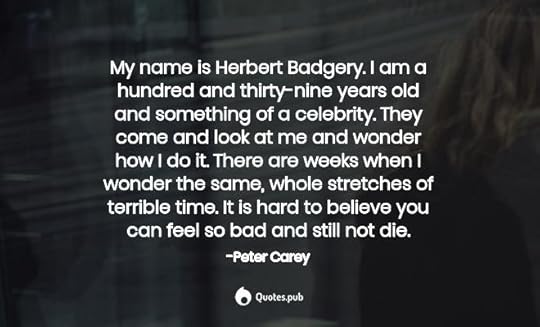
"My name is Herbert Bargery. I am a hundred and thirty-nine years old and something of a celebrity...

I am a terrible liar and I have always been a liar. I say this early to set things straight. Caveat emptor.
"

We are soon pitched back to 1919, where Herbert lands his small plane in a field in rural Victoria and charms the McGrath family who are picnicking there. He moves into their house and persuades his host to invest in what would be Australia's first aircraft factory, and the 17 year old daughter Phoebe soon falls for him.

This is just the start of a wild, funny and often bawdy picaresque fantasy cum family story that blends social history and magic realism, populated by an array of memorable characters.

So yes, it could have been shorter, but in the end I enjoyed the journey.
Profile Image for Warwick.
Author 1 book15.3k followers
January 10, 2014
G'day, g'day!
How ya going?
What do you know!
Well, strike a light!
G'day, g'day,
And how ya go-o-oing?
Just say g'day, g'day, g'day,
And you'll be right!

  —Slim Dusty

This is a novel about Australia: the souvenir-shop image of Slim Dusty records and tourist posters, and the romantic but gritty reality that underlies it. It is about how to separate the two: how to celebrate your own history without turning it into a cartoon or a travesty. It is, in short, about ‘the problems of belief and principle’ faced by three generations of proud Australians.

‘I am a hundred and thirty-nine years old,’ our narrator, Herbert Badgery, tells us at the start. ‘I am a terrible liar…My age is the one fact you can rely on.’ His being 139 is, of course, one of the least believable ‘facts’ in here, and so right from the beginning of this long, picaresque novel, there is an in-built lack of trust – an uncertainty which frees you up to concentrate on the emotional and symbolic value of what you're being told without worrying too much about its feasibility.

Just as well, because the plot at times feels like nothing more than a series of tall tales, shaggy dog stories, fireside anecdotes and family legends – albeit brilliantly told ones, because Peter Carey seems incapable of writing a boring sentence. Planes are crashed, children are conceived, narrow escapes are had. At first I thought it was brilliant, but I have to admit that the novel gradually beat me down from four stars to three-and-a-half. The problem is one of focus. There isn't one – or if there is, it's the whole country. The book rambles, and even our aged narrator does not constitute a central character for much of it – many sections do not involve him at all, and although the digressions are enjoyable I found myself wondering what exactly it was adding up to.

But perhaps this is my fault. Characters, central or otherwise, are not the main concern, and Carey tells us as much near the end, in a reference to one character's own literary exploits:

the real subject of Goldstein's work was not the people, but the landscape and its roads, red, yellow, white, ochre, mustard, dun, madeira, maize, the raw optimistic tracks that cut the arteries of an ancient culture before a new one had been born.


Illywhacker likewise takes us on a delirious journey through western Victoria, the placenames beating out a steady rhythm in a way that reminded me of the geographical romance of Kerouac's America: Ballarat, Bacchus Marsh, Jeparit, Geelong, not to mention wonderful sketches of Melbourne and Sydney. ‘It is not a country where you can rest,’ says one character. ‘It is a black man's country: sharp stones, rocks, sticks, bull ants, flies. We can only move around it like tourists.’

The book itself tries (like so many of its characters) to forge or identify some kind of authentic Australia. Its language is discretely shot through with regionalisms: wildlife like she-oaks and yabbies, people that work as cockies or bushies or rabbit-ohs, obscure references to mud-maps and kero and dunnymen, clichés like Akubras, fair-dinkum and dinky-di, surprising mundanities like ‘nature strips’ and ‘rear-vision mirrors’. Sentences like ‘the johns had sworn to massacre the swaggies if they jumped the rattler.’

In the early parts of the book, set in the 1910s and 1920s, this Australia is defined in opposition to England, and Herbert reserves his most withering scorn for fellow countrymen who still idolise the motherland.

It was what happened in this country. The minute they began to make a quid they started to turn into Englishmen. Cocky Abbot was probably descended from some old cockney lag, who had arrived here talking flash language, a pickpocket, a bread-stealer, and now, a hundred years later his descendents were dressing like his gaolers and torturers, disowning the language, softening their vowels, greasing their way into the plummy speech of the men who had ordered their ancestors lashed until the flesh had been dragged in bleeding strips from their naked backs.


But towards the end of the book, the enemy shifts to become multinational industry in general, and American investors (who ‘misunderstood our ironies and took them for firmly held beliefs’) in particular. Herbert and his family, struggling to turn their Sydney premises into a monument to Australian fauna, end up with something between a tourist attraction and a prison, funded by General Motors and owned by the Mitsubishi Company of Japan. Almost everyone involved ends up reduced to – in Carey's typically memorable phrase – ‘a skin-wrapped parcel of fucked-up dreams’.

‘I have not valued what I have loved,’ frets one character. To this extent Illywhacker is a cautionary tale. You can love your country to your heart's content, but giving it its proper value is an altogether trickier proposition. In a country founded on lies, maybe lying is the best solution after all.
Profile Image for Tim.
245 reviews119 followers
March 5, 2021
Illywhacker is like a huge playground for Peter Carey to let his rather brilliant imagination loose. It's the comic life story of a man who tells us he's 139 years old and a liar. I never quite understood why Carey made such a big point of defining him as a liar. Every narrator of every novel is a liar in the literal sense of the word so what's the big deal? I was expecting some fabulous twist on this theme but it never arrived. There isn't much plot in this novel and for that reason it's a little uneven and unfocused at times. There are many brilliant set-pieces. Lots of fantastic writing. Sometimes though Carey gets a bit carried away with his comic imagination and for this reason I was a little less enamoured with this book than Oscar and Lucinda and The Secret Life of the Kelly Gang, both of which benefit from a gripping plot which is missing here. Still though a great read.
Profile Image for Leo.
4,971 reviews623 followers
March 11, 2022
3.5 stars. This was a different kind of read for me as I at parts felt that I didn't enjoy reading about the characters nor the plot but still wasn't able to put it down as I was very curious on what was going to happen next. Similar with not knowing what made me slightly not loving it I can't figure out why I was intrigued by it. Maybe it was the writing style. I would want to read more by Peter Carey but unfortunately no more books is available on my library nor book app but I'll look for some at my local second hand
12 reviews
February 4, 2012
I tried thinking of a couple of clever ways to start this review, then I remembered this is just a personal internet thing. I loved this book and here's why.

Sometimes you just want to hear a great, rollicking, absurd yarn of a story that makes the elements of life seem larger and more important than they really are while still retaining a bittersweet sense of the transient nature of all things. Maybe it's hard to find books like that (it is) but this is one like that.

Illywhacker is the story of liar, con man, aviator, car salesman, storyteller, nationalist, and prisoner Herbert Badgery and his strange family life. He is a hilariously unreliable narrator (he begins by claiming to be 139 years-old) who dreams of a life and a country that is bigger than the one he gets. Instead of mulling on his failures he continually strides ahead, weaving bigger and bigger lies about himself and his plans, though what he often claims to want is a steady family life. I don't want to give away any of the many charming, and charmingly scoundralish (sure, that's a word), plot twists but they are only a part of the books delight. Carey's style is steeped in evocative everydayness, with a twist of surreal magic (as it's told by the 139 year-old scoundral with a penchant for big ideas) and manages to summon up a world both real enough to debate whether Australia should conscript soldiers to fight in Britain's wars and unreal enough to contain the Best Pet Shop in the World.

(That's one of the larger themes of the book: the push and pull of the grubby, painful realities of the world with the one we might imagine we live in.)

The structure of the book is also like a big, rangy story, and a little unconventional. Told in short vignettes that often careen decades off course, it's not a difficult book to keep track of, but it might throw the stylistically inexperienced reader off. Carey leaves his narrator for long stretches of the book, though Badgery is still the narrator - he just is recounting thing told to him or imagined by him), and delves into the past of the many characters that inhabit the long-lived con man's life.

I can't recommend this book enough, though I'll have to hold off on commenting on how true it is in an Australian way until I talk to my friend who grew up there. It's great fun, has very memorable language and characters, and is full of passages that make you want to call up a friend and read them out loud for the sheer joy of the language and the world where we all might wish we lived.
Profile Image for Emily.
172 reviews267 followers
Read
November 10, 2009
Boy, it's been kind of gloomy around here recently, hasn't it? What with unanticipated abridgments, disorganized Englishmen, and lukewarm responses to historical fiction, things have looked rosier. But here, my friends, is the antidote: Peter Carey's rollicking Australian epic Illywhacker is robust and uproarious - a chewy, stew-like story you can really sink your teeth into, and which also offers a thought-provoking meditation on the nature of lying and the truth.

I've written before about how I would cheerfully devour a phone book if Peter Carey took it into his head to write one, and Illywhacker is no exception - although it is different than the other Carey novels I've read. It doesn't have quite the focused incandescence of Oscar and Lucinda and True History of the Kelly Gang, or the obsessive surreality of My Life as a Fake. Instead, it follows a John Irving-like model of sprawling, character-driven, oddball family saga: a portrait of three generations in the quick-tempered and bandy-legged Badgery clan. Narrating the tales of his progeny and their hangers-on is the 139-year old patriarch Herbert Badgery, an exuberant liar who has yarned, belched, strutted and cajoled his way through the Australian countryside over more than a century. Badgery is the archetype of the charismatic con-man, and Carey depicts him masterfully: we observe, at once, his flatulence and grime, and also his grand dreams of love and aviation, of starting an Australian airplane factory, of building a rambling mansion for the woman he loves. He's simultaneously crass, cynical, and grandly ambitious, and, somewhat predictably, gets his heart broken at least as often often as he breaks the hearts of others. Possibly most important, he's a freewheeling unreliable narrator, telling the reader on the first page, "[M:]y advice is to not waste your time with your red pen, to try to pull apart the strands of lies and truth, but to relax and enjoy the show."

Apart from his masterful control of sentences and paragraphs, one of the most interesting things about Peter Carey is the complex morality in his novels; all of the four that I've read so far have interrogated the relationship between lying, storytelling, and the truth, and come to complicated conclusions that can't readily be summarized. Mid-way through Illywhacker, Badgery (sort of) wins and then (kind of) loses a puritanically honest woman named Leah Goldstein, of whom he eventually and unexpectedly makes a lying addict. After they are separated, she spends years upon years faithfully writing to him, creating letters which are almost complete balderdash:


Later she would think of these months, when she helped her friend die, as one of the most important times in her life.


But she wrote not a word about it to me. Instead she described long walks with Rosa along the clifftops to Tamarama. She did not date these walks, but the impression given was that they had happened an hour or a minute before, that Rosa sat across from her at the kitchen table, drinking fragrant tea. They were beautiful letters, bulging with powerful skies and rimmed with intense yellow light. Every blade of grass seemed sharply painted, every word of conversation exact and true. Perhaps these things had once taken place. Perhaps she invented them. In any case they gave me that electric, unnatural mixture of emotions that every prisoner knows, where even the best things in the world outside become slashed with our own bitterness or jealousy. This confusion of love and hurt is very powerful. I came to crave it even while I dreaded it. It is a more potent drug than simple happiness.

...

There was a time, when I finally learned the truth, that I could have killed her for her deception, to have made me feel so much about what revealed itself as nothing. I will tell you, later, how I got on the train with my bottle and my blade. But when I think about her now I cannot even imagine my own anger.


Another word for "lying addict"? "Accomplished fiction writer." When he learns that the lovely world Leah created for him is a lie, Badgery is faced, on a more dramatic scale, with the feelings we all have upon finishing a fantastic book: loss and grief for a world he believed in. Leah has written herself through a gauntlet of lies and somehow become a novelist - and also, argues Badgery, a fully fledged Australian citizen. For, as Carey has his famous fictional historian MV Anderson relate,


Our forefathers were all great liars. They lied about the lands they selected and the cattle they owned. They lied about their backgrounds and the parentage of their wives. However it is their first lie that is the most impressive for being so monumental, i.e., that the continent, at the time of first settlement, was said to be occupied but not cultivated and by that simple device they were able to give the legal owners short shrift and, when they objected, to use the musket or poison flour, and to do so with a clear conscience. It is in the context of this great foundation stone that we must begin our study of Australian history.


Together, these two passages paint an impressively complex view of lying and storytelling. On the one hand, Badgery spends the entire novel fighting for Australian pride - for Australians to invest, for example, in Australian-made cars and airplanes, rather than importing British and American models thought to be self-evidently better than anything "we" could make. He rails against the colonial inferiority complex that motivates many Australians of his day to truckle to the British crown. And so, recognizing that lying and tall-tale-telling are an integral part of his Australian heritage, he embraces them with unmitigated exuberance. I couldn't help loving him for it; the charisma of his voice is intoxicating. On the other hand, though, a big reason that lying has become a national pastime for Australians (and, I might add, Americans) is both shameful and essentially BRITISH: the foundation stone of British colonization in both places was a huge, convenient deception about whether the land they took was already being used. So Badgery's mode of protest against the British turns out to originate with them, and his recommendation to his readers not to look too closely at the truthfulness of his own stories mirrors the cavalier disregard with which they invaded continents and invented the convenient fiction that they had "discovered" them.

But while the lies of Badgery and the British colonizers are largely selfish and convenient, however attractive they may seem, Leah's fictions are a more complicated matter. It doesn't directly benefit her to provide Badgery with false images of a beautiful life which she is not really living. It provides a bit of escapism for her, crafting these letters in which everything she wishes is made true, but it also accentuates the gulf between what she wants and what she has. Whatever results her actions have (and there are both positive and negative repurcussions), her primary motivation, arguably, is kindness. It's painful to Badgery to learn that (almost) everything he believed about Leah's life is a lie, but he's such an inveterate liar himself that it's hard to pity him too much. And if we condemn Leah, what to make of our own decision to pick up Peter Carey's Illywhacker? Of all people, isn't Herbert Badgery, con-man extraordinaire, ASKING to be conned himself, just as we readers of fiction are when we crack open his book? After all, it was Badgery who taught Leah to lie in the first place. Not to mention that through her lies, she manages to demonstrate truths: the truth that she loves Badgery, and that she wishes things were different.

Without giving too much away, I'll just say that toward the end of Illywhacker all these intersecting threads of lies and counter-lies, of the personal versus the national, take a disorienting and eerie turn. I don't pretend to have tracked them all; as Badgery says in the novel's opening, there comes a point when it's best to just sit back and enjoy the ride. And enjoy it I did, thoroughly and completely. Carey has yet to disappoint.
Profile Image for Nick.
174 reviews30 followers
July 2, 2018
Savour every page in this tour-de-force by Australia's finest Booker prizewinner. It's not just 139 year-old Herbert Badgery's outlandish shaggy dog stories on women, aviation and the outback, it's not just the people and places that spring vibrantly from the page, it is the beauty of Carey's craftsmanship, his perfectly-proscribed prose and lovingly-nurtured descriptions that make this novel such a pleasure to read. Enjoy the ride of each and every chapter in what would be an overworked storyline in anyone else's hands. Under Carey's watchful eye Illywhacker delights with story after unbelievable story. Definitely one of the best novels I have ever read, and, in my humble opinion, more deserving of the Booker prize than 'Oscar and Lucinda' or 'The Kelley Gang' (see my other review). Fantastic.
I have just read this book again - not easy for such a lengthy tome - so is it still worth it? Do I still stand by the glowing review that I wrote based on my memory of the book? Do I still think it is more deserving of a Booker prize than "Oscar & Lucinda" or "Kelley Gang"? Too damn right, I do. There is so much to love here. I cannot recommend it highly enough.
Profile Image for Kim.
2,713 reviews12 followers
October 1, 2023
Setting: Victoria and Sydney, NSW, Australia; 20th century.
This Australian tour-de-force is narrated by, and features, confidence trickster and inveterate liar Herbert Badgery as he tells the story of his life, employment and relation history, featuring many unforgettable characters and escapades - if of course you believe the words of this unreliable narrator who, at the end of the story, is supposed to be 139 years old!
Perhaps this book is a bit too long as, despite the enjoyable characters and incidents, it started to drag a bit towards the end for me. Nonetheless, the quality of the writing and the characterisation means I cannot fail to give this book 4 stars - 8/10.
Profile Image for mkfs.
333 reviews28 followers
February 14, 2018
Is this The Great Australian Novel?

Perhaps it's a bit too playful to aspire to such pretensions, but nonetheless it is an admirable attempt.

The book is often categorized as magical realism, due largely to events that could be (and probably are) entirely fabrications of the narrator: a disappearing act, an alleged Chinese sorcerer, and a mysterious Vegemite jar containing either shape-shifting matter or a rotting body part. Don't be dissuaded: there may be some tall tales told, and a fair amount of stunning coincidence, but the bulk of the book is firmly grounded out in the bush.

The novel follows ne'er-do-well Herbert Badgery and two generations of his children, spanning Australia's "coming of age" during the twentieth century. This is the Australia of Walkabout and Wake In Fright, rather than the lawlessness of Ned Kelly's day or the Mad Max franchise.

From the outset, the author informs us that he is 139 years old and that his word is not to be trusted. He then spins a yarn of his incompatible attempts to earn a buck and to foster native transportation industry in Australia ("we can make just as good a car or plane as the English!").

It is this latter character trait, more than the dusty squatter backdrop, that makes this book peculiarly Australian. Resentful of the English and distrustful of the Americans, the country is attempting to claim its birthright as a modern, industrial power, only to be domineered and exploited by the others. The ruling government and the dissident political parties prove helpless in the face of foreign capital: there is a muted call-to-arms for each citizen to make his own way as an independent Australian.

The narrator spends a third of the book in gaol. Mercifully (as jail stories get rather tedious), the author takes this opportunity to relate the maturation and success of his son, setting the stage for a third act in which the narrator returns and once again introduces casual upheaval into the lives of his loved ones. This lends the novel an epic tone, despite having a first-person narrator: we see Australia through the experiences of three generations of the Badgery family,and how their particular craftiness proves more or less fortunate in changing times.

A fun, engaging read. Perfect for the pending summer.
Profile Image for Tracey.
1,134 reviews8 followers
May 24, 2009
Okay, I enjoyed this book, I liked the characters but as read further into the novel, I found myself wanting more of Herbert Badgery's story. About three quarters of the way, I get bogged into a whole heap of characters that I neither cared about or want to know. I was intrigued by Herbert and I found this massive slab of his story just disappeared as I was taken along to the story about his son and then grandson.
Parts of the book moved into the surreal with people living in cages and just decaying away before our eyes in their own madness.
The opening part of this book gripped me and I really thought I was going to be taken along on the greatest ride by a great Australian con-man but I only half got that story.
It will not stop me reading more Carey because I do enjoy the topics he tackles.
Profile Image for Jason.
253 reviews133 followers
August 15, 2007
If a novel's flaws are flaws of ambition, I forgive them pretty easily. Such is the case with this massive, sprawling, hilarious, poignant, stuttering epic about an Australian teller of tall tales that he passes off as his own personal history. It ends with an image I defy anyone to forget & features, as well, perhaps, the funniest scene I've ever encountered in fiction.
Profile Image for Chip.
278 reviews
August 5, 2009
My copy of this book was a gift, and I was suckered in by the adjective "funny" from the review on the cover. Intrigued, I read all the glowing reviews from the "big name" periodicals and prepared myself for one amazing read. By the first hundred pages, as I got familiar with the protagonist and the author's style, I began to wonder if I had been flim-flammed. I have to admit my first thought, upon finishing the book, was that this may have been the biggest waste of reading effort I have ever put into a book and that the glowing reviews were faked. Yes, there are lush descriptions of Australia. There are words and phrases that are singularly Australian. There are a couple of plot twists that could only happen in Australia... yet there isn't anything about the characters that is uniquely Australian (their universality is in fact a plus for the author). I'm left very confused, then, wondering how this could be considered the Great Australian Novel?

Where is the "funny?" The "towering?" Before you accuse me of ethnocentrism I'll inform you that I am a well-read fan of world literature, and I'm familiar with novels that are "funny" and "towering." This book has not earned the right to be listed among them. Lest you think I'm too hard a critic, in all my years I've only read one other book that, upon completion, I deemed a complete waste of time and trees... and my dislike for it dims in comparison to my visceral rejection of "Illywhacker." It is no small feat, therefore, to land on this, my very short list of books to avoid. I've even waited two months after finishing "Illywhacker" to attempt a review, out of concern I would be too vitriolic in my critique. Please keep in mind that I am exercising restraint when I say I read 600 pages waiting for something spectacular to happen, only to feel ripped off when I closed the book. If that was the intent of the author, then he achieved the effect marvelously. However, he's also achieved my personal disdain and I'm confident that nothing short of a large cash payment in advance will encourage me to open another of his books. Even today, eight weeks after finishing the book (and for the rest of my life, I fear) I actually *loathe* the name of the main character, "Badgery."

This would be a good book to have if you were stranded on a deserted island; you wouldn't feel guilty using it for toilet paper.

I do not think it helpful or prudent to steer people away from books in general, but please use caution when deciding to purchase this for a friend. It would only be fair to finish with the admission that I am no longer speaking to the "friend" who gave me this book, who claimed they had read it and that it was "wonderful," only to concede (after I had finished it) that they had given up twelve pages in. If you love and would like to keep your friends, do not send them a copy of this book.
Profile Image for Emily.
767 reviews2,546 followers
July 6, 2016
I wish I could give this book a half star; for me, it hovers somewhere between 3 and 4.

"Illywhacker" was remarkable because of the incredible dexterity with which Carey handles his prose. In the first half of the book, Carey manages to shift narrative perspectives, discard his narrators again and again, and jump around in time without disorienting the reader at all. His descriptions of characters are amazingly vivid, unique, and interesting. The first half of "Illywhacker" was essentially a manual on how to write sweeping yet beautiful prose, and I enjoyed it immensely.

However, while the story claims to focus on the title illywhacker, Herbert Badgery, it spends its final third dissecting the life of his son, Charles. While Charles' family and final fate are interesting, his plotline takes center stage as Herbert languishes (for ten years!) in prison. Charles' family becomes more and more fantastical, pushing the caricature-like nature of all of Carey's characters to the limit. I finally reached a point where I no longer cared about any of the supporting cast - I wanted to return to Herbert's younger days, not drag along in the tragedy of the next Badgery generation. Herbert alludes to some of his other exploits as he narrates from his deathbed, but those are never fully explored. I would have enjoyed a stronger focus on Herbert, or even the leisure of spending some time away from the awful Emma Badgery.

In the end, this novel is redeemed by its prose and its characters. For me, the direction of the work wasn't quite there.
Profile Image for Geoff.
Author 2 books1 follower
June 18, 2009
Ah, remember when books were important! And very very long. This teeming Dickensian Sydney, plonked in a Patrick White desert, was thrust at me by a wild-eyed enthusiast in 1985, shortly after it became the novel that should have won the Booker that year. I took one look at the size of the thing and decided to wait till I was more grown up - in my case another 24 years. To anyone who remembers the 80s it seems dated now by the fashions of the decade (Magic Realism, Wow!) though this effect will fade as it encounters new readers, and anyway the fashions have proved robust: Victoriana, modern architecture, Yankee hegemony, interesting animals ,the history of the left and, of course, Australia. The London literati recognised it as a fair old crack at the Great Aussie Novel and lavished arch obliquities on it ("A great tottering tower that stands up against all the odds"-Victoria Glendinning.) Helpfully typical that Australian greatness should flow from the brash pen of an advertising exec. For all that, they handed the Booker to another exponent of undisciplined Antipodean over-reach, Keri Hulme, whose representatives sang fetchingly at the Guildhall banquet in the time-honoured way of colonial curiosities. After all, Carey might have turned up in Rayban sunnies and a Porsche.
Profile Image for Benjamin.
104 reviews10 followers
March 11, 2022
This is a big and strange book - a national epic, you might say. I’ve taken to describing it as being Australia’s ‘Midnight’s Children’, which is about as accurate as you can really get without actually saying anything about it. There probably isn’t, in reality, anything as tidy as the Great Australian Novel (and Illywhacker certainly is anything but tidy), but this should take a prominent place in any discussion about the theoretical G.A.N., since it's massive enough and disgusting enough and honest enough and beautiful enough and surprising enough and weird enough to represent its country as well (or better, even) than any other.
Profile Image for Michael Finocchiaro.
Author 3 books6,252 followers
June 12, 2018
I am a fan of much of Peter Carey's work. Illywhacker, while not his best novel, is still an entertaining story taking place in Australia during the birth of flight. Carey's characters usually have a historical background and then live their life stories against this canvas. The book is highly entertaining, but I preferred Oscar and Lucinda.
Profile Image for Anna Kennedy.
43 reviews2 followers
January 10, 2013
Oh I so wanted to love this book, I have picked it up so many times over the years and promised myself that I would get through it one day. I cannot disagree with anyone who has reviewed it as a masterpiece of prose, as always I am in awe of authors who can produce this many words of such dizzying proportions and depths ... but oh God by the end I was praying for the relief of the last page. On reading the first few pages and the back sleeve I had been ready for a long novel of hilarious anecdotes and stories from a larrikin and a player, but as the novel wore on I realised that it was merely the story of a few unsympathetic characters mired together by hardship and necessity. I knew it wasn't going to be light reading but the trudge through the lives of Leah, Izzy et al just never lived up to what the book promised, and although the details of the bizarre twists and turns were obviously carefully explored and described, and the extraordinary behaviour of Herbert's later life family in Sydney were fascinating and unbelievable, I had lost any interest in what the outcomes may be. Can see how some would love it, but I was left bored and let down by the messages of space, containment and freedom hidden within.
Profile Image for Len.
708 reviews22 followers
December 14, 2024
A novel full of comic characters that is not a comic novel. Possibly the characters are the creation of the illywhacker - the conman, the trickster, the compulsive liar - Herbert Badgery; 139 years old so he says and still with a lively and inventive mind. Mind you, I suppose a definition of an illywhacker would be an author of fiction, someone who seeks a living by making up stories. It makes one wonder who the illywhacker really is.

The sense of humour in Herbert's stories originates in lies, deliberate lies, lies meant to distract and fool, cruel lies of sarcasm and sneer. That may be why the novel does not reach out towards being a light-hearted picaresque adventure. It sneaks into being a masquerade, a harlequinade, in which Herbert hides true identities in order to lampoon people from his real life.

The pleasure of the book lies in those fictitious portraits which fill its landscape of twentieth-century Australian life and people from the outback farms and small towns of Victoria and New South Wales to the growing cities of Melbourne and Sydney; especially during the Depression years of the 1930s. They are all exaggerated for comic effect.

There was Herbert's pretend-English father, though his accent denied it he was actually born in Warrnambool, who travelled from farm to farm hoping to sell a Newby Patented 18lb Cannon to the farmers, "to protect themselves from Russians or Chinese or shearers." The McGrath family: father Jack, a former bullock driver made good in the road haulage business and taxi driving; his delightful wife Molly - delightful to the point of mental instability and the star of the first part of he novel - she wears a battery powered electric belt around her waist to control what would now be diagnosed as panic attacks; and their beautiful, snobbish, occasional lesbian, occasional sex hungry teenage nympho daughter, Phoebe. Leah Goldstein, who gives up medical training to turn to becoming the dancing queen of the outback and Herbert's lover. Izzie Kaletsky, expelled by the Communist Party of Australia - a case of mistaken identity involving his unfortunate brother. And the tragic Charles, Herbert's son and pet shop owner of high ambition, who has a family one wouldn't wish on anyone.

There are also so many small characters who shine brightly if briefly: Madame Ovliskey, "Clairvoyant of Little Mallop Street, Geelong"; Dr. Grigson, quack and purveyor of the electric invigorator, of which Molly wore an example; Horace Dunlop and his adventures attempting to provide Phoebe with an abortion; and a lot of chooks - they are all over the place for a while - not forgetting a goanna with three legs.

While it sounds uproariously comedic almost every story has its bitter side. I feel Mr. Carey is not a comic writer at heart. Life's burden is heavy and ultimately it must be portrayed in that way. Laugh as much as you like, hide behind a smokescreen of fibs and tales as much as you want, reality will hit you in the end. And the end of the novel drifts towards absurdity eventually - more absurd than the feast of lies that preceded it. However, that is a small point. I recommend wallowing in it all. A tremendous read.
64 reviews1 follower
April 24, 2021
An exuberant and raucous literary free-for-all for the the first third of the novel, and then becomes rather a chore to finish.
Profile Image for Matthew Budman.
Author 3 books83 followers
February 21, 2020
I took Illywhacker with me on my first trip to Australia, since it seemed like the most Australian of Peter Carey's novels, and indeed, was delightful to spend time with the characters on the streets and among the landmarks of Melbourne and Sydney. But it took me nearly two months to finish the novel! Illywhacker is only 600 pages but feels much longer—it's packed with plot and characters and incidents and color. Carey's descriptions and dialogue are marvelous, which makes it hard to skim to move ahead. There's a great deal here that will stick with me, including indelible characters and scenes.

It's a tale told mostly by one Herbert Badgery, who tells us right away that he's a champion salesman and liar as well as a fierce advocate of all things Australian. His story careens through a wide range of locations and relationships—a wife, a business associate, a surrogate father, a theatrical partner, an entrepreneurial son, and many more. It's often hilariously funny and never less than compelling.

But too much happens. It's easy to lose the plot, especially when Badgery disappears for many chapters at a stretch (hey, who's telling the story?) and we get sucked into lives that may or may not be relevant later. It all converges at the end—and Illywhacker is worth reading all the way through—even if the climax and coda are nowhere near as clever or powerful as Carey intends.
Profile Image for Peter.
314 reviews141 followers
March 28, 2023
This is one of the archetypal magic realism novels: an absolute gem, full of Australian colour and humour. It tells the story of aviator, car salesman, and all-round larrikin and confidence man Herbert Badgery.
Profile Image for Adina.
5 reviews
June 23, 2019
Illywhacker came to me when I was looking for the kind of book that keeps me trapped in its world. I was looking for a different story, for an unusual take, for memorable characters, for memorable language. I got this and a lot more.

There was always an element of surprise that came either from the story itself or from the way it was told. Really refreshing, engrossing and stimulating. I was fascinated with the multitude of themes that crowd this already crowded family saga crossing three generations.

There is an intentional casualness to Carey's style of prose that I haven't come across anywhere else. He drops story bombs like he is releasing birds from cages: swiftly and masterfully. Carey chooses to mention something of shattering importance (like the death of a character) in a way that makes you take a double look and wonder if your eyes are deceiving you.

I loved the magical, surreal elements of the story mixed with historical, social and Australian national identity themes.

The book opens with the now famous words "My name is Herbert Badgery. I am a hundred and thirty-nine years old and something of a celebrity. [...] I am a terrible liar and I have always been a liar. I say that early to set things straight. Caveat emptor."

Herbert Badgery's story is in fact Australia's story. However, admitting to the lie is the only way of becoming honest.

The illiterate illywhacker selling American cars to Australian farmers, eventually goes to prison where he models himself after historian M.V. Anderson and takes a degree in Australian History. Badgery bases his studies on Anderson's book, quoting him without abbreviation: "Our forefathers were all great liars. They lied about the lands they selected and the cattle they owned. They lied about their backgrounds and the parentage of their wives. However it is their first lie that is the most impressive for being so monumental, i.e., that the continent, at the time of first settlement, was said to be occupied but not cultivated and by that simple device they were able to give the legal owners short shrift and, when they objected, to use the musket or poison flour, and to do so with a clear conscience. It is in the context of this great foundation stone that we must begin our study of Australian history."

Illywhacker is not just a book, it is a complex wondrous story, a memorable saga, a masterpiece. It was a great introduction to the modern history of Australia, of the feel of the country at the beginning of the 20th century and its struggles to find its place on the map of the world.
Profile Image for John.
48 reviews8 followers
July 31, 2013
Peter Carey is a fabulous writer, and any book he writes is likely to be worth reading just for the luscious, brilliantly observant, surprising prose and the Dickensian characters. Having gotten that out of the way, I have to say that I was left disappointed by Illywhacker. Clearly it's designed to be a rambling, picaresque story (reviewers mention Tom Jones as a cousin of this book), and it does a marvelous job for the first half or so, which focuses on the roguish con man/narrator Herbert Badgery. In the second half, though, the story gets more fantastical and much less focused as it tries to follow a whole cast of characters whom Badgery has met or begotten. Though the gorgeous writing kept me going, the story seemed to me just to dissolve into chaos.

For Carey, life is not a happy place. People reach out for love and meaning but are dragged down by circumstance and by their own folly. As in Carey's Oscar and Lucinda, we see over and over again that people's sheer obliviousness can do as much harm (to themselves and to those they love) as malevolence. Images of imprisonment permeate Illywhacker and seem to be much of its theme: time and again, people put themselves in real and metaphorical cages; to say they do so deliberately would be to credit them with more self-awareness than Carey usually allows his characters.

Many reviews emphasize this book's Australian-ness, and see in it an insightful dissection of modern Australian history and national character. I'm not Australian, so probably this whole dimension went over my head. Perhaps if I were more attuned to the book's national perspective I would have appreciated it better.
Profile Image for Carol.
1,410 reviews
November 17, 2017
This novel is about Australia. Not just things that happened there, or people who lived there, but the place itself. It is narrated by Herbert Badgery who lives to be 139. However, Herbert spends very little time talking about himself and his own life - the book is mainly about the people he meets and lives with during his long life - friends, family, lovers, adversaries, etc. He delves into their characters, their histories, and their lives with near-omniscience. The characters are the most important and the best thing in the book, not the plot. And they are incredibly fascinating and entertaining people.
"Illywhacker" is an Australian term (slang, I think) for a charlatan, a confidence man, a grifter. All of the people in this book, including the narrator, are illywhackers in some way. I think that Herbert is really a personification of Australia, the "voice" of the country, perhaps. However, Carey is in no way disparaging Australia by saying that it is a place of (and even built by) charlatans. Rather, I think he's trying to evoke a place made by imagination, formed out of the dreams and schemes of its people. Or something like that.
Profile Image for Colleen.
793 reviews23 followers
May 19, 2019
Three generations. Father, Herbert Badgery, book 1. Son, Charles Badgery, book 2, Grandson, Hissao Badgery, book 3. Herbert's father sold huge cannons to little coastal Australian towns, and his mother died when Herbert was very young. Herbert sold cars and dreams of starting an aircraft industry in Australia. His wife (not the first one) ran off when his daughter was born, so Herbert went on tour with the dancer Leah Goldstein to keep the kids fed. Charles built The Best Petshop in the World and married a crazy woman. Hissao kept the business going so the family would survive. The entire history here is about how the white settlers changed the landscape to fit their European dreams and how Australia disappeared. No one is innocent. The women either die, run off, disappear or go along with the program. Bungaree Trout in the Depression. Waltzing Matilda. Mechanical wonders. Conning the locals. Missed reading lessons. Dangerous goannas and snakes. The 140 year journey is epic, delusional, funny and tragic. Well worth the read. 6 stars out of 5. Wish there was something like this for US history.
Profile Image for George.
3,241 reviews
April 19, 2022
An entertaining, eventful, quirky, humorous, metafiction novel set in Australia and narrated by Herbert Badgery, a liar, trickster and confidence man, an “illywhacker’. Badgery begins his story in 1919 when he is 33 years old. He lands his plane in a field close to Jack McGrath. Badgery becomes lover of Jack’s teenage daughter Phoebe. They marry and have two children, Charles and Sonia. Phoebe learns to fly and steals Badgery’s plane. Badgery and his kids go on the road. Badgery’s life is never ordinary. There’s a variety act, snakes, another woman, meeting Badgery’s Chinese childhood mentor, Goon Tse Ying, imprisonment, pet smuggling and more! There is good plot momentum for all of this book’s 600 pages.

An engaging, worthwhile, pleasurable reading experience.

This book was shortlisted for the 1985 Booker Prize.
Profile Image for J.S. Watts.
Author 30 books44 followers
December 31, 2021
A good book. A well crafted picaresque tale of a conman as he tricks his way across the landscapes and timelines of modern Australia. I should have liked the book more than I did, but I never engaged with the sea of colourful characters and, though the novel is described as a "dazzling comic narrative", I didn't find it funny, just grotesque, dark and sometimes sad. Possibly the tale is an analogy for modern Australia itself, it is clever, but, for whatever reason, it never really grabbed me. That's why I took so long to read it, or maybe it was because I took so long to read it that I never fully engaged.
Profile Image for Darren.
1,149 reviews52 followers
September 6, 2017
Astounding, entertaining, sprawling achievement. Ostensibly the story of a man's (Herbert Badgery's) life, but focusing more on those people/places/events around him. Marvelous blend of the realistic and the bizarre, with superb dialogue and highly evocative throughout of Australian history/psyche through the 20th century. Essentially 5 Stars, but I'm marking it down slightly cos I was never quite completely bamboozled into not noticing that this is more like a collection of short stories.
Displaying 1 - 30 of 171 reviews

Can't find what you're looking for?

Get help and learn more about the design.