Jump to ratings and reviews
Rate this book

The Charles Eliot Norton Lectures

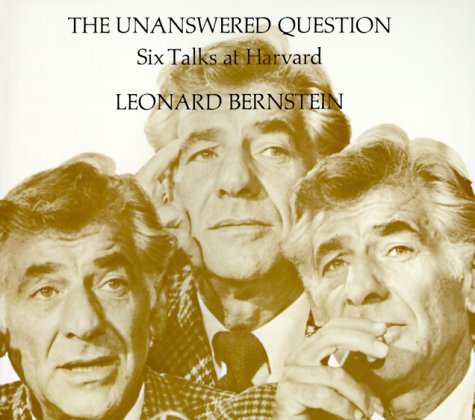
The Unanswered Question: Six Talks at Harvard (Charles Eliot Norton Lectures) by Leonard Bernstein (1-Jul-1990) Paperback

Rate this book
Leonard Bernstein's Norton Lectures on the future course of music drew cheers from his Harvard audiences and television viewers. In this re-creation of his talks, the author considers music ranging from Hindu ragas through Mozart and Ravel to Copland, Schoenberg, and Stravinsky.

Paperback

First published January 1, 1976

21 people are currently reading
655 people want to read

About the author

Leonard Bernstein

452 books90 followers
Leonard Bernstein was an American conductor, composer, author, music lecturer and pianist. He was the first conductor born and educated in the United States of America to receive world-wide acclaim. He is perhaps best known for his long conducting relationship with the New York Philharmonic, which included the acclaimed Young People's Concerts series, and his compositions including West Side Story, Candide, and On the Town. He is known to baby boomers primarily as the first classical music conductor to make many television appearances, all between 1954 and 1989. Additionally he had a formidable piano technique and was a highly respected composer. He is one of the most influential figures in the history of American classical music, championing the works of American composers and inspiring the careers of a generation of American musicians.

Ratings & Reviews

What do you think?
Rate this book

Friends & Following

Create a free account to discover what your friends think of this book!

Community Reviews

5 stars
135 (59%)
4 stars
70 (30%)
3 stars
17 (7%)
2 stars
4 (1%)
1 star
0 (0%)
Displaying 1 - 28 of 28 reviews
Profile Image for Jay.
214 reviews88 followers
February 1, 2024
Just so outrageously brilliant in every way that this review will do well not to devolve into a hyper-earnest-massively-too-long gushing love letter. Let us see how it fares…

These talks have been on YouTube since the dawn of time. I first stumbled on them when I was about 14, at which point I was in the early phases of a tentative pubescent rebellious episode. My chosen approach to rebellion was to act out by developing strong feelings for classical music before blasting out the louder composers — Shostakovich, Strauss, Stravinsky, Bruckner, Mahler, Wagner… — at high volume from the smelly sanctuary of my bedroom, no doubt unconsciously intent on annoying my rock’n’roll-loving parents… Because that’ll show ‘em! At that age, Bernstein’s charisma mesmerised me, even if I understood very little of what he was actually saying. His words sounded important and that was that. He lit something inside that I don’t think will ever go out now.

In more recent years I’ve moved away from Lenny a bit. I think I genuinely convinced myself for a time that I’d outgrown his mannered and lofty delivery style, which was surely just for young people. Don’t for a moment take that to mean I felt I’d outgrown his conducting — jamais! — get that thought out of your head; in my mind, the only “unanswerable question” in music is: Why would someone bother buying a Sibelius or Mahler box-set that isn’t one of the Deutsche Grammophon/Bernstein ones? — No, I only mean I’d imagined that his TV presenter persona was now somehow beneath me (probably because I hold my 14-year-old self’s taste in low regard). However, I was on the interweb the other night when this nice coffee-table book (containing a transcription of these famous lectures alongside glossy photographs and extracts of sheet music) popped up in my Amazon recommendations — The Algorithm! It knows me. It gets me. Praise be.

Coming back to these lectures now, this time with the added luxury of also being able to see Bernstein’s frequently gorgeous words set down on the page, I have to admit that I have been bowled over by them all over again. I am in love. He is pure charisma — one of the most talented musicians of the 20th century, an intellectual giant, a phenomenal communicator…

At the beginning, the content is only of middling interest. Lenny sets off by discussing Chomsky and develops a whole series of analogies between human language and music. The first two lectures are of passing intrigue: they’re neither the most academically rigorous nor the most musically inspiring — so probably skippable if you’re in a hurry. From lecture three onwards, however, he soars off onto another level. He becomes visibly more comfortable with the format and his writing and delivery become more exuberant. All of the later lectures are brilliant, but the fifth one (“The Twentieth Century Crisis”) is my special favourite. It’s a totally phenomenal piece of theatre as much as it is a fascinating and informative lecture. A masterpiece, in fact — all fireworks and magnetism — an engaging piece of analysis that spins itself into something poetical, attaining an impassioned aesthetic beauty all of its own.

Across all six, Bernstein fuses music history and literary analysis to arrive at a philosophical manifesto for the value of aesthetics in a soiled world. How he does this, in a way entirely accessible to the layman but also insightful to the seasoned musician, is beyond me. Here he is, in full swing towards the end of the fifth lecture, setting out what he is essentially trying to achieve:

“Why are we still here, struggling to go on? We are now face to face with the truly Ultimate Ambiguity which is the human spirit. This is the most fascinating ambiguity of all: that as each of us grows up, the mark of our maturity is that we accept our mortality; and yet we persist in our search for immortality. We may believe it's all transient, even that it's all over; yet we believe a future. We believe. We emerge from a cinema after three hours of the most abject degeneracy in a film such as “La Dolce Vita”, and we emerge on wings, from the sheer creativity of it; we can fly on, to a future. And the same is true after witnessing the hopelessness of “Godot” in the theater, or after the aggressive violence of “The Rite of Spring” in the concert hall. Or even after listening to the bittersweet young cynicism of an album called “Revolver”, we have wings to fly on. We have to believe in that kind of creativity. I know I do. If I didn't, why would I be bothering to give these lectures? Certainly not to make a gratuitous announcement of the Apocalypse. There must be something in us, and in me, that makes me want to continue; and to teach is to believe in continuing. To share with you critical feelings about the past, to try to describe and assess the present — these actions by their very nature imply a firm belief in a future.”


Bernstein believed in music, and he believed in the salvation of the human spirit through art. This much is self-evident. He was a man who loved life, and he never stopped trying to spread his joy when the world seemed, so often, to be looking the other way.

I’m the first to admit that some of his arguments are hard to swallow, especially if taken at face value: can the components of music be literally deconstructed into direct linguistic correspondents? Of course not. Did Mahler actually predict the twentieth century and encode his prophecy into his music? Of course not. But Lenny was, I believe, getting at that other, “deeper” kind of truth — that “something bigger” only perceived by art. In the Mahler case, I think he was suggesting that the highly intuitive intelligences of the great artists of the early 1900’s had become pre-occupied with a latent anxiety brought on by the sheer rate of cultural change enacting itself around them; it was this insight, rather than a literal mystic sense of the future, that lies at the root of the existential dread omnipresent in their art — Mahler’s in particular.

These wild overreaches were all part of Lenny’s abundantly “over the top” personality. The same hyper-extroverted drive is evident whenever you watch him conduct. He looks like someone having a Star Wars inspired lightsabre battle with a wall of sound far more than he looks like a serious musician trying to objectively manage rich orchestral forces. The orchestra responds in kind, producing an immediately distinctive sound: messy, stretched, staggeringly forceful. In high-brow circles, it is fashionable to distance yourself from such things. Subtly is king, so you’re supposed to say that the great conductors were Kleiber, Karajan, Abbado, Solti, Furtwängler, Toscanini, Klemperer, Barbirolli, Boulez, and so on. Of course, all these men were brilliant artists (except for Boulez, whom I loathe). In fact, I suspect I probably listen to Karajan more frequently than even Bernstein. In the company of these men, Bernstein’s style could easily be dismissed as “overwrought”, “unsubtle”, and “self-indulgent”. He takes liberties and risks with the score, all to suit the whims of his moods and elevated narratives. A good example would be his 1987 recording of Tchaikovsky’s Sixth with the New York Philharmonic. He takes the finale (a piece that usually lasts around 9-10 minutes) so slowly that it runs to almost 18 minutes — just shy of half the marked tempo. Academics find this sort of thing arrogant and disingenuous, but I, personally, think that when it’s done well the results can be magnificent. I now struggle to listen to any other recording of the Sixth: the ascendant development section that starts from about four minutes never fails to make all the muscles in my bum cheeks go extra stiff (surely one of the only true tests of great music making?).

Amid all the highest quality vanilla ice cream that the academic study of music seems to manufacture, Bernstein somehow emerged as pistachio and mango. For him, no lurid flavour was too ghastly, regardless of whether he was conducting Mozart or Stravinsky. This was true in his thinking style, as displayed in these lectures, just as it was with his music-making.

If anyone wants to know how to make this music survive, Bernstein’s recorded and written legacy is, after 50 years, still the best place to start looking for the answers. As a book, his lectures make for great reading — simultaneously accessible and profound. Nevertheless, reading them is no replacement for seeing and hearing them… and that pleasure is free thanks to the joy of the internet.

How was that? — Too gushing? — Definitely too long.


--


Frasier: How did [you become the arts critic for this snooty magazine], Niles?
Niles: I was at a party thrown by the publisher, Olga Suerbread. The pretentious fop who had the job before me was there too, spouting sheer drivel about Leonard Bernstein. Being polite I kept my tongue sheathed… until he referred to Bernstein's conducting as “overrated!!!”
Frasier: [gasps in outrage!] I assume you pounced?!!
Niles: Like a ninja! By the time I had finished with him, Olga could see I was a far better critic than that arrogant poseur.
Daphne: She fired him right there?
Niles: Well, he was leaving anyway for his junior year abroad.


--


“The poetry of earth is ceasing never.”
Profile Image for Ryan.
133 reviews4 followers
November 25, 2012
This is a beautiful cross-disciplinary approach to explaining the balance between tonality and atonality of music in our century. Bernstein starts by establishing a musical vocabulary borrowed from linguistics, and uses these tools to illustrate the theory behind a range of classical music from Mozart to Debussy. What makes it distinct from other popular texts on classical music is that the linguistic analogies enable Bernstein to talk about specific musical constructions as if they were poetic constructions, dissolving the barriers in understanding usually faced by lay-people.

Unfortunately the lectures end all too soon, and you can imagine that Bernstein would have continued them given the opportunity. The final lecture is slightly disappointing, but only in that it tries to wrap up topics too huge to be given closure in such a short work. But the lessons developed over the entire series are well worth the final ambiguity, and in fact instill an appreciation for ambiguity, both in music and written language.
Profile Image for J C.
84 reviews32 followers
Currently reading
December 17, 2015
I'm watching the lectures. The use of linguistic analogy seems tenuous. They are probably as tenuous as his ideas of a 'musical monogenesis' -- the structures we build around, or which naturally evolve from the original flash of inspiration, especially when reworked over generations, often depart substantially from the source. He does concede this, and even admits that there are 'deviants' such as Hindu Raga but he argues that one can still, with effort, trace its construction to the same natural (inbuilt?) musical structure.

There seems to be something in the idea that the higher harmonics form the basis of most musical compositions across cultures throughout history, the central theme in his first lecture entitled 'phonology'. His demonstrations of this idea via a mozart symphony were rather glib, especially to someone as musically inexperienced as I am. Though I am definitely intrigued.
Profile Image for Sophie Wieland.
129 reviews1 follower
June 22, 2020
These lectures are incredibly thought-provoking and deeply investigate music within other disciplines, but are very dense. I recommend breaking them into much smaller, easier to digest chunks, with long breaks between.

(As an aside, I did watch more of them than I read, and would also recommend that.)
Profile Image for Kat.
174 reviews67 followers
December 28, 2007
My brother, a violinist, turned me on to Bernstein's ideas about the "grammar" of music - his explanation of the crisis of early twentieth-century music is worth it all - readable, erudite and human in the best Bernstein way!
Profile Image for Deke.
Author 32 books67 followers
February 20, 2018
I have mixed feelings about this written encapsulation of Bernstein's obviously brilliant Norton Lectures. Much that he says is unquestionably true, but he also makes some obvious statements (the syntax of music can be akin to that of language), some overreaches (the syntax of music is essentially always that of language... why such broad strokes?), and some ascribing soothsaying where it's not needed (no, Mahler did not see all of the 20th century, and encode it into his 9th symphony, give me a break). Nonetheless, much insight here, and fun to see how Bernstein's musical mind works at its highest levels.
Profile Image for Hiệp Lê Tuấn.
69 reviews31 followers
January 23, 2024
Chà, con người ta, để chơi nhạc và viết nhạc hay hơn cần có một vốn hiểu biết đa ngành, chứ không chỉ mỗi âm nhạc như chúng ta hay nghĩ.
- Ta cần vật lý để hiểu cấu tạo đàn, cách chúng phát ra âm thanh để từ đó nghĩ cách xử lý cho thuận tiện với bản thân.
- Ta cần toán học bởi: Phức tạp một chút thì mọi sự kết hợp âm thanh khiến chúng ta dễ chịu khi nghe đều xuất phát từ bản năng tự nhiên mà những thứ đó bằng một cách thần kỳ đều có m ột công thức tổng quát để thành lập. Còn đơn giản thì là cách đọc bản nhạc nhanh hơn.
- Ta c���n lịch sử để hiểu hoàn cảnh ra đời, phán đoán tâm tư tác giả muốn truyền đạt qua bài viết.
Còn ti tỉ thứ khác nữa mà nếu viết ra thì mình sẽ tốn cả một giờ mất.
Hãy đọc và xem trên youtube (đã có vietsub - do mình dịch) để có thể tận hưởng hết cái hay cái đẹp mà Bernstein muốn truyền tải nhé.
Link youtube: https://www.youtube.com/watch?v=p1_QT...
Profile Image for Vincent Russo.
252 reviews37 followers
February 24, 2014
Leonard Bernstein was an incredibly passionate conductor of classical music, and gave a series of wonderful lectures recorded at Harvard. These lectures present his theory that music can be broken down into constituent atoms of musical words and phrases that form the structure necessary for a form of language. He draws heavily on the linguistic influence of Noam Chomsky and applies this theory to music. In doing so, he analyzes popular classical pieces and dissects them in a while to expose these inherent properties.
Profile Image for Janice Fehlauer.
7 reviews1 follower
November 21, 2015
There is little to be said about these lectures that has not already been said. They are illuminating and chock-full of brilliant insights, and especially thought-provoking in the way that they weave connections between different disciplines. The only segment that I didn't feel stood the test of time was the final one, regarding the mid-twentieth century tonal/serial conflict. Perhaps Bernstein's conclusion was not fully satisfying because he was too close to his subject and lacked our decades of hindsight.
Profile Image for Cody.
604 reviews50 followers
June 5, 2007
Though I don't necessarily agree with Bernstein's opinion about the true "answer" to the "unanswered question" of tonality, these lectures are passionate, insightful, and riveting, even in written form.

Ah, if only Charles Ives could be resurrected in order to settle this debate! Who am I kidding, he'd remain "neutral" just to provoke us all.
Profile Image for Airam.
255 reviews39 followers
July 15, 2018
Brilliant! These lectures are captivating, insightful, cross-disciplinary, thought-provoking, mind-expanding and beautiful. Immensely rich lines of thought from which so much can be explored... What a blessing!
Profile Image for Janis Ian.
Author 69 books127 followers
October 15, 2010
This is finally out in DVD - I bought it when it was only available on vinyl nd as a book. It changed my life.
Profile Image for Victor Villas.
58 reviews6 followers
December 6, 2018
This was a first time experience. I don't consider myself to be any close to something like a music connoisseur or to have any aesthetics philosophy, so all of my forms of art appreciation have been mostly subjective.

The series of lectures delivered much more than I expected. It broadened my view of arts, expressiveness, linguistics, language and meaning. I came looking for gold but found platinum. Bernstein follows an interesting case that I'll try to summarize in case the future me decides to revisit this piece.

The history of music (and to a great extent, poetry) has been a quest for bigger and better ambiguities - that being the driver of the increasing power of expressiveness. Expressiveness is not to be confused with meaningfulness, because meaning is something that can't come directly from music.

By increasing ambiguity, expressiveness increases with the mechanisms that allows us to understand (and create) meaning out of metaphorical constructs. Inevitably, though, it comes a point where ambiguity is too strong and metaphors too subtle for some to ingest it.

At last, the salvation to an ever inflating need for a fresher disruption is as much as a solution as it isn't: ambiguous ambiguity. The paradox that powered a neo-classical (in the broad sense of the word) music exemplified with Stravinsky is to embrace atonality as yet another kind of tonality, bring it in and break expectations, humor the listener. [humor in all senses of the word]
Profile Image for Bruce.
446 reviews81 followers
April 12, 2022
Bernstein's rambling attempt to marry Bach with Chomsky. He makes a solid go of it, pre- Daniel Levitin by imagining the origins of human noise-making (the heartbeat!) and spinning that out against both the physics of sound (overtones!), but soon finds himself lost in the weeds of nationalism, cultural tropes, childhood exposures, and the varied sets of audience expectations and associations that result. Repetition legitimizes in the words of Adam Neely, but notwithstanding the myriad positions that Bernstein contorts himself into thinking aloud before a captive audience of Harvard music students, music defies attempts to impose any logic or meaning beyond that which we already bring to it.

Might there be such a thing as a universal musical grammar? Not so much.

[You can currently also enjoy the entire lecture series on YouTube.]
Profile Image for Aarón.
135 reviews
March 13, 2022
¡No sabía que este libro estaba en Goodreads!

Ha sido toda una sorpresa porque llevaba leyéndolo algunas semanas.

Todo el mundo sabe que hablar de divulgación musical y de Bernstein es apostar por la excelencia.

En este libro se recogen las 6 conferencias que dió el compositor y director en Harvard a finales del siglo pasado.

En ellas se habla de todo, fenómeno físico-acústico, serie armónica, elementos de la sintaxis musical que ayudan al análisis de la partitura y el cambio de paradigma que supone la introducción del atonalismo entre otros.

Creo que es un libro recomendado y dirigido para los estudiantes de música en general, pero para aquellos que están entre 4o y 5o de enseñanzas profesionales en particular.
Profile Image for thuys.
282 reviews80 followers
Read
June 18, 2023
Despite the fact that these lectures did not receive positive receptions from musical community at the time it took place and that you may need a little more than basic musical knowledge to fully understand what Mr. Bernstein was trying to say in each of the six parts, these six lectures still at least give audience a sense of 'musical meaning' or at best transform your whole idea of what to look for when listening to music, whatever kind it maybe. Not just highly recommended, reading this text along with watching those lectures is a must.
195 reviews2 followers
June 19, 2025
Mama I love him. Love Bernstein and his musings. I watched the actual lectures themselves rather than read the transcripts text, and it helped. He is very engaging and I like his rigorous examination of music. It is important to remain a student as much as you are a teacher.
1 review
October 5, 2021
Loved it. Didn’t understand all of it but delightfully engaging and satisfying nevertheless.
Profile Image for Peter.
10 reviews
November 15, 2023
On a couple of evening sessions I watched the YouTube videos while reading the book. This was very resourceful and inspiring. What a generous share of musical knowledge.
18 reviews
October 24, 2019
This book, and its accompanying video lectures, were my first exposure to Bernstein, the instructor. It is pretty safe to say that there has never been someone so charismatic and passionate about the dissemination of musical knowledge. Even his records for CBS are fantastic. This series, though... this is the holy grail. I have revisited it time and time again, gleaning detail after detail with each reading. I wish the book was not so hard to find, otherwise I would be buying copies of it for all of my music loving friends.
Profile Image for Ingrid Fong-Daley.
8 reviews1 follower
April 27, 2017
As a musician and as a linguist, I find this some of the more intelligent, sound, and innovative writing I've found on both frontiers. Its style is also very accessible for the layperson; the examples are clear and concise. A fascinating subject put forth beautifully by a brilliant mind.
For those wishing to listen to the excerpts and pronunciations/sounds "in the moment," you can watch the series on Netflix as well.
Profile Image for Douglas.
5 reviews
July 31, 2009
These lectures were filmed as well. Great stuff.
Profile Image for Markus.
95 reviews2 followers
July 21, 2015
A must read (or listen) for any serious music lover. Bernstein, in his typical brilliance, finds ways to explain the unexplainable, thus answering Charles Ives's Unanswered Question.
Profile Image for Courtney Dantzler.
92 reviews
Read
February 8, 2022
universal grammar is outdated now, but i really admire bernstein for tackling the most fundamental musical questions and relating it to theories of the time. he is such a great educator and orator.
Displaying 1 - 28 of 28 reviews

Can't find what you're looking for?

Get help and learn more about the design.