

What do you think?
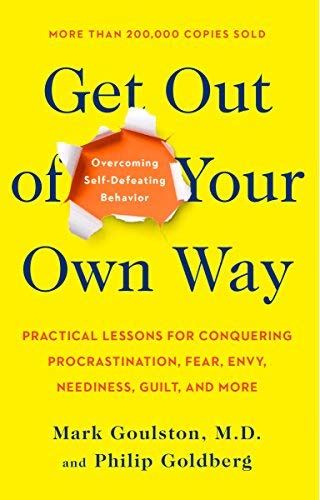
Get out of Your Own Way: Overcoming Self-Defeating Behavior by Mark Goulston (30-Oct-2003) Paperback
Practical, proven self help steps show how to transform 40 common self-defeating behaviors, including procrastination, envy, obsession, anger, self-pity, compulsion, neediness, guilt, rebellion, inaction, and more.
Unknown Binding
First published February 1, 1996
About the author
Mark Goulston
31 books176 followersMARK GOULSTON, M.D., is a business psychiatrist and consultant, author of the bestselling Just Listen, and subject of the PBS special “Just Listen with Dr. Goulston.” He writes a Tribune syndicated career column; blogs for Fast Company, Business Insider, Huffington Post, and Psychology Today; and is featured frequently in major media including The Wall Street Journal, Harvard Business Review, Fortune, Newsweek, CNN, NPR, and Fox News.
Ratings & Reviews
Friends & Following
Create a free account to discover what your friends think of this book!
Community Reviews
Displaying 1 - 30 of 252 reviews

November 29, 2019
There is absolutely zero depth in this book.
"Procrastinate? Well, don't."
"Hold grudges? Well, stop"
"Unable to say no? Then say no"
"Procrastinate? Well, don't."
"Hold grudges? Well, stop"
"Unable to say no? Then say no"

March 21, 2013
I was not impressed with this one. I think what he was going for was practical application to every day life, but the stand alone lessons seem nothing to do with one another and are too simplistic to address the deep roots from which self defeating behaviors stem.

October 20, 2017
Let me start my review by stating that, people are blessed in many ways. Some are intellectuals and some are emotionally intelligent. You can’t have everything or be everything at the same time, but the cool thing is: you can build, you can evolve and change.
I loved this book, for what it is. A guide to those who are emotionally troubled, or have no previous training or knowledge when it comes to handling their emotions.
I’m not saying that this book is going to radically change your life, and that once you read it you’ll be a messiah of some sort or whatever. Clearly, if someone is deeply troubled they’d have to seek therapy and meds if they have any history of mental illness so that’s not what I’m advocating this book for, it should in NO way substitute proper therapy.
On the contrary, I simply view this book, as more of a guide into how you can build your self emotionally, how you can control your emotional floss and what you should care about, especially if you have NO clue what you’re doing.
I’m guilty of most of these “self defeating coping mechanisms” that the author talks about, and it has made my life crazy for a while. I did procrastinate ever so often, I chased the love of people who weren’t my parents but I felt the notion is the same in this case, I held grudges, and Saying “yes” when I really wanted to say “no” just to make people like me etc... it definitely didn’t turn out to be in my favor.
I felt like a doormat for most of the time, so to have this book was a great tool for me. I learned so much, in such a short read. It was enjoyable. Of course, this wasn’t a magic fix, it did take me years to change and get over my “sins” but you can say that this book was the starting point for me. It has sound advice, it makes a lot of sense too. It resonated with me so well. I guess most of the stuff included are very obvious already, but to some of us it’s not that obvious, especially if you’re growing up and you’re still finding out who you are and how you fit into this world.
So overall, I liked it a lot. It did help me. It’s a useful read.
I loved this book, for what it is. A guide to those who are emotionally troubled, or have no previous training or knowledge when it comes to handling their emotions.
I’m not saying that this book is going to radically change your life, and that once you read it you’ll be a messiah of some sort or whatever. Clearly, if someone is deeply troubled they’d have to seek therapy and meds if they have any history of mental illness so that’s not what I’m advocating this book for, it should in NO way substitute proper therapy.
On the contrary, I simply view this book, as more of a guide into how you can build your self emotionally, how you can control your emotional floss and what you should care about, especially if you have NO clue what you’re doing.
I’m guilty of most of these “self defeating coping mechanisms” that the author talks about, and it has made my life crazy for a while. I did procrastinate ever so often, I chased the love of people who weren’t my parents but I felt the notion is the same in this case, I held grudges, and Saying “yes” when I really wanted to say “no” just to make people like me etc... it definitely didn’t turn out to be in my favor.
I felt like a doormat for most of the time, so to have this book was a great tool for me. I learned so much, in such a short read. It was enjoyable. Of course, this wasn’t a magic fix, it did take me years to change and get over my “sins” but you can say that this book was the starting point for me. It has sound advice, it makes a lot of sense too. It resonated with me so well. I guess most of the stuff included are very obvious already, but to some of us it’s not that obvious, especially if you’re growing up and you’re still finding out who you are and how you fit into this world.
So overall, I liked it a lot. It did help me. It’s a useful read.

August 23, 2008
As I began to read this book, I recalled the core concepts in The Knowing-Doing Gap co-authored by Jeffrey Pfeffer and Robert Sutton. Briefly, they assert that “so many managers know so much about organizational performance, say so many smart things about how to achieve performance, and work so hard, yet are trapped in firms that do so many things they know will undermine performance." Many (most?) people have a “gap” between knowing what to do and doing it, not only at work but in all other areas of their lives. How to close this gap? Mark Goulston and Philip Goldberg believe that a self-defeating attitude results in self-defeating behavior…and I agree. They identify 40 different examples of self-defeating behavior and briefly discuss each, also including relevant quotations and a “Usable Insight” for each. I immediately identified with several (as will other readers) and, after reading “10 Things You Can Learn from Each” and then the Introduction: “How to Beat Self-Defeat,” zeroed in on caught my eye.
Goulston and Goldberg offer an abundance of sound advice. It remains for each reader to determine which of the self-defeating behaviors are most relevant to her or him, then make whatever behavior adjustments may be necessary. The authors suggest that the book be read straight through. I chose to take a different approach. Either way is fine. It is imperative to read “10 Things You Can Learn from Each” and then the Introduction: “How to Beat Self-Defeat” first. The extent to which a reader is receptive to improvement of mindset and behavior will determine whether reading this book is a journey of meaningful self-discovery or an extended exercise in self-delusion. Reader’s choice.

April 9, 2018
The authors break down 40 different self-defeating behaviors in 180 pages. Some of these behaviors can take years to establish in a person’s life. A measly 2-3 pages with bullet points at the end of each section is hardly enough to scratch the surface of each behavior. It’s also sprinkled with several famous and not so famous quotes which don’t really do much to add to the material. They end up looking more like space filler than anything. I pushed through to the end hoping for something helpful, useful. Looks like I just wasted my time.

August 30, 2021
Chapters are short and to the point. This book offers helpful examples for a number of self-defeating behaviors along with some insight into the childhood trauma that cultivated them. Not all of the behaviors or advice in this book felt helpful, some passages feeling very cheesy, and the various quotes by famous figures did not add anything of value to this book besides to fill space. While it doesn't spend much time on any one particular self-defeating behavior (as each chapter is only a few pages long) overall I think this is a good starting point to help identify unhealthy behaviors.

July 15, 2020
Full list of ways how you can ruin your life but no plan and almost no advice how to fix yourself.
May 11, 2021
DNF. Disappointed in this one because I was looking forward to reading it. I started reading all the way through, but lost interest so I skipped to chapters that I related to instead. Unfortunately the lessons in the book did not teach me anything new.

March 21, 2024
The book definitely had some gems and I did have some breakthroughs throughout this book. I liked how the chapters were short & digestable.
However I feel like some topics were brushed over to briefly and a more in depth explanation would be better. I think including a bit less chapters but elaborating a bit more on each one would've made a difference.
Would still recommend this book!!
A quote that stuck with me: "Sometimes the easy way out is the right way in."
However I feel like some topics were brushed over to briefly and a more in depth explanation would be better. I think including a bit less chapters but elaborating a bit more on each one would've made a difference.
Would still recommend this book!!
A quote that stuck with me: "Sometimes the easy way out is the right way in."

Read
January 29, 2022This year I am attempting to try to read more non-fiction books.
So I basically googled “non-fiction books” and added every one that sounded somewhat interesting.
This was incredibly interesting and I did enjoy learning about the behavioral psychology aspect.
So I basically googled “non-fiction books” and added every one that sounded somewhat interesting.
This was incredibly interesting and I did enjoy learning about the behavioral psychology aspect.

Read
July 20, 2017There were 3 excellent pages (xi-xiv) and the rest was awful (cheesy, cliche, mansplainy...). This book maintains the trend I see with my research on the writing out there about self sabotage in high performers: no bueno.

May 20, 2015
Ментальные ловушки на работе.

September 24, 2019
Very practical way to learn about our own behaviors and to deal with other people’s behaviors too. Really recommend. Easy to listen and short book.

May 2, 2018
My teaching partner and I are previewing self-help books for a unit we are going to do with our seniors next year and I think this book will be perfect for them.
At first I wanted more out of this book, and found the 3 to 4 page chapters to be too brief to actually discuss any of these issues sufficiently. The more I continued to read, the more I enjoyed the fact that these chapter were not trying to go into great depth on any one topic, yet were simply trying to get the reader to acknowledge some of their self-defeating behaviors, and then provide some basic ideas on how to overcome those behaviors.
Some gems include- “Holding a grudge is a powerful defense mechanism that protects you from having to own up to your own shortcomings.” “Mentally healthy
People feel what they are supposed to feel when they are supposed to feel it.” And, “If you are having fun and things are coming easily to you, don’t feel guilty. It doesn’t mean you are being irresponsible or lazy.”
At first I wanted more out of this book, and found the 3 to 4 page chapters to be too brief to actually discuss any of these issues sufficiently. The more I continued to read, the more I enjoyed the fact that these chapter were not trying to go into great depth on any one topic, yet were simply trying to get the reader to acknowledge some of their self-defeating behaviors, and then provide some basic ideas on how to overcome those behaviors.
Some gems include- “Holding a grudge is a powerful defense mechanism that protects you from having to own up to your own shortcomings.” “Mentally healthy
People feel what they are supposed to feel when they are supposed to feel it.” And, “If you are having fun and things are coming easily to you, don’t feel guilty. It doesn’t mean you are being irresponsible or lazy.”
July 26, 2024
Now, I’m not really sure how I feel about this book. It’s helped me learn, but in a pretty mundane way if I’m honest. I’d give this a three star because it’s good for being emotionally and mentally aware of your state, but to me as a 12 year old, it was slightly boring. As I usually say though, some parts of this book have changed or added parts to my mindset, like an incomplete machine that gets a bit added with each nurturing voice of different authors.
This did, though, make me look inside myself and see where I was at. I'm also someone who gets scared easily, e.g. jumping off a small platform onto an airbag I won’t do, but there are a few chapters on the context of fear which helped me feel braver. I remember some of the things said in this book, and some help me do things old me wouldn’t have dreamt of. All an all, 3 stars but I would recommend for anyone who’s trying to improve themselves!

February 24, 2026
One of my book clubs is doing themes rather than a specific book and our theme for February was self-help. I chose this book because I was running out of time before our meeting and it was available at the library. In the interest of time, I chose the audio version.
Because I was listening to it in the background while I was working, I ended up listening to it a few times to see if I initially missed anything. I did so I'm glad I chose to listen to it on repeat.
The book discusses engaging in self-defeating behaviors on an individual basis as well as in relationships and each chapter ends with a takeaway, or small lesson, that can be incorporated into daily life to help stop the behaviors. It's recommended that you listen to the book all the way through and then focus on chapters that resonate. I found myself stopping the narrative several times so I could jot down what was being said as well as a couple of the chapter numbers to go back to. A couple of the things that stood out to me were the idea we don't procrastinate because we are lazy, but because we are lonely, and the section on quitting too soon - are you really quitting because you are giving up or are you quitting because you have re-evaluated and realize it's time to take another path? And that sometimes, leaving when it feels too soon is the right answer. (This resonated with me as I was facing such a decision).
I don't read a lot of self-help books (though I would probably benefit from doing so) and as I'm constantly trying to downsize here and there, I don't own a lot of books anymore but this one resonated enough with me that I went out and bought a copy.
Because I was listening to it in the background while I was working, I ended up listening to it a few times to see if I initially missed anything. I did so I'm glad I chose to listen to it on repeat.
The book discusses engaging in self-defeating behaviors on an individual basis as well as in relationships and each chapter ends with a takeaway, or small lesson, that can be incorporated into daily life to help stop the behaviors. It's recommended that you listen to the book all the way through and then focus on chapters that resonate. I found myself stopping the narrative several times so I could jot down what was being said as well as a couple of the chapter numbers to go back to. A couple of the things that stood out to me were the idea we don't procrastinate because we are lazy, but because we are lonely, and the section on quitting too soon - are you really quitting because you are giving up or are you quitting because you have re-evaluated and realize it's time to take another path? And that sometimes, leaving when it feels too soon is the right answer. (This resonated with me as I was facing such a decision).
I don't read a lot of self-help books (though I would probably benefit from doing so) and as I'm constantly trying to downsize here and there, I don't own a lot of books anymore but this one resonated enough with me that I went out and bought a copy.

July 28, 2022
Сама идея о том, что человек злейший враг самому себе, и своим же поведением мешает себе жить - отличная. И в книге коротко описано аж 40 типов такого поведения. Но по ходу прочтения чувствуешь себя на приёме у психотерапевта, и также становится понятно что определить у себя то или иное поведение, а тем более сознательно изменить его - практически невероятная затея. Примерно как самому тренировать себя в большом спорте. Так что годится разве что для изучения как оно бывает, чтобы лучше понимать когда пора обратиться за помощью.

July 26, 2020
Probably 3.5 stars but I rounded up. I enjoyed reading it and would recommend to anyone looking for accessible advice. The chapters are short, 2-4 pages each. I found it difficult to sit down and read for extended period due to the fragmentation. It wasn’t written to have a single narrative throughout, but that is what I personally find most enjoyable. It would be an excellent book to keep by the toilet and read in short dumps. :)
September 17, 2022
3.7 ⭐️
I thought this book was very good! There were allot of quotes I liked and connected with throughout reading this story. I thought that there was a lot of advice in relation to the various topics throughout the book.
I really loved the format of this story. It would give a scenario of the problem and then steps on how to fix it. This made it incredibly easy to follow and was nicely organized.
I thought this book was very good! There were allot of quotes I liked and connected with throughout reading this story. I thought that there was a lot of advice in relation to the various topics throughout the book.
I really loved the format of this story. It would give a scenario of the problem and then steps on how to fix it. This made it incredibly easy to follow and was nicely organized.
January 25, 2023
I enjoyed this book. Made me reflect on some situations I've encountered in the past and better understand why I felt what I did or why someone reacted the way that they did. I thought it was really helpful the way they identified a self-sabotaging behavior, then gave an example of it so the reader could better understand and then added the "Usable Insight" as a great one-line take away, and then the "Taking Action" gave you a checklist of how to address or overcome the particular behavior.
September 16, 2020
A lot of great advice and takeaways but the style of the book with a chapter per problem, means most people will have a few chapters that are irrelevant to their personality or situation... Which makes it strange to read.
As a side note, I enjoyed the narration but was a bit shocked every time a chapter was announced because the announcement was almost twice as loud as the rest of the book.
As a side note, I enjoyed the narration but was a bit shocked every time a chapter was announced because the announcement was almost twice as loud as the rest of the book.

February 22, 2023
Helpful advice for people blind to their own privilege and working jobs they hate. The advice is very gender-normative and aimed at straight people with children. The text is padded with a lot of quotations out of context and of questionable relevance. Not a bad book, if you’re in the demographic it’s written for.

June 24, 2025
2.5 stars rounded up. I appreciated the lessons in this book and it did make me reflect on my self-defeating behaviors and what I potentially need to change, but I felt like it didn’t offer any action steps to overcome those behaviors. It seemed like a lot of chapters highlighted a self defeating behavior, and then the authors advice was “stop feeling this way.” Overall, the lessons were helpful, but could’ve offered more direction to the reader.

June 10, 2026
This book was okay, but I think I would have enjoyed it more if I had read the physical copy instead of listening to the audiobook. I had a hard time staying focused on the narration due to the voice lol…The book also spent a lot of time telling stories about other people, and I was hoping for more direct, practical advice. (:

August 7, 2022
Initially I thought this book was outdated information consisting of too basic concepts. The more I read, the more the concepts resonated with me. The book is only a five hour read. Of the 38 concepts there will be at least a few that apply to any reader.


July 28, 2020
Порция годного контента от неутомимого Гоулстона. Книга давняя, но актуальности не теряющая. Стоило пройтись и примерить к себе, какие то идеи отзываются

February 25, 2021
Drastic changes I have felt after reading this book. Much helpful to get rid of the sabotage behavior of oneself.

Did Not Finish
May 26, 2021Lmao made it like 5 pages before stopping. I’m trying to read EVERYTHING to see what does and doesn’t stick... this is a miss. c’est la vie

June 8, 2026
Knowing this book came out in 1996, its surprisingly still pretty timely and relevant. I needed the insights presented in this book to actualize on some behaviours that don't benefit me anymore
Displaying 1 - 30 of 252 reviews