No DJ, sunning to cover. Cracked spine but all pages are intact. Minimal handwriting to some pages. Support an awesome bricks and mortar book shop in WV! [A5]
was a well known and very influential German Orientalist and scholar, who wrote extensively on Islam and Sufism. She was a professor at Harvard University from 1967 to 1992. .. مستشرقة المانية ولدت في مدينة إرفورت بوسط ألمانيا لعائلة بروتستانتية تنتمي إلى الطبقة الوسطى..في عام 1939 نزحت مع الأسرة إلى برلين وفيها بدأت دراستها الجامعية للأستشراق. وبعد عام واحد بدأت العمل على رسالتها للدكتوراة حول مكانة علماء الدين في المجتمع المملوكى تحت إشراف ريشارد هارتمان وقد انتهت منها في نوفمبر 1941 وهى في التاسعة عشر من عمرها ونشرتها عام 1943 في مجلة "عالم الإسلام" تحت عنوان "الخليفة والقاضى في مصر في العصور الوسطى المتأخرة". وفى نوفمبر من عام 1941 عملت كمترجمة عن التركية في وزارة الخارجية الألمانية. وفى وقت الفراغ واصلت اهتمامها العلمى بتاريخ المماليك حتى تمكنت من عمل فهارس لتاريخ ابن إياس. وفى مارس 1945، قبيل نهاية الحرب العالمية الثانية بقليل، انتهت من رسالة الدكتوراه في جامعة برلين عن الطبقة العسكرية المملوكية. وقد احرزت،، في عام 1995 وكأول مستشرقة ودارسة للإسلام جائزة السلام الألمانية التي يمنحها اتحاد الناشرين الألمان ويسلمها رئيس الدولة الألمانى.
ANNEMARIE Schimmel (آنا ماري شيمل) was a well known and extremely influential German Orientalist and scholar, who wrote extensively on Islam and Sufism. She was born in Erfurt, Germany, on April 7, 1922. She was a professor at Harvard University from 1967 to 1992. She died on January 26, 2003. IT is a well-known fact that Annemarie Schimmel has written numerous books on several subjects and personalities, including Islam, Sindhi culture, Rumi, Mirza Ghalib and Allama Iqbal. Her book A Two-Colored Brocade: The Imagery of Persian Poetry grew from a series of lectures which she gave at Harvard for more than two decades. The lectures were meant to introduce students to the wonderful world of Persian and Persian poetry.
Sir Muhammad Iqbal (9th Nov 1877 - 21st April 1938) also renowned as Allama Iqbal was an Islamic scholar, philosopher, poet, political visionary, statesman and social reformist. He had also studied at Heidelberg University (Germany) where a street near the Neckar River has been named in his honour.
She explains in the introduction: “A more recent problem in the interpretation of Persian lyrics is that the younger generation of western-educated Persians or Pakistanis often have little knowledge of literary traditions, and besides, many Persian, Urdu and Turkish words have changed in meaning in the course of nearly a millennium, as has happened in German and English as well. Misreadings and wrong interpretations are often the result of well-meant attempts to understand classical poetry and make it understood to others.” The German scholar must have known all too well that few Pakistanis read books, leave alone have any knowledge about literary traditions. Who could have known Pakistan and understood Pakistanis better: she visited the country at least 38 times during the course of her life. In a chapter titled “Ideal loving couples”, Annemarie Schimmel talks about a much-loved topic among Persian poets: love stories. The old Arabic love story of Layla and Majnun seems to be the favourite. The first Persian poet to treat the story of the star-crossed lovers was Nizami with his Layla-u-Majnun. Following in the footsteps of Nizami many other writers treated the tragic love story. Amir Khusrau, Jami, Mir Alishir Nawa’i and Fuzuli were some of the major ones. Mirza Ghalib too has alluded to the plight of Qais (Majnun) in some of his Urdu verses.
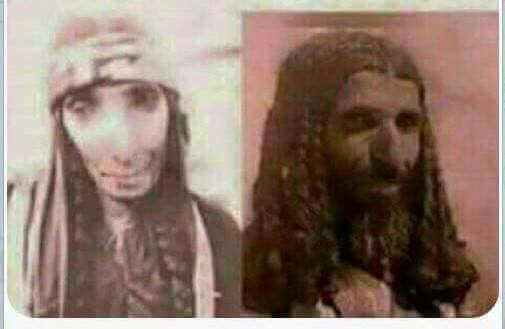
Layla-Majnun photo kept in a museum in France.
However, the poets’ fascination with the romantic protagonists did not end with poetry as Qais sitting in the wilderness of the desert, surrounded by animals, became one of the favourite themes of Persian miniature painters. Schimmel states: “Indeed one of the most touching miniatures of the Majnun circle, painted about 1540 by Mir Sayyid Ali, shows children casting stones at the enchained madman. The combination of ‘children’ and ‘stone throwing’ remained common in later poetry,” including that of Azad Bilgrami in 18th-century India. Another famous Persian writer Farid Ud-Din Attar, who lived in Khorasan during the second half of the 12th century and well into the 13th, has alluded to Layla and Majnun in his most famous work Mantiq al-Tayr (The Conference of the Birds). The main story is interspersed throughout with a variety of subsidiary tales. An extract from a translation of the book by S.C. Nott states: “At this the birds were petrified with astonishment. Nevertheless, when they came to themselves a little, they said: ‘Will this great King reject us so ignominiously? And if he really has this attitude to us, may he not change it to one of honour? Remember Majnun, who said: ‘If all the people who dwell on earth wished to sing my praises, I would not accept them; I would rather have the insults of Laila. One of her insults is more to me than a hundred compliments from another woman’!”
Farid Ud-Din Attar's classic twelfth-century Persian epic poem "The Conference of the Birds" tells the story of a flock of birds in search of the true king, Simorgh, who lives on the mountain of Kaf. Drawn from all species, the flock travels through the seven valleys: quest, love, understanding, detachment, unity, amazement, and death.
Where Nizami was concerned, he did not end his adventures in the world of romantic stories with Layla-u-Majnun as he established his greatness with another romantic poem: “Khusrau u Shirin”. Khusrau, Farhad and Shirin, the protagonists in Nizami’s epic “Khusrau u Shirin”, are often cited in lyric verse as parallel with Layla and Majnun. Abul Qasim Firdausi had described the love story of Khusrau and the Armenian princess, but Nizami added a third dimension with the introduction of Farhad, an architect who fell in love with Shirin. Farhad fulfilled all kinds of tasks in order to win Shirin’s hand, and even dug a tunnel through solid mountain rock so that the milk from Shirin’s cows could flow to the valley below.
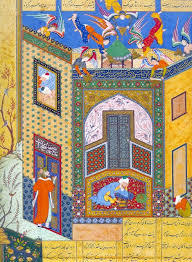
A miniature Persian painting shows Shirin astride a horse being carried by Farhad. Artists those days did not sign their names on paintings which is why the artist for this one remains unknown.
A grave in the Lasbela region of Makran, Pakistan, where rocks around a spring are covered with whitish sinter is locally called the tomb of Farhad and Shirin because the white natural resource reminds people of the milk stream in the Persian story of the star-crossed lovers. Later, Amir Khusrau too composed an epic “Khusrau Shirin”. By then the story of Farhad and Shirin had become widespread in Iran, Turkey and India. Persian literature is replete with many more loving couples: Rustam and Tahmina, Zal and Rudaba (the daughter of the King of Kabul), Wamiq and Azra, and Yusuf and Zulaikha. The first two pairs of lovers are mentioned in Firdausi’s Shahnama, which is the finest achievement of Persian poetry. It was written during the rule of the Ghaznavid dynasty (962-1186). Its subject is the history of Iran from legendary times to those of the Sassanian kings.
"In Avicenna and the Visionary Recital", Henry Corbin tells the story of the Persian lovers Wamiq and Azra as recounted in a 15th century poem of Jāmī. Wamiq “anticipates the mystical consummation demanded by all love in the true sense” which can only be attained “through a slow initiation, a long experience of integration". Here is what Wamiq wishes: "What I wish… is to flee all alone with Azra into a desert, is to seek my native country in solitude and to pitch my tent beside a spring, keeping far from friend and enemy alike, soul and body both in peace, safe from men. May I be able to walk more than two hundred parsangs in any direction without finding human footprints. And then may every hair of my head, every hair on my body, become so many eyes, and may the one object of my sight be Azra, so that I may turn to her with thousands of eyes and contemplate her face forever. Ah! better yet, may my contemplative condition be abolished. What I seek is to be delivered from duality, is to become She. As long as duality remains, distance remains, the soul is branded with the iron of separation. When the Lover enters the retreat of Union, it can contain but One alone. Peace!"
Though Wamiq and Azra’s story is originally Arabic, they are better known in Persian tradition through the retelling of a romantic poem by Unsuri at Mahmud Ghaznavi’s court. Farrukhi too alluded to it. The theme of Yusuf and Zulaikha was an extremely popular one with Persian poets. Embellishing the Quranic account, they turned it into a tragic love story, exonerating Zulaikha on the ground that Yusuf’s beauty was irresistible. Jami, who is commonly considered the last great classical Persian writer, wrote a poem called “Yusuf u Zulaikha” which is one of his best works. However, where poets’ romantic life was concerned, it was one of their most important duties never to reveal the beloved’s name in their poetry. A poet would prefer to die rather than defame his beloved. Hafiz, who was born in Shiraz, began to work at an early age in a bakery to help his widowed mother out of debt. While delivering bread, he fell madly in love with an extremely beautiful Turkish woman, Shakh-e-Nabat (literally branch of sugarcane). He expressed his love for her through his poems which made him famous. There is hardly an admirer of Persian poetry who does not know about the ghazal which talks about “the Turkish beauty of Shiraz” who held Hafiz’s heart in her hand. Yes, he was most willing to even sacrifice Samarkand and Bukhara for the mole on her cheek. In the chronology, the names of several poets are mentioned who were executed. After many years of travel and teaching, the mystic Hallaj “Mansur” was arrested, imprisoned and finally brutally executed in Baghdad on March 26, 922, because to some people he appeared to contradict Islam’s fundamental understanding of the transcendence of God and threatened the social disorder. Suhrawardi, the “Master of illumination” (Shaykh al-Ishraq), a mystical philosopher, was executed in Aleppo in 1191. Nesimi, the Turkish Hurufi poet, was cruelly executed in Aleppo in 1405. However, it is not mentioned whether they were executed for revealing their beloved’s name, for their religious beliefs or political leanings. Sarmad, the composer of melancholy quatrains and friend of Dara Shikoh (Aurangzeb’s brother), was executed for heresy in 1661. Farid Ud-Din Attar, lyrical poet, hagiographer and author of the best-known mystical Masnawis, was killed during the Mongol invasion of Eastern Iran in 1220.
Farid Ud-Din Attar Tomb, Nishapur.
There are some typos in the book — for example, on page 289, the doyen of Indian realist cinema, director Satyajit Ray, is mentioned as “Satyajiv”. Apart from that, the book is a great source of information and should be read through at leisure.
Obituary of Dr. Annemarie Schimmel published on 27th January 2003, a day after her death.
For over a millennium the classical poets of Persia and the Persianate world (Muslim India, Central Asia and Ottoman Turkey) used a sophisticated system of imagery in their poetry, which developed and evolved over centuries. These images and allusions were employed by poets in different eras to express their views on varied subjects and themes of life (e.g. the metaphysical works of Rumi and Attar, the nature poetry of Farrukhi and Qa’ani and politico-philosophical works of Iqbal) and were later also borrowed by Urdu, Chagatai and Turkish poets and incorporated into the poetic traditions of these languages. However, while being highly enjoyable for the connoisseur or the patient reader, they can also make it a challenging task for the modern reader to understand the ‘hidden’ meaning or appreciate the true beauty of this literature and can easily be lost in translation. This erudite work by Annemarie Shimmel, a leading authority on the Persian and Persianate (Urdu, Turkish and Sindhi) literature, gives an excellent introduction to this literary tradition and its imagery. The book has been divided into three parts. In the first (and the shortest) part, Schimmel explains the different genres (epic, qasida or panegyric, ruba’i or quatrain, masnavi, marsiya or dirge, and the most cherished and enchanting of all oriental genres ghazal). Rhetorical requirements and principles of prosody of the Persian poetry are also introduced in this part. Schimmel’s elaboration of the various rhetorical forms (san’at), wordplays, metaphors and puns employed by the Persian poetry is possibly the most delightful part of the book. The examples she has presented here from various poets (especially those belonging to the convoluted sabk-e Hindi i.e. the Indian Style) are truly enjoyable. For instance, this couplet by Emad Faqih with its cunning play on the word Mahi: دل عکس رخ خوب تو در آب روان دید واله شد و فریاد برآورد که ماهی (Del aks-e rokh-e khub-e to dar aab-e ravan did Valeh shod o faryad bar-avard ke “Mahi!”) Schimmel’s translation is natural and true to the original: “When the heart saw the reflection of your lovely cheek in running water It became confused and cried out “Mahi! Mahi can mean ‘a fish!’ or ‘You are the moon!’, or in Arabic, ‘What is that?!’”, she goes on to explain. (I would suggest the interested reader to check the entry for ‘zol-ma’niyein’ in Dehkhoda’s dictionary, which has many more delightful examples of such poetic wordplays.) The next three parts of the book discuss the themes borrowed by Persian poets from history, mythology, literature, various natural phenomena and their own daily lives. Schimmel’s encyclopaedic knowledge of the Persian and Persianate societies and traditions from pre-Islamic times to her own century with her psychological insight to the minds and culture of these writers is clearly reflected in the effortless way she explains the most convoluted of the images and allusions. Take this example for instance from the themes of calligraphy and precious stones (both being highly popular with the classical poets). شد نسخ خط یاقوت اکنون همه رعنایان تعلیم خط از لعلت، گیرند به مکتبها (Shod naskh khatte Yaqut, aknun hame ra’nayan Ta’lime khatt az la’lat, girand be maktabha) Now the writing (khatt) of Yaqut (a famous calligrapher of the Abbasid era; also a form of ruby) has become abolished, And all the lovely ones learn writing (or instructions concerning your down i.e. khatt) in school from your ruby mouth. In Schimmel’s own words, “by playing on the double meaning of khatt as well as of naskh (both “naskh writing” and “abolishging”) Jami opines that it is more important to gaze on the beloved’s down, which grows around the ruby mouth, than to study the calligraphy of Yaqut: the combination of la’l, “ruby” and Yaqut, which also means “precious ruby”, adds to the elegance of the lines.” About four centuries later, Ghalib said in an extremely enigmatic Urdu couplet: سبزہِ خط سے ترا کاکلِ سرکش نہ دبا یہ زمرد بھی حریفِ دمِ افعی نہ ہوا (Sabza-ye khatt se tera kakul-e sarkash na daba Ye zumurrud bhi harif-e dam-e af’i na hua) Your fierce tresses could not be suppressed by the greenness of your down This emerald could not prove a worthy opponent of the serpent’s breath. Thanks to its outlandish language, this couplet had caused me many sleepless nights until I came across the section on stones in the book. It explains that in the ancient traditions, emerald “had healing powers and was thought to blind the eyes of venomous serpents and dragons”. Here, it would be relevant to add a note on this often-cited ‘down’ “that sprouts on the youthful friend’s lips and cheeks” constituting “one of the most important ingredients in the description of poetry” and which seems to have posed problems for some western scholars (e.g. Joseph von Hammer as Schimmel herself mentions). Schimmel proposes that it was “a veiling tactic” as it was “impossible to allude openly to a feminine beloved, and one thus had to mention a boy’s attributes when describing the beloved”. The fact that both Persian and Turkish lack grammatical gender certainly facilitated this device. However, one should not ignore the fact that the Muslim medieval societies were more tolerant of romantic relations between men (as is known, for instance, from the famous legend of Mahmud, Sultan of Ghazna, and his slave, Ayaz the Turk). This is a highly-researched and erudite work and I would recommend it to every student of Persian poetry. As far as I know it’s been translated into Persian by Dr Firouzabadi and certainly deserves to be translated into Turkish and Urdu.
A really useful resource when considering what the different pieces of imagery in Persian poetry would mean with really great examples of each. Well-written and engaging; especially the part on the significance of the rose and the nightingale.