

What do you think?
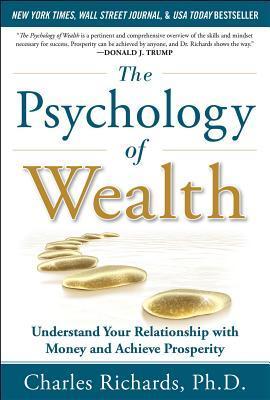
The Psychology of Wealth: Understand Your Relationship with Money and Achieve Prosperity
The New York Times and Wall Street Journal bestseller! “ The Psychology of Wealth is a pertinent and comprehensive overview of the skills and mindset necessary for success. Prosperity can be achieved by anyone, and Dr. Richards shows the way.”
―Donald J. Trump “What’s in your head determines what’s in your wallet. Dr. Richards gives you the mental hard-drive upgrade you need to finally achieve the greater prosperity and success you desire.”
―Darren Hardy, Publisher, SUCCESS magazine “Dr. Richards shakes up our preconceptions about wealth by examining the psychological aspects of how we relate to money. When you understand the real sources of wealth in your life, you’ll find it much easier to achieve a more prosperous and happy life.”
―Jordan E. Goodman, America’s Money Answers Man at MoneyAnswers.com and Author of Master Your Money Type “This might be one of the most important books you’ll ever read. If you feel like your life has been stuck in neutral―or even worse, put in reverse―Dr. Richards will set you on a clear path to success.”
―Barnet Bain, Producer, What Dreams May Come About the Why do some people feel a perpetual state of lack and fear about money, while others feel genuinely prosperous, regardless of the size of their bank accounts? Why do some people shudder with dread when it comes to setting financial goals, while others embrace it with enthusiasm and confidence? What makes the difference? Could it be in their relationship with money itself? People who enjoy a healthy relationship with money share common habits and traits. So, how do they think, and what do they do differently? Are these behaviors hardwired in an individual’s psyche, or can they be learned? In this provocative book, psychotherapist Dr. Charles Richards provides unexpected and encouraging answers to these questions. Based on his research and expert interviews, Dr. Richards shows how each of us can develop a thriving relationship with money and create a rich and rewarding life. A t the book’s heart are the stories of people who have faced adversity with courage and created extraordinary lives. Their accounts―along with Dr. Richards’ interviews with finance professors, legislators, entrepreneurs, and mavens of success―pave a path to a brighter future for us all. Today we live in a trying economic environment. Every day, popular financial advisors exhort us to hunker down, play it safe, and protect ourselves from an uncertain future. To the voices who promote fear and doubt, Dr. Richards answers with balance, wisdom, and optimism. The Psychology of Wealth is for anyone interested in succeeding personally or professionally, and in achieving true prosperity. It offers golden steps on the path to a better life.
―Donald J. Trump “What’s in your head determines what’s in your wallet. Dr. Richards gives you the mental hard-drive upgrade you need to finally achieve the greater prosperity and success you desire.”
―Darren Hardy, Publisher, SUCCESS magazine “Dr. Richards shakes up our preconceptions about wealth by examining the psychological aspects of how we relate to money. When you understand the real sources of wealth in your life, you’ll find it much easier to achieve a more prosperous and happy life.”
―Jordan E. Goodman, America’s Money Answers Man at MoneyAnswers.com and Author of Master Your Money Type “This might be one of the most important books you’ll ever read. If you feel like your life has been stuck in neutral―or even worse, put in reverse―Dr. Richards will set you on a clear path to success.”
―Barnet Bain, Producer, What Dreams May Come About the Why do some people feel a perpetual state of lack and fear about money, while others feel genuinely prosperous, regardless of the size of their bank accounts? Why do some people shudder with dread when it comes to setting financial goals, while others embrace it with enthusiasm and confidence? What makes the difference? Could it be in their relationship with money itself? People who enjoy a healthy relationship with money share common habits and traits. So, how do they think, and what do they do differently? Are these behaviors hardwired in an individual’s psyche, or can they be learned? In this provocative book, psychotherapist Dr. Charles Richards provides unexpected and encouraging answers to these questions. Based on his research and expert interviews, Dr. Richards shows how each of us can develop a thriving relationship with money and create a rich and rewarding life. A t the book’s heart are the stories of people who have faced adversity with courage and created extraordinary lives. Their accounts―along with Dr. Richards’ interviews with finance professors, legislators, entrepreneurs, and mavens of success―pave a path to a brighter future for us all. Today we live in a trying economic environment. Every day, popular financial advisors exhort us to hunker down, play it safe, and protect ourselves from an uncertain future. To the voices who promote fear and doubt, Dr. Richards answers with balance, wisdom, and optimism. The Psychology of Wealth is for anyone interested in succeeding personally or professionally, and in achieving true prosperity. It offers golden steps on the path to a better life.
256 pages, Hardcover
First published December 1, 2011
Ratings & Reviews
Friends & Following
Create a free account to discover what your friends think of this book!
Community Reviews
Displaying 1 - 30 of 31 reviews

October 30, 2017
Here I sit, barely having survived being force-fed the syntactic atrocities "psychology of wealth" and "wealth psychology." It really felt like he was rushing to claim his chapter in an intro to psych textbook, but didn't feel like supporting it with any research. He spent a majority of the book detailing rags-to-riches anecdotes and attempting to extract common personality traits for the reader to adopt. It's great to have role models, and some of the stories were undoubtedly inspiring, but the book lacked any science. The whole first chapter was dedicated to redefining "wealth" (red flag). He honestly should've redefined psychology, too. And, I don't know, maybe... changed the title of his book while he was at it. I did find the chapter on evaluating self-esteem and taking personal responsibility to be enlightening, but its usefulness was all but lost in the humdrum of karmic happy endings.

December 17, 2023
I suddenly remember I skimmed and scanned this book in 2019. The content is good. It is about your ability to manage your finances. There is also a chapter that connects your self-esteem to your financial wealth. It is believed that your financial wealth is healthy when you have a healthy level of self-esteem.

May 27, 2015
This book is exactly what it claims to be; although it's "personal finance," Dr. Richards talks more about behavior, thought process, and constructive action than actual money. He does a great job of tying these topics together in an appealing style! I enjoyed the constant short stories within- this book is packed with wisdom.

July 8, 2017
Personally, both the psychology and the economics were too watered down for my taste.

June 19, 2021
One of the most beautiful statements that I discovered in the book was defining your relation with money. Often, we consider relationship as just being with a partner or with family or friends But we never think about how is our relationship with money - is it good, bad getting worse, getting better?
Further, the book also cleared my perspective towards creating value.How to develop a culture within you and your surroundings that will eventually benefit you. When author was discussing about his family history, what his great grandparents did in order to create a strong foundation for the wealth,I was comparing my family. I could clearly see the difference on the points where we are lacking to create a perennial wealth.
Another book that gained my attention was Psychology of Money. It seems both are on similar lines. But I thought psychology of wealth should be given the preference because because wealth is a bigger concept than money I think I made the right decision but I will give my review on psychology of money as well in following weeks.
https://www.reviewbeforeread.com/2021...
Further, the book also cleared my perspective towards creating value.How to develop a culture within you and your surroundings that will eventually benefit you. When author was discussing about his family history, what his great grandparents did in order to create a strong foundation for the wealth,I was comparing my family. I could clearly see the difference on the points where we are lacking to create a perennial wealth.
Another book that gained my attention was Psychology of Money. It seems both are on similar lines. But I thought psychology of wealth should be given the preference because because wealth is a bigger concept than money I think I made the right decision but I will give my review on psychology of money as well in following weeks.
https://www.reviewbeforeread.com/2021...
February 22, 2020
Wealth has many facets, and Charles brings this out using real-life examples. It starts with you! Financial discipline starts with planning and we can be wealthy if we choose to.

January 7, 2018
This was a remarkable book that gave me a greater appreciation for what wealth is. Interestingly enough, a lot of ideas in this book were affirmations for my own ideas that I had been employing in my life, which also supported why I have a lack of understanding from outsiders. I’m currently the average American as it comes to personal finance, but this book has confirmed that everything is on a value system , and the way that you determine wealth is truly personal . This doesn’t mean money doesn’t matter, because it surely does. It’s just that it’s one of many facets when it comes to wealth. That’s just one of the many different ideas in this book and one that stuck out to me a lot. It was a phenomenal read. I recommend this to anyone who’s trying to work their way up in wealth. Thanks Dr. Richards !

September 7, 2020
This was a large collection of anecdotes of people successfully becoming wealthy. There was a couple of interesting points where it talked about common personality traits of the successful people detailed in the book most of it revolving around a healthy amount of self-esteem. I felt front there was a fair amount of trying to redefine what wealthy was which made me suspicious that it was not really trying to talk to me about the psychology of wealthy people but rather how to find inner happiness even though you're poor.
If you want to provide some anecdotes of people succeeding and attitude a presentation or talk this book might be interesting for you otherwise I would pass.
If you want to provide some anecdotes of people succeeding and attitude a presentation or talk this book might be interesting for you otherwise I would pass.

July 14, 2019
Psychology of Wealth is the book in which perceives the concept of wealth and prosperity within the society in the perspective of psychology, varying from what actually defines wealth, tangible or intangible, and how wealth is perceived quite differently among different social groups and individuals.
It sort of enlightened me as this book provides the life stories of several inspirational characters in order to represent the scenario of different people, from their ups and downs, thus giving more relatable emphasis upon varying concepts of wealth. Wealth, in itself, is a fluid concept, there is no fixed yardstick or category that defines wealth as one particular thing, and that means that we are able to determine and define our own concepts of wealth and work towards the effort towards prosperity in our terms, and lead ourselves to a prosper and fulfilling journey that is life.
However, there are several features that are pretty lacking in this book. One of which, is that it doesn't really put much emphasis in scientific explanation of these psychology of wealth, therefore not really supporting the ideas that are delivered, but more of suggestions and plausible arguments down the line. Another underlying problem is that some of the economic aspects in the book have been watered down, right from the lack of explanation about the problems on credit lending, and the impact of the economic crisis on the citizen's purchasing power.
It sort of enlightened me as this book provides the life stories of several inspirational characters in order to represent the scenario of different people, from their ups and downs, thus giving more relatable emphasis upon varying concepts of wealth. Wealth, in itself, is a fluid concept, there is no fixed yardstick or category that defines wealth as one particular thing, and that means that we are able to determine and define our own concepts of wealth and work towards the effort towards prosperity in our terms, and lead ourselves to a prosper and fulfilling journey that is life.
However, there are several features that are pretty lacking in this book. One of which, is that it doesn't really put much emphasis in scientific explanation of these psychology of wealth, therefore not really supporting the ideas that are delivered, but more of suggestions and plausible arguments down the line. Another underlying problem is that some of the economic aspects in the book have been watered down, right from the lack of explanation about the problems on credit lending, and the impact of the economic crisis on the citizen's purchasing power.

March 18, 2020
Very confusing to read. In some chapter I'm not sure what is the main point the author wants to talk about. A mixture of psychology, motivation, and financial knowledge but put in a very confusing order.
Overall only two chapters have captivated my full attention. The first one is Chapter 4 "Self-Esteem and Its Influence on Wealth", the other one is Chapter 7 "Living Consciously".
Overall only two chapters have captivated my full attention. The first one is Chapter 4 "Self-Esteem and Its Influence on Wealth", the other one is Chapter 7 "Living Consciously".

November 10, 2020
This was nothing special. Rather on the amateurish-side actually.
I was mistaken and thought this was the title of a book a friend recommended. I kept pushing through this book expecting something more.... Most memorably, this book (published in 2012) had a lot of flattering quotes from Donald Trump.
I was mistaken and thought this was the title of a book a friend recommended. I kept pushing through this book expecting something more.... Most memorably, this book (published in 2012) had a lot of flattering quotes from Donald Trump.

October 21, 2021
I feel as if this book wasted my time. I thought it was supposed to help me understand my relationship with money but there are so many paragraphs lauding Donald Trump that it's no wonder his review is on the cover.

January 5, 2023
I love this book
It gives so much energy and good vibes when I’m reading chapter thru chapter
Love the way writer putting example
I’m not alone in this struggling world and wealth is not about tangible things and how rich you are. It’s about what you perceive and how you think and react
It gives so much energy and good vibes when I’m reading chapter thru chapter
Love the way writer putting example
I’m not alone in this struggling world and wealth is not about tangible things and how rich you are. It’s about what you perceive and how you think and react
August 29, 2023
This book gave a pretty good overview of the psychology side of being wealthy and thinking like the rich. Gave several stories of successful individuals, where they started out (usually with very little), and how they overcame their challenges.
June 22, 2024
This book has a copyright date of 2012. It is not a classic like Think and Grow Rich or Millionaire Next Door. There are good principles that are stated in many other books.
The book references Trump as a success. Obviously before what we all now know.
The book references Trump as a success. Obviously before what we all now know.

August 9, 2019
Contains what you need to know in preparation for a journey towards prosperity.
September 6, 2019
Very inspiring, kinda make me realize that wealth doesn't have to be all about money

January 7, 2022
This kind of read like a college student's final exam essay. But it was easy and had a few interesting anecdotes.


March 3, 2017
Good illustration of the true meaning of wealth, from his own perspective. Motivational
March 16, 2012
The Psychology of Wealth discussed the background on how we define wealth and the circumstances of our economic collapse. Our uprising by our parents define us on how we see wealth. We see things that we are working toward within our means. But somewhere, we lost sight and become irresponsible. We based wealth on wants and not needs. We went beyond on what we could afford because we were looking at the future that everything is find and dandy.
The book also discussed that wealth doesn't always buy happiness. Happiness is doing something that one is happy with and wealth usually follows. Wealth is having friends and families not hoarding all the money to yourself. Wealth is having more money that one can used and then sharing with people/giving back to the communities.
I like the book since it describe step by step of what wealth is. But for readers who have the background in economics, finance or business, the concept is pretty much repetitive. One of the things I like about the book is that it offers references to get more information. It also list simple steps to do such as Chapter 4 on Self-Esteem. I'm pretty sure there are those of us that our parents and friends put us down believing we will never amount to much. That is a very good chapter to read and to encourage us to find more self-help references.
The book also discussed that wealth doesn't always buy happiness. Happiness is doing something that one is happy with and wealth usually follows. Wealth is having friends and families not hoarding all the money to yourself. Wealth is having more money that one can used and then sharing with people/giving back to the communities.
I like the book since it describe step by step of what wealth is. But for readers who have the background in economics, finance or business, the concept is pretty much repetitive. One of the things I like about the book is that it offers references to get more information. It also list simple steps to do such as Chapter 4 on Self-Esteem. I'm pretty sure there are those of us that our parents and friends put us down believing we will never amount to much. That is a very good chapter to read and to encourage us to find more self-help references.

February 23, 2012
A basic book that gives an overview of not only the current economic situation, but also how our thoughts and habits determine our wealth. Although I did not find a lot of new information (having read a number of the books referenced), the presentation included a an assortment of stories, which tie the ideas to emotions and help support change. This would be a great book for someone starting to learn a about wealth and success. I received a free copy if this book from Goodreads.

August 10, 2012
Self-esteem and self-respect are necessary before anyone can achieve any success however they define success. Anyone can cultivate self-esteem and self-respect in themselves and a few exercises are provided. Most of the book is filled with people's stories of success, some more inspiring than others.
Not a 'must-read' by any means but it was a quick read and interesting.
Not a 'must-read' by any means but it was a quick read and interesting.

July 22, 2012
interesting psychology behind prosperity and wealth.. Old message in a new package.

September 12, 2012
This book helped me understand why I view finances the way I do. And living within my means was eye opening for me. I have gathered useful tips for myself and am happy to put them into everyday use.
February 3, 2013
Not sure it requires a book for the points the author tries to make. Could have been done in 10 pages

April 18, 2014
Accidentally checked out one of those self-help books full of platitudes and lacking data. Oops.
January 29, 2016
Found nothing new or inspiring in this read. A lot of common sense with a lot of nice examples of people achieving success by determination, courage, fortitude, character, etc....
February 6, 2016
Hardly anything about wealth. Pop psychology.
October 15, 2016
A well written and inspiring read. Interesting historical perspectives on the use of credit and debt.
Displaying 1 - 30 of 31 reviews