Over the last 30 years, Martin Puryear has created a body of work that defies categorization, creating sculpture that examines identity, culture and history. Departing from the impersonal and machined aesthetic of Minimalism, Puryear's work combines Modernist abstraction with the traditions of crafts and woodworking, in shapes informed by the natural and by ordinary objects, made with materials such as tar, wood, stone and wire. It is quiet but deliberately associative, encompassing wide-reaching cultural and intellectual experiences and drawing on a huge and varied reserve of images, ideas and information. As a high school and college student, the artist studied ornithology, falconry and archery, and in the 1960s he volunteered with the Peace Corps in Sierra Leone, where he schooled himself in the region's indigenous crafts; these are only a few of the influences and methods that have embedded themselves in his work. And the sources of his works are no less varied than the possible and open-ended "I think there are a number of levels at which my work can be dealt with and appreciated," Puryear said in a 1978 interview. "It gives me pleasure to feel there's a level that doesn't require knowledge of, or immersion in, the aesthetic of a given time or place." This volume is published on the occasion of the artist's Fall 2007 exhibition at The Museum of Modern Art, which travels from New York to Fort Worth, Washington, D.C. and San Francisco. It follows Puryear's development from his first solo show in 1977 to new works that are presented here for the first time and contains essays by John Elderfield, Michael Auping and Elizabeth Reede, and a conversation with the artist by Richard Powell.
John Elderfield (25 April 1943 - ) was Chief Curator of Painting and Sculpture at the Museum of Modern Art, New York, from 2003 to 2008.
Elderfield studied the history of art at the University of Manchester and the University of Leeds. He received his PhD from the Courtauld Institute of Art in 1975.
Elderfield received the award of Chevalier des Arts et des Lettres from the French Government.
Sculptor Martin Puryear is often called postminimalist by critics, but like most serious artists he eschews labels. His materials are primarily wood, wire mesh, tar, and later in his career, bronze and stone.
He’s one of my favorite sculptors.
As a young man, "I didn't understand abstract art at first, and I didn't consider it very valid. I soon learned, however, that the representational art that I was most drawn to had qualities that depended less on the sleight of hand of the artist in reproducing the look of things in nature than on how the work of art was structured. This allowed me to begin to relax the death grip I had on verisimilitude as the crux of what constituted art for me. It felt like I was recapitulating the history of modernism in my own struggle during this period, grappling with the transition in my own work from realism to something more abstract." (p. 101)
“I had to really fight my way [through abstraction],” says Puryear, “out of my habits of a very meticulous realism.” He says that “in studying Franz Kline and Robert Motherwell I saw that their work derived its force from the same dynamics as the work of artists like Pieter Brueghel or Paolo Uccello. I still had to work my way through all of this step by step – literally to abstract from reality.” (p. 168)
His inspirations have been African, Scandinavian, and Native American. He has taken cues from ornithology (he briefly practiced falconry) and boatbuilding. He learned how to do wood joinery and carpentry as a Peace Corps volunteer in Sierra Leone. "...I have spent most of my working life making work that may seem to be carved but which in fact is constructed, made from parts and put together."
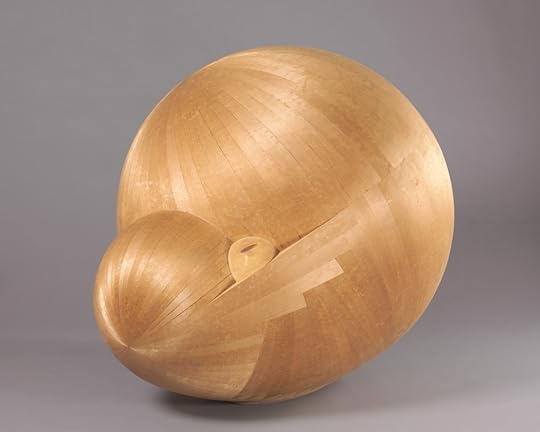
Alien Huddle, 1993-95 Red cedar and pine 52 15/16 x 63 15/16 x 52 15/16 in. Cleveland Museum of Art
Minimalism was something he pushed back against – the way it “cultivated a distance, a sense of anonymity, so that you didn’t get involved with any kind of signature or personal touch” (p. 77) – yet also served as an inspiration – “minimalism became a strong clue for me about how powerful primary forms could be” (p. 170). His rejection of it was ultimately based on his need to work with his hands – he wasn’t happy with the notion of someone else fabricating his art (the way, for example, Donald Judd’s boxes were made). (However, on some large-scaled commissions later in his career, he has designed the sculptures but others have created and fabricated them, out of necessity.)
He specifies that he is "wary of being tied to notions of craft and primitivism.” “I'm as interested in the modern as I am in the primitive; I think I'm interested in where the two meet." (p. 179)
A critic "used the term "eccentric abstraction" to describe works by artists like Eva Hesse and Louise Bourgeois," an interviewer informs Puryear in one of the book's essays. "One senses she was thinking about this work in opposition to what was happening in sculpture with Minimalism, perhaps trying to describe a kind of conceptual and emotional emphasis that went against the grain of a lot of what was being produced" in the 1960s. "That's what critics do," Puryear responds. "They invent categories and find ways to try to understand what artists are doing. My own feeling is that it's just unlimited what can go into art. It is not simply a strict line, at least in my case, of conceptual thinking, which is so focused and recognizable. I learn from my work. I am often curious and fascinated to see what is made of it by the world, including by critics and writers. I think once art leaves the hand of the artist, leaves the studio, it's really announcing itself to the world, and it's not my place to tell you what you are looking at or even what I meant to do with it, because sometimes I don't consciously know. I certainly would not tell a person what to look for." ( p. 107) His titles often come after the work is finished. "I think titles at their best are like poetry rather than descriptions that sum up something. I think they should open up the imagination rather than shut it down."
Along with the usual slew of Untitleds, his titles include Bower, Le Prix, Malediction, Brunhilde, Desire, Greed’s Trophy, Old Mole, Sharp and Flat, Pride’s Cross, Dumb Luck, The Charm of Subsistence, Dowager, Confessional, In Sheep’s Clothing, Alien Huddle, Big Bling, and Ladder for Booker T. Washington.
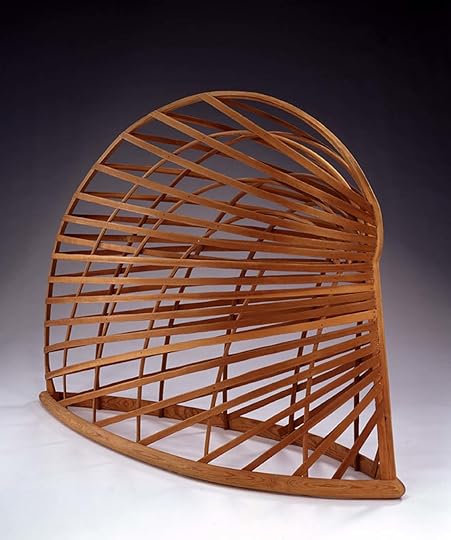
Bower, 1980 Sitka spruce, pine, and copper tacks 64 1/4 × 94 5/8 × 26 in. Smithsonian American Art Museum
In 1989 Puryear says he is "interested in realizing work that has a certain kind of independence from dogma and from theory and a capacity to speak in a way that I hope is visceral and direct, rather than needing a strictly historical or linear framework to be intelligible." (p. 184)
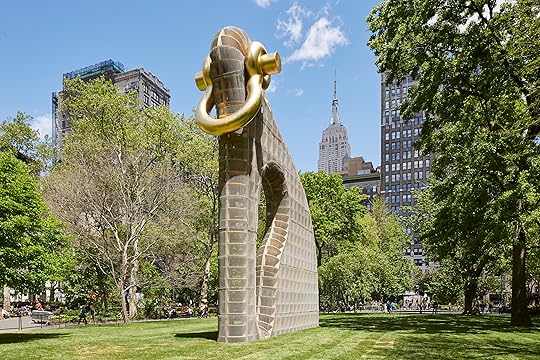
Big Bling, 2016 Wood, chain link fence, gold leaf Height: 40 feet Madison Square Park, NYC
Re Big Bling: "People ask me what is this sculpture of? What does it represent? I trust their eyes...their imagination...and I trust my work to be a visual poem." (newyorksocialdiary.com)
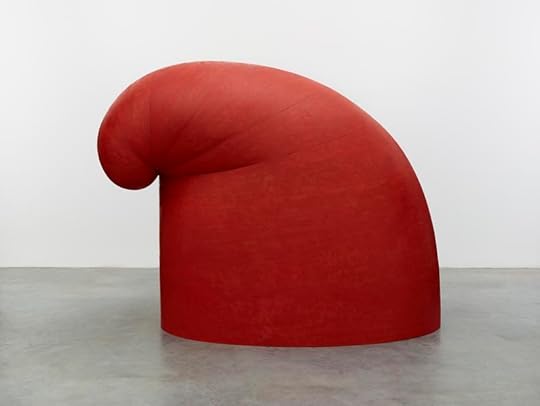
Big Phrygian, 2010-2014 Matthew Marks Gallery Painted red cedar 58 x 40 x 76 inches
Michael Auping's essay is excellent, as are the many, many images (including ones of little known work), but Elderfield's and Reed's are rather disappointing. Still. Vive Puryear!