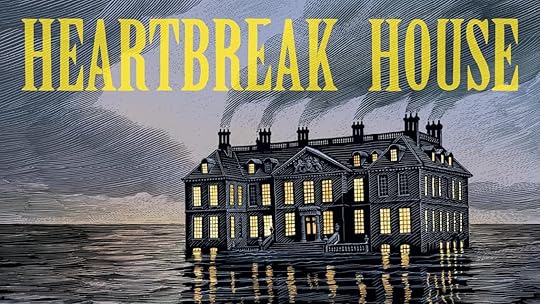
Heartbreak House (“HH”) by Bernard Shaw (“GBS”) is a selection on my 2020 Reading Challenge list. {SPOILER ALERT} British critics refer to George Bernard Shaw as Bernard Shaw. My edition of HH is British, but I will use “GBS” to connote Bernard Shaw. As always, my comments have some spoilers.
1. I rated this with 5 stars out of 5. I have devoted little time in my reviews to plays like HH. It is a comedy, and like many comedies, it has historical references unique to its own time. So I did not expect it to be as relevant to today as other works. But I know what a superb writer Shaw is, from his celebrated plays like “Pygmalion,” “Candida,” “The Devil’s Disciple,” and “Major Barbara.” And I am pleased that it exceeded my expectations. In the simplest terms, it tells me a lot about the leisure activities, and their accompanying deceptions and delusions, within much of the ruling classes of Europe just before the outbreak of World War I. And make no mistake about this play: it is all about the complete shattering of those deceptions and delusions, and the desperate need for our destroyed delusions in the face of the war’s horrible reality. So I will call it a black comedy dipped into the sulfuric acid of intense irony.
2. It begins with a lengthy preface identifying all the players throughout England and much of Europe as World War I (“the war to end all wars”) commenced. I was at first caught off guard about this piece of European history prefacing a comedy. But it all came together in his subsection of the preface entitled “The Next Phase,” and “The Ephemeral Thrones and the Eternal Theater,” and finally “How War Muzzles the Dramatic Poet.” Several quotes from these subsections are appropriate to explain why GBS delayed production of the play until after the Armistice: “In the meantime, there is, for him [referring to the American President Woodrow Wilson} another history to write; for me, another comedy to stage. Perhaps, after all, that is what wars are for, and what historians and playwrights are for. If men will not learn until their lessons are written in blood, why, blood they must have, their own for preference”; “…..Prime Ministers and Commanders-in-Chief have passed from a brief glory as Solons and Caesars into failure and obscurity as closely on one another’s heels as the descendants of Banquo; but Euripides and Aristophanes, Shakespear and Moliere, Goethe and Ibsen remain fixed in their everlasting seats…”; and “….what would have been the effect on the nation? That is why comedy, though sorely tempted, had to be loyally silent; for the art of the dramatic poet knows no patriotism; recognizes no obligation but truth to natural history; cares not whether German or England perish;…..and thus becomes in time of war a greater military danger than poison, steel, or trinitrotoluene. That is why I had to withhold Heartbreak House from the footlights during the war; for the Germans might on any night have turned the last act from play into earnest, and even then might not have waited for their cues.”
3. The heart of the story is the love interest between Ellie Dunn and Mangan. That creates a wonderful kind of fantasy about the chance of the marriage of the lower orders and wealthier capitalist dreams. But wait. Mangan turns out to be a fraud. So maybe it is the love interest between Ellie Dunn and Captain Shotover. But then that May-December non-romance has problems too, with her being his “white wife” and his fondness for rum to stay sober. Or maybe it is Hesione’s interest in trapping various men in her schemes. Or Addy’s interest in much the same thing. Or whatever! These various affairs are all part of the class struggles (as imagined by these clueless people) that GBS forces them all to portray, and yet all they do is create a miasma of utterly useless activities that leads merely to more histrionics. All these motivations at the center of HH have a limited life, because they are all playthings to keep these people too occupied from leading normal lives. And I think that is GBS’ point.
4. It is no accident that there are two casualties following the bombings of the cave in the gravel pit in Act Three: Mangan and the burglar. As Mazzini and Lady Utterword summarize the loss, Mangan and the burglar are both “burglars and two practical men of business.” We see GBS throwing his socialist axe into the mix on this conclusion.
5. There are too many hysterically funny scenes for me to recount. Here is one, about the burglar, who is caught upstairs in an attempted diamond theft (Act 2). He complains not that he has been caught, but rather that Mazzini used one of Hector’s dueling pistols to stop him and that it nearly took the skin off his ear. He then pleads to a “fair cop” and to be arrested immediately, saying “Ten little shining diamonds! Ten long black years!” and when they resist the complications of court proceedings, he exclaims, “No, I must work my sin off my conscience….I shall have my reward above.” As they continue to protest, the burglar even says, “It’s compounding a felon, you know.” At which point, Mangan expresses the ultimate irony in exasperation: “The very burglars can’t behave naturally in this house.” We all know what ultimately happens here, of course, when the burglar extorts money from them all to buy his silence. And taking up the collection for him is another absurd thing to see.
6. A second scene that is hilarious for me is the clash between Ellie and Mangan, coupled with the clash between Mangan and Mrs. Hushabye in Scene 2. After the constant derision, Mangan shouts out “Am I never to have the last word?” Shotover suddenly appears at the starboard garden door and says, “There is a soul in torment here. What is the matter?” Mangan replies that “The girl doesn’t want to spend her life wondering how long her gloves will last.” Of course, Shotover concludes the scene by saying, “Don’t wear any.” There you have it: an inane conversation concluded by a sound conclusion that is just as inane.
7. Shotover is a fascinating character for me. He is merely a vestige of a former age, as a retired sea captain who has created in his Sussex home what he thinks is a reasonable alternative to the ships he commanded. He is constantly cranky, and impressively wise (with some visionary ideas), and generally kept afloat with three bottles of rum a day. Although a realist, Shotover strives to attain the seventh degree of concentration, which I understand to be perfect tranquility. He also spends much of his time experimenting with death-dealing inventions, especially dynamite. The captain once sailed his ship, the “Dauntless,” around the world. Although he appears to live without rhyme or reason, he is well aware of what is going on under and above. He also displays beneath his pachydermatous appearance a tender heart and all the wisdom of GBS himself. It may be that GBS wrote him in as a speaker for himself. Although Shotover is the ultimate source of chaos, by confusing Mazzini Dunn for Billy Dunn, by ignoring the arrival of his long-lost daughter Lady Ariadne Utterword, and by spewing forth random comments as he wanders aimlessly on and off the stage, I think the Captain is the only one who remains oblivious to the frenzy of Heartbreak House: "I've stood on the bridge for 18 hours in a typhoon," he declares. "Life here is stormier; but I can stand it."
8. I think Shotover carries the heart of whatever moral there may be in HH. From his viewpoint as the last vestige of the old order, Shotover recognizes the problem most lucidly of all. He sees his daughters and their men living foolish lives of romance and sentiment and snobbery. And he sees the younger generation, turning from their romance and sentiment and snobbery to money and comfort and hard common sense. But I think he is sure that only by shunning these petty concerns can one hope not merely to survive but to live. He conveys both this integrity and plenty of salty humor through a slow, shuffling gait and simultaneously gruff and affectionate delivery. Shotover seems reconciled to having carved out a lifestyle for himself in a world in which he is merely a vestige of a former age. He is reconciled to it only by keeping to his own kind of delusion in which he blows up the entire world.
9. For anyone unsure about the subtitle of HH as “A Fantasia in the Russian Manner on English Themes,” it merely is homage to Anton Chekhov. The imprint of Chekhov's style is apparent in GBS's reliance on dialogue, rather than physical action or plot development, to express characterization and the atmosphere of pre-war England.
10. This play has been subject to numerous interpretations since its first performance in 1920. GBS's final act is especially ambiguous and leaves the audience pondering whether GBS fostered hopes for the establishment of a new post WWI social order or whether, like Chekhov, he foresaw only a grim continuation of existing institutions. To my thinking, GBS merely presented all the delusions that he saw for the present, especially facing mass destruction akin to the explosions at the very end of Act 3, leaving us only a choice among those many delusions. Or to put it differently, the play's central metaphor is civilization as a ship about to crash upon the rocks. It is also about love and marriage and money and, for the first time, old age. There is also something akin to intellectual exhaustion in HH. GBS, as a socialist, reformer, educator, orator, and vigorous pamphleteer, was confronting the likelihood that society's ills were not to be healed by a rational philosophy. This exhaustion may be in common with other writers who had done their major work before 1914, such as Henry James among them, and the outbreak of the war came as a ''devastating'' shock to GBS. It signaled the death of optimism.