

What do you think?

The Journey to the West #1
Путешествие на Запад, том 1
Написанный У Чэн-энем (1500-1582) около 1570 г. роман ”Путешествие на Запад” стал началом жанра героико-фантастической эпопеи. Повествование о похождениях Сунь У-куна – царя обезьян – стало одним из любимейших в Китае и одним из самых известных за рубежом. Роман У Чэн-эня ”Путешествие на Запад” основывается на народных легендах о путешествии монаха Сюань-цзана в Индию (VII в.). Постепенно сюжет обрастал дополнительными подробностями, становясь все больше похожим на волшебную сказку – появлялись дополнительные сюжеты, не связанные с основной темой, новые персонажи. У монаха появляются ”волшебные помощники” – царь обезьян Сунь У-кун, сосланный на землю за устроенный им переполох в Небесном дворце, и свин Чжу Ба-цзе, также сосланный с небес за провинности. Сунь У-кун – персонаж героический, Чжу Ба-цзе – комический. Вместе с монахом Сюань-цзаном они образуют весьма интересную группу, очень по-разному реагирующих на действительность. В романе У Чэн-эня вслед за народными легендами персонаж Сунь У-куна выходит на передний план, именно он побеждает врагов, пока монах Сюань-цзан рассуждает о всеобщей добродетели и непротивлению злу. Именно Сунь У-кун стал одним из любимейших героев китайской литературы, символом жизненной силы и бунтарства. Роман трактуется и как буддийское наставление, и как символическое отражение народной борьбы, и как волшебная сказка, и как роман о поисках истины.
ebook
First published January 1, 1592
About the author
Wu Cheng'en
677 books210 followersLibrarian Note: There is more than one author by this name in the Goodreads database.
Wu Cheng'en (simplified Chinese: 吴承恩; traditional Chinese: 吳承恩; pinyin: Wú Chéng'ēn, ca. 1505–1580 or 1500–1582, courtesy name Ruzhong (汝忠), pen name "Sheyang Hermit," was a Chinese novelist and poet of the Ming Dynasty, best known for being the probable author of one of the Four Great Classical Novels of Chinese literature, Journey to the West, also called Monkey.
Wu Cheng'en (simplified Chinese: 吴承恩; traditional Chinese: 吳承恩; pinyin: Wú Chéng'ēn, ca. 1505–1580 or 1500–1582, courtesy name Ruzhong (汝忠), pen name "Sheyang Hermit," was a Chinese novelist and poet of the Ming Dynasty, best known for being the probable author of one of the Four Great Classical Novels of Chinese literature, Journey to the West, also called Monkey.
Ratings & Reviews
Friends & Following
Create a free account to discover what your friends think of this book!
Community Reviews
Displaying 1 - 30 of 231 reviews

November 11, 2018
The star rating system is really not appropriate for classic books of this sort, read for curiosity and education as much as pleasure, but have a somewhat random 4.
I was led back to this by revisiting, this month, an anime/manga version from the early 00s of the adventure, Saiyuki by Kazyua Minekura, which may not even be the most gonzo version ever, though I suspect it's up there. But that should get a review of its own. I also see by my Netflix that there is a new Chinese movie of The Journey by the same director who gifted us with the also deeply gonzo Kung Fu Hustle. Clearly, I will have to follow this up.
I had read, some years ago, the now-classic abridged translation by Arthur Waley titled Monkey, which gives the gist of the tale, but I was curious about what all had been left out. So rather than rereading to refresh my failing memory, I poked around Amazon and found this.
Good choice. Besides the instant large print available on my tablet, the footnotes system (and boy, does this need its footnotes and annotations) is brilliant: just click on the little blue number, and the footnote appears as a handy popup, departing at the next click. Some of the footnotes are also pretty amusing in their own right, particularly when the translator vents his despair at translating the Chinese puns and wordplay in the original. The translator's English prose is smooth and clever, and he does an elegant job on the many interspersed poems, as well. Well worth the academic-press e-price.
The translator starts with a 90-page intro written in high academic, parts of which I judge worth having plowed through. It includes most usefully a short bio of the real 7th Century Tang monk on whose decades-long trip to India to gather and bring back to China Buddhist scriptures so much folklore, religious and social allegory, wonder tales, and more have accreted over the ensuing centuries. Now I want to go find an expansion of that, because, really, it sounds like a spectacular adventure in its own right, without any need for supernatural helpers. For quicker orientation for those unfamiliar with much Chinese history or literature, Wikipedia can also help out.
One of the comparisons made in that long intro was with Edmund Spenser's The Fairie Queene, which I thought illuminating. Both were from about the same era, on opposite sides of the planet, both offered an adventure tale on a substrate of religious and other metaphor and allegory. I read the Spenser when I was 15, as a result of having read the parody of same in one of the De Camp & Pratt's The Incomplete Enchanter fantasies and tracking back. Spenser's allegory was a lot more accessible, partly because I knew more about the sources, partly because he was sort of thudding about it. I have much less idea what all the Journey writer is drawing on, because not my culture, though the footnotes help. But his storytelling does seem more fluid than the rather rigid Elizabethan writer.
Though one of the things that has glimmered up to me just from what I've read so far is what short shrift the usual thumbnail histories of China that the average American encounters gives to Daoism and Chinese mythology generally. Buddhism and Confucianism get way more page time. The Journey writer seems to be playing hard with all three. Chinese medieval alchemy and European medieval alchemy may be off-putting to modern sensibilities for much the same reasons: deliberately obscurantist, over-complicated, and wrong, so why spend the brain space? Unless one is an historian of ideas, whom I will cheerfully sacrifice in my place.
Anyway, as Chapter 25 of this 100-chapter four-volume edition ends on a cliffhanger, with our Monkey King hero about to be fried in oil by his justifiably irate Daoist host, I shall shortly plow on to Volume 2. (Also, word on the street is that there is an mpreg chapter, no, really, in Volume 3, which clearly cannot be missed.) I trust it will take me less time to get to India than our heroes ancient or modern.
Ta, L.
I was led back to this by revisiting, this month, an anime/manga version from the early 00s of the adventure, Saiyuki by Kazyua Minekura, which may not even be the most gonzo version ever, though I suspect it's up there. But that should get a review of its own. I also see by my Netflix that there is a new Chinese movie of The Journey by the same director who gifted us with the also deeply gonzo Kung Fu Hustle. Clearly, I will have to follow this up.
I had read, some years ago, the now-classic abridged translation by Arthur Waley titled Monkey, which gives the gist of the tale, but I was curious about what all had been left out. So rather than rereading to refresh my failing memory, I poked around Amazon and found this.
Good choice. Besides the instant large print available on my tablet, the footnotes system (and boy, does this need its footnotes and annotations) is brilliant: just click on the little blue number, and the footnote appears as a handy popup, departing at the next click. Some of the footnotes are also pretty amusing in their own right, particularly when the translator vents his despair at translating the Chinese puns and wordplay in the original. The translator's English prose is smooth and clever, and he does an elegant job on the many interspersed poems, as well. Well worth the academic-press e-price.
The translator starts with a 90-page intro written in high academic, parts of which I judge worth having plowed through. It includes most usefully a short bio of the real 7th Century Tang monk on whose decades-long trip to India to gather and bring back to China Buddhist scriptures so much folklore, religious and social allegory, wonder tales, and more have accreted over the ensuing centuries. Now I want to go find an expansion of that, because, really, it sounds like a spectacular adventure in its own right, without any need for supernatural helpers. For quicker orientation for those unfamiliar with much Chinese history or literature, Wikipedia can also help out.
One of the comparisons made in that long intro was with Edmund Spenser's The Fairie Queene, which I thought illuminating. Both were from about the same era, on opposite sides of the planet, both offered an adventure tale on a substrate of religious and other metaphor and allegory. I read the Spenser when I was 15, as a result of having read the parody of same in one of the De Camp & Pratt's The Incomplete Enchanter fantasies and tracking back. Spenser's allegory was a lot more accessible, partly because I knew more about the sources, partly because he was sort of thudding about it. I have much less idea what all the Journey writer is drawing on, because not my culture, though the footnotes help. But his storytelling does seem more fluid than the rather rigid Elizabethan writer.
Though one of the things that has glimmered up to me just from what I've read so far is what short shrift the usual thumbnail histories of China that the average American encounters gives to Daoism and Chinese mythology generally. Buddhism and Confucianism get way more page time. The Journey writer seems to be playing hard with all three. Chinese medieval alchemy and European medieval alchemy may be off-putting to modern sensibilities for much the same reasons: deliberately obscurantist, over-complicated, and wrong, so why spend the brain space? Unless one is an historian of ideas, whom I will cheerfully sacrifice in my place.
Anyway, as Chapter 25 of this 100-chapter four-volume edition ends on a cliffhanger, with our Monkey King hero about to be fried in oil by his justifiably irate Daoist host, I shall shortly plow on to Volume 2. (Also, word on the street is that there is an mpreg chapter, no, really, in Volume 3, which clearly cannot be missed.) I trust it will take me less time to get to India than our heroes ancient or modern.
Ta, L.

January 15, 2019
Journey to the West is one of the great Classic Chinese Novels. It’s one of the great works of Chinese literature. It’s a fictionalized account of the legends around a Buddhist monk’s pilgrimage to India in order to obtain religious texts. And to say it is a popular story nowadays would honestly be an understatement. It’s probably one of the most influential and most retold stories in the world right now. So, I thought the original story might be worth taking a look at. And I’m glad I did. I’m looking at this mostly from an entertainment point of view but there are of course many other ways to look at this story.
The story starts with the birth of monkey, also known as Sun Wukong. His character is that of a skilled fighter, but also a trickster because of his childlike playfulness and his goofy impulsiveness. He’s a cheeky monkey and he’s easily the strongest and most fleshed out character in the entire story. His character has been very influential in for example some popular Japanese shonen manga. This is mostly thanks to the popularity of Dragon Ball, which was partly inspired by Journey to the West. He’s a very intelligent, inquisitive and independent strong character who’s not afraid to make his own decisions. He’s not always a likeable character though. He’s selfish, childish and very egotistical. But when he goes overboard, he frequently gets punished to counteract this and to basically teach him a lesson.
Monkey doesn’t take long to crown himself the monkey king. But he quickly finds himself worrying about the future. The monkey king then decides to leave the mountain he has called home for so long, in search of immortality. Long story short, the monkey king causes some trouble for the gods. The greatest divine battle ever ensues, the monkey king is defeated and is trapped and buried underneath a mountain.
A long time later, a monk known as Tang Sanzang or Tripitaka is tasked with retrieving original religious scriptures for China. During his pilgrimage, he will undoubtedly encounter many dangers and monsters. Since the monk is clueless and powerless, the heavenly powers look for some powerful disciples to aid and protect him on his journey. In return, the disciples will be forgiven for their sins once the journey is over. The first to accept this task is the monkey king, who is finally freed from his prison under the mountain.
The monk Tang Sanzang is the protagonist and he advances the plot. Much like Rincewind from Terry Pratchett's Discworld series, his primary function is not to be interesting by himself but rather to meet interesting people. The monkey king being a prime example of the character that absolutely steals the show in this story. He isn’t the only interesting disciple the monk picks up along the way though. Zhu Bajie is half pig, half human. Much like the monkey king, he is a skilled fighter with a flawed personality. He frequently gets his friends into trouble thanks to his laziness and his insatiable appetite. And he is very jealous of the monkey king. A third disciple named Sha Wujing got turned into a monster and sent to the mortal world as punishment. He doesn’t really get fleshed out much but he’s a character with potential. He’s basically the quiet but dependable disciple. There’s also a dragon who gets turned into a horse, which completes the main cast.
The actual plot takes a while to really get going but even the backstory and the fleshing out of the monkey king is very interesting and certainly not uneventful. A pretty good start to an epic and historically fascinating adventure of a lifetime.
The story starts with the birth of monkey, also known as Sun Wukong. His character is that of a skilled fighter, but also a trickster because of his childlike playfulness and his goofy impulsiveness. He’s a cheeky monkey and he’s easily the strongest and most fleshed out character in the entire story. His character has been very influential in for example some popular Japanese shonen manga. This is mostly thanks to the popularity of Dragon Ball, which was partly inspired by Journey to the West. He’s a very intelligent, inquisitive and independent strong character who’s not afraid to make his own decisions. He’s not always a likeable character though. He’s selfish, childish and very egotistical. But when he goes overboard, he frequently gets punished to counteract this and to basically teach him a lesson.
Monkey doesn’t take long to crown himself the monkey king. But he quickly finds himself worrying about the future. The monkey king then decides to leave the mountain he has called home for so long, in search of immortality. Long story short, the monkey king causes some trouble for the gods. The greatest divine battle ever ensues, the monkey king is defeated and is trapped and buried underneath a mountain.
A long time later, a monk known as Tang Sanzang or Tripitaka is tasked with retrieving original religious scriptures for China. During his pilgrimage, he will undoubtedly encounter many dangers and monsters. Since the monk is clueless and powerless, the heavenly powers look for some powerful disciples to aid and protect him on his journey. In return, the disciples will be forgiven for their sins once the journey is over. The first to accept this task is the monkey king, who is finally freed from his prison under the mountain.
The monk Tang Sanzang is the protagonist and he advances the plot. Much like Rincewind from Terry Pratchett's Discworld series, his primary function is not to be interesting by himself but rather to meet interesting people. The monkey king being a prime example of the character that absolutely steals the show in this story. He isn’t the only interesting disciple the monk picks up along the way though. Zhu Bajie is half pig, half human. Much like the monkey king, he is a skilled fighter with a flawed personality. He frequently gets his friends into trouble thanks to his laziness and his insatiable appetite. And he is very jealous of the monkey king. A third disciple named Sha Wujing got turned into a monster and sent to the mortal world as punishment. He doesn’t really get fleshed out much but he’s a character with potential. He’s basically the quiet but dependable disciple. There’s also a dragon who gets turned into a horse, which completes the main cast.
The actual plot takes a while to really get going but even the backstory and the fleshing out of the monkey king is very interesting and certainly not uneventful. A pretty good start to an epic and historically fascinating adventure of a lifetime.

July 27, 2013
I read the four-volume revised Kindle edition of this book, translated by Anthony C. Yu. The story is the fictive rendition of a journey made by a 7th century Buddhist monk, Xuanzang, during the Tang Dynasty. He undertook his famous, nearly two decade-long pilgrimage in order to study Buddhism and acquire original Sanskrit texts of the religion from India. When he returned to China, he translated many of the original texts to Chinese, thus leaving a decisive legacy on Chinese Buddhism. Some of the pilgrim's original scrolls are saved in a pagoda inside Xingijao Temple near today's Xian.
The story starts with the mystical events of a creature becoming the (Handsome) Monkey King. Through various twists and turns, he acquires great skills and a variety of supernatural power which he will continue to use throughout the book. Some mischievous acts in Heaven land him in trouble but upon the departure of Xuanzang - in the book also called the Tang Monk or Tripitaka after the Three Baskets of Buddhism that held the 3 original Buddhist scrolls - from the Emperor's palace, the Monkey King is given the opportunity to become the disciple and protector of the Monk. In the first phase of the long journey Tripitaka is granted two additional converted vicious monsters as his disciples: Eight Rules who has the appearance of a pig and Sha Monk who has the look of a water buffalo. To complete the mystical traveling company, a water monster is enforced to serve as the replacement of Tripitaka's deceased horse.
The bulk of the story is the description of the group's arduous traveling through impenetrable forests, burning mountains, and dangerous rushing rivers. They encounter countless demons, spirits, monsters, dragons, and fiends who invariably want to devour the guiltless Tripitaka. This enhanced interest in the Tang Monk as a culinary delight roots from his purity that is thought to guarantee extremely long life to the cannibalistic food connoisseurs. With his boundless ingenuity and smarts the Monkey King leads the three disciples to defend the Monk.
For the contemporary reader, the story has a few stumbling blocks, not the least of which is the length of almost 2400 pages. In the book one will find numerous repetitions where the four main heroes tend to recite some of their earlier adventures in various situations when they meet new characters. The reader is already fully aware of these events and they tend to slow down the flow of the story. One can skip these paragraphs however, without losing much from the narration.
For some readers another obstacle could be the numerous poems and songs throughout the book. In my rough estimation 15-20% of the text may well be poetry. The poems are enjoyable and usually provide finer details of, or clarifications to, the main story. As such, they are more functionally part of the book then in another classic pillar of ancient Chinese literature, the poetry in the Dreams of the Red Mansion. In that book the poems and songs are highly transcendent with the purpose of providing insight into the characters' inner selves. I skimmed through many, but not all poems. Others may decide to skip the poems altogether but those who decide to read them in even greater details, will experience an enhanced overall literary beauty of the book.
Of the four characters, the Monkey King is by far the best portrayed one and the main reason I gave not 3 but 4 stars to this book. He is an absolute riot; a perfect timeless embodiment of a bad guy turned good who has a curiously complex psyche with a mixture of self-adoration, self-assuredness, mischief, steadfast loyalty, courage, wisdom, practicality, and, on the top of everything, a great sense of humor. Typical of him is the name he has chosen to himself early in the story: The Great Sage Equal to Heaven.
Among all the fictive characters I have encountered in my readings, the Monkey King has become one of my all time favorites for his colorful and likeable temperament and for the exquisite perfection with which he has been portrayed.
Although the Tang Monk is formally the lead-hero of the story, he really pales in comparision to the Monkey King. He is the most benevolent, spiritually pure individual imaginable who is singularly driven by his unshakable convictions and principled Buddhist mind. Unfortunately, he is also gullible to the point of annoyance and this brings a copious amount of trouble to the poor Monkey King.
Eight Rules is a secondary character whose personality is also drawn with an expert pen. He is stupid, yet quite capable in many ways. His loyalty to the Monk never feels solidified, however he seems to function perfectly well under the critical tutelage of the Monkey King and the exculpation of the high-minded Tripitaka.
The character of the third disciple, Sha Monk, is far less complete than the previous three and doesn't deserve particular attention in this review.
Overall, the book in its full length is not an easy read. I recommend it mostly to those tickled by a potential glimpse into the spirituality of an ancient world, namely the Tang Dynasty, from the perspective of a much later, but still very old, time, namely the late Ming Dynasty. What a rare privilege to enjoy such a treasure!
An abridged English translation is also available for those curious readers with a more tepid interest.
Additional information: The book has served as inspiration for multiple movies, TV shows, stage plays, and comics. I saw one of these adaptations, Alakazam the Great. This Japanese cartoon film, although adorable in its own right, in no way should be considered a faithful presentation of the original story. I've also read the Ultimate Journey: Retracing the Path of an Ancient Buddhist Monk Who Crossed Asia in Search of Enlightenment, by Richard Bernstein. The book adds a unique, modern-time perspective to this ancient story.
The story starts with the mystical events of a creature becoming the (Handsome) Monkey King. Through various twists and turns, he acquires great skills and a variety of supernatural power which he will continue to use throughout the book. Some mischievous acts in Heaven land him in trouble but upon the departure of Xuanzang - in the book also called the Tang Monk or Tripitaka after the Three Baskets of Buddhism that held the 3 original Buddhist scrolls - from the Emperor's palace, the Monkey King is given the opportunity to become the disciple and protector of the Monk. In the first phase of the long journey Tripitaka is granted two additional converted vicious monsters as his disciples: Eight Rules who has the appearance of a pig and Sha Monk who has the look of a water buffalo. To complete the mystical traveling company, a water monster is enforced to serve as the replacement of Tripitaka's deceased horse.
The bulk of the story is the description of the group's arduous traveling through impenetrable forests, burning mountains, and dangerous rushing rivers. They encounter countless demons, spirits, monsters, dragons, and fiends who invariably want to devour the guiltless Tripitaka. This enhanced interest in the Tang Monk as a culinary delight roots from his purity that is thought to guarantee extremely long life to the cannibalistic food connoisseurs. With his boundless ingenuity and smarts the Monkey King leads the three disciples to defend the Monk.
For the contemporary reader, the story has a few stumbling blocks, not the least of which is the length of almost 2400 pages. In the book one will find numerous repetitions where the four main heroes tend to recite some of their earlier adventures in various situations when they meet new characters. The reader is already fully aware of these events and they tend to slow down the flow of the story. One can skip these paragraphs however, without losing much from the narration.
For some readers another obstacle could be the numerous poems and songs throughout the book. In my rough estimation 15-20% of the text may well be poetry. The poems are enjoyable and usually provide finer details of, or clarifications to, the main story. As such, they are more functionally part of the book then in another classic pillar of ancient Chinese literature, the poetry in the Dreams of the Red Mansion. In that book the poems and songs are highly transcendent with the purpose of providing insight into the characters' inner selves. I skimmed through many, but not all poems. Others may decide to skip the poems altogether but those who decide to read them in even greater details, will experience an enhanced overall literary beauty of the book.
Of the four characters, the Monkey King is by far the best portrayed one and the main reason I gave not 3 but 4 stars to this book. He is an absolute riot; a perfect timeless embodiment of a bad guy turned good who has a curiously complex psyche with a mixture of self-adoration, self-assuredness, mischief, steadfast loyalty, courage, wisdom, practicality, and, on the top of everything, a great sense of humor. Typical of him is the name he has chosen to himself early in the story: The Great Sage Equal to Heaven.
Among all the fictive characters I have encountered in my readings, the Monkey King has become one of my all time favorites for his colorful and likeable temperament and for the exquisite perfection with which he has been portrayed.
Although the Tang Monk is formally the lead-hero of the story, he really pales in comparision to the Monkey King. He is the most benevolent, spiritually pure individual imaginable who is singularly driven by his unshakable convictions and principled Buddhist mind. Unfortunately, he is also gullible to the point of annoyance and this brings a copious amount of trouble to the poor Monkey King.
Eight Rules is a secondary character whose personality is also drawn with an expert pen. He is stupid, yet quite capable in many ways. His loyalty to the Monk never feels solidified, however he seems to function perfectly well under the critical tutelage of the Monkey King and the exculpation of the high-minded Tripitaka.
The character of the third disciple, Sha Monk, is far less complete than the previous three and doesn't deserve particular attention in this review.
Overall, the book in its full length is not an easy read. I recommend it mostly to those tickled by a potential glimpse into the spirituality of an ancient world, namely the Tang Dynasty, from the perspective of a much later, but still very old, time, namely the late Ming Dynasty. What a rare privilege to enjoy such a treasure!
An abridged English translation is also available for those curious readers with a more tepid interest.
Additional information: The book has served as inspiration for multiple movies, TV shows, stage plays, and comics. I saw one of these adaptations, Alakazam the Great. This Japanese cartoon film, although adorable in its own right, in no way should be considered a faithful presentation of the original story. I've also read the Ultimate Journey: Retracing the Path of an Ancient Buddhist Monk Who Crossed Asia in Search of Enlightenment, by Richard Bernstein. The book adds a unique, modern-time perspective to this ancient story.

October 2, 2022
This translation is a comprehensive work covering 100 chapters of Journey to the West. Volume I consists of the first 25 chapters. It's a bit of a slow start, but once the journey itself begins and each chapter ends on a cliffhanger, you're drawn quickly to the next adventure. (In all, it also resembles a travel book, albeit one of mythical landscapes and legendary escapades.) What is going to be off putting for quite a few readers is the translator's Introduction, which covers almost 200 pages. The Intro contains much interesting and valuable information, especially for scholars in the area, but it most appropriately should be positioned as an Afterwards. Too much analysis and detailed citing of earlier works makes it largely valueless for someone with but a bare minimum of knowledge about Journey and its place in Chinese literature.
What couldn't be helped, is my trying to find equivalents in other myths and epics. The tale of the Monkey King and his search for immortality, for example, echoes Gilgamesh. Old Monkey's abilitly to transport himself over vast distances with but one step and riding across the sky on clouds sounds similar to Seven-League Boots and Arabian Nights. And, yes, the way in which villainous characters are drafted into Tripitaka's (Xuanzang) band and made into monks, wayward though they may be, reminds me of The Wizard of Oz. Outrageous you say? Oz includes "The Dainty China Country" in its tale, and, indeed, Oz could be China.
Up next. Volume 2.
What couldn't be helped, is my trying to find equivalents in other myths and epics. The tale of the Monkey King and his search for immortality, for example, echoes Gilgamesh. Old Monkey's abilitly to transport himself over vast distances with but one step and riding across the sky on clouds sounds similar to Seven-League Boots and Arabian Nights. And, yes, the way in which villainous characters are drafted into Tripitaka's (Xuanzang) band and made into monks, wayward though they may be, reminds me of The Wizard of Oz. Outrageous you say? Oz includes "The Dainty China Country" in its tale, and, indeed, Oz could be China.
Up next. Volume 2.
December 25, 2016
A monk and his 3 supernatural disciples set out on a journey westward to obtain buddhist scriptures. Actually that description is the story eventually... there's quite a bit of build up and background to get through first.
So there were a few surprises in this for me. Firstly while it might well be based on ancient legend this isn't some oral tale which has simply been written down but rather a proper literary piece from the 16th century.
Which is quite recent from china's point of view. I find it quite difficult to read fairytales so was quite glad this wasn't one.
Secondly i'm a big fan of the tv adaptation of this 'Monkey'. It was a 70's show made by japan rather than china* and then dubbed into english by people who often didn't even have a script, they would just make up the story based on what seemed to be happening on screen.
For all of these reasons i assumed that the book would bare little resemblance to the show, but i was wrong. All the crazy, funny ridiculousness of the show is totally in here :D .
The comedy and satire is Rabelais-esque at times.
About a 5th of the story is done in poetry. I don't know whether this rhymed in its original language but it doesn't now. It still has a certain rhythm about it though. I might have disliked the poetry except that it only occurs on specific occasions.
Its basically a descriptor. Whenever someone or something new turns up or when there's a fight sequence it switches to poetry and the poetry is usually more over the top than the prose.
Its like in certain movies or shows where they might switch to animation for fight sequences, or in certain kinds of musical where the songs are only used to replace fight or love scenes.
The story can get a bit repetitive both figuratively and literally. Literally in that every so often you get a little recap of events. One character will go off and do something, then comeback and tell people what they've just done.
I didn't mind this so much as it was never very long and did make me remember things a bit better.
The other repetitiveness is a little more annoying as several of the fight sequences follow a very similar pattern which can start to get old.
Oh, one other thing that some might find annoying is the buddhism. There are various pieces of buddhist philosophy in this which will make no sense to most people.
I don't even know if their real. Its like quantum theory, someone could be telling you a real but confusing piece of quantum theory or a fake bit, i simply don't have the necessary experience to tell the difference.
Anyway, i was constantly hearing the people from the tv show in my head (aswell as picturing the very pretty monk ;) ) so i feel like i may be more naturally inclined to like this over people who didn't see the show.
I look forward to reading the rest of the volumes but not right away, i think a break between each one is a good strategy.
*the male monk is played by a female actress on the show which caused me considerable confusion as a child :) .
So there were a few surprises in this for me. Firstly while it might well be based on ancient legend this isn't some oral tale which has simply been written down but rather a proper literary piece from the 16th century.
Which is quite recent from china's point of view. I find it quite difficult to read fairytales so was quite glad this wasn't one.
Secondly i'm a big fan of the tv adaptation of this 'Monkey'. It was a 70's show made by japan rather than china* and then dubbed into english by people who often didn't even have a script, they would just make up the story based on what seemed to be happening on screen.
For all of these reasons i assumed that the book would bare little resemblance to the show, but i was wrong. All the crazy, funny ridiculousness of the show is totally in here :D .
The comedy and satire is Rabelais-esque at times.
About a 5th of the story is done in poetry. I don't know whether this rhymed in its original language but it doesn't now. It still has a certain rhythm about it though. I might have disliked the poetry except that it only occurs on specific occasions.
Its basically a descriptor. Whenever someone or something new turns up or when there's a fight sequence it switches to poetry and the poetry is usually more over the top than the prose.
Its like in certain movies or shows where they might switch to animation for fight sequences, or in certain kinds of musical where the songs are only used to replace fight or love scenes.
The story can get a bit repetitive both figuratively and literally. Literally in that every so often you get a little recap of events. One character will go off and do something, then comeback and tell people what they've just done.
I didn't mind this so much as it was never very long and did make me remember things a bit better.
The other repetitiveness is a little more annoying as several of the fight sequences follow a very similar pattern which can start to get old.
Oh, one other thing that some might find annoying is the buddhism. There are various pieces of buddhist philosophy in this which will make no sense to most people.
I don't even know if their real. Its like quantum theory, someone could be telling you a real but confusing piece of quantum theory or a fake bit, i simply don't have the necessary experience to tell the difference.
Anyway, i was constantly hearing the people from the tv show in my head (aswell as picturing the very pretty monk ;) ) so i feel like i may be more naturally inclined to like this over people who didn't see the show.
I look forward to reading the rest of the volumes but not right away, i think a break between each one is a good strategy.
*the male monk is played by a female actress on the show which caused me considerable confusion as a child :) .

September 16, 2017
This first volume is pretty interesting and less formulaic than the subsequent volumes, which are the pilgrims' episodic adventures, rinsed and repeated. Here we start with Monkey's enlightenment, how he causes chaos in Heaven and is punished; the Tang Emperor makes a really trivial mistake that almost costs him his life and necessitates the commission of a pilgrimage to India to show his piety; Guanyin doing the legwork of gathering all the involved parties for Tripitaka's pilgrimage.
Tripitaka, Monkey and Pigsy's backstories are pretty vivid; it is kind of hilarious that Monkey is a total ruffian, much like the thugs in 水浒传 Outlaws of the Marsh, Pigsy is lazy, lecherous, and sinful, and Tripitaka is naggy and cowardly. Sandy and the horse... don't really need to be mentioned.
One annoying thing about this story is the fact that all the demons are really there just for the sake of being enemies and putting tribulations in Tripitaka's way. These deus ex machina interventions by gods and deities remove tension from the story since you never really fear for the characters too much. But if you know the story I'm sure you were prepared for that. This translation, with its very comprehensive introduction (though the academic jargon is at times unforgivably tortuous) is a decent one to pick up.
Tripitaka, Monkey and Pigsy's backstories are pretty vivid; it is kind of hilarious that Monkey is a total ruffian, much like the thugs in 水浒传 Outlaws of the Marsh, Pigsy is lazy, lecherous, and sinful, and Tripitaka is naggy and cowardly. Sandy and the horse... don't really need to be mentioned.
One annoying thing about this story is the fact that all the demons are really there just for the sake of being enemies and putting tribulations in Tripitaka's way. These deus ex machina interventions by gods and deities remove tension from the story since you never really fear for the characters too much. But if you know the story I'm sure you were prepared for that. This translation, with its very comprehensive introduction (though the academic jargon is at times unforgivably tortuous) is a decent one to pick up.

February 3, 2012
I really enjoy, as most do, Part One, the origin of Sun Wukong and his hell-raising days before he is finally subdued by Buddha. After that, I am often annoyed, as some are, by how weepy yet obstinate Xuanzang is (especially because he is supposed to be a highly cultivated monk), how underdeveloped the characters Sha Wujing and Yulong Santaiz are, how repetitive the 81 ordeals can be, and the author's repeated use of deus ex machina. Nevertheless, it is a fascinating and often hilarious adventure story of enlightenment. I only wish I could read the Chinese original -- I'm certain the poems would be more fluid and beautiful and the text would be full of wordplay. I would also be interested in reading an annotated version.

August 4, 2020
Va čia tai pasakojimas. Dabar aišku iš kur Liu Cixin'as taip moka siužetą raityti. Tradicija.

May 28, 2023
Was your gateway to anime either Dragonball or Inuyasha*? Do you in general enjoy storytelling that features adventures of the week AND slow-burn character development? Do you like classical allegorical journeys-of-the-soul a la Dante’s The Divine Comedy, but feel they could do with a bit more satire and/or a ridiculously over-powered monkey sidekick? If you answered “yes” to any of these questions, then you need to read this.
Volume 1 starts out like any good superhero story: with backstories and assembling the team. Monkey gets the most extensive and badass origin story, which includes hatching out of a stone egg, becoming immortal at least 3 times over, and getting in fights with the entire heavenly bureaucracy before Buddha puts him in a 500 year time-out under a mountain. But Tripitaka’s family history is kinda hardcore as well. With the blessing/prodding of Boddhisatva/Goddess of Mercy Guanyin, the monk sets out to retrieve some scriptures from India – a task based on an actual Tang dynasty pilgrimage. He picks up Monkey (representing mind) and 3 other super-powered disciples on the way: a young dragon who takes the form of a horse (representing will), a hog-faced dude (representing the appetites) commonly known as Pigsy - though here his names are more literally translated as Eight Rules, Idiot, or Old Hog – and a river spirit Sandy/Sha Monk (I THINK representing something like energy or chi?). They proceed to bicker and fight demons for thousands of miles.
If you’re curious whether this is something you’d like, check out the delightfully illustrated YouTube summaries made by OSP: https://www.youtube.com/watch?v=61nuX... . I thought they were making a joke about the influence this has had on anime by having a “next time, on…Journey to the West!” ending. But no, the chapters actually end like that!: “We do not know where the chase took them to or what was the outcome of the fight. Let’s listen to the explanation in the next chapter”
Speaking of which, volume 1 leaves off on a Daoist immortal threatening to cook the crew in a giant frying pan (not particularly priestly behavior, I’d have thought!) due to some Monkey and Pigsy shenanigans involving long-life fruits that look bizarrely like newborn infants. Luckily, my volumes 2 & 3 are in the mail, and I’m looking forward to continuing the adventure.
*Dragonball’s Son Goku is directly based on Monkey, AKA Sun Wukong. But Inuyasha has the whole team:
- Reincarnation of an ancient priest(ess), on a quest to collect magical/religious item = Tripitaka/Kagome (Refreshingly, she probably gets kidnapped LESS than Tripitaka)
- Hot-headed, impulsive dude with animal characteristics and impressive fighting skills, who can be controlled by some magical jewelry = Monkey/Inuyasha ("Inuyasha, SIT!")
- Guy who’s creepily lecherous and also a bit too focused on food, who gradually reforms = Pigsy/Miroku
- Magical steed = Dragon horse/Kirara
- The…other one, who’s pretty useful in fighting demons = Sandy/Sango (The latter establishes her personality a bit quicker, TBH)
+ bonus adorable child (Shippo)
Volume 1 starts out like any good superhero story: with backstories and assembling the team. Monkey gets the most extensive and badass origin story, which includes hatching out of a stone egg, becoming immortal at least 3 times over, and getting in fights with the entire heavenly bureaucracy before Buddha puts him in a 500 year time-out under a mountain. But Tripitaka’s family history is kinda hardcore as well. With the blessing/prodding of Boddhisatva/Goddess of Mercy Guanyin, the monk sets out to retrieve some scriptures from India – a task based on an actual Tang dynasty pilgrimage. He picks up Monkey (representing mind) and 3 other super-powered disciples on the way: a young dragon who takes the form of a horse (representing will), a hog-faced dude (representing the appetites) commonly known as Pigsy - though here his names are more literally translated as Eight Rules, Idiot, or Old Hog – and a river spirit Sandy/Sha Monk (I THINK representing something like energy or chi?). They proceed to bicker and fight demons for thousands of miles.
If you’re curious whether this is something you’d like, check out the delightfully illustrated YouTube summaries made by OSP: https://www.youtube.com/watch?v=61nuX... . I thought they were making a joke about the influence this has had on anime by having a “next time, on…Journey to the West!” ending. But no, the chapters actually end like that!: “We do not know where the chase took them to or what was the outcome of the fight. Let’s listen to the explanation in the next chapter”
Speaking of which, volume 1 leaves off on a Daoist immortal threatening to cook the crew in a giant frying pan (not particularly priestly behavior, I’d have thought!) due to some Monkey and Pigsy shenanigans involving long-life fruits that look bizarrely like newborn infants. Luckily, my volumes 2 & 3 are in the mail, and I’m looking forward to continuing the adventure.
*Dragonball’s Son Goku is directly based on Monkey, AKA Sun Wukong. But Inuyasha has the whole team:
- Reincarnation of an ancient priest(ess), on a quest to collect magical/religious item = Tripitaka/Kagome (Refreshingly, she probably gets kidnapped LESS than Tripitaka)
- Hot-headed, impulsive dude with animal characteristics and impressive fighting skills, who can be controlled by some magical jewelry = Monkey/Inuyasha ("Inuyasha, SIT!")
- Guy who’s creepily lecherous and also a bit too focused on food, who gradually reforms = Pigsy/Miroku
- Magical steed = Dragon horse/Kirara
- The…other one, who’s pretty useful in fighting demons = Sandy/Sango (The latter establishes her personality a bit quicker, TBH)
+ bonus adorable child (Shippo)

October 7, 2018
Sorry in advance for a terrible review, I suck at writing them.
So The Journey to the West starts out with this stone monkey and his adventures on Flower-Fruit Mountain. After the first 7 or so chapters we move to a Buddhist monk and his 3 disciples (one of those being that monkey) going on (surprise!) a journey to the west. I found this book really fascinating and surprisingly easy to read. So far in this story they haven’t accomplished much and have mostly just been gathering disciples, fighting monsters, and stealing things (cough Sun Wu’Kung cough). Looking forward to reading volume 2. I just started watching the new Netflix adaptation called the New Legends of Monkey or something like that and honestly it’s really not great.
So The Journey to the West starts out with this stone monkey and his adventures on Flower-Fruit Mountain. After the first 7 or so chapters we move to a Buddhist monk and his 3 disciples (one of those being that monkey) going on (surprise!) a journey to the west. I found this book really fascinating and surprisingly easy to read. So far in this story they haven’t accomplished much and have mostly just been gathering disciples, fighting monsters, and stealing things (cough Sun Wu’Kung cough). Looking forward to reading volume 2. I just started watching the new Netflix adaptation called the New Legends of Monkey or something like that and honestly it’s really not great.

June 3, 2024
"Nothing in the world is difficult, only the mind makes it so."
Finishing the first of four parts of Antony C. Yu's translation of Journey to the West, I found it more engaging and profound than I had expected. While Monk Tripitaka/Tang Xuanzang, Sun Wukong/Monkey King, Zhu Eight Rules/Zhu Wuneng, Sha Wujing, and the White Dragon Horse's epic journey is undoubtedly goofy, repetitive, and full of incomprehensible references to Buddhist and Daoist deities, it is nonetheless worth reading for its intricacy, humour, and occasional wisdom.
If you have the patience to read through the introduction, you might understand why it is a story known and loved around all Asian countries, continuously inspiring newer adaptions, including the worldwide celebrated Dragon Ball.
For me, the obvious star of the show is Monkey, and I enjoyed the first chapters dedicated to his background story the most.
"Even more compellingly and appropriately, his study suggest - to this reader at least - that the evolution of the novelistic monkey character was mediated through the lengthiest and most voluminous process of textual translation and cultural exchange the world has ever known and the impact this process had on Chinese writing and other cultural artefacts."
Since this book ends with a cliffhanger, I will surely continue with the story, hoping that I can perceive "the Buddha-nature in all things" and that my patience will last me to the very end of the Journey.
"You can walk from the time of your youth till the time you grow old, and after that, till you become youthful again; and even after going through such a cycle a thousand times, you may still find it difficult to reach the place where you want to go to. But when you perceive, by the resoluteness of your will, the Buddha-nature in all things, and when every one of your thoughts goes back to it's very source in your memory, that will be the time you arrive at the Spirit Mountain."
只要你见性志诚,念念回首处,即是灵山。
Finishing the first of four parts of Antony C. Yu's translation of Journey to the West, I found it more engaging and profound than I had expected. While Monk Tripitaka/Tang Xuanzang, Sun Wukong/Monkey King, Zhu Eight Rules/Zhu Wuneng, Sha Wujing, and the White Dragon Horse's epic journey is undoubtedly goofy, repetitive, and full of incomprehensible references to Buddhist and Daoist deities, it is nonetheless worth reading for its intricacy, humour, and occasional wisdom.
If you have the patience to read through the introduction, you might understand why it is a story known and loved around all Asian countries, continuously inspiring newer adaptions, including the worldwide celebrated Dragon Ball.
For me, the obvious star of the show is Monkey, and I enjoyed the first chapters dedicated to his background story the most.
"Even more compellingly and appropriately, his study suggest - to this reader at least - that the evolution of the novelistic monkey character was mediated through the lengthiest and most voluminous process of textual translation and cultural exchange the world has ever known and the impact this process had on Chinese writing and other cultural artefacts."
Since this book ends with a cliffhanger, I will surely continue with the story, hoping that I can perceive "the Buddha-nature in all things" and that my patience will last me to the very end of the Journey.
"You can walk from the time of your youth till the time you grow old, and after that, till you become youthful again; and even after going through such a cycle a thousand times, you may still find it difficult to reach the place where you want to go to. But when you perceive, by the resoluteness of your will, the Buddha-nature in all things, and when every one of your thoughts goes back to it's very source in your memory, that will be the time you arrive at the Spirit Mountain."
只要你见性志诚,念念回首处,即是灵山。

March 10, 2023
The Chinese Coyote/Spider/Loki
There are four widely-recognized classic Chinese novels. Seriously, do a web search for "classic Chinese novels" and you will find dozens of pages referring to "The Four Classic Novels of Chinese Literature". (Wikipedia lists six on its Classic Chinese Novels page" -- these include the usual four, plus two others.) The phrase "Four classic Chinese novels" also appears frequently in commentary on Chinese literature. The four are
Romance of the Three Kingdoms
The Water Margin
Journey to the West
Dream of the Red Chamber
Some of these come in multiple versions, even in Chinese, and multiple English translations, often with different titles. (For instance, Dream of the Red Chamber is also known as The Story of the Stone.) So it can get a little confusing.
Journey to the West is the most accessible of these to an American reader (meaning me, of course). Every culture that I know of tells stories of the trickster. Here in the USA we have Coyote (in Native American folklore) and Anansi and Br'er Rabbit (brought from Africa), as well as several European variants. Sun Wukong, the Monkey King, is instantly recognizable as a Chinese trickster, and many of the stories will feel familiar. Tricksters vary in stature -- Anansi and Coyote are sometimes just runty little animals, but sometimes gods. Puck is somewhere inbetween, one of the fae and a familiar of gods. The Norse trickster Loki is unquestionably a god. Monkey is somewhere in the higher echelons -- he consorts with gods and is called "Great Sage". (This is a nickname Monkey chooses for himself -- humility is not a virtue that Monkey has a lot of use for.)
The novel is attributed to Wu Cheng'en, but it is obvious that he was more compiler than creator -- collecting hundreds of stories of Monkey from folklore. He puts it all in a framework. The Buddhist monk Tang Sanzang (an actual historical figure) travels to India to obtain authentic Buddhist sutras. He is accompanied, served, and protected on his pilgrimage by Monkey, Pig, Ogre, and Horse (a transformed dragon). As they travel westward they run into difficulties that they get out of, mostly thanks to Monkey's clever tricks. Although they all give lip service to Sanzang's serious quest and holiness, no one really takes anything too seriously. Monkey serves Sanzang and purports to revere him, but Sanzang is sometimes petty, and Monkey occasionally mocks him.
Some of the stories are excellent. But the biggest problem with Journey to the West from the point of view of a reader looking for entertainment is that it is too long. By the time you reach the end the stories have become repetitive, and you will be thinking "Wu Cheng'en could have used an editor." Of course, there have been historically any number of editors and translators of this huge work. I have not read any of the abridged versions, so cannot recommend one. But if you want to undertake the Long Journey and read the whole thing, I would encourage you to skim or skip when you feel like it.
Blog review.
There are four widely-recognized classic Chinese novels. Seriously, do a web search for "classic Chinese novels" and you will find dozens of pages referring to "The Four Classic Novels of Chinese Literature". (Wikipedia lists six on its Classic Chinese Novels page" -- these include the usual four, plus two others.) The phrase "Four classic Chinese novels" also appears frequently in commentary on Chinese literature. The four are
Romance of the Three Kingdoms
The Water Margin
Journey to the West
Dream of the Red Chamber
Some of these come in multiple versions, even in Chinese, and multiple English translations, often with different titles. (For instance, Dream of the Red Chamber is also known as The Story of the Stone.) So it can get a little confusing.
Journey to the West is the most accessible of these to an American reader (meaning me, of course). Every culture that I know of tells stories of the trickster. Here in the USA we have Coyote (in Native American folklore) and Anansi and Br'er Rabbit (brought from Africa), as well as several European variants. Sun Wukong, the Monkey King, is instantly recognizable as a Chinese trickster, and many of the stories will feel familiar. Tricksters vary in stature -- Anansi and Coyote are sometimes just runty little animals, but sometimes gods. Puck is somewhere inbetween, one of the fae and a familiar of gods. The Norse trickster Loki is unquestionably a god. Monkey is somewhere in the higher echelons -- he consorts with gods and is called "Great Sage". (This is a nickname Monkey chooses for himself -- humility is not a virtue that Monkey has a lot of use for.)
The novel is attributed to Wu Cheng'en, but it is obvious that he was more compiler than creator -- collecting hundreds of stories of Monkey from folklore. He puts it all in a framework. The Buddhist monk Tang Sanzang (an actual historical figure) travels to India to obtain authentic Buddhist sutras. He is accompanied, served, and protected on his pilgrimage by Monkey, Pig, Ogre, and Horse (a transformed dragon). As they travel westward they run into difficulties that they get out of, mostly thanks to Monkey's clever tricks. Although they all give lip service to Sanzang's serious quest and holiness, no one really takes anything too seriously. Monkey serves Sanzang and purports to revere him, but Sanzang is sometimes petty, and Monkey occasionally mocks him.
Some of the stories are excellent. But the biggest problem with Journey to the West from the point of view of a reader looking for entertainment is that it is too long. By the time you reach the end the stories have become repetitive, and you will be thinking "Wu Cheng'en could have used an editor." Of course, there have been historically any number of editors and translators of this huge work. I have not read any of the abridged versions, so cannot recommend one. But if you want to undertake the Long Journey and read the whole thing, I would encourage you to skim or skip when you feel like it.
Blog review.
April 26, 2015
3.5/5
It's been a while since I last made my way through an extended volume set. In terms of familiarity, this doesn't have the recognizable if conscious obfuscation of 'In Search of Lost Time', nor is it as esoteric despite its relative straightforwardness as The Arabian Nights. Indeed, I compared the experience in a previous group read message to my reading of "The Canterbury Tales", which is both more contemporaneous with JttW than the previous two, and also has a more similar structure of a sequence of interlinked short stories/adventures conveyed through a set case of minimally fluctuating characters. There are vast differences, of course, what with JttW being far meatier in terms of theological expansion and intricate renderings of feasts and prayers and myriad poetic interjections, but while my edition doesn't have the plethora of footnotes I imagine others have, I was still able to follow the story well enough, aided by the focus that a great character as Sun Wukong, the Monkey King, provides. The first volume ends with a literal cliffhanger, and peeking ahead shows a continuum of page numbers, so it will be easier to bear in mind how far I've come when I'm tiredly pondering how far I have to go.
The first volume eases one into the journey, as there are a bevy of pictures introducing the main characters, some of who don't even appear in the first volume and will thus draw one back to the beginning during the successive physical stages of each volume. One thing that many popular conceptions of JttW, including the much watered down version I first encountered in the form of Dragon Ball Z, is how long the story takes to carefully set up the origins and motivations of each of the characters making this journey, a litany of rises and falls and conversions and perversions until each, for better or worse, is committed to the path described in around 1800 pages of text and images. What engaged me the most so far is the substructure one could glimpse every so often of the cultural conversations people of the work's time were having about religion, evil doing, afterlife retribution, values, scriptures, Confucianism vs Buddhism, Buddhism vs Taoism, all encompassed by a litany of folk tales with especial emphasis on the glories of material aesthetics, as well as explanations for certain weather phenomena. I won't say it was a breeze to get through, but it is certainly fascinating in parts, and in other parts even entertaining enough to veritably make the pages fly by. Considering these stories are read to children and transformed into cartoon shows, I was surprised how brutal the tales got with regards to sexual matters, but I suppose, like any surviving story, it is complete enough to both enculturate the young and maintain value for the old, and the certain flashes of insight that were blunt enough for even me, lacking all that I do of an inherent Chinese upbringing, to pick up justified that further. Not what I expected, in a good way.
I have three volumes, or roughly 1300 pages, left to go of this. I'm trying to pace myself, but I'm also wary of neglecting it in the manner that stretches 400 pages to a month or more. It's not the most entertaining thing in the world, but it's engaging in different ways than I had expected it to be, and plus, there's always the reading cred to consider. Reading it has also made me pay more attention to the other sets I have on hand, namely The Story of the Stone, Pilgrimage, the more flexible The Diaries of Anaïs Nin, and a handful of duologies, imagining how much commitment I'd have to spend to seriously engage with each of them in a reasonable time frame. I'm not going to hurry, as JttW and the remaining thirty books in my combined 2018 reading challenges is enough to see me through the next few months, especially with my return to school on the horizon. Burnout is not in my plans for the future.
It's been a while since I last made my way through an extended volume set. In terms of familiarity, this doesn't have the recognizable if conscious obfuscation of 'In Search of Lost Time', nor is it as esoteric despite its relative straightforwardness as The Arabian Nights. Indeed, I compared the experience in a previous group read message to my reading of "The Canterbury Tales", which is both more contemporaneous with JttW than the previous two, and also has a more similar structure of a sequence of interlinked short stories/adventures conveyed through a set case of minimally fluctuating characters. There are vast differences, of course, what with JttW being far meatier in terms of theological expansion and intricate renderings of feasts and prayers and myriad poetic interjections, but while my edition doesn't have the plethora of footnotes I imagine others have, I was still able to follow the story well enough, aided by the focus that a great character as Sun Wukong, the Monkey King, provides. The first volume ends with a literal cliffhanger, and peeking ahead shows a continuum of page numbers, so it will be easier to bear in mind how far I've come when I'm tiredly pondering how far I have to go.
The first volume eases one into the journey, as there are a bevy of pictures introducing the main characters, some of who don't even appear in the first volume and will thus draw one back to the beginning during the successive physical stages of each volume. One thing that many popular conceptions of JttW, including the much watered down version I first encountered in the form of Dragon Ball Z, is how long the story takes to carefully set up the origins and motivations of each of the characters making this journey, a litany of rises and falls and conversions and perversions until each, for better or worse, is committed to the path described in around 1800 pages of text and images. What engaged me the most so far is the substructure one could glimpse every so often of the cultural conversations people of the work's time were having about religion, evil doing, afterlife retribution, values, scriptures, Confucianism vs Buddhism, Buddhism vs Taoism, all encompassed by a litany of folk tales with especial emphasis on the glories of material aesthetics, as well as explanations for certain weather phenomena. I won't say it was a breeze to get through, but it is certainly fascinating in parts, and in other parts even entertaining enough to veritably make the pages fly by. Considering these stories are read to children and transformed into cartoon shows, I was surprised how brutal the tales got with regards to sexual matters, but I suppose, like any surviving story, it is complete enough to both enculturate the young and maintain value for the old, and the certain flashes of insight that were blunt enough for even me, lacking all that I do of an inherent Chinese upbringing, to pick up justified that further. Not what I expected, in a good way.
I have three volumes, or roughly 1300 pages, left to go of this. I'm trying to pace myself, but I'm also wary of neglecting it in the manner that stretches 400 pages to a month or more. It's not the most entertaining thing in the world, but it's engaging in different ways than I had expected it to be, and plus, there's always the reading cred to consider. Reading it has also made me pay more attention to the other sets I have on hand, namely The Story of the Stone, Pilgrimage, the more flexible The Diaries of Anaïs Nin, and a handful of duologies, imagining how much commitment I'd have to spend to seriously engage with each of them in a reasonable time frame. I'm not going to hurry, as JttW and the remaining thirty books in my combined 2018 reading challenges is enough to see me through the next few months, especially with my return to school on the horizon. Burnout is not in my plans for the future.
"My child," said the minister, "this was not a case of abandoning morality for the sake of material gain. You acted under duress, and did nothing to be ashamed of."

September 19, 2015
Well, this is just one of four parts to this rather enormous Chinese work that I've been meaning to read for a long time now. The Journey to the West, at least this portion, is most notably about the origins of Sun Wukong, the mischievous monkey king of folklore. For the most part, even just this installation of the epic feels like it is split into two distinct subcategories, one being far supreme to the other.
The first thing I noticed was a return to that beautiful, distinct style of prose that marks most East Asian literature. However, as this is the first Chinese novel I've read, I notice subtle differences from Japanese counterparts. Scattered selections of descriptive verse embellish the entire work and make it that much more of a joy to read, even when there is not much happening. These passages usually pick out a small piece of action or focus closer on a description of color, texture, or general appearance. As a result, it seems as if Cheng'en is really trying to paint a clear visual picture in the reader's mind- he succeeds on all levels.
However, I must digress and go back to a point I briefly brought up- the first half of Journey is vastly superior to the second half. For the most part, this is because Sun Wukong is such a badass character with seemingly unlimited power and an insatiable taste for fisticuffs. He is portrayed as a reckless yet nearly unbeatable being, and he definitely goes to great lengths to prove this to anyone and everyone. So it's really all a good romp with Wukong for a while, until he actually gets himself into trouble and has to be assigned someone to babysit him, which is where things really slow down. Enter Xuanxang, the monk appointed to do the job and to spread a Buddhist message back East. Things definitely remain well-written, but I think that for the most part Wukong does it for me, and his diminished role actually sort of diminishes my enjoyment, but only marginally.
Overall this is a formidable work and I'm not sure if I'm going to dive straight into the next volume, but it looks like my university's library has got them all and they aren't exactly in high demand. So, sometime I'll come back to Journey but for now I am left with a good impression and a pleasurable read.
The first thing I noticed was a return to that beautiful, distinct style of prose that marks most East Asian literature. However, as this is the first Chinese novel I've read, I notice subtle differences from Japanese counterparts. Scattered selections of descriptive verse embellish the entire work and make it that much more of a joy to read, even when there is not much happening. These passages usually pick out a small piece of action or focus closer on a description of color, texture, or general appearance. As a result, it seems as if Cheng'en is really trying to paint a clear visual picture in the reader's mind- he succeeds on all levels.
However, I must digress and go back to a point I briefly brought up- the first half of Journey is vastly superior to the second half. For the most part, this is because Sun Wukong is such a badass character with seemingly unlimited power and an insatiable taste for fisticuffs. He is portrayed as a reckless yet nearly unbeatable being, and he definitely goes to great lengths to prove this to anyone and everyone. So it's really all a good romp with Wukong for a while, until he actually gets himself into trouble and has to be assigned someone to babysit him, which is where things really slow down. Enter Xuanxang, the monk appointed to do the job and to spread a Buddhist message back East. Things definitely remain well-written, but I think that for the most part Wukong does it for me, and his diminished role actually sort of diminishes my enjoyment, but only marginally.
Overall this is a formidable work and I'm not sure if I'm going to dive straight into the next volume, but it looks like my university's library has got them all and they aren't exactly in high demand. So, sometime I'll come back to Journey but for now I am left with a good impression and a pleasurable read.

July 4, 2008
By far, the most exciting translation of the classic tale, Journey to the West that I have read. The story unfolds in a beautiful, fluid manner through Mr. Yu's high linguistic skills. I've re-read this four volume set several times over as it speaks to me (and is crafted) on many levels.
The story is loosely based on the fourteen year pilgrimage of Ven. Hsaun T'sang, a Buddhist monastic/scripture pilgrim who traversed the Silk road from the Tang court in Chang-an, through the Kyber Pass into India, and who served as the real life model for Tripitaka (the Tang monk) in the novel. I cannot praise this book enough.
The story is loosely based on the fourteen year pilgrimage of Ven. Hsaun T'sang, a Buddhist monastic/scripture pilgrim who traversed the Silk road from the Tang court in Chang-an, through the Kyber Pass into India, and who served as the real life model for Tripitaka (the Tang monk) in the novel. I cannot praise this book enough.

Read
July 26, 2017I first started reading this book many years ago but didn't pick it up seriously until last week. I'm surprised at how many of the incidents I recognize in translated form from various comic books, movies and video games imported originally from Japan. For being a mostly unknown story in America, this novel (half folklore and half fiction) casts a wide shadow across Asia with its mix of Chinese, Japanese and Indian folk elements.

July 29, 2018
one of the greatest stories which came from china

December 15, 2025
Aunque me salte parte de la intro(usando una de las dos opciones que daba el autor,para evitar posibles spoilers, ya por eso merece miles de agradecimientos) , que terminare de leer ya que termine los libros restantes (objetivo 2026), lo de la historia del Monito si me lei los 25 capitulos de este volumen.
Es muy divertido y astuto para salirse con la suya. Me ha gustado lo que lei, y si no lei los otros fue más por cuestiones ajenas o compromisos lectores distintos.
4.5 stars
Es muy divertido y astuto para salirse con la suya. Me ha gustado lo que lei, y si no lei los otros fue más por cuestiones ajenas o compromisos lectores distintos.
4.5 stars

September 27, 2026
We do not know if Journey to the West is really a great book, and you must read the explanation in the following review.
(That's how all the chapters in Journey end.)
This is the first volume of the widely celebrated and frequently adapted 16th-century novel, most likely written by Wu Cheng'en. It has a lot in common with the storytelling forms and content of the other Four (or Six) Classic Novels of China, including the astonishing length, episodic narrative, and folksy sensibility. But Journey still stands apart.
Its cast of characters has an incredible degree of variety and depth. Farmers, monks, monsters, gods, and even Lao Tzu and the Buddha appear, but the reader's heart is first and finally won by Monkey, who dominates the first several chapters. He lives in an Edenic paradise but he cannot bear the realization that he will one day die, so he travels across the world searching for the secrets of immortality and magical powers. He's successful and shortly after earns a seat alongside the gods and sages in heaven. Monkey becomes wise and powerful but also more foolish, capricious, and destructive. He wreaks havoc in heaven and it takes none other than the Buddha himself to curb him and lock him away until he can become useful.
Monkey is a tremendous and beautiful creation -- surely one of the greatest characters in fiction -- who is endlessly endearing, maddening, and shocking. The "monkey mind" concept in Buddhism certainly informed Monkey's creation and meaning in Journey, but the strength of the characterization points to one of the core conundrums of the work as a whole: if Monkey represents the agitated and aimless workings of the unenlightened human spirit, then why do the very gods above fail time and again to contain him? And why do we love and endure him even in his most craven or perverse moments? This reflects a broader conundrum: why is this book about Buddhism -- the religion of nirvana and dharma -- so fun and action-packed? Answering that last question might take one deep into the collision of elite and popular culture as embodied in the great Ming novels.
The following several chapters build towards the introduction of the basic plot and the other main character of the novel, the monk Tang Sanzang. For after locking away Monkey, the Buddha dispatched the Boddhisattva Guanyin on a mission to the Tang imperial capital, Chang'an, to find a monk who could travel to his holy temple in India and retrieve some sacred scrolls. It's a sort of celebratory trial that the Buddha has devised for our as yet undiscovered monk. Along the way to Chang'an, Boddhisattva Guanyin encounters Monkey and the other sinful monsters who will become the monk's companions for the sake of their own redemption. And when she's finally reached Chang'an, the reader is dropped into a very different world from the fantastical regions that Monkey inhabited.
Chang'an is a real place with credibly written medieval people, so the author expertly slows down the pace to allow us to readjust to our new surroundings. This happens through interlinking digressions of characters and storylines -- at one point we are five layers deep into a digression and start to hear about chess strategy. Finally, the Emperor appoints Tang Sanzang for this most important mission and he sets out on the perilous road to India. He is a scrupulous, pious, and honest Buddhist -- lacking only in a bit of courage, but who can blame him when basically the first thing that happens is his aides get dismembered and devoured by monsters.
Much of the rest of the first 25 chapters of Journey follows his trek beyond the Western bounds of the Tang empire. He encounters strange and sinister characters, dramatic landscapes, and of course, his pilgrims Monkey, Pig, and Sandman (I'm going with the simplest of their many names and titles). This is a masterclass in picaresque storytelling on every level, and the dynamic of Tang Sanzang and his pilgrims -- Monkey, especially -- has a similar magic as Don Quixote and Sancho Panza's.
And sure, there's no need to shy away from it: it's obvious that this is exactly the kind of narrative format that works splendidly in a long-running serial adventure show or the main quest/side quest structure of a video game. Whenever Monkey goes out to fight a monster while Tang Sanzang stays behind quivering in fear with the horse and luggage, I was reminded of stuff like the Metal Gear Solid 2 mission when you (Raidan) have to babysit EE because she's afraid of everything. It must be a pain in the ass to be Monkey. But some of the other genres that we encounter in the course of a brisk 25 chapters include: epic, mock epic, fantasy, horror, satire, travel and pilgrimage chronicle, and comedy.
At its highest level, Journey is a Buddhist allegory. You have to dig into all of the footnotes to get a taste of the complex Buddhist cosmology and philosophy (with Taoist and Confucian inflections, of course, and a big helping of esoteric alchemy), and it's completely worthwhile -- essential, even. I'm nowhere closer to understanding its meaning as of yet (redemption? karmic rebirth? relinquishing attachment? it's not easy to fit it all together), but the allegory is rarely overbearing or distracting.
In fact, the moral dimension to some of the incidents is genuinely awe-inspiring. For example, early in their journey, Tang Sanzang and Monkey reach a monastery and meet an elderly monk who covets a sacred, beautiful cassock they're carrying. The old monk appears genuinely agonized that the cassock cannot be his, and that makes his long life worthless to him. He plots to steal it and madness and hilarity ensue. But how ridiculous is the old monk's covetousness, really? It cannot be any more or less pathetic than the many shades of covetousness we all harbor.
And as a Buddhist allegory, Journey is an incredible cross-cultural work -- it melds Tang China and Buddhist India as filtered through centuries of Chinese cultural development. Of course, the book is inspired by the real-life pilgrimage of a Chinese monk to India in the 7th-century. He didn't meet an immortal talking monkey, but he did traverse the Silk Road and all its hazards and he did bring back important scripture and thinking he'd gathered. By the the 12th-century, Buddhism died in its homeland, but it has stayed alive in East and Southeast Asia. Journey is a dramatization of the rescue of a faith.
By the end of the first volume, some of the book's features are close to wearing out their welcome. The story beats and characterization in the episodes begin to feel familiar. They weren't a significant issue before, but now the frequent interruptions for poetry and the compulsive repetition of reports starts to test the reader's patience (when one character has to tell another character what is going on: they tell them. And we read it.). Keeping the book going is a problem for the next 75 chapters to tackle. These first 25 are genius.
A note on translation: Anthony C. Yu wrote the definitive unabridged English edition, and it is lively, witty, and thoroughly researched. There are original and revised editions out there, and this time I read the original edition. I think the original suffices. It just has more typos than you find in your average book, and it uses the older romanization, Wade-Giles, rather than modern pinyin.
Gate! Gate! Paragate! Parasamgate! Bodhi Svaha!
(That's how all the chapters in Journey end.)
This is the first volume of the widely celebrated and frequently adapted 16th-century novel, most likely written by Wu Cheng'en. It has a lot in common with the storytelling forms and content of the other Four (or Six) Classic Novels of China, including the astonishing length, episodic narrative, and folksy sensibility. But Journey still stands apart.
Its cast of characters has an incredible degree of variety and depth. Farmers, monks, monsters, gods, and even Lao Tzu and the Buddha appear, but the reader's heart is first and finally won by Monkey, who dominates the first several chapters. He lives in an Edenic paradise but he cannot bear the realization that he will one day die, so he travels across the world searching for the secrets of immortality and magical powers. He's successful and shortly after earns a seat alongside the gods and sages in heaven. Monkey becomes wise and powerful but also more foolish, capricious, and destructive. He wreaks havoc in heaven and it takes none other than the Buddha himself to curb him and lock him away until he can become useful.
Monkey is a tremendous and beautiful creation -- surely one of the greatest characters in fiction -- who is endlessly endearing, maddening, and shocking. The "monkey mind" concept in Buddhism certainly informed Monkey's creation and meaning in Journey, but the strength of the characterization points to one of the core conundrums of the work as a whole: if Monkey represents the agitated and aimless workings of the unenlightened human spirit, then why do the very gods above fail time and again to contain him? And why do we love and endure him even in his most craven or perverse moments? This reflects a broader conundrum: why is this book about Buddhism -- the religion of nirvana and dharma -- so fun and action-packed? Answering that last question might take one deep into the collision of elite and popular culture as embodied in the great Ming novels.
The following several chapters build towards the introduction of the basic plot and the other main character of the novel, the monk Tang Sanzang. For after locking away Monkey, the Buddha dispatched the Boddhisattva Guanyin on a mission to the Tang imperial capital, Chang'an, to find a monk who could travel to his holy temple in India and retrieve some sacred scrolls. It's a sort of celebratory trial that the Buddha has devised for our as yet undiscovered monk. Along the way to Chang'an, Boddhisattva Guanyin encounters Monkey and the other sinful monsters who will become the monk's companions for the sake of their own redemption. And when she's finally reached Chang'an, the reader is dropped into a very different world from the fantastical regions that Monkey inhabited.
Chang'an is a real place with credibly written medieval people, so the author expertly slows down the pace to allow us to readjust to our new surroundings. This happens through interlinking digressions of characters and storylines -- at one point we are five layers deep into a digression and start to hear about chess strategy. Finally, the Emperor appoints Tang Sanzang for this most important mission and he sets out on the perilous road to India. He is a scrupulous, pious, and honest Buddhist -- lacking only in a bit of courage, but who can blame him when basically the first thing that happens is his aides get dismembered and devoured by monsters.
Much of the rest of the first 25 chapters of Journey follows his trek beyond the Western bounds of the Tang empire. He encounters strange and sinister characters, dramatic landscapes, and of course, his pilgrims Monkey, Pig, and Sandman (I'm going with the simplest of their many names and titles). This is a masterclass in picaresque storytelling on every level, and the dynamic of Tang Sanzang and his pilgrims -- Monkey, especially -- has a similar magic as Don Quixote and Sancho Panza's.
And sure, there's no need to shy away from it: it's obvious that this is exactly the kind of narrative format that works splendidly in a long-running serial adventure show or the main quest/side quest structure of a video game. Whenever Monkey goes out to fight a monster while Tang Sanzang stays behind quivering in fear with the horse and luggage, I was reminded of stuff like the Metal Gear Solid 2 mission when you (Raidan) have to babysit EE because she's afraid of everything. It must be a pain in the ass to be Monkey. But some of the other genres that we encounter in the course of a brisk 25 chapters include: epic, mock epic, fantasy, horror, satire, travel and pilgrimage chronicle, and comedy.
At its highest level, Journey is a Buddhist allegory. You have to dig into all of the footnotes to get a taste of the complex Buddhist cosmology and philosophy (with Taoist and Confucian inflections, of course, and a big helping of esoteric alchemy), and it's completely worthwhile -- essential, even. I'm nowhere closer to understanding its meaning as of yet (redemption? karmic rebirth? relinquishing attachment? it's not easy to fit it all together), but the allegory is rarely overbearing or distracting.
In fact, the moral dimension to some of the incidents is genuinely awe-inspiring. For example, early in their journey, Tang Sanzang and Monkey reach a monastery and meet an elderly monk who covets a sacred, beautiful cassock they're carrying. The old monk appears genuinely agonized that the cassock cannot be his, and that makes his long life worthless to him. He plots to steal it and madness and hilarity ensue. But how ridiculous is the old monk's covetousness, really? It cannot be any more or less pathetic than the many shades of covetousness we all harbor.
And as a Buddhist allegory, Journey is an incredible cross-cultural work -- it melds Tang China and Buddhist India as filtered through centuries of Chinese cultural development. Of course, the book is inspired by the real-life pilgrimage of a Chinese monk to India in the 7th-century. He didn't meet an immortal talking monkey, but he did traverse the Silk Road and all its hazards and he did bring back important scripture and thinking he'd gathered. By the the 12th-century, Buddhism died in its homeland, but it has stayed alive in East and Southeast Asia. Journey is a dramatization of the rescue of a faith.
By the end of the first volume, some of the book's features are close to wearing out their welcome. The story beats and characterization in the episodes begin to feel familiar. They weren't a significant issue before, but now the frequent interruptions for poetry and the compulsive repetition of reports starts to test the reader's patience (when one character has to tell another character what is going on: they tell them. And we read it.). Keeping the book going is a problem for the next 75 chapters to tackle. These first 25 are genius.
A note on translation: Anthony C. Yu wrote the definitive unabridged English edition, and it is lively, witty, and thoroughly researched. There are original and revised editions out there, and this time I read the original edition. I think the original suffices. It just has more typos than you find in your average book, and it uses the older romanization, Wade-Giles, rather than modern pinyin.
Gate! Gate! Paragate! Parasamgate! Bodhi Svaha!

Read
September 4, 2022Something about a centuries old epic length historical Chinese novel with high literary clout predisposes me to anticipate it being a pretty stodgy and dry affair. To my huge surprise, this was not the case at all. This is one of the most exquisitely fun adventure stories I’ve ever read.
To begin with, parts of it are the heights of comedy. I revelled in the mockery of the puffed up and bureaucratically overloaded Court of Heaven, with its long pointless titles and snobbish formalities.They get absolutely trampled on by agent of chaos Sun Wukong, already a favourite character of mine, an impulsive train wreck who is somehow maddeningly endearing. There’s some hilarious imagery like the long queue of heavenly deities lined up to present formal complaints to the flustered Jade Emperor.
The dynamic of the group on the eponymous journey (to retrieve Buddhist scriptures from western lands) is just great, with Wukong teaming up with mild mannered monk Tripitaka, heart of the group, and several more demons in search of redemption. It’s such a great time seeing them face off episodically against monstrous threats, getting into silly predicaments, and steadily recruiting members (invariably not without a fight first) until we have the legendary 5-man band, in a way that inspired 1000 anime plots and group dynamics.
To begin with, parts of it are the heights of comedy. I revelled in the mockery of the puffed up and bureaucratically overloaded Court of Heaven, with its long pointless titles and snobbish formalities.They get absolutely trampled on by agent of chaos Sun Wukong, already a favourite character of mine, an impulsive train wreck who is somehow maddeningly endearing. There’s some hilarious imagery like the long queue of heavenly deities lined up to present formal complaints to the flustered Jade Emperor.
The dynamic of the group on the eponymous journey (to retrieve Buddhist scriptures from western lands) is just great, with Wukong teaming up with mild mannered monk Tripitaka, heart of the group, and several more demons in search of redemption. It’s such a great time seeing them face off episodically against monstrous threats, getting into silly predicaments, and steadily recruiting members (invariably not without a fight first) until we have the legendary 5-man band, in a way that inspired 1000 anime plots and group dynamics.

Read
October 9, 2022Ze wstępu możemy się dowiedzieć, że „Małpi bunt” stanowi wybór ze średniowiecznej powieści chińskiej „Wędrówka na zachód”, autorstwa Wu Ch`eng-ena, znanego poety i prozaika epoki Ming. Jest to powieść zawierająca wątki fantastyczno-mitologiczne i podróżnicze. Tłem historycznym jest wędrówka buddyjskiego mnicha Hüan-tsanga po święte księgi do Indii, która stała się źródłem licznych ludowych opowieści, których zamiłowanym kolekcjonerem był Wu Ch`eng-en.
Głównym bohaterem powieści jest król małp, Sun Wu-k’ung – obrońca maluczkich, szlachetny buntownik, cieszący się dużą popularnością wśród ludu. Postać Sun Wu-k’unga jest bardzo znana w społeczeństwie chińskim, pojawiała się często nawet w klasycznym repertuarze opery pekińskiej.
Sama książka była dla mnie najłatwiejsza w odbiorze, w porównaniu do „Opowieści znad brzegów rzek” i „Dziejów Trzech Królestw”. Przygody Sun Wu-k’unga były nawet całkiem zabawne, szczególnie jego popisy na Brzoskwiniowej Uczcie :)
Głównym bohaterem powieści jest król małp, Sun Wu-k’ung – obrońca maluczkich, szlachetny buntownik, cieszący się dużą popularnością wśród ludu. Postać Sun Wu-k’unga jest bardzo znana w społeczeństwie chińskim, pojawiała się często nawet w klasycznym repertuarze opery pekińskiej.
Sama książka była dla mnie najłatwiejsza w odbiorze, w porównaniu do „Opowieści znad brzegów rzek” i „Dziejów Trzech Królestw”. Przygody Sun Wu-k’unga były nawet całkiem zabawne, szczególnie jego popisy na Brzoskwiniowej Uczcie :)
January 7, 2025
Very decent translation considering the awkwardness of this kind of Chinese to English. Many important points were not lost.
I enjoy the monkey. I appreciate that it took ~500 pages to get the gang together and go on one outing. Very slow burn.
I enjoy the monkey. I appreciate that it took ~500 pages to get the gang together and go on one outing. Very slow burn.

May 7, 2022
Absolutely brilliant stuff. I love the parallels and convergences that this work has with Indian mythology/history. Wish I could read the original in Chinese.
September 22, 2024
Full disclosure... I decided to read this book after starting the game Black Myth Wukong, which is based on this story. I've also watched plenty of DragonBall so there was more than enough incentive to go check out the source material.
There's a reason certain stories withstand the test of time. This is a prime example. It's such a fun story to read. I know there's a bunch of symbolism and other meanings to what goes on. That being said, the story is entertaining even without knowing all the nuanced meaning behind everything.
The translation is excellent and the introduction and notes section are fantastic. The author does such a good job of explaining all the things that the less informed people like myself would not know about or would not understand. Like I said, you don't need to read them, but they definitely enhance the story and bring more clarified meaning to the text.
I am so glad that I'm finally reading this and I am pumped to start volume 2. Can't wait to see what else this band of mischievous monks gets up to next. 5 stars without question.
There's a reason certain stories withstand the test of time. This is a prime example. It's such a fun story to read. I know there's a bunch of symbolism and other meanings to what goes on. That being said, the story is entertaining even without knowing all the nuanced meaning behind everything.
The translation is excellent and the introduction and notes section are fantastic. The author does such a good job of explaining all the things that the less informed people like myself would not know about or would not understand. Like I said, you don't need to read them, but they definitely enhance the story and bring more clarified meaning to the text.
I am so glad that I'm finally reading this and I am pumped to start volume 2. Can't wait to see what else this band of mischievous monks gets up to next. 5 stars without question.
August 28, 2019
My goodness this certainly expands the story. For comparison, Arthur Waley's "Monkey" is "The Hobbit" and Anthony C. Wu's "Journey to the West" is "The Lord of the Rings". Although it starts strongly with the birth and (mis) adventures of Sun Wukong (Monkey 🙊) it does dip in the middle of this first volume as Tripitaka doesn't even really appear or start his journey until Chapter 12/13. Once the journey starts and monkey joins the quest then it picks up again. There are nice cliffhanger endings to many chapters so you are always eager to "listen to the explanation in the next chapter".

March 26, 2023
It was a little boring

November 7, 2025
I grew up watching and loving the reruns of the 1996 TVB drama
Journey to the West
and the 1998 sequel
Journey to the West II
.
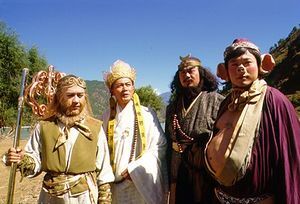
I have many fond memories of watching this show every day after dinner at my grandparents' house. I remember laughing at all of Sun Wukong and Zhu Bajie's wild adventures and the constant mischief that they were up to.
Reading this story was nostalgic and helped jog my memory and explain many events that I recall watching from the show (like The Monkey King training to obtain his immortal powers, defending his home and fellow monkeys at Flower-Fruit Mountain, challenging Heaven and eating all the peaches from the Garden of Immortal Peaches, getting punished and imprisoned, joining Tripitaka and receiving his signature headband as a punishment, and meeting the other disciples as they start their journey westward).
This first volume only covers the first 25 (out of 100) chapters of this epic and classical saga and leaves off on a cliffhanger where Pilgrim Sun provokes the Zhenyuan Immortal at the Five Villages Abbey after stealing and destroying all of the Great Immortal's ginseng fruit. At this point, I have to wonder if the Monkey will ever mature and learn from his mistakes (he tends to constantly provoke everyone he meets!)
I hadn't realised this as a kid (but it makes a lot of sense while I'm reading it now) that this story is heavily based on Buddhism and Daoism, with many footnotes that provide much-needed context on relevant religious terms and practices. The entire purpose of Tripitaka's journey to the west is to obtain scriptures from Buddha in the Western Heaven. I also didn't know that Guanyin had essentially handpicked several disciples (who at one point or another were banished from Heaven) to accompany Tripitaka during his pilgrimage so that they could obtain enlightenment (which explained her many appearances - I had often wondered, as a kid, why she kept checking up on them).
I will note that it was a bit confusing how all the characters have multiple names (I do remember the TVB drama included a rap of some sort for Sun Wukong's full name) but their many names are as follows:
- Sun Wukong, also known as The Monkey King, Great Sage Equal to Heaven, BanHorsePlague (or Bimawen in other translations), Old Monkey, Pilgrim, or Pilgrim Sun
- Tang Sanzang (how I've always known him as), also known as Tripitaka, Chen Xuanzang, or Tang Monk (because he's a monk sent by the Great Tang Emperor Taizong to obtain scriptures from the West).
- Zhu (Pig) Bajie, also known as Zhu Eight Rules, Zhu Whuneng, Marshal of the Heavenly Reeds, or more commonly referred to by Pilgrim Sun as 'Idiot'
- Sha Wujing, also known as Curtain-Raising Captain, or Sha Monk
- White Dragon Horse or Third Prince Jade Dragon of the Dragon King Aorun
A note on the introduction:
I skipped the first 100-page introduction and dove straight into the story. I tried going back to read the intro and ended up skimming it (and also because I had to return my library book).
There were some interesting parts, such as:
- the fact that this is the first and most comprehensive/unabridged western translation available that includes translations of several poems that were omitted in most, if not all, abridged versions;
- that Tripitaka was a real person who travelled to India to obtain and translate Buddhist scripture;
- there are many differing scholarly opinions about how Tripitaka's magical disciples ended up being included into his story over time, as he did not have any disciples and did not travel with anyone; and,
- there are several disputes over where the story really originated from and who the first author to put the story to paper was
Despite these interesting tidbits, the intro was a pretty dry read in which the target audience are probably students and professors of Asian literature.
*** #41 of my 2025 Popsugar Reading Challenge - A book by the oldest author in your TBR pile ***
I have many fond memories of watching this show every day after dinner at my grandparents' house. I remember laughing at all of Sun Wukong and Zhu Bajie's wild adventures and the constant mischief that they were up to.
Reading this story was nostalgic and helped jog my memory and explain many events that I recall watching from the show (like The Monkey King training to obtain his immortal powers, defending his home and fellow monkeys at Flower-Fruit Mountain, challenging Heaven and eating all the peaches from the Garden of Immortal Peaches, getting punished and imprisoned, joining Tripitaka and receiving his signature headband as a punishment, and meeting the other disciples as they start their journey westward).
This first volume only covers the first 25 (out of 100) chapters of this epic and classical saga and leaves off on a cliffhanger where Pilgrim Sun provokes the Zhenyuan Immortal at the Five Villages Abbey after stealing and destroying all of the Great Immortal's ginseng fruit. At this point, I have to wonder if the Monkey will ever mature and learn from his mistakes (he tends to constantly provoke everyone he meets!)
I hadn't realised this as a kid (but it makes a lot of sense while I'm reading it now) that this story is heavily based on Buddhism and Daoism, with many footnotes that provide much-needed context on relevant religious terms and practices. The entire purpose of Tripitaka's journey to the west is to obtain scriptures from Buddha in the Western Heaven. I also didn't know that Guanyin had essentially handpicked several disciples (who at one point or another were banished from Heaven) to accompany Tripitaka during his pilgrimage so that they could obtain enlightenment (which explained her many appearances - I had often wondered, as a kid, why she kept checking up on them).
I will note that it was a bit confusing how all the characters have multiple names (I do remember the TVB drama included a rap of some sort for Sun Wukong's full name) but their many names are as follows:
- Sun Wukong, also known as The Monkey King, Great Sage Equal to Heaven, BanHorsePlague (or Bimawen in other translations), Old Monkey, Pilgrim, or Pilgrim Sun
- Tang Sanzang (how I've always known him as), also known as Tripitaka, Chen Xuanzang, or Tang Monk (because he's a monk sent by the Great Tang Emperor Taizong to obtain scriptures from the West).
- Zhu (Pig) Bajie, also known as Zhu Eight Rules, Zhu Whuneng, Marshal of the Heavenly Reeds, or more commonly referred to by Pilgrim Sun as 'Idiot'
- Sha Wujing, also known as Curtain-Raising Captain, or Sha Monk
- White Dragon Horse or Third Prince Jade Dragon of the Dragon King Aorun
A note on the introduction:
I skipped the first 100-page introduction and dove straight into the story. I tried going back to read the intro and ended up skimming it (and also because I had to return my library book).
There were some interesting parts, such as:
- the fact that this is the first and most comprehensive/unabridged western translation available that includes translations of several poems that were omitted in most, if not all, abridged versions;
- that Tripitaka was a real person who travelled to India to obtain and translate Buddhist scripture;
- there are many differing scholarly opinions about how Tripitaka's magical disciples ended up being included into his story over time, as he did not have any disciples and did not travel with anyone; and,
- there are several disputes over where the story really originated from and who the first author to put the story to paper was
Despite these interesting tidbits, the intro was a pretty dry read in which the target audience are probably students and professors of Asian literature.
*** #41 of my 2025 Popsugar Reading Challenge - A book by the oldest author in your TBR pile ***

October 22, 2023
It took me a long while to finish this, but not because of a lack of interest. It's remarkable how this 500 year old Chinese classic manages to be so many things at once. It's a fictionalized account of the pilgrimage of the historical monk Xuangzang, an argument for the superiority of Buddhism over Daoism and Confucianism, an allegory of enlightenment, and a fantastical tale filled with monsters, magic, and amazing characters that reads like an unhinged DnD campaign.
While I appreciated the lengthy introduction and the many helpful footnotes, a lot of the information went way over my head and was difficult for me to get through. This translation is clearly aimed at the serious student of Chinese literature and religion, not the average reader like me. Still, as it's the only unabridged English translation available, it's the best option if you want to get the full story. And once I resigned myself to missing much of the context and stopped googling everything I didn't understand, I could appreciate the story for what it was.
The structure of the story took some getting used to, as it started with a lot of long backstory about Monkey and Tripitaka before turning into a monster-of-the-week episodic adventure once the actual journey began. Now that the gang's all assembled though and the journey is in full sway, I'm looking forward to more banter, ridiculous fights and monkey business (pun intended) in the other volumes.
While I appreciated the lengthy introduction and the many helpful footnotes, a lot of the information went way over my head and was difficult for me to get through. This translation is clearly aimed at the serious student of Chinese literature and religion, not the average reader like me. Still, as it's the only unabridged English translation available, it's the best option if you want to get the full story. And once I resigned myself to missing much of the context and stopped googling everything I didn't understand, I could appreciate the story for what it was.
The structure of the story took some getting used to, as it started with a lot of long backstory about Monkey and Tripitaka before turning into a monster-of-the-week episodic adventure once the actual journey began. Now that the gang's all assembled though and the journey is in full sway, I'm looking forward to more banter, ridiculous fights and monkey business (pun intended) in the other volumes.

September 9, 2017
"The Journey to the West" is a lengthy 16th century novel, regarded as one of the four great classics of Chinese literature. The author of the book is uncertain, but is thought to be Wu Cheng'en. This volume contains the first twenty-five chapters of the hundred-chapter narrative, plus extensive notes and a ninety-six-page introduction by the translator, Anthony C. Yu. I found the introduction a difficult read, no doubt due to my prior ignorance about almost everything it covered. But the introduction was helpful, and I am glad I labored through it.
The book itself defied my expectations. It was neither dry, nor dense, nor inscrutable. To my surprise, it appears to have been intended to be fun, and, despite the intervening centuries, I often found it such. The narrative is a fantastical retelling of Xuanzang's pilgrimage to India to obtain Buddhist scriptures, a pilgrimage that took place roughly a thousand years before "The Journey to the West" was written. In the retelling, there are gods, monsters, dragons, trickery, humor, and a plethora of epic fights. There is also a remarkably large amount of poetry, serving both as description and commentary, and the poetry lightened the reading. Since this volume contains only the first quarter of the story, I will postpone further comments for now.
The book itself defied my expectations. It was neither dry, nor dense, nor inscrutable. To my surprise, it appears to have been intended to be fun, and, despite the intervening centuries, I often found it such. The narrative is a fantastical retelling of Xuanzang's pilgrimage to India to obtain Buddhist scriptures, a pilgrimage that took place roughly a thousand years before "The Journey to the West" was written. In the retelling, there are gods, monsters, dragons, trickery, humor, and a plethora of epic fights. There is also a remarkably large amount of poetry, serving both as description and commentary, and the poetry lightened the reading. Since this volume contains only the first quarter of the story, I will postpone further comments for now.
July 12, 2025
I’m hard pressed to give a ‘review’ as I’m only one book into a volume of four. Equally, there are so many different angles to approach this masterpiece of Sino-Indic history and culture from. It’s longwinded but the depth of story and characterisation is something I’ve yet to see anywhere else. The introduction by Mr. Yu at times strayed into areas that were above my comprehension, especially relating to Daoism and Buddhism.
He saw, however, that the people of the world were all seekers after profit and fame; there was not one who showed concern for his appointed end. (p. 109)
When he had finished writing, he retrieved his hair, and with a total lack of respect he left a bubbling pool of monkey urine at the base of the first pillar…
"You pisshead ape!" scolded Tathagata. (p. 195)
Treasure a handful of dirt from your home, But love not ten thousand taels of foreign gold.” (p. 292)
As he was traveling, he saw a little demon approaching from the main road, who had a box made of pear tree wood wedged between his left arm and his body. Suspecting that something important was inside the box, Pilgrim raised his rod and brought it down hard on the demon's head. Alas, the demon could not take such a blow! He was instantly reduced to a meat patty, which Pilgrim tossed to the side of the road. (p. 356)
He saw, however, that the people of the world were all seekers after profit and fame; there was not one who showed concern for his appointed end. (p. 109)
When he had finished writing, he retrieved his hair, and with a total lack of respect he left a bubbling pool of monkey urine at the base of the first pillar…
"You pisshead ape!" scolded Tathagata. (p. 195)
Treasure a handful of dirt from your home, But love not ten thousand taels of foreign gold.” (p. 292)
As he was traveling, he saw a little demon approaching from the main road, who had a box made of pear tree wood wedged between his left arm and his body. Suspecting that something important was inside the box, Pilgrim raised his rod and brought it down hard on the demon's head. Alas, the demon could not take such a blow! He was instantly reduced to a meat patty, which Pilgrim tossed to the side of the road. (p. 356)
Displaying 1 - 30 of 231 reviews