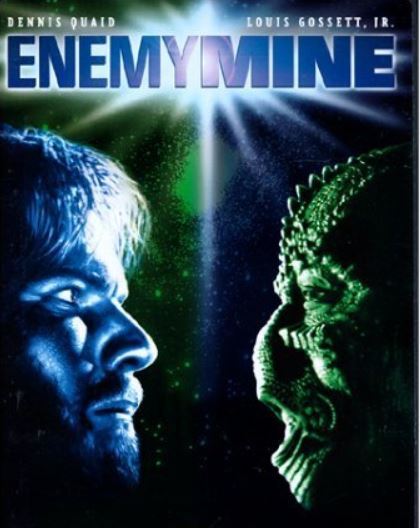
The complete Enemy Mine Trilogy plus much of the Drac bible and more. A story of war, peace, and honor told by an alien bible, by a man, by a woman, and by a Drac. Three complete novels, essays, and the Drac vocabulary.
The collection was a great discovery for me and a source of much reading pleasure. I made the mistake thinking that seeing the movie “Enemy Mine” meant I wouldn’t miss much by skipping the novella. But luckily curiosity about a tale that in 1979 won the Triple Crown of Nebula, Hugo, and John Campbell Awards got the best of me. The reading of the “author’s cut” here (not the longer novelization of the screenplay he did with David Gerrold) revived my faith in science fiction to put our search for meaning in current life into a timeless perspective. I also report here on my responses to the wonderful 1983 sequel novel “The Tomorrow Testament” contained in this collection.
The premise of the novella is that a human fighter pilot, Willis Davidge, and an alien Drac, nicknamed Jerry, damage each other’s warcraft in the longstanding war between their species. They crash land on a harsh planet. The urge to kill each other soon becomes transformed to teamwork by their common needs for survival, and over time they become friends. The war has killed billions on many planets, so the hatred and racial stereotyping both have been subject to takes a lot for them to overcome. That the Dracs are lizardlike and hermaphrodites challenges the reader on that score as well. But soon loneliness makes their perpetual insults to each other (“toadface” for the Drac and “kizlode” or “shithead” applied to Davidge) turn to humor and affection.
After much travail, they learn how to eke out an existence finding food, making clothes, and creating a shelter against the brutal winter that comes to pass. They learn each other’s language and Davidge eventually conquers a reading of the Drac bible “The Talman.” Davidge is surprised that the philosophy it contains does not seem alien at all. As they sit around a fire in the cave sewing, Jerry shakes its head and initiates this exchange: “You are not a terribly profound creature, Davidge.” “What’s that supposed to mean?” Jerry held out a three-fingered hand. “A universe, Davidge. There is a universe out there, a universe of life, objects, and events. There are differences, but it is all the same universe, and we all must obey the same universal laws. Did you ever think of that?” “No.” “That is what I mean, Davidge. Not terribly profound.” I snorted. “I told you. I’d heard this stuff before. So I imagine that shows humans to be just as profound as Dracs.” Jerry laughted. “You always insist on making something racial out of my observations. What I said applied to you, not the the race of humans.”
A turning point in their relationship comes in the middle of the story and sets Davidge on a path to become a better human. The apparent simplicity of this morality tale is enriched by the realization of an improbable friendship and the depth of the history and lessons embedded in the pieces from The Talman it contains. Longyear took the effort to create a whole Talman volume, an impressive achievement which I skipped. Instead, I appreciated its application to the situations of the characters.
The Talman is even more a foundation for the novel “The Tomorrow Testament.” An intelligence officer, Joanne Nicole, is captured by the Dracs and while in a restricted community along with Dracs who refuse to fight she saves some Drac children from a fire after a bombing, becoming blinded in the effort. Because one of the children is the son of a great spiritual leader, she is brought to the Drac’s home planet to receive rewards of its gratitude. There she gets sucked into a game-like process behind the desperate negotiations of a truce and treaty to end the war. As in “Enemy Mine”, the relationships between the humans and aliens become a platform to explore universal questions for which the Talman provides a structure.
The Dracs are masters of structured problem solving, finding pathways called talma between a present situation and a goal for the future, but their history is founded on a situation where they had to go outside the rules to war against other Dracs in order to survive. Joanna, in her blindness, has a special capacity to love beings independent of their outward forms. As en extension of that capacity, she begins to perceive how the flaws in their approach lies in their proclivity to game their way beyond the rules. Like the long conflicts in Israel and Ireland, the fighting between humans and Dracs on one planet they both colonized has too many atrocities in its history for either side to compromise. Also similar, the local struggles become a larger conflict when more nations take sides. In this case, the fighting of hundreds of worlds has a focus on the intransigent parties on the single planet Amadeen. The tough solutions Joanna helps the negotiating parties toward are nicely connected to the parables and Zen koan-like messages from the Talman. Here are some examples to whet your appetite:
Without a key, a door is a wall. Without a door, a key is but matter. A door with a key in the presence of mind is an opening. Without mind, neither the key, nor the door, nor the opening can exist.
Test the truth by forcing it to lie; test the lie by forcing it to be true.
If talma points toward an answer, the horror of which causes you to reject the answer, then blindness is both your tool and goal. Greatness of any kind—be it theory, plan, or horror—is not comprehensible to the mind of limits. To understand all, one must be able to accept all.
There is a point where Joanne looks to lessons from the Talman about the cost of attaining peace. In one section, a master asks his student if he would effectively “kill for peace” or even kill his master to see an end to war. When he gets a reluctant affirmative answer, he then asks: “And, now, would you die to achieve this?” “I would risk death as does any warrior.” “Again, Niagat, that is not my question. If an end to war can only be purchased at the certain cost of your own life, would you die by your own hand to achieve peace?” ..”I am willing to take the gamble of battle. In this gamble there is the chance of seeing my goal. But my certain death, and by my own hand—there would be no chance for seeing my goal. No I would not take my own life for this. That would be foolish. Have I passed your test?” “You have failed, Niagat. Your goal is not peace; your goal is to live in peace. Return when your goal is peace alone and you hold a willing knife at your own throat to achieve it. That is the price of a warmaster’s blade.”
Sometimes the puzzles posed in the Talman are left to the reader to find their own solution: And the student said, “Jetah, love is not a thing of rules, it is a thing of feelings.” Lita smiled. “And you do not see, Fa Ney, that feelings are creatures of rules?” “I do not, Jetah.” “Do you love me, Fa Ney?” “Of course, Jetah.” “Why?” “I just do.” “And if all that I taught you were lies, if I constantly beat you, degraded you, and humiliated you, would you still love me?” The student thought. “No.” “Then, Fa Ney, your feelings demand certain conditions; they require that I be a certain way, and do certain things. Your love demands that I comply with certain rules, rules you invented.” Fa Ney began to cry. “Does this mean, Jetah, that I do not love you?”
The other novel in this collection, “The Last Enemy” (2010), will have to wait for a future read. I have enough satisfaction to render a resounding applause and broad recommendation to most readers. It has the feeling of a blend between the anti-war tale of Haldeman’s “The Forever War” and Coehlo’s myth-like stories. But I got more laughs and tears and “aha” moments from the two works here than from those books. An extra plus with this collection is the author’s reflections on the writing process in creating the work and surprises in their success. That he got some of his inspiration from being a rural Maine resident contemplating the isolation of winter was a special treat for me because of my similar experience.
5 Stars! One of the best Sci-Fi books and thought-provoking books ever. Why is this not more well-known? The ideas about alien religion, and war, and communication, and politics, and compromise, and understanding, and acceptance, and loyalty, and family, and love, etc… Just really really great. Can’t say enough good things about this SF series masterpiece. Individual story ratings and comments below…
The Talman: 5 Stars! The Story of Uhe was excellent. The Story of Shizumaat was maybe even better. All the excerpts after were also full of great lessons. Really loved this. Learning about the alien religion was so interesting.
Enemy Mine (author’s cut): 4.75 Stars! Excellent. I just thought the movie novelization version was perfect. So if you can get your hands on it, then I would recommend that one. But this is great too. It’s just missing some important messages.
The Tomorrow Testament: 4.75 Stars! Really enjoyed this. It was very deep and makes you think. Having the MC be blind made it so interesting too. A lot of political intrigue and twists and cunning plots. But also emotional and meaningful.
The Last Enemy: 5 Stars! Maybe my favorite of the whole collection. It follows an alien fighter and his mission for peace on Amadeen. Also brings back beloved characters from Enemy Mine and connects everything. The resolution is everything. This series is one of the best and should be well-known.
The Talman Quotes: - “Know this! As there are worse things than war, there are things worse than eating one's young. We fight to be free. We do not fight to make slaves.” (p41) - “Never again shall one tribe starve because of a boundary, tabu, or law while other tribes live in plenty. We are the Sindie: one people. But one's place in this people is no birthright. It is a value to be earned.” (p42) - “Have you ever noticed that you can never find a god when you need one?” (p51) - “What it takes to conquer a world is different than what is needed to rule a world.” (p57) - “The truth I see is that rules are meant to serve the Sindie; the Sindie is not meant to serve rules… If the rule is good, it should be obeyed; if it is not good, it should be cast aside as Uhe cast aside the Law of Peace… If the laws come from the servants, then the laws come from mortal, fallible creatures, and can be false… If the laws come from Aakva, then either Aakva is fallible, or there is no Aakva…” (p63) - “A beating in defense of my truth is one thing. I am not up to my parent beating me because I was beaten. That seems a little overdone.” (p65) - “He is the key, not I. Questions, new ideas, different ways of thinking, these come naturally. He allows them to happen by not forbidding them.” (p66) - “Every person, place, and thing can teach us, if we have the wit to learn.” (p67) - “My truth is this. In all things that we do, some ways are better than others. Of all of the better ways, some are the best. Of the best that exist, still better ways wait to be discovered and invented.” (p79) - “Time is our friend… In time, tomorrow will come.” (p89) - “You have failed. Your goal is not peace; your goal is to live in peace. Return when your goal is peace alone and you hold a willing knife at your own throat to achieve it. That is the price of a warmaster's blade.” (p91) - “We will take it all. We will gather in everything and we will examine, test, discuss, and challenge everything. If we are honest and mean only to serve truth, then what remains will be the truth of it.” (p92) - “The only entity who knows all the paths of talma is the Universe. As a part of the Universe, I will exercise patience and wait for the rest of the Universe to inform this part what the proper path is.” (p93) - “In the past are the mistakes we made. In the future are the mistakes we will make. In the present are the mistakes we are making. Curse the mistakes, rail at them, regret them, learn from them. But do not wish for the perfection of time when mistakes will no longer be made, for that is what we call death.” (p94) - “Without a goal, you are simply taking up space—not only in this room, but in this Universe. Either find a goal, or turn the space over to one who does have a goal. (p95) - “Without a key, a door is a wall. Without a door, a key is but matter. A door with a key in the presence of mind is an opening. Without mind, neither the key, the door, nor the opening can exist.” (p97) - “Are we to ignore a truth revealed through crime because the method of obtaining the truth is somehow tainted? Nonsense. Truth is truth. The crime would be to ignore it.” (p97)
Enemy Mine Quotes: - “There is a universe out there, a universe of life, objects, and events. There are differences, but it is all the same universe, and we all must obey the same universal laws.” (p145) - “If you are alone with yourself, you will forever be alone with others.” (p170)
The Tomorrow Testament Quotes: - “There are all kinds of cowards, Sergeant. It's only the honest ones that have to carry the name.” (p223) - “Haven't you ever looked in a mirror? Of course you're beautiful! Perhaps not very smart, but beautiful… Asking me if I think you are beautiful is a stupid question.” (p239) - “The more we learn, the closer we get; and the closer we get, the more there is to learn...” (p252) - “A beating in defense of my understanding of truth is one thing. I am not up to my parent beating me because I was beaten. That seems somehow to be taking the gesture past integrity into foolishness.” (p268) - “He asked what the difference is between ignorance and stupidity. And he answered his own question by telling me that ignorance is self-inflicted stupidity.” (p302) - “The composition would be untrue if all of the notes were there. This song is crippled, as it must be.” (p303) - “‘It is strange. In the dark like this, you are not... not a human. With the darkness of your eyes, do you see the same?’ - ‘Yes. I see us as...beings?’” (p303) - “I am able to tell you my purpose; I am not willing. It is none of your concern.” (p306) - “Without her eyes, she was seeing more than she ever had seen before…“ (p334) - “Do not close paths simply because another wants them explored.” (p344) - “All rules aim toward goals, and all goals are rules aimed toward further goals… To understand the circle, break it and travel in both directions until you meet yourself. To understand the chain, understand the closest link, then travel in both directions until you run out of links.” (p346) - “Be prepared to accept all. But test the truth by forcing it to lie; test the lie by forcing it to be true.” (p352) - “Truth of nature and import of meaning are not matters determinable by a consensus. If only one being understands the meaning, the meaning is understood. If only one being sees the truth, the truth is seen.” (p375)
The Last Enemy Quotes: - “I am calm about death. Waiting for death is the strain.” (p381) - “My parent once said that if there is ever to be peace, we must first talk. I laugh at this now. All either species knows how to do with words is to wound.” (p382) - “Dead bodies: a strange way to measure occupational proficiency.” (p382) - “…To drool or not to drool, that is the question.” (p384) - “How can a being tremble in fear of losing its life one moment and care not a dot the next?” (p387) - “I should have gotten the name of the woman. Those who change the entire course of a life need to be named.” (p393) - “It is the first of many reminders that war makes its own race of children, aliens to those who have not had the same parent.” (p416) - “That's a big stick you have up your ass. Try not to scratch the chair.” (p451) - “There is a difference, my children, between conviction and stubbornness. The former is based on knowledge or sincere belief. The latter is rooted in stupidity brought on by the need to be regarded as right.” (p477) - “My parent, it is a shame how stupid your parent is. I have always said so.” (p477) - “Fairness is an illusion. Neither effort nor intention holds title to the nature or form of either the present or the future. And if sincere effort has no title, what interest can the bellow or the lamentation hold?” (p492) - “What is the point of putting you two together if he learns nothing from you, and you learn nothing from him? We are all students; and we are all teachers.” (p493) - “Words are maps to existence. Once you travel a piece of reality it is possible to know the meaning of its words. If all you have before you are words, all you can consider are meaningless marks and sounds.” (p500) - “If I know what I know, and I know what you know, I know more than you and therefore have the advantage… Until I have walked your steps, breathed your breaths, and seen your seeing, I can never know what you know…” (p511) - “There I sit in the dark and remind myself why the children of the battlefield do without love and hope. To have love one must have hope, and to have hope one must be a fool.” (p531) - “How many ways are there to be a fool? I am not certain, but I think I must have explored all of them by now. Of course, every time I think that, I am usually on the brink of discovering new worlds of foolishness.” (p531) - “I do not judge you. If I do not, who are you to judge yourself?” (p556) - “You are but one. Pain, grief, sorrow, hate, and revenge are armies without number.” (p591) - “The darkness covers all the universe. It is such an all-powerful evil, I feel so small and helpless within it. Next to this darkness, the black of death seems so bright.” (p591) - “Perhaps what the Dracs say is true: to get a human's attention takes a mirror, a loud voice, and a sharp stick.” (p605)
This is Barry Longyear's magnum opus, including all the works set in the Enemy Mine universe. The movie wasn't bad, but it didn't even come close to doing justice to this incredible series of novels that explore the repercussions of the Human/Drac interstellar war from the perspectives of a handful of men, women, and Sindie (the Drac's name for themselves- they're hermaphroditic) who, through their small actions, help steer the course of a war that has spanned galaxies and lasted generations.
Includes four complete works; Enemy Mine, The Tomorrow Testament, The Last Enemy, as well as all the surviving portions of the Talman, the Sindie book of history and wisdom that recounts the origins of their race and the various philosophers who have guided their culture through the millennia.
Although this book has been out for over a decade (and the novels it collects for even longer), it's extremely timely. Current world conflicts are thrown into sharp relief, despite the sci-fi trappings.
This review is based on my reading of Enemy Mine. I haven't yet read the other two books in the collection. As a long-time fan of the film, I was curious about the source material it was based on and decided to give it a look.
I enjoyed the read. The story was surprisingly short, more of a novella than a book. I liked how the story dives deep into the lore of the Drac religion. The film did its best to touch on that, but the story gives you more context, which was interesting.
I was surprised at how quickly it got to the Zamis story-line, considering how the film spent a lot if its time dealing with Davidge and Jerry's relationship.
The third act of the story is completely different from the movie. I can see why since it deals with more of an internal drama vs a cinematic or visual one. All in all, its a good read and something that any fan of the film should experience, if only for the segments that expand on the Drac culture.
If you have not read this, you are seriously missing out on one of the best Sci-fi books. I could not put it down.
This is one of those rare gems where the movie was excellent and the book even better. Kudos to the movie makers in keeping fairly well with the storyline of the book, but as always the detail and depth is much greater in the book. This edition is particularly fantastic in that it includes the Drac Holy Book: The Talman.
Read this series. It is a fantastic work that discusses religion, war, revenge, philosophy, racism, and a lot of other topics. The movie made from the first half of the first book in this series is great but doesn't do the series justice.
The Enemy Papers is a series of gripping stories with great character development and an underlying philosophy for how to break the endless negative circle of prejudice and tribalism. I'm suprised it didn't give birth to a new religion or philosophy in the real world.
This is science fiction envisioning life if everyone was a systems engineer. (I am one, also an electrical engineer who has a lifetime of optimizing performance, and assessing life-cycle costs/benefits). So, yeah, the books are overrun with geek philosophy - what's new in SF, right? So, I am a bit underwhelmed that path optimization is ideally suited to the pursuit of happiness, but other than that, the books are a very good read. The Enemy Papers puts the guiding principles of one of the races first. So, you start off reading a "bible", which makes good sense. The stories then revolve around the application of talma (optimization theory for pursuit of peace, as defined via parables in the bible). Oh! If only! Under it all, are well written characters, and a very good yarn. The author captures the mindset of tribe-based warfare very well. Well worth a read.
The Talman - a bible for the civilisation of Dracs, an alien species - was great. Especially because it is not religion, but philosophy. With its main focus being to question everything. That is the Talma, the way; to always find a better way. Because even when you have found what you think is the best of ways, there is always a better one. And this should be an antidote to stagnation and conservatism.
"Enemy Mine," the first short story in this volume, is certainly the best. Simple, elegant and memorable, it's clear why Issac Asimov loved this story and why Longyear won a slew of awards for it. Willis Davidge crash lands on Fyrine IV after attempting to shoot down a Drac pilot named Jeriba Shigan. Both survive and, with little chance of rescue, they need each other to make it on this desolate planet. I loved the relationship that forms between them, with all the humorous dialogue, bickering and truth bombs that you would expect from two close friends. This lovely novella about survival and brotherhood should be read by everyone, not just science fiction fans. An enthusiastic 5 stars!
"The Tomorrow Testament" is the second story and a decent read but doesn't have the same emotional impact as "Enemy Mine." There's more political intrigue here, and it continues to build the world begun in the first novella but lacks heart. It follows a woman named Joanne Nicole, a major for the USEF (United States of Earth Force), who is captured by Dracs then blinded by a USEF raid on planet Ditaar where she's being held. We find out that there are more alien species out there than just humans and dracs and that there is a sinister plot underway. It's all quite interesting but I didn't care as much about the characters in this one. Still worth a read. 3.5 stars.
Due to the actions set out in "The Tomorrow Testament" thirty years prior, the war between two extremist factions of dracs (the Madevah) and humans (the Front) has been quarantined on Amadeen while the rest of the quadrants live in peace. The story is told from a Drac's point of view. Yazi Ro, a drac terrorist weary of fighting, leaves the Mavedah to find a path to peace. It leads Yazi to being smuggled off Amadeen to Draco in order to deliver an important manuscript. Yazi then meets a now 63-year-old Willis Davidge and, together with their cohorts, attempt to bring peace to war-torn Amadeen. At times a touch meandering but the character development here, especially Yazi Ro's, made this a strong end to the trilogy. 4.5 stars!
This is an excellent series that I thoroughly enjoyed.
It begins with Enemy Mine, the original story that spawned the screenplay and movie, which the author is well pleased with. The story is remarkably short (about 100 pages) and differs from the film adaptation in a few ways.
The next story focuses on another human commander, a woman, who is taken prisoner by the Dracs and becomes key to the peace process between the two species. It is a much longer tale and highly enjoyable.
The final story reintroduces Willis Davidge as the Uncle of the family of Jeriba Shigan, and he performs the same duties for them as he did with Zammis - he spends his life raising the young Dracs to be good and thoughtful adults. This story is the longest one and involves several other characters who are striving to create a lasting peace on the final world still in conflict.
There is also a rendition in English of the Talma, the contents of the little book carried by Jerry in the film, which amounts to their key philosophy that orients them in all things. It is a series of stories from Drac history that is compellingly told and well worth reading.
Just finished a second read of this book. First time was about 10 years ago when I first bought it. Longyear does a good job at creating a believable alien race. Although he does fall into one of the biggest problems of sci-fi, that of making a homogeneous alien race and language, he at least gives a good reason of how that might have come about. The biggest problem I had was that somehow the entire race were master philosophers, with only a single philological system in place. Again, he tried to explain it, but it did feel contrived. Still, the stories were well written, the characters were engaging, and the end result was an enjoyable read. I have to say my favorite part was the work he put into the Drac religion and language. The depth of data he created allows you to make a vivid image of the Drac's mental outlook, both in terms of their philosophical bent and their way of thinking based on what there language lets you say. Anyone who speaks two or more languages can tell you that sometimes thinking about something is much depending on what language you are thinking in.
I liked this a lot. The creation of the alien culture and the alien religion was impressive. The allusions to Judaism and Christianity were interesting. Most of it read well and kept me engaged. Overall the authors philosophy of rationalism and peacemaking came through more strongly than anything else. recommended by Andrew House.
This is probably my favorite Longyear work. Fascinating philosophy, in a mil sf/space opera setting. I remember reading the novella years ago, and then seeing the movie. (I loathe the movie and do not recommend it.) Tomorrow Testament and The Last Enemy are also incredible books.
🚀🦎 Akta wroga Barry’ego B. Longyeara to jedna z tych powieści science fiction, które pod warstwą kosmicznej przygody ukrywają bardzo uniwersalną i poruszającą opowieść o człowieczeństwie. Początkowo historia wydaje się prostą opowieścią o wojnie między ludźmi a obcą rasą, jednak bardzo szybko okazuje się czymś znacznie głębszym. Autor wykorzystuje motyw dwóch wrogów uwięzionych na obcej planecie, aby opowiedzieć o uprzedzeniach, samotności i potrzebie porozumienia. Barry B. Longyear stworzył historię pełną emocji, która mimo fantastycznej otoczki mówi przede wszystkim o relacjach i o tym, jak łatwo strach potrafi zamienić innych w potworów.
🚀🦎 Największą siłą książki jest relacja pomiędzy Willisem Davidge’em a Drako Jeribą Shiganem. Początkowo obaj bohaterowie widzą w sobie wyłącznie wroga, którego należy nienawidzić i którego propaganda nauczyła się bać. Jednak wspólna walka o przetrwanie na niegościnnej planecie powoli zmienia ich spojrzenie na siebie nawzajem. Barry B. Longyear fantastycznie pokazuje proces rodzenia się zaufania i przyjaźni pomiędzy istotami, które dzieli niemal wszystko — wygląd, kultura, język i historia wojny. Dialogi między bohaterami są momentami zabawne, momentami bardzo wzruszające, ale zawsze autentyczne. To właśnie dzięki tej relacji książka zyskuje ogromną emocjonalną siłę.
🚀🦎 Bardzo podobało mi się również to, jak autor przedstawia codzienność przetrwania. Budowanie schronienia, zdobywanie jedzenia czy walka z brutalną zimą sprawiają, że historia nabiera realistycznego charakteru mimo fantastycznonaukowej scenerii. Longyear pokazuje, że wspólna walka o życie stopniowo niszczy stereotypy i uprzedzenia, które przez lata budowała wojna. Szczególnie interesujące okazało się poznawanie kultury Draków oraz ich filozofii zawartej w Talmanie. Fragmenty tej duchowej księgi nie są jedynie dodatkiem do świata przedstawionego, lecz ważnym elementem całej opowieści. Dzięki nim książka zyskuje refleksyjny, niemal filozoficzny wymiar.
🚀🦎 Ogromnym atutem Akt wroga jest rozbudowanie historii poza samą opowieść Mój własny wróg. Kolejne części i dodatkowe teksty pozwalają lepiej zrozumieć zarówno konflikt między rasami, jak i samą kulturę Draków. Barry B. Longyear stworzył świat bardzo przemyślany i pełen szczegółów, ale nigdy nie przytłacza czytelnika nadmiarem informacji. Szczególnie ciekawie wypadają rozważania dotyczące pokoju, odpowiedzialności i ceny, jaką trzeba zapłacić za zakończenie wojny. Autor pokazuje, że prawdziwe pojednanie wymaga znacznie więcej niż podpisania traktatu — wymaga gotowości do zrozumienia drugiej strony i porzucenia własnej nienawiści. ㅤ 🚀🦎 Styl Barry’ego B. Longyeara bardzo pozytywnie mnie zaskoczył. Autor pisze prostym, przystępnym językiem, ale jednocześnie potrafi zawrzeć w swojej historii wiele emocji i ważnych refleksji. W książce nie brakuje humoru, wzruszających momentów i scen naprawdę poruszających. Szczególnie dobrze wypada balans pomiędzy przygodą a filozoficznymi pytaniami dotyczącymi natury wojny i uprzedzeń. Longyear nie moralizuje wprost, lecz pozwala czytelnikowi samodzielnie dojść do wielu wniosków. Dzięki temu Akta wroga nie są wyłącznie klasyczną historią science fiction, ale opowieścią o bardzo uniwersalnym przesłaniu. ㅤ 🚀🦎 Akta wroga to książka, która mimo upływu lat nadal pozostaje niezwykle aktualna. Barry B. Longyear stworzył historię o wojnie, ale przede wszystkim o przełamywaniu granic między ludźmi i o potrzebie wzajemnego zrozumienia. To powieść pełna emocji, refleksji i świetnie napisanych bohaterów, którzy na długo zostają w pamięci. Połączenie survivalowej przygody, filozoficznych rozważań i wzruszającej relacji między dwojgiem dawnych wrogów sprawia, że trudno przejść obok tej historii obojętnie. To science fiction, które nie skupia się wyłącznie na technologii czy kosmicznych bitwach, lecz przede wszystkim na tym, co najbardziej ludzkie — nawet wtedy, gdy bohaterowie wcale ludźmi nie są.
Reading The Enemy Papers left me convinced that Barry B. Longyear has mapped out the exact mechanics of how ideological echo chambers isolate and neutralize independent minds.
Ok first off you need to understand the history here - the books is based around the short story Enemy Mine - which I believe was printed in a magazine - then collected together as part of a series of short stories linked together (see Manifest Destiny - by the same author) - however - after that the story was revised and lengthened - and basically turned in to a totally new story. This revised version was the basis of this book. Yes here is the revised and extended edition but also a number of essays about the Drac, additional stories on them and their culture along with a little of the history of the stories. However this is most definitely about the Drac and he humans who met, fought and eventually came to understand them. A fascinating book containing one of my all time great short stories - in places hard going and at others distracting but very very interesting none the less.
Enemy Mine is of course the best out of this collection. A story about war and racism set in a world where aliens are real. But some of the other novels are worth reading.