Athletic contests help define what we mean in America by "success." By keeping women from "playing with the boys" on the false assumption that they are inherently inferior, society relegates them to second-class citizens. In this forcefully argued book, Eileen McDonagh and Laura Pappano show in vivid detail how women have been unfairly excluded from participating in sports on an equal footing with men. Using dozens of powerful examples--girls and women breaking through in football, ice hockey, wrestling, and baseball, to name just a few--the authors show that sex differences are not sufficient to warrant exclusion in most sports, that success entails more than brute strength, and that sex segregation in sports does not simply reflect sex differences, but actively constructs and reinforces stereotypes about sex differences. For instance, women's bodies give them a physiological advantage in endurance sports, yet many Olympic events have shorter races for women than men, thereby camouflaging rather than revealing women's strengths.
I am a big fan of women's sports, especially soccer, so I wanted to like this book. And it certainly make some good points but in the end fails to make its case: "that coercive … sex segregation in sports should be called out for what it is: a violation of the Fourteenth Amendment's Equal Protection Clause" and eliminated.
There's definitely a massive amount of sexism in sports, and this well-researched book seems to spell out every single instance, particularly from the 1800s until the 1970s when women were considered too delicate to fully participate and Little League - while being adamantly anti-segregation when it came to race - fought tooth and nail to keep girls from playing even when the girls were as good are better than the boys, of which several examples are supplied. I particularly liked this phrase: "At the turn of the century, women internalized so many messages about female weakness and sex-based limitations, it seems now remarkable that they even got out of bed in the morning, much less found their way onto playing fields."
They do make a good case that women and men should be considered on a more individual basis and not automatically segregated. Certainly the bell curves of athletic ability for the two sexes overlap considerably, and the authors again seem to make room for every single instance where a woman outdid a man, or was prevented by arbitrary rules from doing so (see the Little League bit above).
That being said, they provide absolutely no recognition for the logical result of eliminating sex-segregated teams: that a very few women would make it onto the combined teams, and all the other women would be out of luck.
A lot of their examples are cherry-picked. They note that in the 2003 Boston Marathon among the top 207 runners the women averaged 2:36:55 while the men averaged 2:41:33 and take particular glee in pointing out that the #16-19 finishers were all women and were better than all of the remaining men. They don't bother to mention that out of all 207 (everyone who finished in under 2:50) only 14 were women.
Similarly, they make much out of Billie Jean King beating Bobby Riggs in straight sets in the famous "Battle of the Sexes" tennis match while not once mentioning that a few months earlier Riggs beat Margaret Court - then the top woman in the world - in straight sets.
And of course there's absolutely no mention that the US national women's soccer team - certainly the poster stars for women's teams everywhere - regularly plays and loses to U-17 boys' teams.
After giving multiple examples of how male teams are treated better than female teams, they go into this rant:
"Who can fairly argue that the boys from Saugus or Boynton Beach are superior athletes to the girls from Waldorf, Maryland? Why can say their games are more compelling? Why is their athleticism more highly valued?
"Organized sport is not a free-market system. Female athletes are not recognized less, paid less, or followed less because they are lesser athletes or offer less compelling play. Rather, male baseball players and male football players are paid hundreds of thousands or millions because we have decided that their games matter more. We have decided males athletes are worth more than female athletes. And we have evolved values and traditions that keep in place practices which enforce athletic, hierarchical gender order, sometimes using public resources to do it."
As for the rhetorical questions, I would answer, "Anyone who pays attention to this sort of thing." I'm a huge fan of women's soccer and prefer it to men's soccer. But even I have to admit that men's soccer is faster-paced and more athletic than women's. When I switch to the men's game, it feels as if the field has shrunk (and vice-versa when I switch back). This is an advantage in some ways, as women soccer players have to be more patient and tactical - they have to play prettier soccer - than the men, who can just bull their way through and fire shots from 30 yards out that rocket into the net.
That being said, this book makes lots of good points. I would even note that the chief difference between Major League Soccer - the top soccer league for American men - and the Women's United Soccer Association - the original top soccer league for American women - is that people with deep pockets were prepared to lose tens of millions of dollars on the former but were unwilling to lose even a few million on the latter.
Most significantly, the book demonstrates that sports are much more important to our society than people realize and denying women opportunities in sports ends up denying them opportunities in life. I just think it goes too far in recommending the elimination of sex-segregated teams, as well as other recommendations like requiring "equal television time for women's sports." But there's a case to be made that we need to do better by our women athletes, and this book makes it.
Best book I've read on the topic. Straight forward narrative. Relevant. Visonary. I refer to it time and again while addressing these issues. I'm a grad student researching this topic. When I first met with my adviser I had the book in my backpack and my adviser had it on her bookshelf. A must read for all coaches, athletes, sports officials, sports administrators, lawmakers, sports policy makers, parents, and anyone involved in sports male and female including fans.
great book! we need to end sex segregation in sports right away. fully integrate everything from t-ball to pro sports. whatever you think right now, read this book and see if you don't agree with me. equity in sports must be achieved on the path to full equality in society over all.
While somewhat repetitive, this book shatters the arguments about women at large not being able to compete physically with men at large in all sports. It's social, stupid, not physical or biological.
Playing with the Boys - McDonagh & Pappano (See update at bottom.) Social change is challenging. And legislation makes for a crude and necessary tool for this change. It's difficult to envision what will be when you live in what is, your vision colored and incomplete. Not to mention those acting with a negative motive, regardless of the human failing that gives those that obstruct their motives. It all takes time to get it all to grow from the root.
Going toward forty years with Title IX [which was necessary but not sufficient] this book looks at the past and current state of women's athletics, at all levels (school, college and professional) and across a wide variety of sport. There has been real progress. And yet there is very far to go, and i completely agree with the authors here, we are not even near where we should be.
One thing that is very much needed is clearness on objective. Equality alone doesn't seem to me enough for an objective. Equality to what? Who says that male participation currently in sports is in any way an ideal. This book goes some ways to defining objectives, but i think much more is needed to be done now with this basic requirement.
At basis the premise of this book is, "SEPARATE IS NEVER EQUAL!" You'll need to read this yourself to understand the authors' perspective on this. The book does a very good job at looking at the history, and presenting a context to consider questions, involving all levels of sports and participation in sports. This book will make you think.
Here is a list i made of objectives described in this book: 1. Accept a gender neutral view of athletic ability. 2. Increase opportunity in gender integrated sports at all levels. 3. Make all sports rules gender blind. 4. Establish financial parity for salary, promotion and ticket prices at educational institutions. 5. Equalize media coverage for women in sports, and cover with a gender neutral view-point. 6. Equalise women's participation in the network between sports, business and media. 7. Find ways to improve women's interest, understanding and literacy of sports. 8. Individuals should make choices to watch and become financially involved with women's sports. 9. Strengthen Title IX laws for more financial equality.
[Aside: I think that some will consider the topic of this book extraneous, sports being considered by them as a topic not worthy, a topic for men who are sport's fans, and not about real life, and not essential. That indeed is probably a part of the problem, and a good reason that topics in this book should be examined and considered.]
It's been a perspective of mine that feminism is humanism. The way forward for women and sports, includes the questions of everyone's involvement.
Later: A few more current event stories showing where we're at.
#1 Here's hoping for a very long baseball career for Paige Sultzbach. (go ahead and google her.)
#2 The Minnesota Lynx just won the WNBA championship, very decisively. The local NFL and NBA teams bought tens of thousands of tickets and gave them away (good on them for doing this) to get at least some semblence of a home-town crowd at the local play-off games. The local celebration for the returning team was joyous by those attending, but largely eclipsed with the disappointing major league men's teams, having miserable losing seasons. In fact the Lingerie League team here is getting more media coverage!
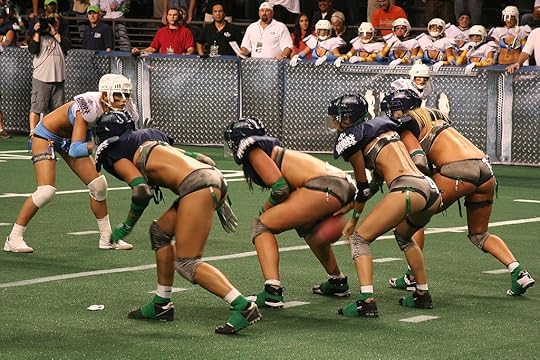
#3 The Lingerie Leagues -- Football in particular. Seattle Mist vs. San Diego Seduction -- Yeah those are garter belt clasps. This is tackle football minus safety equipment. The league apparently doesn't cover the injured player's medical expenses. The Minnesota Valkyrie's QB just broke her arm as for instance. This is serious athletics truly debased by it's sexist marketing.
This is simply one of the most illuminating books I have ever read. Title IX is frequently and widely touted as a government mandate that has made everything right for girls and women involved in elementary, high school and college sports, but this book revealed it to be the Plessy v. Ferguson of educational and athletic accommodations for women. It also proves, with dozens of examples, that, more than a generation after Title IX, such accommodations for girls and women are still very often woefully inferior to those enjoyed by men--separate AND unequal.
But it doesn't stop there. Authors McDonagh and Laura Pappano cite studies showing how women are fully able--physically and mentally--to compete directly against men in many, if not all, sports. They provide examples of athletes who don't fit neatly into gender categories to show why gender segregation in sports is illogical. They build on U.S. Supreme Court decisions in cases involving race, disability and employment discrimination to show why keeping people out of certain sports (girls out of football; boys out of volleyball) simply because of their gender is unconstitutional.
Why does it matter? McDonagh and Pappano make the case that equal opportunity in sports is vital to women's economic success and therefore to their full participation in society, not only because sports constitutes a multi-billion dollar industry, but also because participation in, knowledge of, and success in sports are so often the lubricants that keep things humming in the business world: deals get made on the golf course, bonding happens in the sports bar, respect is earned on the basketball court. The authors forcefully make the case that ALL people deserve the chance to explore their potential in athletics.
You may agree or disagree with the assertions in this book. Based on my experiences talking about these topics, chances are good that you--whoever you are--will disagree with many of them. But, if you're honest, you'll have to admit that, by the time you finish this book, your only argument left standing will be "because it's always been that way."