Robert Anson Heinlein was an American science fiction author, aeronautical engineer, and naval officer. Sometimes called the "dean of science fiction writers", he was among the first to emphasize scientific accuracy in his fiction, and was thus a pioneer of the subgenre of hard science fiction. His published works, both fiction and non-fiction, express admiration for competence and emphasize the value of critical thinking. His plots often posed provocative situations which challenged conventional social mores. His work continues to have an influence on the science-fiction genre, and on modern culture more generally. Heinlein became one of the first American science-fiction writers to break into mainstream magazines such as The Saturday Evening Post in the late 1940s. He was one of the best-selling science-fiction novelists for many decades, and he, Isaac Asimov, and Arthur C. Clarke are often considered the "Big Three" of English-language science fiction authors. Notable Heinlein works include Stranger in a Strange Land, Starship Troopers (which helped mold the space marine and mecha archetypes) and The Moon Is a Harsh Mistress. His work sometimes had controversial aspects, such as plural marriage in The Moon Is a Harsh Mistress, militarism in Starship Troopers and technologically competent women characters who were formidable, yet often stereotypically feminine—such as Friday. Heinlein used his science fiction as a way to explore provocative social and political ideas and to speculate how progress in science and engineering might shape the future of politics, race, religion, and sex. Within the framework of his science-fiction stories, Heinlein repeatedly addressed certain social themes: the importance of individual liberty and self-reliance, the nature of sexual relationships, the obligation individuals owe to their societies, the influence of organized religion on culture and government, and the tendency of society to repress nonconformist thought. He also speculated on the influence of space travel on human cultural practices. Heinlein was named the first Science Fiction Writers Grand Master in 1974. Four of his novels won Hugo Awards. In addition, fifty years after publication, seven of his works were awarded "Retro Hugos"—awards given retrospectively for works that were published before the Hugo Awards came into existence. In his fiction, Heinlein coined terms that have become part of the English language, including grok, waldo and speculative fiction, as well as popularizing existing terms like "TANSTAAFL", "pay it forward", and "space marine". He also anticipated mechanical computer-aided design with "Drafting Dan" and described a modern version of a waterbed in his novel Beyond This Horizon. Also wrote under Pen names: Anson McDonald, Lyle Monroe, Caleb Saunders, John Riverside and Simon York.
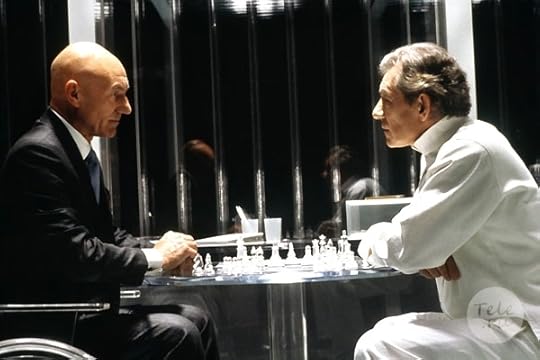
Professor X and Magneto are playing chess and discussing Robert A. Heinlein’s 1949 novella Gulf.
Erik: So what did you think, Charles?
Charles: It was a very Poul Andersonish kind of story. A superspy discovers he is a part of a super society, and perhaps a part of a race that would overcome humanity.
Erik: Hmmmm, remind you of anything at all?
Charles: Oh come now, Erik, Bob Heinlein first produced this in the late 40s -
Erik: It occurs to me, old friend, that there was then and now a precedent in reality. A group of “humans” are more than their otherwise peers. And he returned to some of the same ideas in his 1982 novel Friday.
Charles: Are you truly suggesting, Erik, or should I say – Magneto, that Heinlein was demonstrating supermen as mutants?
Erik: Why of course, what else? Oh certainly it is also reminiscent of Theodore Sturgeon with gestalt ideas and homo sapiens being taken over by a newer, better race. A newer and better RACE, Charles, distinct and separate from lowly sapiens – SAPS – as Heinlein so aptly names them. Just as once Cro Magnon divided the tree from primitive Neanderthal, so too does Heinlein document, in fiction, how we have split off from our lessers.
Charles: Oh I say! Erik, must we again down this path?
Erik: I’ll go one step further, old friend, I submit that Heinlein made such assertions because he too is a mutant.
Charles: What?
Erik: Indeed. His extraordinary narrative ability, his virile sexuality, his omnipresent imagination –
Charles: Well, I am speechless. Do you have anything else to say, Erik?
Erik: Why yes. LIVE FROM TENNESSEE It’s Lyn’s 2016 Summer Heinlein Reading Fest!!! RAH! RAH! RAH!
This Sci-fi adventure story/thriller, set on a future Earth and Moon, is full of fascinating contradictions. The anachronisms - for example, the plot depends on the physical transmission of microfilms - ought to render it unreadable for a modern reader, but the quality of the writing and the characterisation both take it into the realm of the 'classic'.
Written in 1949, long before the computer was commonplace, although Turing had by that time already shown such a machine was a real possibility, the exclusion of this major influence on the world is a serious omission. I suspect, had Heinlein been aware of the extraordinary changes to communication encouraged by computers and their peripherals, he would have found a way to modify his story to include this aspect of modern life.
There's a good deal of philosophising in the book; much of this could conceivably be considered an analogy for Hitler's attempts to breed a pure race of Tutons. Here, however, we have the idea of a race of 'supermen' based entirely on brainpower. That, perhaps, is the least attractive part of the book. There's a singular lack of emotional content in both the characters and the philosophy many of them espouse. I gained the impression, from the large portions of author intrusion, that Heinlein was definitely on the side of the 'supermen'.
Whilst many of the ideas expressed are attractive to anyone who has a rational element to their personality, the lack of emotional content is a serious worry. Imagining a world taken over by those with the ability to reason and rationalise their way out of our most pressing problems, but lacking any emotional connection either with each other or with their intended victims, makes for a barren world devoid of the most important single quality displayed by humans: their capacity to love.
The story itself is fast moving, full of event and crammed with ideas. The central character, Gilead, is an extraordinarily capable survivor in what is often an almost incomprehensible world. His connection with and partnership of Baldwin allows the story to take on a new dimension and it is following this association that the philosophising really begins.
The denouement was both surprising and, on reflection, inevitable. I find myself recalling certain passages and considering the various messages and theories postulated by the book. I suspect this is a story that will stay with me for quite a while and one which will inform my own writing in certain ways.
So, if you're susceptible, beware of reading this book. It might give you ideas! It's an old story but, in spite of its deficiencies, one worth reading.
It has been said that in Gulf, Heinlein tackles the question, 'What is a superman?' and in answering it, makes previous answers appear muddleheaded. I'd add to that observation that Heinlein's 'superman' is the product of equal muddleheadedness. The total lack of a moral framework or an emotional component, makes his superman more a totalitarian despot than a true superhero, I think.
Nevertheless, I'd happily recommend this as a read for sci-fi and general readers alike.
This is primarily a vehicle for Heinlein's ideas about how a super society could function and separately improve itself until it's effectively a different race -- openly running society and "keeping the matches away from baby". But you won't get to that point until halfway through.
The first half is a fast-paced spy thriller, and the second half switches to a hidden community that explains their ideas and ways of life to the protagonist for almost the rest of the novella. The spy thriller section is well-written enough, but the switch-up is jarring, and the second half of the book is the real "meat" of the sci-fi.
The community of geniuses has invented their own language, methods of processing information quicker, and technologies they haven't yet allowed the rest of humanity to see. They prioritise making decisions informed by data and logic even in painful situations that normally lower humans to base instincts. It's an aspirational look at what humanity could be.
It came recommended by the rationality community, which holds similar aspirations of forming better ways of thinking (though without the same eugenics vibes). Glad I read it, despite it essentially being a collection of ideas about the future of intelligence shoehorned into a completely different genre -- without even much of an attempt to mix the two. It's half a book of spy-fi, and half a book of ideas, rigidly in that order.
One of the stories written my the Master that shows how it's done. I have lost count how many times I've read this, but every time it succeed in bringing out the emotion as only RAH could do.
2.5 Stars. Overall, I didn’t really enjoy this novella too much. The first half was not very interesting to me and the little bits of sexism was surely annoying. However, it got a little better later when it became more philosophical. And then had a decent ending. Still not anything I’d recommend reading though.
Quotes: - “Scalping a man is a hell of a poor way to cure him of dandruff.” - “Man is not a rational animal; he is a rationalizing animal.” - “One of the hardest things to believe is the abysmal depth of human stupidity.” - “The gulf between us and them is narrow, but it is very deep. We cannot close it.” - “A man has lived long enough when he no longer longs to live. I ain’t there yet.”
Great science. . . Except RAH assumed that Darwinism and genetics are compatible i.e. random mutation as described by Darwin, along with natural selection, is the modus operandi of new speciation aka the evolution of species. But it isn’t, genetics completely refutes the concept of mutation bringing about new speciation, only adaptive variation. To wit, there are no new species at all, ZERO, only “incipient” new species e.g. Darwin’s famous finches etc. But how do species originate? They don’t. They have no separate origin whatsoever, but originated in principio like everything else. The fossil “record” notwithstanding.
In many ways, the epitome of Heinlein... a tedious Old Man boring us near to death with his lectures and pronouncements, the search for the superman with weird, bogus techniques to enhance the human race, a feisty woman character, which sounds great on paper, but is really just a love interest and of course for writing from the man who never edits. Still, this one is not the worst of his and at least it's short.
"Gulf" changed the direction of my life when I read it sometime around 1971. Perhaps I would have found that direction anyway, but...teenage me wanted to be homo novis. More, I wanted to deserve to be homo novis. When my grandfather gave me that General Semantics book later in the same decade, I was ready. - https://www.lesswrong.com/posts/qc7P2...
Super spies physically smuggling microfilm from the moon, super bombs that destroy planets, secret societies of super-men speaking scientific secret super languages deftly sculpting the utopian future through carefully applied violence: Gloriously goofy, pulp Science Fiction that was more Fiction than Science even when it was first published.
3 stars. The premise of this story was ridiculous, as were many of the plot points, but it led to some fun action sequences and character interactions. The conclusion was weak, because it didn’t logically follow and even besides that it just felt unsatisfying.
A fun story about saving the world, joining a secret society of geniuses and learning their artificial language that lets them think faster and more logically. But definitely a bit rushed and pulpy.
A great old rip-roaring spy adventure and one of Heinlein's early novellas. I was fascinated by it because the story features a character from Friday, ones of his later novels. Turns out, this was indeed a precursor to Friday. Well written and aged like fine wine.