Sometimes the every day person who's not a scientist or a physicist or anything such related wants a science book that can help explain the most simple and basic questions relating to the human experience. After all, the world we observe is also the world we experience, and it could be said that the latter is what truly matters (although Carroll thinks the former matters more, but I'll get to that).
In those moments, its always great to find someone who can distill big and complicated ideas that people like me could never otherwise understand, and break it down into language and ideas that can make sense. Usually that involves taking the observations and placing them within the human experience. Carroll does precisely this in the first half of this book. One of the reasons I picked this book up is because I just finished Kieran Fox's spiritual biography of Einstien (I am Part of Infinity). This book felt like a helpful pairing, and truth be told, if you want something that can distill things like Einstein's theory of relativity into the most clear and basic possible picture, this book is worth it.
I will admit though, by the time I got to the end my brain was hurting. It's not that I felt completely stranded (although I won't pretend like I understood it all), its that there is such a sharp shift between the first half when he is dealing with practical and shared observations and the second where he suddenly leaps off the cliff into the real reason for his writing this book- into his predictions about the arrow of time and the question of what happened (or what is) before the big bang. Others have noted that this is where his admitted extreme minority position ultimately ends up unconvincing, and I would share that sentiment. I would simply attach that sentiment to my intuition. What I'm really interested in is, how does this idea make sense of the way we experience the world in the here and now, in this minute space that we call our minds and our bodies. What he posits is very clearly a thought exercise that appears so eager to get to his prediction that he keeps covering up hypothesis after hypothesis in order to make it coherent.
Now, one of the best parts of this book is his observations about the scientific process. He acknolwedges an elephant in the room right off the start, which are his disenters. So right off the bat we are left with this sense that the reason he wrote this was to respond to the criticisms of his present conclusions. Fair enough. It's just important to keep that in full view. One of his main rebuttles is that science cannot be distilled merely to information. Predictions, which are made in relationship to working theories which can be falsified, are equally necessary. Even if the entire prediction proves wrong, that part of the process is an essential part of getting us to where we are going, which is to a fuller understanding of the world we experience. I think he's right, and hits on a core issue within modern science.
This is a side tangent, and it will speak to my own concerns that I bring with me into this book. I am both a person of faith and someone who has a layperson's interest in certain subjects and ideas that exist far beyond my own expertise. In the epilogue, Carroll makes the categorical mistake of defining God in terms of the common notion of "the gaps." What's more odd is that he uses this as a slight jab against his disenters whom might see him appealing to an argument from the gaps. In one fell swoop, he wants to distance himself from what he sees as the common move of the religious while slyly suggesting that it's actually his disenters that are enabling that view, not him. The fact that he is willing to place equal emphasis on "predictors" in dialoging about what is stands as the essential proof that his approach actually trusts the notion that "we" (by which he means the human enterprise of science) will one day arrive at the proper answers and figure it out.
Which of course, from my own vantage point, is something that I think he misrepresents and takes too far. Given that his argument centers around spacetime as an eternal state without a true beginning, he sees this as the definitive point that sets him apart. And yet, the only thing he is offering is more funcitonal information about how things work in spacetime. The illusion he is creating is that somehow he has bypassed the necessary questions about beginnings or existence by placing a universe with, as he states, clear boundaries, within cycles. All this does is reshape the information, it doesn't change any of the quesitons or the intuitions. On the question of God, no matter how much he positions himself in such a cosmic portrait, none of this changes what we find in our experience of this world as creatures occupying existence in spacetime. He hasn't rid the world of God, God is still present in the fabric of these experiences.
Which is not to say that he must conclude the existence of a God. It is simply to say, I think his giddiness for, ironically, distilling all things to "information," which he seems to think is what truly matters and should be a source of human pride and exceptionalism as "we struggle to understand things much greater than ourselves," makes him forget how it is we know anything at all- through our experience of this world. With all due respect, I simply do not buy that we "create purpose and meaning" by seeking information that explains our world away in reductionist terms. That's simply not true to our experience. Its true for a worldview that adheres to scientism, but not to the world we both observe and experience.
And with all due respect, seeking God is not seeking something "outside of the universe." But of course one would appeal to such a descriptive if one wants to keep God out of sight out of mind. Rather, it is about what the nature of the world reveals itself to be. One in which God exists, or one in which God does not. And what's ironic about my experience of this book, and perhaps more ironic given Einstein's own spiritual convictions, the simple fact that reality has an eternal shape evokes an eternal nature. For me, his predictions are not doing away with God, they are finding in our present theories a nature that points to God.
So, what does all of his prediction, ultimately defined by appeals to the multiverse (which is not a working theory, as he rightly points out) and baby universes that grow and die (or expand and detract), come down to? Entropy. Time is entropy. The natural boundary of how a universe, or anything, emerges relates to that initial low entropy state that moves to a high entropy state, or from order to disorder. Entropy increases but always wants to come back to that initial low state. Where time is concerned relates to that which is irreversable. Here is prediction of baby universes takes root by suggesting that these universes make sense of what we might call the incoherence of the seeming arrow of time precisely by acounting for the loss of that emergence that connects to high entropy states. Once this conracts or reverses, it acts more like a child all its own rather than a singularity. It's not coming back into the womb in other words.
He spends a good deal of time in the first half of the book trying to explain how spacetime acts and functions as a coherent thing. The question is not about time itself, but about where something exists in relationship to another thing. It is only because we have a reliable and consistent measure that time is a thing. Otherwise what we have is not past, present and future, but entropy changing things from one state to another. There is no "similtaneous far-away events." Rather, what we have is a surface of constant time that spreads throughout the universe, in which every point is the same relative to its vantage point (the big bang occurs and all things move apart, thus where we might stand in spacetime would not be at a particular point but the same point with a different vantage. As he states, "Time can be measured along each individual world line, but it's not a built in feature of the entire spacetime. " p80
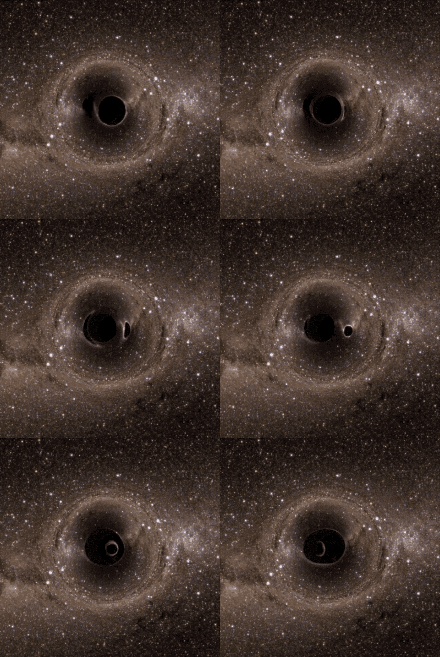
So much of this has to do with things in motion. One interesting point here is the notion that freefall is the nature state, gravity is not. What we experience in gravity is the push of things trying to get to its nature state against a contrary force. From the perspective of a free fall, any measure of spacetime becomes equally incoherent, which is precisely what applies to the movement of something like our earth. Or the fact that things like dark energy and black holes are universals where as objects are not (which is to say, not all things are equal to this end). What we experience as time is really understood as a personal vantage point
And yet, any ultimate theory still includes life. He spends some time talking about life in the second half of his book. Some brain breaking theories regarding the expansion of the universe, and how all things will eventually disappear into empty space. And yet, he brings up pertinant questions about why we don't just see empty space. Why, he asks, do we find ourselves in a universe evolving gradually from a state of incredibly low entropy (order), rather than being isolated creatures that recently fluctuated from the surrounding chaos?" (p314). A problem, he states, that needs us to look at the arrow of time. The cold and forbidding emptiness is overhwelmingly likely. Not only that, but an early universe "suffused with dark energy" (inflation theory) causes the acceleration precisely to this end. Why we find ourselves where we are is because we are very close to the big bang.
How does this apply to our experience of this world? I'm not sure. I don't think Carroll is entirely sure. One place I disagree with Carroll is on the notion that theories ever arrive. They don't. Theories are always overturned, and will continue to be overturned for all of time. That's how it works. I think he overplays his hand on that front. Information stays true. Experience stays even more true. On this front I agree with Carroll when he posits that theory is best explored in the present (which of course doesn't really exist), given that what happens now should be a measure for what happens at all times. I would narrow that down even further to two things- what is the nature of our experience of this world, and what is the nature of the world we are experiencing. On that front, I think there is lots of fascinating ideas here to transport on to both of those things. After all, what we do with our time is probably one of the most important questions facing the human experience. We shape our lives around this. And if a shaped life is relating to a specific reality or world, understanding the nature of that which we relate to is also a helpful part of that. That might apply to the changing of seasons. It can apply to the contrast between the seeming wideness expanse of space and our minute slice of if where we are. All conceptions that matter to a lived life. Here is where I would suggest that, for me, a world which seems to contain both an eternal nature and the experience of finite time seems to make sense of what we find in how it is we (an emergent universe) relate to God (an eternal presence). After all, if life is disorder awaiting transformation to a truly ordered state, wouldn't that make sense of those inate desires interwoven into all things? If it truly is the case that this is compatible with the notion of distinct things persisting apart from that ordered state (although Carroll believes such things just disappear), all of a sudden there is language to imagine how it is one thing might exist within a singular, eternal whole. That's where my brain tends to go anyways, and this was a good place to kind of spark that kind of thought process.