Издателство ЛИК продължава да запознава българския читател с основополагащи трудове на големия историк на религиите и културолог Мирча Елиаде. След "Трактат по история на религиите", "Шаманизмът и архаичните техники на екстаза", "Речник на религиите" и др. идва ред на знаменитата му монография "Йога-безсмъртие и свобода". Несъмнено това е най-пълното досега описание на теорията и практиката на Йога, увлекателен разказ за всичките и направления. Книгата е достъпна за неспециалисти, но ще е много необходима за историци на религията, психолозите, философите и културолозите. Ще научим смайващи неща за идеите, символите и методите на Йога, такива, каквито намират прилижение в Тантризма, алхимията и фолклора, индийските местни култове.
Romanian-born historian of religion, fiction writer, philosopher, professor at the University of Chicago, and one of the pre-eminent interpreters of world religion in the last century. Eliade was an intensely prolific author of fiction and non-fiction alike, publishing over 1,300 pieces over 60 years. He earned international fame with LE MYTHE DE L'ÉTERNAL RETOUR (1949, The Myth of the Eternal Return), an interpretation of religious symbols and imagery. Eliade was much interested in the world of the unconscious. The central theme in his novels was erotic love.
Long the standard work in the field, Eliade’s big book on yoga still displays its author’s dazzling erudition, while at the same time suffering from a dated style, poor organization, and like so many other scholarly tomes on the exotic field of “Eastern” spirituality, demonstrates the limits of a purely academic approach divorced from serious practice.
I’ve actually lost track of how many times I’ve read this book (or at least portions of it). In college I was a huge Eliade fan—my advisor was a student of his, after all—and indeed, when it comes to the analysis of mythology across cultures, he is the giant in whose shadow everyone labors. This is one of the strengths as well as weaknesses of the book. For the armchair theologian or philosopher, constant allusions to yogic parallels in other cultures—for example, among Inuit shamans—can provide illumination, but it is likely to distract or tire someone who wants to learn something useful from yoga. (Downward dog, anyone?) Eliade is clearly most interested in yoga as an exemplary phenomenon of homo religiosus rather than as a practice he or anyone else might seriously take up in their spare time, and this fact has to be borne in mind when venturing into the text.
First the strong points. Eliade’s seminal volume is one of the first from a Westerner to attempt a comprehensive overview of the gigantic subject that is yoga. When one considers the paucity of Western materials he had to work with (this back in the thirties and forties), the accomplishment is all the more stunning. A review of the bibliography, for example, shows how reliant he was on texts produced by Indians. He went the extra mile too, traveling to India to study under Surendranath Dasgupta, one of the great scholars of Indian philosophy of the twentieth century. Eliade mastered Sanskrit and so was able to read and interpret source materials first hand. He also spent six months in an ashram (much of that time in tantric dalliance with a South African dakini), and this no doubt helped him with some insight into the yogic life. Eliade was, however, not so much a yogin as a scholar of vast erudition, and that erudition is everywhere on display, especially in his marshalling of enormous quantities of facts and insights on yoga, Hinduism, mythology, and the meaning of spirituality.
This really is why someone today should read Eliade. If you have the time and patience you will learn innumerable things you never expected to learn, about so many obscure texts and cults, about the mishmash of ideologies and practices that somehow became Hinduism. As the preeminent scholar of comparative religion, he is able to relate all these seemingly disparate phenomena to others around the globe, thereby offering a broad picture of his subject as an example of human spirituality as opposed to simply some weird Indian cultural product. In this way, Yoga: Immortality and Freedom stands firmly in the line of other great Eliade books such as Shamanism: Archaic Techniques of Ecstasy, The Sacred and the Profane and The Myth of the Eternal Return. It is simply rare than anyone can actually master such a significant body of material and present it coherently and with insight. For understanding yoga in its larger, human context, this book is still one that should be read.
As noted, though, it has its drawbacks. Eliade’s writing style is often ponderous and heavily formal—he even refers to himself in the royal “we”! He also has an irritating propensity for obscure words and neologisms like homology, enstasis, hierophany, as well as an excessive fondness for Greco-Latin phrases. Eliade himself acknowledged this shortcoming in his autobiography:
"The writing went hard at first, requiring more effort than I had anticipated, and I wondered what was wrong with me. Why was I making such slow progress, and why was I writing such strident prose, studded with unnecessary neologisms, with a pretentious, artificial, aggressive syntax?" (Journey East, Journey West (vol. 1), pp. 254-5).
As I said: Patience!
Style aside, there are other problems. The book, which stands as something of a general history of yoga in Hinduism, is arranged in a decidedly non-chronological fashion. It starts with an overview of “The Doctrines of Yoga”—specifically the Samykha and classical yoga of Patanjali—then goes back in time to “Yoga and Brahmanism.” Then it’s forward a millennium to the Gita and Epics, back a millennium to Buddhism and forward again fifteen hundred years to tantrism. The book formally ends (if you don’t include the nearly one hundred pages of “Additional Notes”) with “Yoga and Aboriginal India”—i.e. pre-Aryan, Dravidian, and Harappan cultures. Why? Well, I don’t know why, unless the book can be more accurately characterized as a series of essays as opposed to a unified work. Needless to say, I don’t think this arrangement will help anyone.
Finally, my chronic complaint about scholars rears its ugly head once again—the difference between textual insights and insights born of practice. I’ll limit my critique of Eliade to his discussion of Buddhism, as that is what most people reading this blog are here for anyway.
The relevant chapter is “Yoga Techniques in Buddhism.” The very first sentence caught me by surprise: “During his period of study and asceticism, Shakyamuni had come to know both the doctrines of Samkhya and the practices of Yoga” (p. 162). I scrawled a question mark next to this, but here I’ll be more decisive: To the best of my knowledge, there is no indication of an acquaintance with Samkhya philosophy in the Buddha’s teachings. Note I’m not saying he didn’t encounter it, or argue with proponents of like-minded philosophies, only that to specifically associate the Buddha with Samkhya seems to me to go too far.
However, the passage that sets the tone for Eliade’s discussion of Buddhism is undoubtedly found on page 163. There he writes:
"If [the Buddha] took over the pitiless analysis to which preclassic Samkyha and Yoga submitted the notion of “person” and of psychomental life, it was because the “Self” had nothing to do with that illusory entity, the human “soul.” But the Buddha went even further than Samkhya and Yoga, for he declined to postulate the existence of a purusha or an atman. Indeed, he denied the possibility of having an even approximate experience of the true Self, so long as man was not “awakened.” The Buddha likewise rejected the conclusions of Upanishadic speculation—the postulate of a brahman, a pure, absolute, immortal, eternal spirit identical with the atman—but he did so because this dogma might satisfy the intellect and thus prevent man from awakening" (p. 163).
Oh, how I could wax poetic on the misunderstandings embodied in this passage!
Let us say first that there is no indication the Buddha’s analysis of consciousness owed anything to yoga as Eliade would define it. In fact, it was on account of his rejection of the yoga of his teachers that he ultimately struck out on his own and thereby became the most renowned—and revered—heterodox teacher in India’s long history. More importantly, he “declined to postulate the existence of a purusha or atman” not because such dogmatic concepts might interfere with the process of awakening to the Self, but because when one sees with fully clarified and unobstructed vision (vipassana), such things are not to be found. Sabbe dhamma anatta.
Perhaps we can blame Eliade’s suspicion that the Buddha never denied the Self on his teachers, or maybe we can blame it on the pernicious tendency of human beings to cling to notions of identity and permanence. Either way, it is simply one more cautionary note to carry into this important and worthy book. It is also a reminder of how difficult the Dhamma really is, how “against the stream.”
As David Gordon White eloquently points out in his indispensable introduction, Eliade's early masterpiece was far ahead of the curve; so much so that it is strongest when he sticks to the material he knows first hand. And so his exposition of Samkhya and Raja Yoga which he knew intimately from the Sanskrit material is truly marvelous and stands hardly rivaled to this day. When he wanders further afield the thinness of the available bibliography becomes evident. The chapters on Buddhism and Tantra are quite insufficient and are often inaccurate.
Be that as it may, this marvelous book remains a masterpiece decades after it was written. Eliade's name is synonymous with erudition and this book is one of the cornerstones of his formidable corpus. Highly recommended to anyone interested in Patanjali, Indian philosophy, or comparative religions.
Mircea Eliade introduces this erudite and impressively accessible survey of Yoga with a provocative observation, perhaps more directly pertinent to the existentialist vogue of the 1950s but no less relevant to our twenty-first century context: whereas Western thought, at least since the scientific-mechanistic revolution of the seventeenth century, has been preoccupied primarily with the conditioning of humanity, of exploring and emphasizing the conditionality—temporal, material, spatial, psychological, genealogical, cultural, etc.—that structures our entire existence as psychophysical beings, the ultimate purpose of Indian speculation has traditionally been the deconditioning of humanity; identifying the mutability of the human condition and the substantial matrix (Prakṛti) in which it is enmeshed for the purpose of distinguishing, and seeking union with, the immutable and impassible, conceived in a variety of ways: as God (Īśvara), the Self (Ātman), or the personal Spirit or “witness consciousness” (Puruṣa). While the precise stature of Prakṛti has varied among the numerous Indian traditions and philosophical schools—ranging from its positive veneration in Tantra as that in which “we live and move and have our being,” to the denial by Advaita Vedānta of its ontological reality—it has rarely been posited as the only reality, as in the case of Western materialism.
Yoga—derived from the Sanskrit root yuj, “to yoke”—refers to a wide spectrum of physical and mental practices, many of them quite ancient, undertaken with the aim of “yoking” the yogin to the absolute, the divine, the unconditional, and the imperturbable, attaining liberation (Mukti) from the suffering and privation endemic to karmic existence, and thereby conquering the human condition. The first intellectual “systematizer” of Yoga was Patañjali, whose Yoga Sutras formulated a philosophy of Yoga derived from the dualistic system of Sāṃkhya, traditionally regarded as the oldest of the orthodox Hindu darśanas, or “perspectives.” Unlike Advaita Vedānta (or at least many of its later interpreters), which deprives Nature of its ontological status by identifying it with illusion (maya), and Buddhism, which denies the true existence of the Spirit/Self (or at least prescribes an experiential agnosticism on the matter), Patañjali’s classical Yoga affirms the reality and coeternality of both Nature (Prakṛti) and Spirit (Puruṣa).
Though ontologically distinct, Spirit undergoes an illusory identification with Nature—a category which, of course, includes “internal” psychomental phenomena as well as “external” matter—which constitutes our ordinary experience of reality. This phenomenal (again, not ontological) submersion of Spirit within Nature has no etiological cause, as causality itself, so conceived, is a product of this primordial fall, which disrupts the static repose of Prakṛti and inaugurates a dynamic process of “evolution” or “development” (Pariṇāma), the telos of which is the liberation (or more properly, self-realization) of Spirit. The jivanmukta—the yogin who has attained samadhi, an enstatic state of “union” or “absorption” in which there is no “other” to Puruṣa; whose intellect (buddhi) has been so purified of Prakṛti as to become a mirror of the Puruṣa’s self-revelation; who has “burned” the subconscious latencies (vāsanās) which constitute our individual character, through which Prakṛti manifests itself in conscious thoughts (vrttis) which turn into actions (karma), which in turn produce more vāsanās and perpetuate the karmic cycle—thus assumes a higher condition of existence even than the gods, who have no experience of saṃsāra.
Prakṛti appears in three modalities, or guṇas, each of which has both “internal” (psychic) and “external” (physical) expressions: sattva (luminosity, intelligence), rajas (motor energy, mental activity), and tamas (inertia and psychic obscurity). In the original (and final) stasis, the guṇas exist in perfect equilibrium; but with the “descent” of Spirit into Nature this equilibrium is disrupted, and it is the very predominance of one guṇa over the others that causes its phenomenal appearance. When Prakṛti becomes dynamic, it takes on the form of an energetic mass called mahat or “the great,” which is driven toward its final end (and beginning) by pariṇāma. Nature then assumes the form of ahaṁkāra or “ego-making,” a psychophysical substance with a latent ego-consciousness but no personal center. From here the evolutionary process bifurcates between internal and external phenomena; but the two worlds maintain a deep correspondence. This correspondence is the basis for the claim found in much yogic literature that once in the saṃyamic state—that is, when one has integrated the threefold practice of concentration (dhāraṇā), meditation (dhyāna), and absorption (samadhi)—the yogin may obtain “powers” (siddhis) which allow him to manipulate the external environment in a seemingly paranormal way.
More to the point, this psychophysical genealogy of Nature indicates the interconnectedness—and substantial reality—of all phenomenal experience; both that which occurs to our minds and that which appears in the world “around” us. Even our most rarefied cognitive states, those which we typically consider most personal and unique to ourselves, are in essence but a more subtle configuration of the same (ontologically) homogenous “stuff” of which all material existence is composed. And since this “stuff” is just as “real” as the witnessing Self, there follows the paradoxical conclusion that the liberation towards which yogic practice is oriented is a liberation of Spirit and Nature alike, both of which are freed from the illusion of mutability and return to their primordial repose. What the yogin experiences as “yoking” at the phenomenal level is, at the level of ontology, a separation and mutual purification of Prakṛti and Puruṣa. Mukti liberates the Prakṛti orbiting the individual personality, calming the saṃsāric storm that agitates it.
When Spirit and Nature are liberated from their false identity, the latter will cease to appear to the former as a phenomenon. Yet the persistence of Prakṛti as phenomenal experience even when some have achieved liberation produces another striking conclusion; one which inverts the wisdom of Vedānta: according to Sāṃkhya-Yoga, there are as many Puruṣas as there are people. While Vedānta sees Nature as an (illusory) plurality and the Self as a (real, original) singularity, Sāṃkhya-Yoga posits a single, homogenous Nature and a plethora of individuated Spirits, each of which exists in perfect isolation from the others and from Prakṛti.
Later interpreters of Patañjali, influenced by the rise of devotion (bhakti) as the prevailing mode of spiritual practice, ascribed a greater significance to God (Īśvara), in his aspect as the Supreme Spirit (Puruṣottama), for the attainment of mukti; but for Patañjali, God is conceived as nothing other than the archetypal yogin, or the “macroyogin.” Īśvara does not actively “help” the yogin, except through a kind of metaphysical affinity. Classical yogic practice begins and ends with the initiative of the individual practitioner to conquer his conditional state. That the yogin retains conscious control through the entire procession of āṅgas or “members” leading to liberation, never losing himself in divine ecstasy; that he gains paranormal “powers” (siddhis) as he advances; and that his goal is to realize an ontological individuality all suggest that Patañjali’s Yoga is a series of techniques directed toward his own empowerment. In a word, it is magical rather than mystical.
Time compels me to leave off here, having described the physics and metaphysics behind the Sāṃkhyic system in which I am most interested—the Yoga Sutras are my next intended read on the subject—and without elaborating, as Eliade does so beautifully, on Haṭha-yoga (from which the online “NoFap” subculture gets some of its kookier ideas), Tantric yoga, and the yogas of aboriginal Indian religion. Suffice it to say, despite its age, this text remains an indispensable survey of the philosophies—if not so comprehensively of the practices—of Yoga.
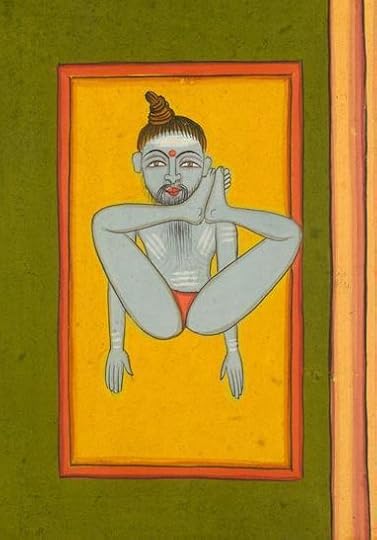
This image depicts a technique of Haṭha-yoga, in which I have little interest; but I found it too charming not to append to this review.
Eliade, Mircea. Yoga: Immortality and Freedom (1958) ***** All serious yoga scholars have this book or want it
I have the Bollingen paperback third printing of the Second Edition of 1969. I have little doubt that they used the plates from that hardcover edition, so the text is identical. The edition of 1970 currently available is the same as the one I have except for a new cover. The original was in French, published in Paris in 1954. This edition is professionally translated by William R. Trask.
Eliade was a nearly legendary scholar of indefatigable energy, and so it is not surprising that this is the definitive single volume academic work on yoga in English (that I am aware of). George Feuerstein's coffee table sized The Yoga Tradition: Its History, Literature, Philosophy and Practice (1998) is a different sort of book, covering yoga from a more practical point of view, and is accessible to a general public. Eliade's book is aimed directly and just about exclusively at academicians. Furthermore, while Feuerstein is a practitioner as well as a scholar, Eliade makes no pretense of first hand experience. As he relates in the Forward, he is interested in the discovery and interpretation of yoga by the West. He wants to explain that in detail. His is a "comparatively full exposition of the theory and practices of yoga... history of its forms, and...its place in Indian spirituality..." (p. xx) The qualifying "comparatively" is a bit of modesty on the part of Eliade. This book really is a "full exposition" (insofar as that is possible) including the ideas, symbolism and methods of yoga "as they are expressed in tantrism, in alchemy, in folklore, in the aboriginal devotion of India." (p. xxii)
The text, which includes lengthy chapters such as, "Yoga and Brahmanism," "Yoga Techniques in Buddhism," "Yoga and Tantrism," "Yoga and Alchemy," etc. runs for 362 dense pages. Sixty-six pages of notes follow, and then a most extensive and valuable bibliography. The Index itself is 47 pages long and concludes with a by-line(!), "Index by Bart Winer," which is only right considering the text was written and set before the age of computers.
This is not a book for practitioners of yoga but a book for students and scholars of the literature of yoga. It is a challenge to read and appreciate and only really accessible to those with some experience with the literature. There is probably no serious yoga book written in the past quarter century that fails to cite it.
A great book, wish I'd read it several years back on my Yoga journey. This book was written in the 1950's but it fills in so many gaps and explains some puzzling aspects of Yoga practice. It has helped me get to understanding why Yoga has become so watered down, and continues to be more so, it is entirely understandable once you read this history of how it has evolved. Inspiring insights, perhaps a bit thick and wordy for anyone who doesn't like academic reading but let's forgive him since he was an academic. Still, keep your browser open with a dictionary page for every 100 words I'll bet there's one you've never seen before lol
A MUST for any Yoga teacher who takes pride in understanding what Yoga is really all about!
когда-нибудь, когда у меня появится время читать подобные книги не в метро, а в более спокойной и располагающей к более вдумчивому чтению обстановке, я напишу об этой книге больше. Однако уже сейчас могу сказать, что первое впечатление от чтения двойственное. С одной стороны, Элиаде охватил в своем тексте довольно большой корпус идей и понятий так или иначе имеющих отношение к йоге в Индии. С другой, текст все же более теоретический, так как уже в самом начале Элиаде пишет, что без непосредственного практического опыта теоретический опыт большинства видов йоги не постигается умом. Определенная часть текста посвящена истории йоги в разных традициях, что было скучно читать. Но в целом, весьма и весьма стояще.
This is an academic treatise which gets very dense towards the end. I found the first half of the book to be very useful. I think the chapter on Buddhism is one of the best descriptions of the original Buddha’s teaching and its relation to yoga I have ever encountered in literature so far. Alas, starting with the chapter on alchemy I lost the interest in the book—Eliade stresses a lot the mythological part, and I simply don’t share the fascination with mythological elements, those remnants of the mythic structure of consciousness. So, for me, the strongest parts of the book are Eliade’s treatment of Samkhya, Patanjali and Buddhism—reading it was a profound experience, which I would recommend to anyone; the weakest part was pretty much everything else (for me personally, obviously).
Yoga in everyday usage has lost its vitality and deep meaning. It is now reduced to a form of exercise and a mild meditation to reduce stress but in the indian philosophy, it is much more. Yoga is a method to conquer the relentless circle of life and death and its cruelty. The writer has done more research than any other modern book out there and he has done it through the mind of the Western reader. The language is simple and the complex ideas of ancient hindi-sanskrit are explained in detail. The writer has attempted to compile the complete list of concepts of yoga that are found in different schools of thought. The books starts with the simple ideas of Maya, Nirvana, Samsara and Moksha. Maya is the illusion of the universe and mundane existence. Nirvana is the completion of the circle of life and achieving immortality through knowledge of the self and the universe. Samsara is the continuation of struggle of existence and moksha is deliverance, or more specifically jeevan-moksha, deliverance before death. Yoga and its variants are found in almost all indian religions and cultures. The books traces the origins of the yoga even before Hindu religion and vedas in the moenjodaro and harrapa civilisations which were destroyed by aryan invaders. Current day hindu religion is based on combination of the two, the pre-aryan religions of the mother and aryanic religions/deities of the father. Yoga existed in all of them and was a means to comprehend the universe and become its master. Meditation is the key to unlocking the secrets of existence and immortality. Yoga involves different techniques that negates the natural way of the existence or prakriti and through negation of the self and focussing, the mind and soul become one with the universe and the doors to knowledge are opened for the yogi leading to mosha or jeevan-mukti.
Yoga has been an essential part of indian religious and cultural thought and is a common occurrence in Brahmanic hindusim, vedic traditions and extends well into Buddhism, jainism and even tantric cults that practiced magical and supernatural, even erotic and violent practices to achieve the elation of the yogi. Yoga can be directed towards achieving boons from gods and godesses or it can be directed towards the self where the yogi can take his or her place among the gods and godesses. The Buddha himself achieved nirvana in the Asana pose, the basic mode of yoga. In most of the traditions, yoga is negation of the self, diving into the self and unlocking the secrets of the universe through secession of breathe and joining the rhythm of the creation. It is in the end knowledge of everything and it is this knowledge that gives a yogi command over everything and they can perform magical wonders. The most striking part of the book that is that yoga can be done in the most noble of actions or in the erotic practices of orgies and bodily pleasure such as kundalini and even in the consuming of human flesh as done by followers of goraknath. Alchemy and shamanism have their own share of the Yoga and yogic practices that have existed in literature and scientific texts from ancient times.
Even Islam has its own version of yoga in the form of dhikr saying Allah-hu with breathe and practioners of islamic yoga are referred to as Faqirs. Strikingly, they are present all over the sub-continent and the middle east and their tombs are celebrated by thousands of the followers even today.
Overall, this book is a bible for students of yoga who wish to understand the connection between Yoga and the realization of Indian thought esp in terms of defeating death, achieving immortality and doing it through sheer will-power and strange world of Yoga and yogis that have made a name for themselves in different religion, cults, cultures and traditions.
This book has been my first interaction with Yoga and although I've read it many years ago and don't remember much it got me hooked and therefore I started diving into the philosophy and practice of Yoga.
So this book is a catalyst for all the learning, developing and self (re)discovery that followed and is still going on in my life.
What else can I comment on it? I suppose this is the point of writing a book! Somebody reads it and changes their life. Mission accomplished!
Un libro esplendido para estudiar la maravilla del Yoga. Mircea Eliade es un referente necesario para comprender y entender los diversos pensamientos religiosos y m��sticos del ser humano; este libro no es la excepción. Alejado de cualquier dogma u especulación, el trabajo de Eliade es profundamente filosófico, conteniendo una documentación impresionante que recoge los textos arcaicos que fueron cformando al Yoga, así como los diversos estudios realizados sobre el mismo, mostrando un panorama invaluable, que va desde su origen, sus elementos, peculiaridades y las principales corrientes espirituales que se conformaron en torno al sincretismo y la herencia cultural. Una de las principales tesis es "el triunfo del Yoga" en el sentido de que innumerables corrientes espirituales lo integraron a sus cosmologías como una parte fundamental debido a la eficacia practica que representa. Encontramos así que el Jainismo, el Budismo, el Tantrismo, el brahmanismo, y otras tantas corrientes adoptaron al Yoga como elemental para sus fines específicos y sus particularidades ideológicas y ritualistas (cabe señalar que en el hinduismo actual, en lo popular, ha devenido más en una devoción mística que en una práctica espiritual). Eliade nos lleva de la mano en los cómo, los cuándo y los por qué.
El autor llega a decir que el Yoga es un "fosil viviente", pues sus orígenes los hallaa en las primeras civilizaciones del río Indo (Harappa y Mohenjo Daro) en el tercer milenio anterior a Cristo, otorgándole una antiguedad de 5000 años, lo cual es simplemente impresionante si consideramos el inmenso cementerio de concepciones espirituales que se han desarrollado alrededor del mundo, siendo el Yoga un elemento arcaico que sobrevive en gran medida por su efectividad como vehículo espiritual.
Muy lejos de ser un manual de asanas (posturas) o técnicas, es un estudio etnológico, filosófico y por lo tanto, es un texto académico. No fue fácil leerlo, tardé cerca de dos años en terminarlo, con dos pausas prolongadas, por lo que terminarlo me da mucho contento, además de que me motiva a seguir practicando y conociendo esta cosmología desde las más diversas vertientes. Este libro cambió mi concepción sobre el Yoga, pues la seriedad con que trata el tema es admirable y clarifica el horizonte en demasía, brindando una concepción profunda sobre su realidad en la antigüedad y una perspectiva para abordarlo en la actualidad.
Je mehr der Mensch leidet, je stärker er also mit dem Kosmos verbunden ist, desto mehr steigt in ihm die Sehnsucht nach Befreiung, desto mehr beherrscht ihn der Durst nach dem Heil.
Patañjali: ,,Alles ist Leiden für den Weisen” Buddha: ,,Alles ist Schmerz, alles ist ephemer” (sarvam duhkham, sarvam anityam) Die menschliche Erfahrung, gleich welcher Art, erzeugt das Leiden. Der Körper ist Schmerz, weil er der Ort des Schmerzes ist; die Sinne, die Gegenstände, die Wahrnehmungen sind Leiden, weil sie zum Leiden führen; sogar die Lust ist Leiden, weil Leiden auf sie folgt.
Die Hoffnung verlängert und vergrößert das Elend der Menschen; glücklich ist allein wer alle Hoffnung verloren hat. (Sâmkhya-Sûtra)
(…) bis er zu der höchsten Idee gelangt. Und wenn er dort angekommen ist, sagt er sich ,,Denken ist das Schlechtere, nicht denken ist besser. Wenn ich denke, forme ich. Es kann sein, dass diese Ideen verschwinden und andere entstehen, die grob sind. Deshalb will ich nicht mehr denken, nicht mehr formen.” Und er denkt nicht mehr und formt nicht mehr. Und da er nicht denkt und nicht formt , schwinden die Ideen, die er hatte, ohne dass andere gröbere entstehen. Er hat das Stillstand verwirklicht.
Lui-pa: ,,Wozu Meditation? Trotz der Meditation stirbt man im Leiden. Lass alle komplizierten Praktiken fahren samt der Hoffnung auf die siddhi und akzeptiere das Leere (sunya) als deine wahre Natur”
Alle Gegensätze sind illusorisch, das extrem Böse koinzidiert mit dem extrem Guten, der Zustand eines Buddha kann (…) zusammenfallen mit der höchsten Immoralität, und zwar aus dem guten Grund, dass einzig das universelle Leere ist und alles übrige ontologischer Realität ermangelt.
Jede nackte Frau ist eine Inkarnation der prakrti. Wenn man vor der nackten Frau nicht in seinem tiefsten Wesen dieselbe erschreckende Bewegtheit entdeckt, die man vor der Enthüllung des kosmischen Mysteriums empfindet, so ist es kein Ritus, sondern nur ein profaner Akt mit allen bekannten Konsequenzen (Verstärkung der karmischen Kette usw.) Das zweite Stadium besteht in der Umwandlung der prakrti-Frau in eine Inkarnation der Sakti; die Genossin im Ritus wird zur Göttin, ganz wie der Yogin den Gott inkarnieren muss.
Man ist auch berechtigt, ,,Mädchen’’ als Leere zu verstehen.
An early comprehensive look at Yoga (written in English). There are probably more thorough analyses nowadays, but reading this brought me back to the days of reading some of Evola's work (with much less of an ideological framework). Eliade approaches this subject with as much thoroughness as could be expected of an excellent scholar, while managing to fit the main bulk of the text (not including notes) around 350 pp. He's packing a lot of subject areas, eight to be precise, that, while there is some overlap, barely manages to feel complete. However, I don't believe he was attempting completion; there is densely packed material here, with an introduction of a Sanskrit or Tibetan word, with hardly any reminders of what that word meant again. Memorize or underline any foreign word immediately. It's sort of like that meme of Inuits having 50 words for snow -- there's about that much for meditation states, their objects, results: samadhi, ekagrata, kasina, siddhi....Buddhists will use different words than Sivaites, Jains than Brahmans, and so on.
There is certainly agreement however, across the Indian religions, on some words -- Samadhi being the classic focus for the Yogi. The Yogi, as can be derived from the title of the book, is one who applies certain spiritual techniques in order to gain immortality, and this immortality can only be gained by the crushing of personality and by liberating the historical being. I mentioned Evola before, and one can see how his esoteric fascism can be attracted to this. Even though he largely disagreed with Nazi ideology, that in no way spoiled his idea of spiritual supremacy. The Aryan is an honorable being, one who lives on the peak. This being, unlike the shaman discussed in chapter nine of this book, does not live under the ebb and tide of ecstatic experiences, but is purely "enstatic". He lives within, on the peak of single-pointedness, and to others looks like a dead man, but is in fact a timeless being. He has ruptured through time, but unlike Hitler's lightning and thunder aura, has no thought of changing others with his powers (siddhis) that he naturally accrues. He must let go even of these great powers (flying, clairvoyance...) in order to find the Self.
The meditative states of consciousness vary little by the time we reach Buddhism. By the time Buddhism occurred, Indian masters had already well described these states. Traditionally, in a case of religious one-up-manship, the Buddhists tacked on another state even more indescribable, which is what the Buddha experienced as nirvana.
If this is your first book on the philosophy of yoga, and in general aren't too familiar with Indian philosophies, this book may shock you. Even if you aren't religious, the ancient Indians have a vastly different theory of Self, and how it is recognized, than the modern American or European. Here we see the postures (asanas) and breathing techniques that seem to have flooded the West over the past fifty years are part of a much larger framework -- yet yoga, even in it's most obvious form (asanas), remains remarkably adaptable no matter what religious or non-religious background.
What shocks is Yoga's insistency to making a human being non-human. We are entirely out of Freud's realm here, one doesn't have to be subject to their unconscious, but even that can be controlled, albeit after much difficulty. We are in a realm where the unconscious and conscious are both brought to a summit, where there is an unendurable heat; or, not only coming out of Plato's cave, but then proceeding to climb Mount Meru. Here, even the balance is cancelled out, and we are not sure what is left.
The postures themselves, when practiced, are making the body obey certain forms in nature -- usually vegetative or animal-like. We can perhaps join Yoga to Tantra here -- of Shiva and his straddling consort, the masculine and feminine elements in Tantra respectively symbolizing: unmoveable concentration joined by expansive consciousness. In the West, Tantra has been largely bastardized by titles like, "How To Have Great Tantric Sex" or other some such nonsense. Which isn't to say there haven't been Buddhists or Hindus who haven't been Tantric masters while likewise enjoying sex or orgies -- looking at Gedun Chopel or the Kapalikas. The female is certainly elevated in this system, but how much and in which system can change the matter. Eliade, like Evola, gives the same description of the Indian Tantric male slowly working with his consort over a period of months or years until he is able to sleep next to her and still manage his tapas. Every female in tantra possesses a divine body that is a sort of a creatrix for all ensuing work. Sex may eventually be engaged in, but the spilling of seed is generally seen as a failure. This is probably the longest chapter in the book along with the ninth, and for good reasons. I'm looking forward to reading Indian Esoteric Buddhism (Davidson 2002), as, like Evola's book, I wasn't provided with any further details on how the female benefits in Tantra. The primary sources both cite seem to favor the male practitioner -- or if they do favor the female the details are lacking. And like Eliade says, much of Tantra is based on a dualistic form of thinking -- of seeing the "washerwoman"(a "base" woman or prostitute) as the prime consort, like the alchemical prima materia, seemingly present at all time, the rock beneath my feet, as interacting with the "pure" unflinching male concentration. But, some Tantrists might retort, this is just an efficient means, that is, it seems to work.
Unless you're familiar with Indian philosophy fairly well, I recommend reading every chapter in the order it was written. The first is about the "doctrines of yoga", primarily discussing Patanjali. The second describes the various meditation techniques (not those connoting shamanistic ones, like tummo, the production of "inner heat"). The third describes Yoga's interaction with the Upanishads and those Brahmanic works after the Vedas. The fourth is about the "triumph of Yoga", and is just that, how Yoga permeated all of India's religious and philosophical life. The fifth is about Yoga's interaction with Buddhism. Six is about Yoga and Tantra, seven, Yoga and Alchemy, and lastly eight describes more of the anthropological and shamanistic context around Yoga, and how it uniquely evolved from the Indo-Aryan and Dravidian mingling.
As noted by many, many others: Eliade runs off into some speculations and associations that just don't work. But, as an introduction to the history, general methods, and goals of hatha and tanra yoga (which are not that far apart)it tracks well with other such texts. The utter lack of Eurocentrism or Orientalism is surprising given the book's date, but Eliade made himself a student of yogic practices and history, so it's a practitioners account -- which is a very different thing to the account of colonial observer.
Encore une fois Mircea Eliade est un puits de science. J'ai appris une tonne de choses sur le yoga et sur l'Inde. Une lecture absolument fascinante. Et difficile (notamment à cause des termes en sanscrit, qui en plus ne sont pas transcrits de la même manière que maintenant) et austère et en même temps drôle à certains moments.
An interesting and dense exploration of the development of yoga. It is a good balance to the present-day sort of texts one encounters. (It is, of course, always important to keep in mind where Eliade was coming from)
An interesting introduction for Westerners into the world of Yoga, but even the erudite Eliade misrepresents/misunderstands some of the aspects of this meditative technology, especially the tantric elements.
I am still reading it. The elaborate description of Sankhya and Yogic philosophies vis a vis human condition is very informative. The book is a little difficult to read given it is a translation from French but the points he made are profound.
All serious yoga scholars have this book or want it
I have the Bollingen paperback third printing of the Second Edition of 1969. I have little doubt that they used the plates from that hardcover edition, so the text is identical. The edition of 1970 currently available is the same as the one I have except for a new cover. The original was in French, published in Paris in 1954. This edition is professionally translated by William R. Trask.
Eliade was a nearly legendary scholar of indefatigable energy, and so it is not surprising that this is the definitive single volume academic work on yoga in English (that I am aware of). George Feuerstein's coffee table sized The Yoga Tradition: Its History, Literature, Philosophy and Practice (1998) is a different sort of book, covering yoga from a more practical point of view, and is accessible to a general public. Eliade's book is aimed directly and just about exclusively at academicians. Furthermore, while Feuerstein is a practitioner as well as a scholar, Eliade makes no pretense of first hand experience. As he relates in the Forward, he is interested in the discovery and interpretation of yoga by the West. He wants to explain that in detail. His is a "comparatively full exposition of the theory and practices of yoga...[a] history of its forms, and...its place in Indian spirituality..." (p. xx) The qualifying "comparatively" is a bit of modesty on the part of Eliade. This book really is a "full exposition" (insofar as that is possible) including the ideas, symbolism and methods of yoga "as they are expressed in tantrism, in alchemy, in folklore, in the aboriginal devotion of India." (p. xxii)
The text, which includes lengthy chapters such as, "Yoga and Brahmanism," "Yoga Techniques in Buddhism," "Yoga and Tantrism," "Yoga and Alchemy," etc. runs for 362 dense pages. Sixty-six pages of notes follow, and then a most extensive and valuable bibliography. The Index itself is 47 pages long and concludes with a by-line(!), "Index by Bart Winer," which is only right considering the text was written and set before the age of computers.
This is not a book for practitioners of yoga but a book for students and scholars of the literature of yoga. It is a challenge to read and appreciate and only really accessible to those with some experience with the literature. There is probably no serious yoga book written in the past quarter century that fails to cite it.
--Dennis Littrell, author of “Yoga: Sacred and Profane (Beyond Hatha Yoga)”
El Yoga, inmortalidad y libertad Es la tercera vez que leo este texto. No había leído esta versión del Fondo de Cultura Económica y me pareció muy buena. Las otras dos lecturas las hice en la Editorial Sudamericana de Argentina.
Escuchando a los Doctores del Colmex. Óscar Figueroa y Adrián Muñoz en cursos diversos a cada uno, les escuche críticas que emitieron a este texto de Mircea Eliade y me propuse volverlo a leer.
Óscar Figueroa criticaba la ideología de Mircea Eliade por ser funcionario del gobierno fascista rumano del cual fue Embajador o cónsul en Portugal.
Adrián Muñoz tiene dos textos editados en el Colegio de México sobre el Hatha Yoga y una Historia mínima del Yoga. El expresaba que el libro de Eliade ya era un libro muy viejo.
Así que ante estos argumentos expresados por estos Doctores. Y honrando la memoria de Eliade y al ser un conocedor de muchas de sus obras volví al texto. El Yoga, inmortalidad y libertad.
Mircea Eliade estuvo estudiando en la Universidad de Calcuta de 1928 a 1931, bajo la tutoría del Profesor Sorendranath Dasgupta y durante 6 meses practicó Yoga en Risikhes con Swami Shivananda.
La primera versión del texto se publicó en francés en 1936 con el nombre. Ensayo sobre los orígenes de la mística india.
El texto lo reescribió completamente en 1948 con el nombre. Técnicas de Yoga. Y finalmente el texto como lo conocemos lo trabajo en Estados Unidos en 1951.
Este texto no es un texto improvisado. Tiene 85 años desde su primera creación.
Hasta el momento no hay un texto que haya superado este tratado de Historia y Filosofía del Yoga de Mircea Eliade. Un texto que se le aproxima es el de George Feuerstein, (2013) La tradición del Yoga. Historia, literatura, filosofía y práctica. De Editorial Herder.
Así que los comentarios de los Doctores no me achicaron a Mircea Eliade, me lo hicieron más grande.
Conozco la obra de Eliade. La implicación en sus diarios nos muestra lo que es. Un hombre obsesionado por la investigación, la escritura, sus crisis existenciales y financieras, y de la angustia al método para hacer sus obras.
Mircea Eliade alcanzó la fama a sus 23 años por su obra, la novela. La noche Bengalí. Maitreyi.
Así que honro a este texto y a la obra y vida de Mircea Eliade quien fue un Gurú occidental. Honras póstumas por el legado que nos dejó Este gran intelectual del siglo XX.
This was written at 1951 and was an influential introduction to the topic in western intellectual circles. The book explored the theoretical underpinnings of yoga as well as its cultural anthropological origins. It also lifted the author out of poverty and launched his career which eventually led to fame at University of Chicago.
Much has been written about yoga and India since then, so now this book really falls into the 'history of ideas' category and I'm not sure his view points are all still accepted. In particular his attempts to source yoga in Davidian or Indus Valley pagan tree cults smacks a bit too much of Frazer and the Golden Bough (as well as Robert Graves). But I'm not an expert.
Hinduism and Buddhism often claim that their foundational texts (yoga, vedas, tantra) are divine transmissions from supernatural beings. But Eliade is good at showing how the magical aspects of yoga have fascinated people over the ages and when intertwined with shamanism give rise to things like tantra. It is a great account and quite plausible.
Also his intro to the Samkya roots of Pantanjali is quite detailed and really a useful way to understand Pantanjali's yoga at a deeper level.
One quirk is that his transliterations are not widely adopted, so if you see a new term in his book, it is almost impossible to google because others have adopted different spellings.
often cited as a text everyone should read if they want more in depth about yoga.
Issues with the text: academic text written for men by men in the 1950s.
However, Eliade apparently held a lot of far right-wing and anti-Semitic views when he lived in Romania before WWII. His Wikipedia page doesn’t really cite any other information at this time.
While he might have come up with the theory of heirophanies (manifestations of the sacred, the differences between the sacred and the profane worlds), I’m wondering how much of his right wing thinking made it into things like this translation or his other works and would have colored his explanation of things like yoga.
I enjoyed the first half more than the second. Maybe this is because I find the gnostic Upanishidic traditions more interesting than the magical, ritualistic traditions of Tantra and Alchemy. But it's certainly an interesting read, and it was worth plodding along to the end. The comparative delineation between Yogic and Shamanistic traditions was profound, whether or not it is historically accurate, which would be impossible to confirm anyway. This is not a yoga guide, by any means, but an anthropological study of yoga throughout the development or the Asiatic religions, in particular in its relevance to India.
Creo que es demasiado denso en cuanto a citas y referencias, lo que dificulta la lectura. Es un gran libro como referencia y manual de estudio, pero si sólo quieres tener cierto margen antropológico y saber algo más de la historia y desarrollo del yoga al final acabas leyendo un poco en diagonal para saltar tanta palabra en hindii y sánscrito sin traducción, citas a miles de manuales distintos y anotaciones.
Molto interessante. C'è molta ricerca e studio per la scrittura di questo libro. Penso che avere già qualche nozione delle varie caratteristiche dello yoga renda la lettura più scorrevole e di facile comprensione.
Both academic and experimental. To me, the book shows many similarities between Yoga and Sufism, also with many other teachings. Same root, apparently looks different on the surface.