These are the voices of women who, throughout the ages, yearned for self-realization and union with the divine. The words of the first known poet were chiseled on cuneiform tablets four thousand years ago. Her name was Enheduanna; she was a moon priestess and daughter of the king of Sumeria, a woman of power and privilege who wrote, "From the doorsill of heaven comes the word: 'Welcome!'" Millennia later, Emily Dickinson would write, "Why — do they shut Me out of Heaven?/ Did I sing — too loud?" Voices of Light brings together spiritual poems by women from around the world and allows these women to sing loudly, whether or not they were welcomed by the heavens or their own social situations. Though often deprived of public position, women have long practiced the personal art of writing and so have been prepared to be our spiritual and visionary voices of light.
All night I could not sleep because of the moonlight on my bed. I kept on hearing a voice calling: Out of Nowhere, Nothing answered “yes.”
— Attributed to Zi Ye (Tzu Yeh) — from a collection of anonymous popular songs, 6th-3rd century BCE. Translated by Arthur Waley
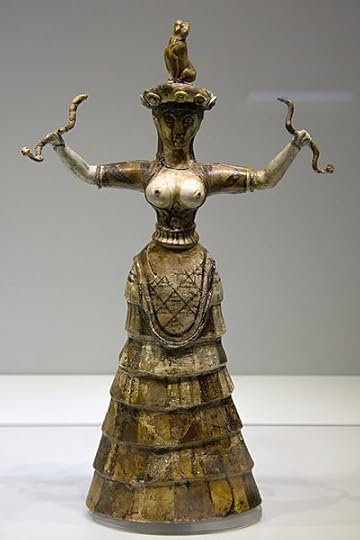
This book IS amazing, so pretty close to five stars. Published as Voices of Light: Spiritual and Visionary Poems by Women from Around the World from Ancient Sumeria to Now in 1999 by Shambala, its title and cover image of the Minoan Snake Goddess beckoned invitingly from a used book sale table and I savored it slowly. (It appears to have been republished later as The Shambala Anthology of Women's Spiritual Poetry.)
Someone else looked at the sky with the same rapture when the moon crossed the dawn.
—Izumi Shikibu (Lady Izumi) ca. 974-1034"
Many poems unite the mystic and erotic sensibilities, linked by a longing for union with the divine/lover which may and/or may not be realized, going back to the oldest known written poetry.
I am sleeping but my heart is awake. My lover’s voice is knocking: “Open, let me in, my sister and darling, my dove and perfect one. My head is soaked with dew, my hair is wet with drops of night.”
I have taken off my garments. How can I put them on? I have washed my feet. How can I dirty them now? My lover’s hand shows at the door and in me I burn for him. I rise to open to my love, my hands drip with liquid myrrh, my fingers drench perfume over the handle of the bolt. I open to my love but my love has turned and gone. He has vanished.
— from the Song of Songs, Anonymous Jew (10th-3rd C BCE)
The first half of the book spans from ancient times to the 18th century, and truly lives up to the subtitle “by women around the world” and from numerous different religious or philosophical or cultural traditions.
Mary Magdalene
Lord, this woman who fell into many sins perceives the God in you, joins the women bringing you myrrh, crying she brings myrrh before your tomb.
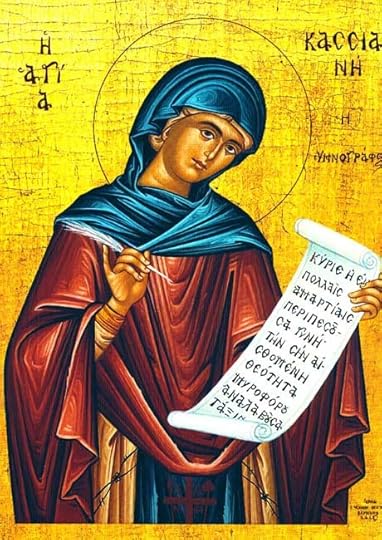
“Oh what a night what a night I’ve had! Extravagant frenzy in a moonless gloom, craving the body. Accept this spring of tears you who empty seawater from the clouds. Bend to the pain in my heart, you who made the sky bend to your secret incarnation which emptied the heavens. I will kiss your feet, wash them, dry them with the hair of my head, those feet whose steps Eve heard at dusk in Paradise and hid in terror. Savior of souls who will trace the plethora of my sins or the knowable chasm of your judgments? Do not overlook me, your slave, in your measureless mercy.”
— The nun Kassia (ca. 840), who wrote the words and music for at least twenty-three hymns that are still today part of the Byzantine Christian liturgy. “Mary Magdalene” is chanted during Holy Week in the Eastern Orthodox Church, and even today Greeks know her hymns by heart as Western Christians know the [Christmas] carols.
The second half of the collection was heavily weighted towards American poets, but with a pretty good smattering of voices from “around the world”. Though the imbalances were a bit disappointing the poetry itself did not disappoint.
They say that plants don’t talk
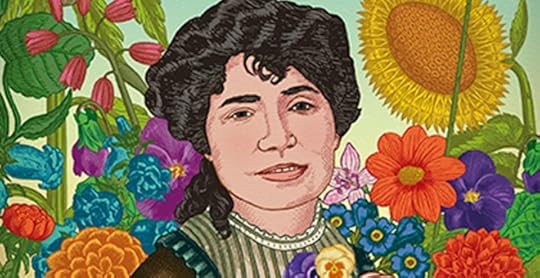
They say that plants don’t talk, nor do brooks or birds, nor the wave with its chatter, nor stars with their shine. They say it but it’s not true, for whenever I walk by they whisper and yell about me “There goes that crazy woman dreaming of life’s endless spring and of fields and soon, her hair will be gray. She sees the shaking, terrified frost covers the meadow.” There are gray hairs in my head, there is frost on the meadows, but I go on dreaming—a poor, incurable sleepwalker— of life’s endless spring that is receding and the perennial freshness of fields and souls, although fields dry and souls burn up. Stars and brooks and flowers! Don’t gossip about my dreams: without them how could I admire you? How could I live?
— Rosalía de Castro, Galician/Spanish, 1837-1885, wrote in the Galician language and in Spanish. translated by Aliki Barnstone and Willis Barnstone
A final note: Short bios identify each poet’s country of origin — but rarely identify the original language of translated poems. This drives me crazy! For instance, I have no idea whether the poem above by Rosalía de Castro was originally written in Galician or Spanish, since she wrote in both languages. (And it’s a flaw of Goodreads too — there’s no data field for original language for translated books.) Many poems, especially the ancient/historical poems, were translated by Willis Barnstone or by Willis and Aliki Barnstone together. A bold decision. Except as noted below, I have not compared these translations to any others.
Blue is Greece where fishermen tame their boats, where I float naked in the color of truth, the sea
humming in my ears, lulling me with ultramarines like a baby kicking in amniotic seas, like god
whose throne is this transparent blue bowl this star-sapphire studded cradle of waves
She must have blue skin and eyes, lapis lazuli looped in strands and strands around her rounded belly
—excerpt from "Blue," Aliki Barnstone
*************************** Image Credits:
The Snake Goddess, Knossos, Crete (Minoan, 1650-1550 BCE) Image by Zde / CC BY-SA (Wikimedia Commons)
Unidentified Ikon of St. Kassia the Hymnographer https://orthochristian.com/92861.html (Note the very different traditional translation of the poem on this web page.)
Rosalía de Castro: Detail of the cover of 'Rosalía' by Luisa Carnés, illustrated by Aitana Carrasco.- TIN LEAF
I never would have bought this collection just by its title. I happened to hear someone reading "Here I Am Once More..." by Moroccan poet Rachida Madani and was transfixed. I had to have it.
I don't think the editor and I share quite the same interests. I haven't always been a huge fan of religious poems. But this... this is an extraordinary thing. I don't think I could help giving this five stars just for being what it is: A collection of poems by women from different countries, cultures, races, sexualities, religions, circumstances, and time periods, from Ancient Sumeria (over 4 thousand years ago) to the present day (as of the publishing date.)
No matter what the subject matter there's something powerful in that. How could I not be fascinated by looking through a little window into the lives, thoughts, feelings, experiences, and perspectives of almost a hundred women throughout the ages? Their voices aren't always heard in history, and hearing them through poetry is so intimate and immersive that it's spell-binding. I appreciated the diversity, the different religions and beliefs represented: Pagan, Hindu, Buddhist, Taoist, Sufi, Native American, Aztec, Abrahamic. Even the ones that didn't appeal to me were still intriguing, just in seeing the beliefs and experiences of a woman in the time and context in which she existed. I enjoyed watching the beliefs change over time.
Whether the religious themes gripped me or not hardly mattered. The poems themselves are beautifully crafted, and there is so much more that you can find in them. To some extent the theme of the poems being "spiritual" is rather loosely interpreted. And not all of their thoughts on the subject are rosy. (There are at least two from the perspective of girls who are furious about being forced to become nuns.) What the poems are about varies greatly. There are poems about social issues, dealing with loss, slavery, war... all kinds of things.
It's not perfect, but I haven't been able to find anything quite like it. (If you have, do let me know.)
Sometimes a book of poetry is just the company I'm looking for. Pulling this book off of my shelf and opening it up is a delightful experience. It is full of wonderful, little gems that I don't run into in my other books.
Sangha (6th-5th Centuries BCE?)
I gave up my house and set out into homelessness. I gave up my child, my cattle, and all that I loved. I gave up desire and hate. My ignorance was thrown out. I pulled out craving along with its root. Now I am quenched and still
Another very good anthology of spiritual poetry by women, from ancient to modern times. Covers many of the same poets as Women in Praise of the Sacred, like Mirabai, Mahadevi, Lal Ded, Sappho, Sun Buer, Dickenson, Tsvetaeva, but also several different poets. The two books together make a good collection.
I used this book to inspire my own writing but now it has done its job and I have other poems to read … cool anthology though!! Def so many relationships btwn sex, love, and religion. Poetry is so awesome
This was a really interesting collection of poems. I've read a few poetry anthologies over the years and I think this might be my favourite, I think I felt some kind of connection with most of the poems which is not something I've found with other anthologies. I think the fact that a lot of the poems have been translated by the same few people (an assortment of Barnstones) might give it a bit more consistency than other anthologies.
I think the premise of "Spiritual" poetry was a bit sketchy, a lot of these "spiritual" poems seemed like pretty conventional love poems to me, though perhaps with a more profound inflection than you might otherwise expect. The central concept of "spiritual" poetry seemed somewhat loosely applied but nonetheless, I think the tone was pretty consistent.
As with most anthologies of poems, I enjoyed most of it but only found that one or two poems made a big impression on me. In this case the poems were Regretful Thoughts by Yu Xuanji (9th century) and the one by Shu Ting (20th century). I've tracked down what few poems I can find by those two poets and will try and understand those writers a bit better.
I think the pervading mood of this book is one of gentle, nurturing tranquility. Many of the poets express a sense of struggle and sadness but also seem to be dedicated to a principle of calmness and gratitude.
All in all it's a charming and beautiful collection of works which hangs together very nicely. Highly recommended to anyone who enjoys poetry of a spiritual ilk.
I’d bought a few books of women’s spiritual writings of late, from mystics to theologians and was disappointed at how overly scholarly and staid it all was. I received this book today, a spontaneous purchase/find, a book I knew nothing about and gosh it is such a great book. Every poem I read in it I loved, I’d open to another gem and another gem. This has passionate poems from Indian women poets from the 1st century, to mystical Indian poets like Mirabai and Chinese women poets writing about jade and coral ornaments that chime and celestial companions. I genuinely couldn’t find a poem in it that didn’t resonate with me, it is a beautiful book. Full of actual poetic romantic language not jarring modernity and plain language. We have Mahadevi from the 12th century writing about riding the blue sapphire mountains wearing moonstones for slippers. Oh this will definitely be a very beloved book of mine that I will treasure forever and take everywhere.