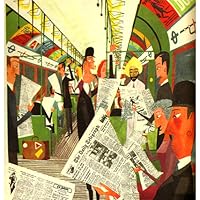
Michael Wharton was of course 'Peter Simple' of the Daily Telegraph. He wrote two volumes of autobiography, this one, "The Missing Will," and its sequel, "The Dubious Codicil." Both are reissued in Faber Finds. "The Missing Will" describes his early life in Bradford, a lamentable career at Oxford, army service in India, years adrift in post-war Bohemia, and finishes on New Year's Day, 1957 when 'I sat down for the first time at my desk in the Daily Telegraph with one of the most appalling hangovers I have ever had in my life, and without a single idea in my head.''The jokes are bizarre and side-splitting, the sense of place and character haunting, and I don't expect to read a more honest piece of self-portraiture for some time to come.' Rivers Scott, "Financial Times"""'Everyone should read this book who want to know how an intelligent and civilised man can survive in the modern world.' Auberon Waugh'Brilliant and hilarious' - Arthur Marshall
This is a very readable memoir by one of Britain's leading humourists who was a very complex man and a melancholic to boot. His early life leads up to a niche on the Daily Telegraph writing the Peter Simple column which was unmissable and indeed made buying the Telegraph worthwhile. It's a sign of the decline of the paper that one can't imagine the column in today's Telegraph.
This is very enjoyable – some parts are very funny – but it leaves one feeling slightly melancholic. This is partly because Wharton was himself somewhat melancholic, and this infuses the pages a little, but also because all the things he hated and wrote about in his Daily Telegraph column have come to pass – only more so. In the Culture Wars, our hero’s team has been soundly thrashed. Some of the very funny mockery Wharton directed against the modern world has lost its power now that so much of real life is beyond parody.
I was surprised to learn that Mr Wharton did such a lot of shagging. One rather thinks this sort of thing didn’t go on much prior to the Beatles, especially if one was an out-and-out reactionary. I was glad to lean that this was not so, at least as far as Mr Wharton was concerned.
Who wrote about a secret society of ultra reactionaries whose hatred of progress was so intense that part of their political programme was the abolition of the future tense? Wodehouse, Waugh, or A N Wilson, I forget which one. Wharton would have approved. The barbarians breached the gates long ago and are firmly in charge. Who can blame Wharton – or indeed anyone -for retreating onto the sunny isles of fantasy and insanity? My bark is setting sail for the same destination...
I confess I never read 'Peter Simple', and the title itself is a tease, but from the first this was a refreshingly honest, time-passed, loss-of-memories tale of negotiating a life the writer felt unfitted for in a variety of places - home, schools, university, what attempted to pass for the workplace and, most vivid of all, in the army in India during World War II. A total delight, albeit frequently tinged with sadness at the personal failures.