Jump to ratings and reviews
Rate this book

Are Women People? A Book of Rhymes for Suffrage Times

Rate this book
Alice Duer Miller (1874-1942) was an American writer and poet. As a novelist, she scored her first real success with Come out of the Kitchen in 1916. The story was made into a play and later the film Spring in Park Lane in 1948. She followed it with a series of other short novels, many of which were staged and (increasingly) made into films. Her marriage endured to the end of her life, but was not entirely tranquil. Her novel in verse Forsaking All Others (1933) about a tragic love affair, which many consider her greatest work, reflects this, though it is certainly not autobiographical. Her other works include Modern Obstacle (1903), The Blue Arch (1910), Are Women People? (1915), Ladies Must Live (1917), Wings in the Night (1918), The Happiest Time of Their Lives (1918), The Charm School (1919), and The Beauty and the Bolshevist (1920).

94 pages, Hardcover

First published January 1, 1915

23 people are currently reading
532 people want to read

About the author

Alice Duer Miller

84 books18 followers
Alice Duer Miller (July 28, 1874 – August 22, 1942) was an American writer whose poetry actively influenced political opinion. Her feminist verses impacted on the suffrage issue, while her verse-play The White Cliffs encouraged US entry into World War II. She also wrote novels and screenplays.

(from Wikipedia)

Ratings & Reviews

What do you think?
Rate this book

Friends & Following

Create a free account to discover what your friends think of this book!

Community Reviews

5 stars
121 (46%)
4 stars
96 (36%)
3 stars
37 (14%)
2 stars
6 (2%)
1 star
0 (0%)
Displaying 1 - 30 of 46 reviews
Profile Image for Debbie Zapata.
1,980 reviews59 followers
April 3, 2016
I don't remember now how I came across this book, but I had added it to a Progressive Reading challenge quite awhile back and finally worked my way down the list to it.

There are other titles of Miller's at Gutenberg, but unfortunately the list does not include her 1917 work Women Are People , which I think would be good to read as a companion piece to this one. But there are a couple of her novels and plays available there, so I hope to read them Someday.

Naturally this book is dated to an extent, since the focus was the women's suffrage movement of the early 1900's. But for a few reasons, the book was fascinating reading for me.

For one thing, many of the poems in this collection were inspired by politicians and
their opinions. We get to see the quotes which led to the poem. Here is an example,
titled Our Idea Of Nothing At All inspired by this quote: ("I am opposed to woman suffrage, but I am not opposed to woman."—Anti-suffrage speech of Mr. Webb of North Carolina.)

O women, have you heard the news
Of charity and grace?
Look, look, how joy and gratitude
Are beaming in my face!
For Mr. Webb is not opposed
To woman in her place!

O Mr. Webb, how kind you are
To let us live at all,
To let us light the kitchen range
And tidy up the hall;
To tolerate the female sex
In spite of Adam's fall.

O girls, suppose that Mr. Webb
Should alter his decree!
Suppose he were opposed to us—
Opposed to you and me.
What would be left for us to do—
Except to cease to be?


Here is another, titled Home And Where It Is written because of this: (An Indiana judge has recently ruled: As to the right of the husband to decide the location of the home that "home is where the husband is.")

Home is where the husband is,
Be it near or be it far,
Office, theatre, Pullman car,
Poolroom, polls, or corner bar—
All good wives remember this—
Home is where the husband is.

Woman's place is home, I wis.
Leave your family bacon frying,
Leave your wash and dishes drying,
Leave your little children crying;
Join your husband, near or far,
At the club or corner bar,
For the court has taught us this:
"Home is where the husband is."


You can feel Miller's indignation throughout the book. It is easy to imagine yourself in the middle of the struggle. Which has actually only partially succeeded, in my opinion, and this is the other reason the book was interesting to me. It made me wonder once more about our modern world. Yes, women got the vote. Yes, women were allowed to become doctors, lawyers, anything they wanted to
be. Oh, and someone in New York state finally decided that it was entirely possible for a married woman to be a teacher!

Laws were passed, but does that mean that women were finally truly respected as human beings? I see the headlines all the time: rapes here, beatings there, female genital mutilation, kidnappings, arranged marriages that are just an excuse for acquiring a slave, the list is endless. And depressing. I wonder what Alice Duer Miller would say now about the conditions of women around the world ?
Profile Image for Wealhtheow.
2,465 reviews605 followers
January 24, 2012
A slim collection of poems mocking common sexist thought and arguments. Pointed and hilarious, like an early Dorothy Parker. Each poem is accompanied by a quote of a recent legal decision or editorial that provides context for the piece--and they are so sexist that they're both laughable and terrifying. I originally found this through the Hairpin's review.

A personal favorite, which still seems a bit too applicable:
Chivalry:

It's treating a woman politely
As long as she isn't a fright:
It's guarding the girls who act rightly,
If you can be judge of what's right;
It's being—not just, but so pleasant;
It's tipping while wages are low;
It's making a beautiful present,
And failing to pay what you owe.
Profile Image for Amy.
3,051 reviews619 followers
May 24, 2021
Sassy suffragettes give me life.

I probably missed the point but I loved the essay on pockets. Even in 1915 women just wanted real pockets.

(Another reviewer likened this volume to an early Dorothy Parker and it is an apt comparison.)
Profile Image for Shauna.
112 reviews93 followers
May 12, 2015
Are Women People? is a compilation of satirical poems written by feminist Alice Duer Miller, a woman whose utter brilliance has me right now considering starting up some sort of fanclub in her honour. I may have missed the boat on that one though.
Miller was a passionate, and published, campaigner for women's suffrage and much of the material for this book was taken from pieces for her column in the New York Tribune. The words Are Women People? became a catchphrase of the suffrage movement.
With vitriolic wit, each poem mockingly addresses different issues/quotes from antis (members of the anti-suffrage movement) and really, it's is satire at it's very best.
To give you some idea;

Our Idea of Nothing at All

("I am opposed to woman suffrage, but I am not opposed to woman."—Anti-suffrage speech of Mr. Webb of North Carolina.)

O women, have you heard the news

Of charity and grace?

Look, look, how joy and gratitude

Are beaming in my face!

For Mr. Webb is not opposed

To woman in her place!

O Mr. Webb, how kind you are

To let us live at all,

To let us light the kitchen range

And tidy up the hall;

To tolerate the female sex

In spite of Adam's fall.
O girls, suppose that Mr. Webb

Should alter his decree!

Suppose he were opposed to us—

Opposed to you and me.

What would be left for us to do—

Except to cease to be?

The Maiden's Vow

(A speaker at the National Education Association advised girls not to study algebra. Many girls, he said, had lost their souls through this study. The idea has been taken up with enthusiasm.)

I will avoid equations,
And shun the naughty surd,
I must beware the perfect square,
Through it young girls have erred:
And when men mention Rule of Three
Pretend I have not heard.
Through Sturm's delightful theorems
Illicit joys assure,
Though permutations and combinations
My woman's heart allure,
I'll never study algebra,
But keep my spirit pure.

What Every Woman Must Not Say

"I don't pretend I'm clever," he remarked, "or very wise,"
And at this she murmured, "Really," with the right polite surprise.
"But women," he continued, "I must own I understand;
Women are a contradiction—honorable and underhand—
Constant as the star Polaris, yet as changeable as Fate,
Always flying what they long for, always seeking what they hate."
"Don't you think," began the lady, but he cut her short: "I see
That you take it personally—women always do," said he.
"You will pardon me for saying every woman is the same,
Always greedy for approval, always sensitive to blame;
Sweet and passionate are women; weak in mind, though strong in soul;
Even you admit, I fancy, that they have no self-control?"
"No, I don't admit they haven't," said the patient lady then,
"Or they could not sit and listen to the nonsense talked by men."


The entire book should take up little more than half an hour of your time-if that- and is available free courtesy of Project Gutenberg, so I highly recommend it.
Profile Image for Thorn.
217 reviews13 followers
January 31, 2012
The worst part of this book is that clever poems and notes are often still as applicable today regarding feminism in general as they were in Miller's time regarding giving the women voting rights.
Profile Image for loane.
29 reviews1 follower
July 27, 2022
« man is often such a goose! »
Profile Image for Megan.
1,165 reviews71 followers
October 22, 2018
Time travel priority #135: Find Alice Duer Miller and see if she'd like to travel to the future to see the work of her daughters-of-the-heart-and-mind. I'd like to show her everything on the Toast. I'd like to tell her about Rebecca Solnit and the term "mansplaining"--I think ADM would be very familiar with the concept and enjoy knowing that naming allows us to recognize, resist, communicate better. We could visit the graves of suffragists, those sites of pilgrimages on our last election day. I'd need to share a copy of Courtney Milan's The Suffragette Scandal (which contains the following line, that I think ADM could appreciate: "Suffragette," she said, "is pronounced with an exclamation point at the end. Like this: 'Huzzah! Suffragettes!'"). We'd check in on Roxane Gay's Twitter feed and we could read some from Bad Feminist. And I'd tell her that many women today still suffer from pocket parity in their clothing choices, but on that front, at least, we have seen some improvements since her time.

So, basically, these are poems (and some short essays) responding to antisuffrage and attacks on women's rights, originally published in newspapers but collected in this 1915 book, and Miller is so mocking and satirical, and it's hilarious and sad and angry-making and wonderful all at once. It makes me think of the phrase "We have always fought," and then I realize now that I should probably include that Kameron Hurley's essay in my time travel fantasy, too.

My favorite selection was this little list, parodying antisuffrage arguments as arguments against women having pockets:
Why We Oppose Pockets for Women

1. Because pockets are not a natural right.

2. Because the great majority of women do not want pockets. If they did they would have them.

3. Because whenever women have had pockets they have not used them.

4. Because women are required to carry enough things as it is, without the additional burden of pockets.

5. Because it would make dissension between husband and wife as to whose pockets were to be filled.

6. Because it would destroy man’s chivalry toward woman, if he did not have to carry all her things in his pockets.

7. Because men are men, and women are women. We must not fly in the face of nature.

8. Because pockets have been used by men to carry tobacco, pipes, whiskey flasks, chewing gum and compromising letters. We see no reason to suppose that women would use them more wisely.
Profile Image for Lew.
166 reviews
January 23, 2012
This book was a delightful surprise. Despite being nearly 100 years old the poems were witty and fresh. Some seemed relevant today, some were fascinating for their historical context. All of them were funny. It was a fast read, and as soon as I was done I wanted to read it again. I want her to be alive today writing poems about today's politics.
Profile Image for Amanda.
Author 11 books207 followers
April 6, 2020
Relatable over a century later. I appreciated the feminist snark!
Profile Image for D. Dorka.
617 reviews27 followers
June 27, 2024
4,5 csillag
Három (nem túl hosszú) (kis)regényét hallgattam meg Alice Duer Millernek, akiről a mai kor embere jellemzően soha nem is hallott. Pedig egészen élvezetes alkotások voltak, főleg a The Priceless Pearl. Amit azért értékeltem a legjobban, mert a kiindulási problémakör az, hogy a Pearl nevezetű hölgyemény túl szép, ezért mindig kirúgják a munkahelyéről. Elképesztő, hogy ez valaha egy valós helyzet lehetett. Pedig az volt, még ha itt sarkítva is jelent meg.
Az Are Women People? verses kötet pedig kis rímelő szösszeneteket sorakoztat fel hasonló témákban. Ironikus-szerkasztikus, élesnyelvű, ritmusos. És nagyon reflektív. Banális, persze, 2024-ben. De kéremszépen, ez 1915-ben jelent meg (illetve újságban jelentek meg időről-időre). Ennek tudatában sokszorosan felértékelődik a egyébként is sok nevetéssel töltött 1,5 óra. Még úgy is, hogy a LibriVoxon több felolvasóval található meg a kötet, ami mentálisan elképesztően fárasztó tud lenni (meg van pár kritikán felül akcentusos egyén.) De még így is megérte. Azért egyszer fizikailag is el akarom majd olvasni.
Profile Image for Anastasia Tuple.
161 reviews
April 12, 2020
Sharp and witty! You can find it here http://www.gutenberg.org/files/11689/...

I particularly loved:

"The Gallant Sex"
Lady, dangers lurk in boilers,
Risks I could not let you face.
Men were meant to be the toilers,
Home, you know, is woman's place.
Have no home? Well, is that so?
Still, it's not my fault, you know.

Charming lady, work no more;
Fair you are and sweet as honey;
Work might make your fingers sore,
And, besides, I need the money.
Prithee rest,—or starve or rob—
Only let me have your job!
Profile Image for Kathleen.
Author 35 books1,359 followers
August 17, 2020
My review for LARB https://lareviewofbooks.org/article/a...


Introduction

Father, what is a Legislature?
A representative body elected by the people of the state.
Are women people?
No, my son, criminals, lunatics and women are not people.
Do legislators legislate for nothing?
Oh, no; they are paid a salary.
By whom?
By the people.
Are women people?
Of course, my son, just as much as men are.


The Protected Sex
With apologies to James Whitcomb Riley.

("The result of taking second place to girls at school is that the boy feels a sense of inferiority that he is never afterward able entirely to shake off."—Editorial in London Globe against co-education.)

There, little girl, don't read,
You're fond of your books, I know,
But Brother might mope
If he had no hope
Of getting ahead of you.
It's dull for a boy who cannot lead.
There, little girl, don't read.

Feminism
"Mother, what is a Feminist?"
"A Feminist, my daughter,
Is any woman now who cares
To think about her own affairs
As men don't think she oughter."

Why We Oppose Pockets for Women

1. Because pockets are not a natural right.

2. Because the great majority of women do not want pockets. If they did they would have them.

3. Because whenever women have had pockets they have not used them.

4. Because women are required to carry enough things as it is, without the additional burden of pockets.

5. Because it would make dissension between husband and wife as to whose pockets were to be filled.

6. Because it would destroy man's chivalry toward woman, if he did not have to carry all her things in his pockets.

7. Because men are men, and women are women. We must not fly in the face of nature.

8. Because pockets have been used by men to carry tobacco, pipes, whiskey flasks, chewing gum and compromising letters. We see no reason to suppose that women would use them more wisely.
Profile Image for Ania.
252 reviews37 followers
June 27, 2012
What a wonderful collection of suffrage poetry!! I particularly liked the format of many of the poems (and this is coming from someone who doesn't like poetry in general!). What I mean is, I really liked that Alice Duer Miller will often take a quote from a popular anti-suffrage speech and reply to it- sarcastically, wittily, intelligently- through poetry, which really makes you appreciate the passion these suffragettes had for the equality of the sexes, as symbolised by the right to vote.

Highly recommended. Download it now!

Profile Image for Rikki.
148 reviews19 followers
May 19, 2020
This is just absolutely stellar.

At times sobering, at others eerily remarkable in its painfully timeless relevance, and at others still just hilarious, this collection is a reasonably short and [bitter]sweet look into the righteous fuming of suffragettes. And it's available free to all with internet access through Project Gutenberg!

I read the entire thing in a few hours, and I'm a slow reader. So you can—and should—too! Here are some of my favorites.

This one is Interviews With Celebrated Anti-Suffragists, and it reads like a 19th century meme and I love it:

"Woman's place is in my home."—Appius Claudius.

"I have never felt the need of the ballot."—Cleopatra.

"Magna Charta merely fashionable fad of ye Barons."—King John.

"Boston Tea Party shows American colonists to be hysterical and utterly incapable of self-government."—George III.

"Know of no really good slaves who desire emancipation."—President of the United Slaveholders' Protective Association.

Another is The Logic of the Law, which is one of the more sobering ones I mentioned.

In 1875 the Supreme Court of Wisconsin in denying the petition of women to practise before it said:

"It would be shocking to man's reverence for womanhood and faith in woman ... that woman should be permitted to mix professionally in all the nastiness which finds its way into courts of justice."

It then names thirteen subjects as unfit for the attention of women—three of them are crimes committed against women.

Several of these are prefaced by brief lines of historical context, which I adored not only for their usefulness but also for their occasional sardonic wit:
Home and Where It Is
(An Indiana judge has recently ruled: As to the right of the husband to decide the location of the home that "home is where the husband is.")

Home is where the husband is,
Be it near or be it far,
Office, theatre, Pullman car,
Poolroom, polls, or corner bar—
All good wives remember this—
Home is where the husband is.

Woman's place is home, I wis.
Leave your family bacon frying,
Leave your wash and dishes drying,
Leave your little children crying;
Join your husband, near or far,
At the club or corner bar,
For the court has taught us this:

"Home is where the husband is."

And one more to share as it's just delicious in its rich references to women throughout history and in its cool rebuke to this not-quite-antiquated misogyny:
Militants

Hippolta, Penthesilea,
Maria Teresa and Joan,
Agustina and Boadicea
And some militant girls of our own—
It would take a brave man and a dull one
To say to these ladies: "Of course
We adore you while meek,
Timid, clinging and weak,
But a woman can never use force."


I wrote down the titles of all my favorites as I was reading, and they are as follows (follow the link above and ctrl/cmd+F to quickly navigate to these, if you care to):
• The Revolt of Mother
• Representation
• Home and Where It Is
• Such Nonsense
• The Newer Lullaby
• The Protected Sex
• What Governments Say to Women
• Our Own Twelve Anti-suffragist Reasons
• Why We Oppose Pockets for Women
• Why We Oppose Schools for Children
• But Then Who Cares for Figures
—> Especially the last two lines:
When a benefit is suggested for men, the question asked is: “Will it benefit men?”
When a benefit is suggested for women, the question is: “Will it benefit men?”

• Why We Oppose Votes for Men
• Do You Know
• Interviews With Celebrated Anti-Suffragists (basically a 19th century meme lol)
• The New Freedom
• Many Men to Any Women
• Evolution
• What Every Woman Must Not Say
• Glory
• Playthings

A long list, but they're just marvelous, and I highly recommend them—and all the rest. Each snippet is very short, with the longest piece in the entire collection comprising *maybe* 20 lines.

I wish author information had been included for each piece of writing, but I know it might not have been available—whether at the behest of the writers themselves or otherwise—at the time Miller was compiling this. I know (rather, I should say I hear) much of the suffrage movement was white and upper- or upper-middle class, and indeed not all women won the vote in the U.S. in 1920; I wonder how many of the women who contributed to this collection were women of color? I want to read from WOC about their perspectives on the suffrage movement, as well.

EDIT: I just realized all of this might have been authored by Miller?? Someone let me know if one has more accurate information on this, 'cause I don't know
Profile Image for olivia.
119 reviews1 follower
June 19, 2024
‘Said Mr. Jones in 1910: “Women, subject yourselves to men.” Nineteen-Eleven heard him quote: “They rule the world without the vote.” By Nineteen-Twelve, he would submit “When all the women wanted it.” By Nineteen-Thirteen, looking glum, He said that it was bound to come. This year I heard him say with pride: “No reasons on the other side!” By Nineteen-Fifteen, he'll insist He's always been a suffragist. And what is really stranger, too, He'll think that what he says is true.’

‘Is it true that the English government is calling on women to do work abandoned by men? Yes, it is true.
Is not woman's place the home?
No, not when men need her services outside the home.
Will she never be told again that her place is the home? Oh, yes, indeed.
When?
As soon as men want their jobs back again.’

‘(“The result of taking second place to girls at school is that the boy feels a sense of inferiority that he is never afterward able entirely to shake off.”— Editorial in London Globe against co-education. )
There, little girl, don't read, You're fond of your books, I know, 35 But Brother might mope If he had no hope Of getting ahead of you. It's dull for a boy who cannot lead. There, little girl, don't read.’
587 reviews2 followers
July 25, 2022
Many reviews describe these poems etc. as satirical. I say they are cynical. This collection was first published in 1915. Duer Miller was an activist and a suffragette before women had the vote. Many of the poems are written in response to comments made by legislators or newspapers. For instance, she quotes Mr. Webb of N. Carolina: "I am opposed to woman suffrage but I am not opposed to woman."

A couple lines of her responding poem are:

O women, have you heard the news
of charity and grace?...
For Mr. Webb is not opposed
To woman in her place!...

...Suppose he were opposed to us -
Opposed to you and me.
What would be left for us to do -
Except to cease to be?

In view of the Supreme Court's recent reversal on Roe v. Wade, this slim volume again seems appropriate.

As a side note, the cover picture on this review is not the one on the book I bought. Mint Edition Books publishes reading materials from the past. They print them only as ordered. They are retyped and are given new, attractive covers. Prices are very affordable. Their website is: minteditiobooks.com
Profile Image for Lena Kane.
106 reviews2 followers
January 11, 2023
Okay although i rated it a 3/5, it's rounded up cause i'd give it like a 2.5/5. So the only reason this book has such a low rating for something that is supposed to empower women was cause of the way it was written. Maybe the quotes just weren't my cup of tea but I still got the meaning of the book.

I feel like this book is more like annotating, delving deep into the simpler words of figures in the past, like reading comprehension style type of things. I'm pretty sure that's why i didn't like it. Alice uses like various quotes that men have said about women (yk the ones about women should stay at home, not vote, all that simultaneous rubbish) and like quotes women say to empower each other (how we must have a lot of patience to deal with bullshit).
Profile Image for Jennifer.
1,739 reviews1 follower
August 19, 2020
Free on Kindle. I had started this several years ago and then forgotten about it. I returned to it in honor of women's suffrage. 100 years of voting. We owe so much to the women and men who worked tirelessly to get women the right to vote. Many of these poems and verses were originally published in the New York Tribune.
Profile Image for Krisca.
41 reviews
December 11, 2025
3.5

there should be an option on goodreads to add a heart on a rating. like on letterboxd. like if i don’t find a book necessarily good, but i really like it anyway. because this book really deserves a heart.

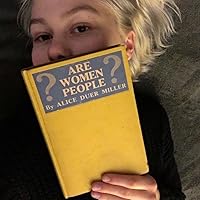
also i started reading this because phoebe bridgers took a photo with it once
Profile Image for R.
10 reviews
May 12, 2018
Brilliant book. A collection of sarcastic poems, clever responses to anti-suffrage comments. A must-read for any feminist/would-be feminist.
It's a short collection and a quick read.
65 reviews
July 5, 2022
A fun little book. It's a tongue and cheek jab at anti-suffragists. A fun look into the early 20th century's women's movement in America.
Profile Image for Angie Byrd.
86 reviews3 followers
April 2, 2024
What a great suffrage poetry collection! It was so witty and clever, but incredibly truthful and wild to see how many of these issues are still in play to this day. Definitely recommend!
Profile Image for Heather Collins.
79 reviews
March 8, 2025
Funny and biting. Easy to read in an afternoon. Timeless in their criticism of misogyny.
774 reviews1 follower
November 18, 2025
The book is full of women’s wit for challenging men on women’s right to vote. It was interesting to read that some of these poems were published in the newspaper.
Profile Image for Carolyn Page.
860 reviews38 followers
March 28, 2022
Clever rhymes, ditties, lists and poems during the WWI suffrage era. Hilarious, historical, and you'll get MAD! Also: pockets 😂
Profile Image for Candace.
363 reviews22 followers
February 2, 2024
💜 a witty poetry collection looking into the suffrage movement’s points and the suffragette responses that made “antis” look and sound as silly as they actually were (ex: a man had literally spoken in front of Congress about how women’s beautiful ankles were a good reason to keep them from voting!)⁣
💜 Miller makes points that are sadly still relevant almost 115 years later. This collection reminds us that though society has advanced tremendously, we still have a long distance to go toward full socio-political equity.⁣
💜 I loved the poems titled “Our Own Twelve Anti-suffragist Reasons” and “Why We Oppose Pockets for Women” because they perfectly point out the nonsensical, paradoxical arguments against a woman’s right to vote that so many anti-suffragists were making at the time (Ex: “1. Because no woman will leave her domestic duties to vote…2. Because no woman who may vote will attend to her domestic duties.”)⁣

✨favorite quote✨⁣
“Men are too emotional to vote. Their conduct at baseball games & political conventions shows this, while their innate tendency to appeal to force renders them peculiarly unfit for the task of government.”
Displaying 1 - 30 of 46 reviews

Can't find what you're looking for?

Get help and learn more about the design.