

What do you think?
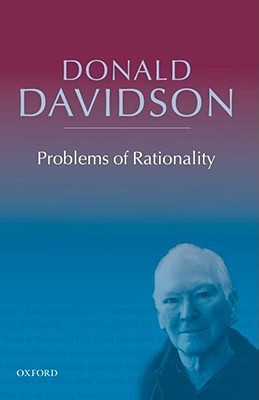
The Philosophical Essays of Donald Davidson #4
Problems of Rationality
Problems of Rationality is the eagerly awaited fourth volume of Donald Davidson's philosophical writings. From the 1960s until his death in August 2003 Davidson was perhaps the most influential figure in English-language philosophy, and his work has had a profound effect upon the discipline. His unified theory of the interpretation of thought, meaning, and action holds that rationality is a necessary condition for both mind and interpretation. Davidson here develops this theory to illuminate value judgements and how we understand them; to investigate what the conditions are for attributing mental states to an object or creature; and to grapple with the problems presented by thoughts and actions which seem to be irrational. Anyone working on knowledge, mind, and language will find these essays essential reading.
- GenresPhilosophyNonfiction
300 pages, Hardcover
First published January 1, 2004
About the author
Donald Davidson
123 books73 followersDonald Davidson was one of the most important philosophers of the latter half of the twentieth century. His ideas, presented in a series of essays from the 1960's onwards, have been influential across a range of areas from semantic theory through to epistemology and ethics. Davidson's work exhibits a breadth of approach, as well as a unitary and systematic character, which is unusual within twentieth century analytic philosophy. Thus, although he acknowledged an important debt to W. V. O. Quine, Davidson's thought amalgamates influences (though these are not always explicit) from a variety of sources, including Quine, C. I. Lewis, Frank Ramsey, Immanuel Kant and the later Wittgenstein. And while often developed separately, Davidson's ideas nevertheless combine in such a way as to provide a single integrated approach to the problems of knowledge, action, language and mind. The breadth and unity of his thought, in combination with the sometimes-terse character of his prose, means that Davidson is not an easy writer to approach. Yet however demanding his work might sometimes appear, this in no way detracts from either the significance of that work or the influence it has exercised and will undoubtedly continue to exercise. Indeed, in the hands of Richard Rorty and others, and through the widespread translation of his writings, Davidson's ideas have reached an audience that extends far beyond the confines of English-speaking analytic philosophy. Of late twentieth century American philosophers, perhaps only Quine has had a similar reception and influence.
Donald Herbert Davidson was born on March 6th, 1917, in Springfield, Massachusetts, USA. He died suddenly, as a consequence of cardiac arrest following knee surgery, on Aug. 30, 2003, in Berkeley, California. Remaining both physically and philosophically active up until his death, Davidson left behind behind a number of important and unfinished projects including a major book on the nature of predication. The latter volume was published posthumously (see Davidson, 2005b), together with two additional volumes of collected essays (Davidson 2004, 2005a), under the guidance of Marcia Cavell.
Davidson completed his undergraduate study at Harvard, graduating in 1939. His early interests were in literature and classics and, as an undergraduate, Davidson was strongly influenced by A. N. Whitehead. After starting graduate work in classical philosophy (completing a Master's degree in 1941), Davidson's studies were interrupted by service with the US Navy in the Mediterranean from 1942-45. He continued work in classical philosophy after the war, graduating from Harvard in 1949 with a dissertation on Plato's ‘Philebus’ (1990b). By this time, however, the direction of Davidson's thinking had already, under Quine's influence, changed quite dramatically (the two having first met at Harvard in 1939-40) and he had begun to move away from the largely literary and historical concerns that had preoccupied him as an undergraduate towards a more strongly analytical approach.
While his first position was at Queen's College in New York, Davidson spent much of the early part of his career (1951-1967) at Stanford University. He subsequently held positions at Princeton (1967-1970), Rockefeller (1970-1976), and the University of Chicago (1976-1981). From 1981 until his death he worked at the University of California, Berkeley. Davidson was the recipient of a number of award and fellowships and was a visitor at many universities around the world. Davidson was twice married, with his second marriage, in 1984, being to Marcia Cavell.
-http://plato.stanford.edu/entries/dav...
Donald Herbert Davidson was born on March 6th, 1917, in Springfield, Massachusetts, USA. He died suddenly, as a consequence of cardiac arrest following knee surgery, on Aug. 30, 2003, in Berkeley, California. Remaining both physically and philosophically active up until his death, Davidson left behind behind a number of important and unfinished projects including a major book on the nature of predication. The latter volume was published posthumously (see Davidson, 2005b), together with two additional volumes of collected essays (Davidson 2004, 2005a), under the guidance of Marcia Cavell.
Davidson completed his undergraduate study at Harvard, graduating in 1939. His early interests were in literature and classics and, as an undergraduate, Davidson was strongly influenced by A. N. Whitehead. After starting graduate work in classical philosophy (completing a Master's degree in 1941), Davidson's studies were interrupted by service with the US Navy in the Mediterranean from 1942-45. He continued work in classical philosophy after the war, graduating from Harvard in 1949 with a dissertation on Plato's ‘Philebus’ (1990b). By this time, however, the direction of Davidson's thinking had already, under Quine's influence, changed quite dramatically (the two having first met at Harvard in 1939-40) and he had begun to move away from the largely literary and historical concerns that had preoccupied him as an undergraduate towards a more strongly analytical approach.
While his first position was at Queen's College in New York, Davidson spent much of the early part of his career (1951-1967) at Stanford University. He subsequently held positions at Princeton (1967-1970), Rockefeller (1970-1976), and the University of Chicago (1976-1981). From 1981 until his death he worked at the University of California, Berkeley. Davidson was the recipient of a number of award and fellowships and was a visitor at many universities around the world. Davidson was twice married, with his second marriage, in 1984, being to Marcia Cavell.
-http://plato.stanford.edu/entries/dav...
Ratings & Reviews
Friends & Following
Create a free account to discover what your friends think of this book!
Community Reviews
Displaying 1 - 2 of 2 reviews
May 30, 2026
This probably was a terrible choice for my first glimpse into Davidson. The essays were terribly organized, not thorough, and very repetitive. But that might just be because I don’t know enough about him yet. I was very frustrated while reading it.
1. The Problem of Objectivity: The fundamental problem Davidson wants to address in this essay is how we come to have the concept of objectivity given the typical epistemological starting point we are granted in philosophy–immediate sensory perceptions or subjective certainties. How do we gain the concept of error, especially since our competencies do not seem to require thinking? How is thought (i.e., propositional content) possible? How do we differentiate between discrimination and having a concept? Then, he says a little about holism then introduces his argument: all propositional thought requires the concept of objective truth which requires other people. “Thus the acquisition of knowledge is not based on a progression from the subjective to the objective; it emerges holistically, and is interpersonal from the start.”
2. Evaluations and Language: This essay was kind of all over the place. It discusses a few procedures regarding how to interpret someone else using only their behavior in regard to sentences, Ramsey vs someone else’s belief and desire derivations, the fundamentality of desire, and more. But the introduction writes that “The thrust of the essay is that understanding
another presumes a shared body of evaluations as well as beliefs.”
3. The Objectivity of Values: Davidson defines objectivity like so: “Objectivity depends not on the location of an attributed property, or its supposed conceptual tie to human sensibilities; it depends on there being a systematic relationship between the attitude-causing properties of things and events, and the attitudes they cause…The considerations that prove the dispute genuine—the considerations that lead to correct interpretation—will also reveal the shared criteria that determine where the truth lies.” Hence, moral evaluations are objective because in order to even have a disagreement about it we must share enough common ground such that the truth conditions for the moral evaluations will be spelled out.
4 The Interpersonal Comparison of Values: This chapter asks how to compare evaluative attitudes between two different agents. He rejects certain normative and descriptive theories that attempt to explain interpersonal differences. These usually involve deciding what the propositions are, compare the strengths of the desires, and what we should do, but Davidson thinks that we cannot separate the last two steps. Instead, he proposes that the same machinery we use for attributing desires to others can be used for interpersonal comparison, which can be done without normative judgments based on them.
5 Turing’s Test: “Turing's Test, and its modified version, are inadequate, then, to discover whether or not an autonomous object thinks. The reason for this, it should be remarked, is not because the Test restricts the available evidence to what can be observed from the outside but because it does not allow enough of what is outside to be observed. The Test is inadequate because the interrogator cannot assume that he understands what the object means (if anything) and no translator is available. What is needed is evidence that the object uses its words to refer to things in the world, that its predicates are true of things in the world, that it knows the truth conditions of its sentences. For the object to have a semantics, it must operate in the world in a certain way, and for someone else to grasp those semantics, there must end be a three-way interaction among object, interrogator, and a shared world.” Davidson thinks the test is good for depending on an interpreter, but does not provide enough information.
6 Representation and Interpretation: We cannot tell if a machine is thinking simply by knowing its physics and syntax because the terms we use to define thought are fundamentally normative. “When thought takes thought as subject matter, the observer can only identify what he is studying by finding it rational—that is, in accord with his own standards of rationality. The astronomer and physicist are under no compulsion to find black holes or quarks to be rational entities.”
7 Problems in the Explanation of Action: He first explains that there is no event added to an arm raising to make it an action–pulling a rope is just raising your arm. Then, the first way explanation of action happens is explanation by redescription that supplies an intention. He then retracts some reductionism he had about intentions. He then argues that beliefs and desires cause actions even if there are no particular laws that connect them. It is a causal explanation because there are no deeper physical laws to be identified. He then discusses some counterarguments to this and ends with remarks of reduction of the mental to the physical.
8 Could There Be a Science of Rationality?: He begins by discussing what Quine’s views, settling on anomalous monism. He then discusses the trouble of reconciling externalist notions of the mind with physical reduction and why Fodor and Chomsky must be internalists of some sort. Davidson himself thinks that there cannot be a science if the mental if externalism, holism, and the normative features of the mental are true. He then assesses the prospects of the Unified Theory which is a unified theory on how to interpret agents with elements of decision theory from Jeffreys. He emphasizes that the Unified Theory is not against a naturalistic theory and that its shortcomings come from explaining irrationality.
9 What Thought Requires/10 A Unified Theory of Thought, Meaning, and Action: The Unified Theory is supposed to explain how to derive one’s beliefs, desires, meanings of words without pre-assuming fully individuated propositions an agent has. Taking preference behavior, we have two unknowns to solve for–degrees of belief and degrees of desire. However, in addition to Bayesian decision theory, we need a way of understanding verbal output. Then we can decide both based on preference between sentences: “What the interpreter has to go on, then, is information about what events in the world cause an agent to prefer that one rather than another sentence be true.” Jeffrey improves on Ramsey by being able to identify utilities and probabilities of sentences not using gambles, but still needs to say how propositions get their meanings. To do this, Davidson proposes some stuff. He ends by emphasizing that:
“What makes the task practicable at all is the structure the normative character of thought, desire, speech, and action imposes on correct attributions of attitudes to others, and hence on interpretations of their speech and explanations of their actions. What I have said about the norms that govern our theories of intensional attribution is at crucial points crude, vague, or too rigid. The way to improve our understanding of such understanding is to improve our grasp of the standards of rationality implicit in all interpretation of thought and action.”
11 Paradoxes of Irrationality: One must be rational in order to be capable of irrationality. Hence, explanations of irrationality have been fraught. Freud’s theories fail to make sense of it for they posit separate agents. He also accuses Freud of both trying to give reason and causal explanations for action. He then gives his definition of irrationality is when a mental state causes another without being a reason for it. The issue with explaining it physically is that the physical is in the realm of the nonrational. But we cannot explain it mentally in terms of reasons either, only can mental states cause others without being reasons if they belong to different people.
“The underlying paradox of irrationality, from which no theory can entirely escape, is this: if we explain it too well, we turn it into a concealed form of rationality; while if we assign incoherence too glibly, we merely compromise our ability to diagnose irrationality by withdrawing the background of rationality needed to justify any diagnosis at all.”
12 Incoherence and Irrationality: The problem with explaining irrationality is that mental states are constitutively rational–hence, how can they contradict each other? He then argues that mental states can only be irrational when they contradict each other, never by themselves and then spells out more troubles for explaining irrationality.
13 Deception and Division: He proposes that self-deception requires some boundary between beliefs.
14 Who is Fooled?: repetition of much of what he already wrote plus some literature
1. The Problem of Objectivity: The fundamental problem Davidson wants to address in this essay is how we come to have the concept of objectivity given the typical epistemological starting point we are granted in philosophy–immediate sensory perceptions or subjective certainties. How do we gain the concept of error, especially since our competencies do not seem to require thinking? How is thought (i.e., propositional content) possible? How do we differentiate between discrimination and having a concept? Then, he says a little about holism then introduces his argument: all propositional thought requires the concept of objective truth which requires other people. “Thus the acquisition of knowledge is not based on a progression from the subjective to the objective; it emerges holistically, and is interpersonal from the start.”
2. Evaluations and Language: This essay was kind of all over the place. It discusses a few procedures regarding how to interpret someone else using only their behavior in regard to sentences, Ramsey vs someone else’s belief and desire derivations, the fundamentality of desire, and more. But the introduction writes that “The thrust of the essay is that understanding
another presumes a shared body of evaluations as well as beliefs.”
3. The Objectivity of Values: Davidson defines objectivity like so: “Objectivity depends not on the location of an attributed property, or its supposed conceptual tie to human sensibilities; it depends on there being a systematic relationship between the attitude-causing properties of things and events, and the attitudes they cause…The considerations that prove the dispute genuine—the considerations that lead to correct interpretation—will also reveal the shared criteria that determine where the truth lies.” Hence, moral evaluations are objective because in order to even have a disagreement about it we must share enough common ground such that the truth conditions for the moral evaluations will be spelled out.
4 The Interpersonal Comparison of Values: This chapter asks how to compare evaluative attitudes between two different agents. He rejects certain normative and descriptive theories that attempt to explain interpersonal differences. These usually involve deciding what the propositions are, compare the strengths of the desires, and what we should do, but Davidson thinks that we cannot separate the last two steps. Instead, he proposes that the same machinery we use for attributing desires to others can be used for interpersonal comparison, which can be done without normative judgments based on them.
5 Turing’s Test: “Turing's Test, and its modified version, are inadequate, then, to discover whether or not an autonomous object thinks. The reason for this, it should be remarked, is not because the Test restricts the available evidence to what can be observed from the outside but because it does not allow enough of what is outside to be observed. The Test is inadequate because the interrogator cannot assume that he understands what the object means (if anything) and no translator is available. What is needed is evidence that the object uses its words to refer to things in the world, that its predicates are true of things in the world, that it knows the truth conditions of its sentences. For the object to have a semantics, it must operate in the world in a certain way, and for someone else to grasp those semantics, there must end be a three-way interaction among object, interrogator, and a shared world.” Davidson thinks the test is good for depending on an interpreter, but does not provide enough information.
6 Representation and Interpretation: We cannot tell if a machine is thinking simply by knowing its physics and syntax because the terms we use to define thought are fundamentally normative. “When thought takes thought as subject matter, the observer can only identify what he is studying by finding it rational—that is, in accord with his own standards of rationality. The astronomer and physicist are under no compulsion to find black holes or quarks to be rational entities.”
7 Problems in the Explanation of Action: He first explains that there is no event added to an arm raising to make it an action–pulling a rope is just raising your arm. Then, the first way explanation of action happens is explanation by redescription that supplies an intention. He then retracts some reductionism he had about intentions. He then argues that beliefs and desires cause actions even if there are no particular laws that connect them. It is a causal explanation because there are no deeper physical laws to be identified. He then discusses some counterarguments to this and ends with remarks of reduction of the mental to the physical.
8 Could There Be a Science of Rationality?: He begins by discussing what Quine’s views, settling on anomalous monism. He then discusses the trouble of reconciling externalist notions of the mind with physical reduction and why Fodor and Chomsky must be internalists of some sort. Davidson himself thinks that there cannot be a science if the mental if externalism, holism, and the normative features of the mental are true. He then assesses the prospects of the Unified Theory which is a unified theory on how to interpret agents with elements of decision theory from Jeffreys. He emphasizes that the Unified Theory is not against a naturalistic theory and that its shortcomings come from explaining irrationality.
9 What Thought Requires/10 A Unified Theory of Thought, Meaning, and Action: The Unified Theory is supposed to explain how to derive one’s beliefs, desires, meanings of words without pre-assuming fully individuated propositions an agent has. Taking preference behavior, we have two unknowns to solve for–degrees of belief and degrees of desire. However, in addition to Bayesian decision theory, we need a way of understanding verbal output. Then we can decide both based on preference between sentences: “What the interpreter has to go on, then, is information about what events in the world cause an agent to prefer that one rather than another sentence be true.” Jeffrey improves on Ramsey by being able to identify utilities and probabilities of sentences not using gambles, but still needs to say how propositions get their meanings. To do this, Davidson proposes some stuff. He ends by emphasizing that:
“What makes the task practicable at all is the structure the normative character of thought, desire, speech, and action imposes on correct attributions of attitudes to others, and hence on interpretations of their speech and explanations of their actions. What I have said about the norms that govern our theories of intensional attribution is at crucial points crude, vague, or too rigid. The way to improve our understanding of such understanding is to improve our grasp of the standards of rationality implicit in all interpretation of thought and action.”
11 Paradoxes of Irrationality: One must be rational in order to be capable of irrationality. Hence, explanations of irrationality have been fraught. Freud’s theories fail to make sense of it for they posit separate agents. He also accuses Freud of both trying to give reason and causal explanations for action. He then gives his definition of irrationality is when a mental state causes another without being a reason for it. The issue with explaining it physically is that the physical is in the realm of the nonrational. But we cannot explain it mentally in terms of reasons either, only can mental states cause others without being reasons if they belong to different people.
“The underlying paradox of irrationality, from which no theory can entirely escape, is this: if we explain it too well, we turn it into a concealed form of rationality; while if we assign incoherence too glibly, we merely compromise our ability to diagnose irrationality by withdrawing the background of rationality needed to justify any diagnosis at all.”
12 Incoherence and Irrationality: The problem with explaining irrationality is that mental states are constitutively rational–hence, how can they contradict each other? He then argues that mental states can only be irrational when they contradict each other, never by themselves and then spells out more troubles for explaining irrationality.
13 Deception and Division: He proposes that self-deception requires some boundary between beliefs.
14 Who is Fooled?: repetition of much of what he already wrote plus some literature

December 25, 2021
This volume is easy to overlook, as none of the material is as well-known and -cited as in previous volumes of this series, but it's a natural successor to the previous two volumes. It deploys familiar Davidsonian concepts—such as the autonomy of meaning, the inescapable constraints of interpreting other language-users as rational, and the natural objectivity that arises from a shared frame of interpretation—in new and characteristically systematic and insightful ways. I found it fascinating material from start to finish.
The unique thing about Davidson is that you can't do any justice to his views without taking into account the ways in which his theses interlock with each other and form a big picture. The most basic assumptions shared by rationalists and empiricists, by realists and anti-realists, he sweeps aside in constructing his own larger vision of the whole of philosophy. One is hard-pressed to accept any of his theses individually without also accepting pretty much everything else he says along with it, but I for one find the power and sense-making of his philosophical edifice compelling enough that I'm happy to call myself a "Davidsonian."
The unique thing about Davidson is that you can't do any justice to his views without taking into account the ways in which his theses interlock with each other and form a big picture. The most basic assumptions shared by rationalists and empiricists, by realists and anti-realists, he sweeps aside in constructing his own larger vision of the whole of philosophy. One is hard-pressed to accept any of his theses individually without also accepting pretty much everything else he says along with it, but I for one find the power and sense-making of his philosophical edifice compelling enough that I'm happy to call myself a "Davidsonian."
Displaying 1 - 2 of 2 reviews