Anthropologist John Fox sets off on a worldwide adventure to thefarthest reaches of the globe and the deepest recesses of our ancientpast to answer a question inspired by his sports-loving
"Why do we play ball?"
From Mexican jungles to the small-town gridirons of Ohio, frommedieval villages and royal courts to modern soccer pitches andbaseball parks, The Ball explores the little-known origins ofour favorite sports across the centuries, and traces how a simpleinvention like the ball has come to stake an unrivaled claim on ourpassions, our money, and our lives. Equal parts history and travelogue,The Ball removes us from the scandals and commercialism of today'ssports world to uncover the true reasons we play ball, helping us reclaimour universal connection to the games we love.
John Fox, a Harvard Ph.D. anthropologist, has contributed commentary to Vermont Public Radio and written for Smithsonian, Outside, and Salon, among other publications. In 2010 he was awarded a MacDowell Colony fellowship. He lives in Boston.
Fox's book, The Ball: Discovering the Object of the Game will be published May 15 by Harper Perennial. He lives in Boston.
Advance praise for The Ball: “Anyone who has ever thrown, caught, bounced, hit (or whiffed) a ball will mightily enjoy John Fox’s stories of where all these balls came from and why, from our earliest days, they have been such an integral part of the very fun that makes us human.”
- Frank DeFord, NPR Commentator and author of The Old Ball Game
Games and sports fascinate me. I have never been really good at them, but I have enjoyed playing them. As it is my habit, it wasn't long until I started digging into their history and the reason behind the sports. It is as if there is some kind of unifying theory of sports and games, and I was determined to find it out.
Most of the games and sports are in a way really a simulation that trains you for something. Usually, but not always, they train you for war. Chess is a game of war. So is spear throwing, a simulation for the real thing in battle. Wrestling and boxing are obviously games of war, but things like running were also having their roots there. And dolls, and make pretend? They trained girls to be good mothers, or little children to play in society. What about building sand castles? The social element as well as the simulation element is obvious.
What I didn't figure out was ball games. It wasn't exactly obvious why they evolved. Who played the first ball game and why? They did seem to have an entire logic onto themselves, and people seemed to enjoy them, but they didn't actually seem related directly to the war. For example, one of the earliest description of a ball game that I've read was in Iliad (Odysseus is playing, IIRC). And it looks very much like a typical rugby or American Football game,... So it has roots that are even older than Iliad!
Now, John Fox's book has some good enough details. First of all, it comes to the same conclusion I came before (it is actually not MY conclusion, but it was thought by someone researcher): Balls are kinetically interesting objects. They attract even kittens and other animals like dolphins. They do resemble a prey, and they are excellent for training hunting, agility, coordination, etc. So no wonder that humans also use them in play. In a way, play with a ball (a spherical object) is older than humans themselves. So that answered my riddle as to how these games originated. I did have some inkling to the idea, since some article on wikipedia does say that spherical objects are attractive to human babies and kittens as well...
After establishing this, John Fox starts on an interesting itinerary through some of the last remaining historical games:
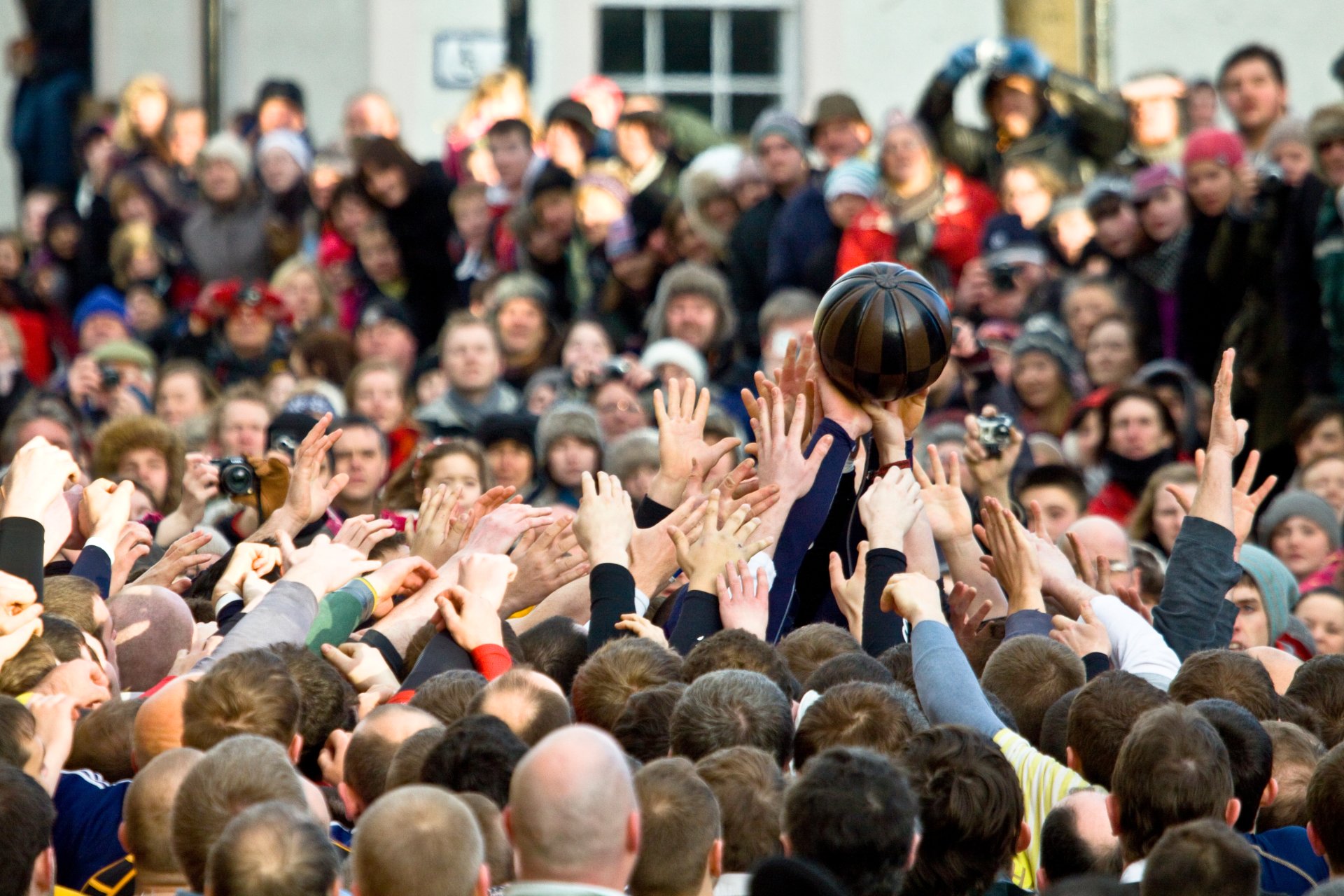
Kirkwall Ba' from Orkney is one of the last remaining ancestors of modern football. Check out that ball! And how many players are playing!
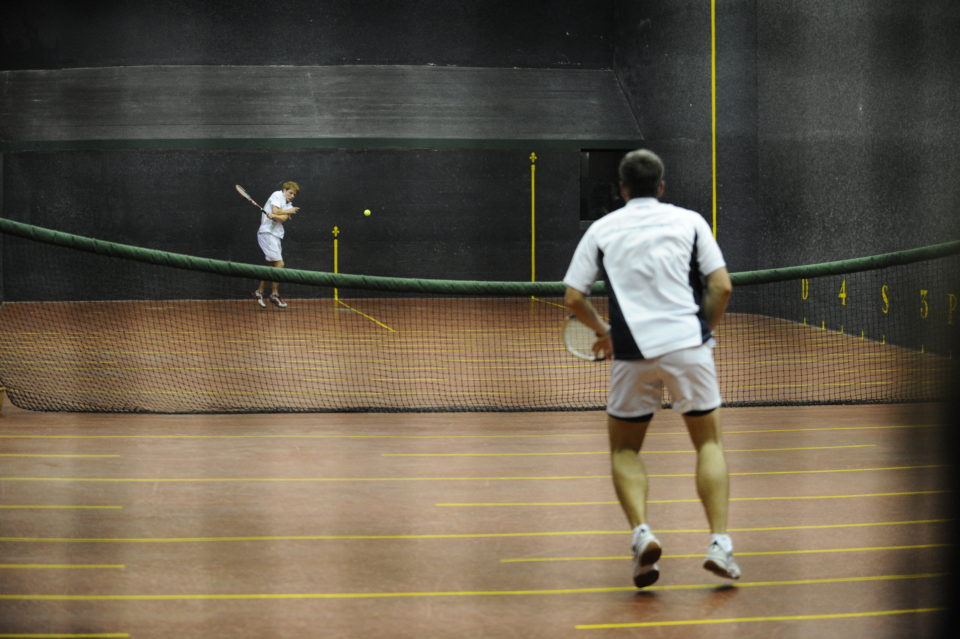
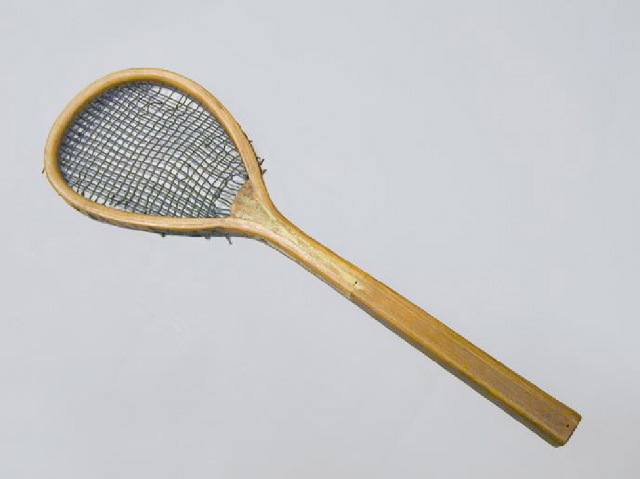
Jeu de paume is the ancestor of modern (lawn) tennis. It is played with heavier balls and rackets and it has quite a different mechanics, despite similar equipment. The balls hardly bounce at all. In England they call it "real tennis". From what I understand, just like in "real estate", the word "real" is the old form of "royal".
Ulama, the ancient ball of the Mayas and Aztecs is still played. It only uses hips and elbows, and a heavy ass balls. This is described in the fourth chapter.
The next few chapter detail some games of which I did have some previous knowledge. First was Lacrosse. I've heard of it, but I didn't know it was a native American game. The second one was baseball. Apparently there are a few "ancestors" of baseball and games similar to baseball sprouted up everywhere, even in my native Romania. So it did have some interesting details on its history and so on. Nothing earth shattering here, but interesting nevertheless.
Last two were American football and Basketball.
Overall the essays were at times interesting, but they were lacking focus. Also, they focused quite a lot on the American continent. 5 of the games (Ulama, Lacrosse, Baseball, American Football, Basketball) are American. I am not saying that they are not popular, but there is such a huge variety that it seems somewhat lopsided. Even worse, these were treated as if the reader was really familiar with the rules.
I would have liked a bit more diversity of ideas. Also, a more unified approach to the ball games, and some appendix with the rules of the games. It is hard to shake off the feeling that this could have been a much better book.
I read this book for a class I was TAing and honestly, as a sports fan I learnt so much. The ethnographic component was fascinating and great history lesson. Sometimes the book felt like it dragged on but that might just be because I was reading for class. All I. All Fox did a great job tying everything together and really sets out to answer “why do we play?”
I saw John Fox speak and do a reading at Porter Square Books in Cambridge before I read The Ball. He was engaging, lively, and humorous, and his book is as well. The premise is simple: during a game of catch, Fox's soon asked, "Why do we play ball?" Fox, an archeologist and sports fan who'd studied ancient Mayan ball games was stumped. So he set out to find out why.
The ensuing chapters are less an answer to that specific question than descriptions of the sport-by-sport case studies Fox undertook to answer it. For example, one chapter is devoted to the murky origins of baseball, our "national past time" which can actually be traced back to British children's games. Another chapter explores the rise of soccer through rugby like mob football games played between European villages. Fox travels to Scotland to witness the centuries old tradition in person and his play-by-play of this event is the book's most entertaining section. The closest Fox comes to really answering the question of "Why do we play ball?" is perhaps in his first chapter, in which he goes to Florida to watch dolphins, the second most playful animal behind humans, in action. Through this experience Fox plausibly suggests that ball play developed as a way to test and improve our hunting, communication, and survival skills. In the end, however, the question is one without a concrete answer. Instead, Fox uses it as a spring board for an entertaining and informative ride that explores the power of the human connection to sport.
I started reading this after plugging "The History of the Mayan Ball League." On the recommendation of an anthropologist. It was a really nice diversion into the history of why we play ball, and in what forms we have, over the years. It contains an interesting chapter on "the ball game," or ulama, as the Maya called it.
This book is my idea of what its like to receive government funding for a boondoggle. You have a nice idea, but its so mundane and moot that your point is made before you finish page one. The author takes over 300 pages of government grants to tell us that playing with a ball is fun, with a splash of "sports can save the world" SJW diversity talk. The history is about the only interesting thing about this book, but to find that you have to slog through 80% of the rest of the op-ed parts of the book. If you have an axe to grind and a grant to spend, hey write a book on how the point of playing ball is fun. Take that to the bank.
After his son asks, "Why do we play ball?" Fox sets out to find answers. The book becomes a bit of history of different sports which involve a ball. The short answer is, "for fun," but along the way Fox puts his anthropological skills to work to explore early references to sports in world civilization. Later chapters explore the history of lacross, baseball, basketball and more. These are some of the more enjoyable chapters in the book, perhaps because they are a bit more focused.
Fascinating book delving into why humans have for as far back as we can tell, expended energy on ball games. Fox takes on back in time to the humble beginnings of the most popular sports of our time; and a few on the brink of extinction.
This book sets out to answer the innocent question of Fox’s seven year old son, “Why do we play ball, anyway?” The author has done a tremendous amount of research, some of it by physically visiting places where embryonic versions of our modern ball games are still played—going to the Orkney Isles, France, and the interior of Mexico in an attempt to show how interwoven playing ball is with being human.
I particularly enjoyed his advancement of the theory that it was man’s development of his ability to throw a rock, in order to hunt more efficiently, that was the first step of early humans toward becoming modern homosapiens. Fox offers as proof the research of the evolutionary biologist, William Calvin from the University of Washington. Calvin believes, “The motion itself may have promoted the first lateralization of a function to the left brain, a spark that set in motion the development of language, tool use and much more.” As he continues to explain this theory Fox offers this gem, which made me laugh out loud, “Now you’ve got a not-so-smart, mostly upright, well-fed primate with a killer fastball and reproductive advantage. Add a lump of chaw and you’ve got your average major-league pitcher!” (pg. 34)
The result of his efforts is a work that is usually enlightening and often humorous though I did think that he got off track a couple of times and digressed on topics too peripheral to his central theme.
If you want to learn why it is so easy to lose yourself in a game of catch, this is the book for you.
I won an advance copy of this through First Reads and was pretty intrigued by the subject matter. There's plenty of fun anecdotes from John Fox's travels around the world playing ball games. There's some interesting facts and history sprinkled throughout the book. But in trying to figure out why I didn't like this more than I did, I think I've found that there's a general lack of focus. If the point was to try to find out 'why do we play,' there's not enough exploration into that topic. I concede it's a question that can't ever be definitively answered, but it doesn't feel as though it was given a real try here. If the point was to present the histories of different types of balls themselves, this is more well addressed. However, after taking a few pages to present those histories, the author runs off on other tangents that have nothing to do with the ball itself. Some of these stories are more interesting than others, but there's no real thread that holds everything together. Though I enjoyed reading this book, I felt like the author just sort of told the stories he wanted to tell and tried to fit them into a common focus rather than going the other way. When I finished the book, I wasn't sure what I was supposed to have gotten out of it. Overall, I was glad I read The Ball. I just think it could have been a more accomplished book with a better direction and goal.
Basically, the author travels to different countries where they have ancient ball games and delves into the history, traditions, cultural impact, etc. He (wisely, in my opinion) doesn't try to identify where the ball came from, since that would be like trying to pinpoint who invented fire, and instead lets each chapter/game/area stand more or less as its own piece.
Some chapters are more interesting than others, naturally, but there are a lot of cool facts here. Most important to me personally was learning that, despite what our limey neighbors across the pond would have you believe, their beautiful, world-wide, ancient, descended-from-heaven-as-god's-gift-to-humankind games of soccer and rugby, and our ugly, artless, brand new, clearly-just-a-ripoff-of-rugby game know as football ARE ALL DESCENDED FROM THE SAME GAME, meaning football is JUST AS OLD AS SOCCER. HA! SUCK IT!
A smart, witty, anthropologically slanted, Bill Bryson-esque romp through mankind's history of ball games, in an attempt to answer the question: "Why do humans play?" (That question is never directly answered but, to be fair, it's probably unanswerable.) THE BALL is delightful book full of details, history, insights, and even some personal memoir. Highly recommended, and not just for sports fans. [Disclaimer: the author is a friend of mine, but I'd think this was a great book even if he wasn't.]
What answer do you come up with to the question "Why do we play ball?" John Fox takes an interesting look at both why we play and the variety of ball games we play. This is a great book for someone who wants to learn something about the subject but doesn't necessarily want every last detail about the ball games Fox discusses. I enjoyed it and have recommended it to some friends.
This book was received as a Goodreads, First Read.
I now feel like I know more about sports than anyone. This book had great history of many games, and many things I had never heard of before like games played in other countries. Also it had a few essay like sections on other areas of the games, such as their use in education, medical things, race differences, and so on. I highly recommend this book as it is also easy to read.
Really enjoyed the intersection between history of the games an storytelling, both on the authors journey and ties to his son throughout. I thoroughly enjoyed the subject matter and it's tone of writing. I'm an avid sports fan and found great excitement in learning origins of the games we take for granted today. All in all, recommended read for any sports enthusiast.
This book looks at the history of ball and how certain games have evolved. Tennis, soccer, football, basketball and baseball are explored in depth. It is fascinating to learn how each of these games developed and changed over time.
Ironically, I read this book at a 4-day national volleyball tourney with over 120K young women participating! This is a quick non-fiction read that helps you connect with the past and humanity. It makes me regret not becoming an anthropologist my first year of college.
I truly enjoyed this book both for its narrative and for the author's viewpoint. I would note that it is much less about the object of the game than the games themselves. Which is perfectly fine, only that the title is a little misleading.
Great book! For those interested in sports, anthropology, and/or the anthropology of sport, this book is for you. I really appreciated the author's academic background and field research in anthropology.