

What do you think?

Poetry #10
Finding My Elegy: New and Selected Poems 1960-2010
"She never loses touch with her reverence for the immense what is." — Margaret Atwood
Though internationally known and honored for her imaginative fiction, Ursula K. Le Guin started out as a poet, and since 1959 has never ceased to publish poems. Finding My Elegy distills her life's work, offering a selection of the best from her six earlier volumes of poetry and introducing a powerful group of poems, at once earthy and transcendent, written in the first decade of the twenty-first century.
The fruit of over a half century of writing, the seventy selected and seventy-seven new poems consider war and creativity, motherhood and the natural world, and glint with humor and vivid beauty. These moving works of art are a reckoning with a whole life.
Though internationally known and honored for her imaginative fiction, Ursula K. Le Guin started out as a poet, and since 1959 has never ceased to publish poems. Finding My Elegy distills her life's work, offering a selection of the best from her six earlier volumes of poetry and introducing a powerful group of poems, at once earthy and transcendent, written in the first decade of the twenty-first century.
The fruit of over a half century of writing, the seventy selected and seventy-seven new poems consider war and creativity, motherhood and the natural world, and glint with humor and vivid beauty. These moving works of art are a reckoning with a whole life.
196 pages, Hardcover
First published September 18, 2012
About the author
Ursula K. Le Guin
1,050 books32.5k followersUrsula K. Le Guin published twenty-two novels, eleven volumes of short stories, four collections of essays, twelve books for children, six volumes of poetry and four of translation, and has received many awards: Hugo, Nebula, National Book Award, PEN-Malamud, etc. Her recent publications include the novel Lavinia, an essay collection, Cheek by Jowl, and The Wild Girls. She lived in Portland, Oregon.
She was known for her treatment of gender (The Left Hand of Darkness, The Matter of Seggri), political systems (The Telling, The Dispossessed) and difference/otherness in any other form. Her interest in non-Western philosophies was reflected in works such as "Solitude" and The Telling but even more interesting are her imagined societies, often mixing traits extracted from her profound knowledge of anthropology acquired from growing up with her father, the famous anthropologist, Alfred Kroeber. The Hainish Cycle reflects the anthropologist's experience of immersing themselves in new strange cultures since most of their main characters and narrators (Le Guin favoured the first-person narration) are envoys from a humanitarian organization, the Ekumen, sent to investigate or ally themselves with the people of a different world and learn their ways.
She was known for her treatment of gender (The Left Hand of Darkness, The Matter of Seggri), political systems (The Telling, The Dispossessed) and difference/otherness in any other form. Her interest in non-Western philosophies was reflected in works such as "Solitude" and The Telling but even more interesting are her imagined societies, often mixing traits extracted from her profound knowledge of anthropology acquired from growing up with her father, the famous anthropologist, Alfred Kroeber. The Hainish Cycle reflects the anthropologist's experience of immersing themselves in new strange cultures since most of their main characters and narrators (Le Guin favoured the first-person narration) are envoys from a humanitarian organization, the Ekumen, sent to investigate or ally themselves with the people of a different world and learn their ways.
Ratings & Reviews
Friends & Following
Create a free account to discover what your friends think of this book!
Community Reviews
Displaying 1 - 30 of 95 reviews

August 26, 2023
Las cinco estrellas no son para la poesía como tal, estamos hablando de una antología escrita a lo largo de más de 50 años: es evidente que no todos son buenos. El sobresaliente se lo lleva Ursula Le Guin - la mujer. Es cierto, ya la adoraba, pero ahora conozco mucho más sobre ella como persona de lo que se aprecia simplemente en su ficción. En su poesía no se disfraza con personajes o escenarios, es.
Qué mujer tan divertida, inteligente, curiosa y sensible. Si podéis, deberíais leerla en inglés porque la traducción no es mala, pero inevitablemente pierde toda la musicalidad, el ritmo, la rima casual, chistes, juegos de palabras y cierto significado. Afortunadamente, esta edición de Nórdica es bilingüe.
Ursula, iría a buscarte en mi máquina del tiempo para que fuéramos mejores amigas en un roadtrip con Lucia Berlin. Por supuesto, mi máquina del tiempo es un cochazo clásico.
Qué mujer tan divertida, inteligente, curiosa y sensible. Si podéis, deberíais leerla en inglés porque la traducción no es mala, pero inevitablemente pierde toda la musicalidad, el ritmo, la rima casual, chistes, juegos de palabras y cierto significado. Afortunadamente, esta edición de Nórdica es bilingüe.
Ursula, iría a buscarte en mi máquina del tiempo para que fuéramos mejores amigas en un roadtrip con Lucia Berlin. Por supuesto, mi máquina del tiempo es un cochazo clásico.

August 25, 2021
The poet's
measures serve
anarchic joy.
The story-teller
tells one story:
freedom.
***
...what we need
to be
is, oh, the small
talk of swallows
in evening over
dull water under
willows.
***
What happens
every day is
what's surprising.
The treasure's
never where I
look to find it
but where I
simply look - the
sky, the wind,
sunrise, a silver
arc, the moment's
chance.
***
Ogives of ice-
lines on the
airplane window
soften to water in
descending
sunlight.
***
A breath breathed
out will set me
free.
I'll choose to do
the thing I must.
The world
dreamed me, I
dream the world.
***
This morning for
just a moment
being
was the moment
and becoming all.
***
Say to me, say
again,
nothing is taken,
only given.
measures serve
anarchic joy.
The story-teller
tells one story:
freedom.
***
...what we need
to be
is, oh, the small
talk of swallows
in evening over
dull water under
willows.
***
What happens
every day is
what's surprising.
The treasure's
never where I
look to find it
but where I
simply look - the
sky, the wind,
sunrise, a silver
arc, the moment's
chance.
***
Ogives of ice-
lines on the
airplane window
soften to water in
descending
sunlight.
***
A breath breathed
out will set me
free.
I'll choose to do
the thing I must.
The world
dreamed me, I
dream the world.
***
This morning for
just a moment
being
was the moment
and becoming all.
***
Say to me, say
again,
nothing is taken,
only given.

November 29, 2013
I find a great affinity for Ursula K. LeGuin, one that I feel even stronger when I read her poetry. I love her novels, but it is her poems that reveal more about her past, her life, her feelings. We were born within 30 miles of one another, although in different decades, and she now lives an hour from where I grew up. Her stomping grounds are mine. Her poems describe places I have been and loved, from Cannon Beach to the Coastal Starlight (a trip I was supposed to take) - I felt like some of her memories are mine. A strange experience when reading poetry. I'm more accustomed to understanding an emotion if not the subject, but that experience is reversed for me.
One of her older poems, For the New Home stuck out to me, for it serves as a very wise blessing. The last line is "And may you be in this house as the music is in the instrument."
In her last set of poems, she takes the opposite approach and curses men involved in war in a very memorable poem, The Curse of the Prophetess. It reads like an actual, witchy incantation, with power behind the words.
In between the blessings and the curses are poems about relationships, nature, and aging. I enjoyed them!
One of her older poems, For the New Home stuck out to me, for it serves as a very wise blessing. The last line is "And may you be in this house as the music is in the instrument."
In her last set of poems, she takes the opposite approach and curses men involved in war in a very memorable poem, The Curse of the Prophetess. It reads like an actual, witchy incantation, with power behind the words.
In between the blessings and the curses are poems about relationships, nature, and aging. I enjoyed them!

October 30, 2021
Some of the best poetry I’ve ever read. Aging, end of a full life, reminiscing. I shed many a tear.

January 24, 2026
Me encantaron estos poemas de Ursula. No conocía su faceta de poeta y disfruté muchísimo esta edición.

January 31, 2013
For decades, Ursula K Le Guin has written some of the best sf/f in the world. Unbeknownst to me, she also writes poetry and has published 11 other collections. This is a collection of the "best" poems she published between 1960 and 2010.
Her early work reminds me of a cross between ee cummings and Mary Oliver, but it didn't particularly inspire me. The first poem I loved in this collection was "The Aching Air," about a "beautiful horsechestnut" that "held up deep branches/in a cathedral/full of wings and voices/and a golden light" that is cut down in the interests of cleanliness in a series of harrowing stanzas and ends
"No fall,
all fall.
All clean.
All bare.
Only the tall,
tree-shaped, empty,
aching air."
Another poem I loved concerned an ornery black cat who lives on the porch and won't leave or come in, and ends:
"I leave the door wide.
She does not come in.
Self-contained, but never placid,
she crouches near her refuge chair,
even in her sleep alert, aware.
I can't judge if she is or is not unhappy.
She's certainly unlucky,
less so than many cats.
She accepts, she does not beg.
She is wholly respectable.
While I'm here to feed her twice a day
she has some ease. When I'm gone,
if the next tenant doesn't,
well, she'll get bone-thin again,
get lame again, get sick and hide and die.
Or a car or a dog will kill her.
Turn as we may in our wonderful ease-making words,
we cannot co-opt her freedom.
We can live with her
only on her hard terms."
But I think my favorite poems are at the end of the collection, which mostly concern old age, death, and what is left behind. In that section is where I found the eponymous poem, "Finding My Elegy," which contains these lines:
"Numbers are easier. So the men of money say
numbers, not names. Grief's not their business.
But I think it may be mine, and if I have
a people any more, I will find them in tears."
Her early work reminds me of a cross between ee cummings and Mary Oliver, but it didn't particularly inspire me. The first poem I loved in this collection was "The Aching Air," about a "beautiful horsechestnut" that "held up deep branches/in a cathedral/full of wings and voices/and a golden light" that is cut down in the interests of cleanliness in a series of harrowing stanzas and ends
"No fall,
all fall.
All clean.
All bare.
Only the tall,
tree-shaped, empty,
aching air."
Another poem I loved concerned an ornery black cat who lives on the porch and won't leave or come in, and ends:
"I leave the door wide.
She does not come in.
Self-contained, but never placid,
she crouches near her refuge chair,
even in her sleep alert, aware.
I can't judge if she is or is not unhappy.
She's certainly unlucky,
less so than many cats.
She accepts, she does not beg.
She is wholly respectable.
While I'm here to feed her twice a day
she has some ease. When I'm gone,
if the next tenant doesn't,
well, she'll get bone-thin again,
get lame again, get sick and hide and die.
Or a car or a dog will kill her.
Turn as we may in our wonderful ease-making words,
we cannot co-opt her freedom.
We can live with her
only on her hard terms."
But I think my favorite poems are at the end of the collection, which mostly concern old age, death, and what is left behind. In that section is where I found the eponymous poem, "Finding My Elegy," which contains these lines:
"Numbers are easier. So the men of money say
numbers, not names. Grief's not their business.
But I think it may be mine, and if I have
a people any more, I will find them in tears."

September 7, 2012
I haven't read much of Le Guin's poetry, but I gobbled up this collection. I'm not sure I always think she's got the form right -- though I'm a sucker for very tightly circumscribed forms of poetry, so perhaps I would think that -- but the way she uses words can rarely be faulted.
My favourite for now is 'Ars Lunga': so that death finds me at all times/ and on all sides exposed,/ unfortressed, undefended,/ inviolable, vulnerable, alive...
My favourite for now is 'Ars Lunga': so that death finds me at all times/ and on all sides exposed,/ unfortressed, undefended,/ inviolable, vulnerable, alive...
October 17, 2012
These are superb poems. My favorites include "The Next War":
It will take place,
It will take time,
It will take life,
And waste them.
and also the poignant "The Aching Air" about the axing of the "most beautiful horsechestnut" tree, apparently a huge tree leaving "only the tall, tree-shaped, empty, aching air".
It will take place,
It will take time,
It will take life,
And waste them.
and also the poignant "The Aching Air" about the axing of the "most beautiful horsechestnut" tree, apparently a huge tree leaving "only the tall, tree-shaped, empty, aching air".

November 25, 2012
The pleasure of a treasure hunt.
Here's one:
GPS
I've flown as far as tern or heron fly,
clear to the polar waters, and returned.
I've run the roads of land and sea and sky
right round the earth's horizons. So I learned
that there are two directions, out and back,
from the still center of the compass rose.
There are two places: home, away. I lack
a map that shows me anywhere but those.
Here's one:
GPS
I've flown as far as tern or heron fly,
clear to the polar waters, and returned.
I've run the roads of land and sea and sky
right round the earth's horizons. So I learned
that there are two directions, out and back,
from the still center of the compass rose.
There are two places: home, away. I lack
a map that shows me anywhere but those.

January 11, 2016
Homage to and Review of Finding My Elegy: New and Selected Poems by Ursula K. Le Guin
Ursula K. Le Guin is my favorite writer. No contest.
I have enjoyed, admired, appreciated, envied and learned from her novels, novellas, short stories, essays, and poetry for over forty years. She is about my mom's age (in her early 80s, now) and still going strong. She is my idol, my mentor, and my role model. I also found out, after reading this collection, that she and share not only a love of writing, speculative fiction, feminism, social justice, pacifism and environmentalism, but Buddhism and meditation. Ah, pure bliss!
This latest collection of her poetry so delighted me that I had to write not just a short review on Amazon or Goodreads, but an entire blog post, complete with images, video, quotes. I hope you run right out and buy, borrow or sit and read aloud from this collection ASAP. You will be glad you did.
Poetry is meant to be read aloud. I enjoy reading poetry aloud as if I am the poet, wondering as I hear each word, line, idea, image, stanza, what the poet was imagining and how this exact turn of phrase came to capture it. Knowing how long many poets take to conjure the precise manner in which to describe and evoke every part of their intention, I want to savor it.
I do NOT read in that artificial, almost-questioning (upturned inflection on the end of lines), drawling almost-monotone that many poetry readers make the horrible mistake of using.
No.
I read poetry aloud as if each poem is its own story, because this unique version of that story is interesting, new, and not mine. I use the line breaks and punctuation as suggestions to help me go with the poet's flow. I smile, I laugh, I pause, I taste the words on my tongue.
Try it. You'll like it!
Le Guin has many poems rooted (pun intended) in nature. This little bird caught her attention several times. She mentions the Swainson's Thrush by name; sometimes it is unnamed and alluded /referred to throughout this collection.
I had to find what the Swainson's Thrush looks and sounds like. Enjoy!
I also welled up with tears reading this next one, Song for a Daughter, imagining myself as a new mom hearing this from my mom, and sharing this with my son's wife should she/they be lucky enough to have a child. Le Guin captures so much of the complexity of these relationships elegantly and succinctly, with beautiful turns of phrase, like these from the first and final stanzas:
Soldiers perfectly depicts the horribleness of most wars, particularly our most recent USA-led wars, in which the military industrial complex---to enrich corporations---sends/inspires young men (and women) to go to their deaths or disfigurements with lies and for specious causes. The anguished images of this powerful poem end with this, which completed the breaking of my heart:
Unsurprisingly, given the title, and with Le Guin's being both a Buddhist (we meditate daily on impermanence) and in her 80s, much of the poems in this collection are concerned with the end of life: the end of her own life, the changing of the seasons, the ruination of nature and places. She draws upon rich and varied imagery from many religious/spiritual traditions, employing words and phrases from several languages and invoking aspects of the rituals of Native Americans/Native Canadians and other indigenous peoples (harkening to her anthropologist father's influence, as always), among others.
I especially liked Every Land (which starts with an epigram from Black Elk), in which she repeats this line, "Every land is the holy land," at the end of each of the three stanzas, like a wistful refrain.
From one of the longer poems, At Kishamish, which is divided into named sections, these lines from "Autumnal" were quite moving. They eloquently evoke the juxtaposition of being somewhere now, when we're so much older, suffused with so many memories of having lived and been at that same place so many times with our children as our younger selves:
One of the "good-bye" poems here could make a statue cry: Aubade, which means "a song or poem to greet the dawn." The term is unironically used here as the poem's title. Le Guin simply depicts what might be said between lovers or long-time intimate friends or family members who must now part due to death. She frames it perfectly in two gorgeous stanzas, which I quote here in their entirety:
Tibetan Buddhists talk about the "between place," the Bardo, the state between a person's pre-birth to our birth, and of the time between our body's death and the shifting of our consciousness to our next incarnation. Le Guin speaks to this and illustrates her readiness, willingness, almost eagerness to "move on" to be In the Borderlands. Fittingly, this poem is placed on one of the last pages of this collection. Le Guin leaves us considering her perspective in this way, putting her thoughts of yearning to leave her body into this poem in the form of a conversation between her soul and her body, ending it in this final stanza with gentle humor and grace:
Thank you, Ursula, for sharing your deep and soulful moments with us all. Once again, due to your artistry with words and your generosity and intelligence, you have paved the way for me and others to follow with some surcease from pain and lighter hearts as we face our own partings, disappointments and deaths.
Ursula K. Le Guin is my favorite writer. No contest.
I have enjoyed, admired, appreciated, envied and learned from her novels, novellas, short stories, essays, and poetry for over forty years. She is about my mom's age (in her early 80s, now) and still going strong. She is my idol, my mentor, and my role model. I also found out, after reading this collection, that she and share not only a love of writing, speculative fiction, feminism, social justice, pacifism and environmentalism, but Buddhism and meditation. Ah, pure bliss!
This latest collection of her poetry so delighted me that I had to write not just a short review on Amazon or Goodreads, but an entire blog post, complete with images, video, quotes. I hope you run right out and buy, borrow or sit and read aloud from this collection ASAP. You will be glad you did.
Poetry is meant to be read aloud. I enjoy reading poetry aloud as if I am the poet, wondering as I hear each word, line, idea, image, stanza, what the poet was imagining and how this exact turn of phrase came to capture it. Knowing how long many poets take to conjure the precise manner in which to describe and evoke every part of their intention, I want to savor it.
I do NOT read in that artificial, almost-questioning (upturned inflection on the end of lines), drawling almost-monotone that many poetry readers make the horrible mistake of using.
No.
I read poetry aloud as if each poem is its own story, because this unique version of that story is interesting, new, and not mine. I use the line breaks and punctuation as suggestions to help me go with the poet's flow. I smile, I laugh, I pause, I taste the words on my tongue.
Try it. You'll like it!
Le Guin has many poems rooted (pun intended) in nature. This little bird caught her attention several times. She mentions the Swainson's Thrush by name; sometimes it is unnamed and alluded /referred to throughout this collection.
I had to find what the Swainson's Thrush looks and sounds like. Enjoy!
[youtube https://www.youtube.com/watch?v=lpLnR...]
I marked pages of this book with pieces of scrap paper so I'd remember which stanzas, poems, titles, lines caught my heart. Here are some, in no particular order. I sometimes annotate or explain. Find your own parts to love and for your own reasons.
I want to give this poem, For the New House, to my son and his wife when they find their first home to purchase. I adore the entire poem, and here are my favorite lines:
For the New House
And may you be in this house
as the music is in the instrument.
I also welled up with tears reading this next one, Song for a Daughter, imagining myself as a new mom hearing this from my mom, and sharing this with my son's wife should she/they be lucky enough to have a child. Le Guin captures so much of the complexity of these relationships elegantly and succinctly, with beautiful turns of phrase, like these from the first and final stanzas:
Song for a Daughter
Mother of my granddaughter
listen to my song:
A mother can't do right,
a daughter can't be wrong....Granddaughter of my mother,
listen to my song:
Nothing you do will ever be right,
nothing you do is wrong.
Soldiers perfectly depicts the horribleness of most wars, particularly our most recent USA-led wars, in which the military industrial complex---to enrich corporations---sends/inspires young men (and women) to go to their deaths or disfigurements with lies and for specious causes. The anguished images of this powerful poem end with this, which completed the breaking of my heart:
Soldiers
And soldiers still will fill the towns
In blue or khaki clad,
The brave, the good, who march to kill
What hope we ever had.
Unsurprisingly, given the title, and with Le Guin's being both a Buddhist (we meditate daily on impermanence) and in her 80s, much of the poems in this collection are concerned with the end of life: the end of her own life, the changing of the seasons, the ruination of nature and places. She draws upon rich and varied imagery from many religious/spiritual traditions, employing words and phrases from several languages and invoking aspects of the rituals of Native Americans/Native Canadians and other indigenous peoples (harkening to her anthropologist father's influence, as always), among others.
I especially liked Every Land (which starts with an epigram from Black Elk), in which she repeats this line, "Every land is the holy land," at the end of each of the three stanzas, like a wistful refrain.
From one of the longer poems, At Kishamish, which is divided into named sections, these lines from "Autumnal" were quite moving. They eloquently evoke the juxtaposition of being somewhere now, when we're so much older, suffused with so many memories of having lived and been at that same place so many times with our children as our younger selves:
At Kishamish
AUTUMNAL
It's strange to see these hills with present eyes
I hold so clear in my mind always, strange once more
to hear the hawk cry down along the meadows
and smell the tarweed, to be here---here at the ranch,
so old, where I was young---it hurts my heart.
One of the "good-bye" poems here could make a statue cry: Aubade, which means "a song or poem to greet the dawn." The term is unironically used here as the poem's title. Le Guin simply depicts what might be said between lovers or long-time intimate friends or family members who must now part due to death. She frames it perfectly in two gorgeous stanzas, which I quote here in their entirety:
Aubade
Few now and faint the stars that shone
all night so bright above you.
The sun must rise, and I be gone.
I leave you, though I love you.We have lived well, my love, and so
let not this parting grieve you.
Sure as the sunrise you must know
I love you, though I leave you.
Tibetan Buddhists talk about the "between place," the Bardo, the state between a person's pre-birth to our birth, and of the time between our body's death and the shifting of our consciousness to our next incarnation. Le Guin speaks to this and illustrates her readiness, willingness, almost eagerness to "move on" to be In the Borderlands. Fittingly, this poem is placed on one of the last pages of this collection. Le Guin leaves us considering her perspective in this way, putting her thoughts of yearning to leave her body into this poem in the form of a conversation between her soul and her body, ending it in this final stanza with gentle humor and grace:
In the Borderlands
Soon enough, my soul replies,
you'll shine in star and sleep in stone,
when I who troubled you a while with eyes
and grief and wakefulness am gone.
Thank you, Ursula, for sharing your deep and soulful moments with us all. Once again, due to your artistry with words and your generosity and intelligence, you have paved the way for me and others to follow with some surcease from pain and lighter hearts as we face our own partings, disappointments and deaths.
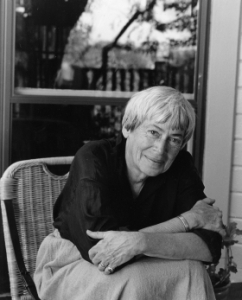
image from her website, photo ©by Marian Wood Kolisch
May your contributions to our literary and emotional landscapes always be known as blessings while you still live and after you die, and may all beings benefit.
Find these poems, this and all her other work here: http://www.ursulakleguin.com Her latest poetry collection, Late in the Day, is my next poetry read!

January 28, 2018
I picked this one up to read the day after Le Guin died. It was exceptionally appropriate given a portion of the poems were dealing with her feelings about her own mortality. (Tears) I must admit, Le Guin's poems are not my stylistic preference. There's a lot of nature description that is done well, but doesn't pull me in because I just am not a fan for the most part. However, her more confessional pieces and political lyrics packed quite an emotional punch and I was glad to have read the volume. I will miss this fiery author. She was wise and gifted with words, traits that are on display well on this book of poetry.
June 28, 2017
An excellent anthology. Though there were two poems that, on a moral ground, I really felt uncomfortable with, this book deserves five stars. Le Guin continues to find such magic and beauty in everyday life. Really astounding.

August 6, 2021
Poezija Ursule Le Guin, pa što više da napišem??

August 11, 2012
The World and Living in Retrospect and In Present Observation
For those unfamiliar with this impressive poet, `Ursula Kroeber Le Guin (born October 21, 1929) is an American author of novels, children's books, and short stories, mainly in the genres of fantasy and science fiction. She has also written poetry and essays. First published in the 1960s, her work explores alternative imaginings of sexuality, religion, politics, anarchism, ethnography, and gender. She is influenced by central figures of Western literature, including feminist writers like Virginia Woolf, and also by modern fantasy and science fiction writers, Norse mythology, and books from the Eastern tradition such as the Tao Te Ching. In turn, she has influenced Booker prize winners and other writers, such as Salman Rushdie and David Mitchell-- and notable futurism and fantasy writers like Neil Gaiman and Iain Banks. She has won various awards, including the Hugo, Nebula, Locus, and World Fantasy Award multiple times.'
This book of poems spans from 1960 to the present and reveals the artist as a seer, observer, reformer, pacifist, naturalist, and humorist - each descriptor meant in the highest of compliments. A read cannot step away form Le Guin's poetry without be at once dazzled and moved. The opening poem, an early one is
SONG
O when I was a dirty little virgin
I'd sit and pick my scabby knees
and dream about some man of thirty
and doing nothing did what I pleased.
A woman gets and is begotten on,
have and receive is feminine for live.
I knew it, I knew it even then:
what after all did I have to give?
A flowing cup, a horn of plenty
fulfilled with more the she can hold,
but the milk and honey will be empted,
emptied out, as she grows old.
More inward than sex or even womb,
inmost in woman is a girl intact,
the dirty little virgin who sits and dreams
and has nothing to do with fact.
Two pacifist poems follow:
HERE, THERE, AT THE MARSH
The papers are full of war and
my head is full of the anguish of battles
and ruin of ancient cities.
In the rainy light a great blue heron
lifts and flies above the brown cattails
heavy, tender, and pitiless.
THE NEXT WAR
It will take place,
it will take time,
it will take life,
and waste them.
But Le Guin can sing songs more gently, recalling hues of the past as in:
SEVEN LINES TO ELISABETH
Come back my daughter and make me another
mild posole, two anchos but no jalapeños.
Play Bach on the cello. Make me a mother
again as you did many years ago now.
Reawaken the old house with music and tears.
Whatever you do, always do it wholly.
O child come back, make me another posole.
The poetry of Ursula K Le Guin is in toto an elegy for one of the more sensitive, outspoken, and important poets of our time. This is a rich book of works that must be read.
Grady Harp
For those unfamiliar with this impressive poet, `Ursula Kroeber Le Guin (born October 21, 1929) is an American author of novels, children's books, and short stories, mainly in the genres of fantasy and science fiction. She has also written poetry and essays. First published in the 1960s, her work explores alternative imaginings of sexuality, religion, politics, anarchism, ethnography, and gender. She is influenced by central figures of Western literature, including feminist writers like Virginia Woolf, and also by modern fantasy and science fiction writers, Norse mythology, and books from the Eastern tradition such as the Tao Te Ching. In turn, she has influenced Booker prize winners and other writers, such as Salman Rushdie and David Mitchell-- and notable futurism and fantasy writers like Neil Gaiman and Iain Banks. She has won various awards, including the Hugo, Nebula, Locus, and World Fantasy Award multiple times.'
This book of poems spans from 1960 to the present and reveals the artist as a seer, observer, reformer, pacifist, naturalist, and humorist - each descriptor meant in the highest of compliments. A read cannot step away form Le Guin's poetry without be at once dazzled and moved. The opening poem, an early one is
SONG
O when I was a dirty little virgin
I'd sit and pick my scabby knees
and dream about some man of thirty
and doing nothing did what I pleased.
A woman gets and is begotten on,
have and receive is feminine for live.
I knew it, I knew it even then:
what after all did I have to give?
A flowing cup, a horn of plenty
fulfilled with more the she can hold,
but the milk and honey will be empted,
emptied out, as she grows old.
More inward than sex or even womb,
inmost in woman is a girl intact,
the dirty little virgin who sits and dreams
and has nothing to do with fact.
Two pacifist poems follow:
HERE, THERE, AT THE MARSH
The papers are full of war and
my head is full of the anguish of battles
and ruin of ancient cities.
In the rainy light a great blue heron
lifts and flies above the brown cattails
heavy, tender, and pitiless.
THE NEXT WAR
It will take place,
it will take time,
it will take life,
and waste them.
But Le Guin can sing songs more gently, recalling hues of the past as in:
SEVEN LINES TO ELISABETH
Come back my daughter and make me another
mild posole, two anchos but no jalapeños.
Play Bach on the cello. Make me a mother
again as you did many years ago now.
Reawaken the old house with music and tears.
Whatever you do, always do it wholly.
O child come back, make me another posole.
The poetry of Ursula K Le Guin is in toto an elegy for one of the more sensitive, outspoken, and important poets of our time. This is a rich book of works that must be read.
Grady Harp

October 16, 2012
The Best of the Beginning and the Latest Poetry from Ursula Le Guin
"Finding My Elegy" is a literary celebration of Ursula Le Guin's decades-long oeuvre in poetry, demonstrating that she is as much a master of this genre as she is of speculative fiction and fantasy. If nothing else, this relatively slim volume should demonstrate her considerable range and talent as a poet, drawing originally from the fantastical realms conjured in her "Ekumen" and "Earthsea" novels and stories, and then, later, drawing on subjects as diverse as her longstanding love of nature and her intensely felt commentary on social and political affairs both here in the United States and abroad.
One of my favorite poems, her ode to the great classical singer Ian Bostridge, demonstrates the intense richness and the elegant simplicity of her literary craft:
Lieder Singer
To Ian Bostridge
He stands by the piano, tall and lean
in black, unsmiling. His hands are tense.
Men are unlikely instruments.
A piano too, a strange awkward thing.
He looks out through the audience
waiting for the accompanist to begin
the running rolling subtle Schubert tune
His gaze changes as he starts to sing.
Now he sees nothing. Is he seen?
Where is he now in these long-drawn laments.
these soft rejoicings in a summer dawn?
Like Echo hidden near the hidden spring,
unbodied to music, he consents
to be nothing but voice, the rest is gone.
"Finding My Elegy" is a literary celebration of Ursula Le Guin's decades-long oeuvre in poetry, demonstrating that she is as much a master of this genre as she is of speculative fiction and fantasy. If nothing else, this relatively slim volume should demonstrate her considerable range and talent as a poet, drawing originally from the fantastical realms conjured in her "Ekumen" and "Earthsea" novels and stories, and then, later, drawing on subjects as diverse as her longstanding love of nature and her intensely felt commentary on social and political affairs both here in the United States and abroad.
One of my favorite poems, her ode to the great classical singer Ian Bostridge, demonstrates the intense richness and the elegant simplicity of her literary craft:
Lieder Singer
To Ian Bostridge
He stands by the piano, tall and lean
in black, unsmiling. His hands are tense.
Men are unlikely instruments.
A piano too, a strange awkward thing.
He looks out through the audience
waiting for the accompanist to begin
the running rolling subtle Schubert tune
His gaze changes as he starts to sing.
Now he sees nothing. Is he seen?
Where is he now in these long-drawn laments.
these soft rejoicings in a summer dawn?
Like Echo hidden near the hidden spring,
unbodied to music, he consents
to be nothing but voice, the rest is gone.

April 18, 2013
As the title suggests, this is an extremely mixed assortment of Le Guin poems -- all well-crafted, many formal or approaching formal, but few actual speculative poems. Readers expecting SF / fantasy poetry are likely to be disappointed, as most are nature-based or philosophical (or both!).
The collection is divided into two sections: Wild Fortune and Life Sciences. The former includes selected poems from several of Le Guin's previous collections (1960-2005). The latter presents new poems from 2006-2010. Many of these newer works deal with memory, time, and/or the experience of aging. The title poem is one of these, and (to my mind) exceptional, as is the collection's final poem, "The Conference."
I took some time getting through this book, renewing it twice from my library. It was well worth my effort, though the didactic tone of several poems in the earlier section gave me trouble. I also had to be in the mood for Le Guin's personal take on the world in order to experience the subtle pleasures of her poetry. Readers who appreciate understated formalism, the outdoors, or a spare, haiku-like vision are most likely to enjoy what's on offer here.
The collection is divided into two sections: Wild Fortune and Life Sciences. The former includes selected poems from several of Le Guin's previous collections (1960-2005). The latter presents new poems from 2006-2010. Many of these newer works deal with memory, time, and/or the experience of aging. The title poem is one of these, and (to my mind) exceptional, as is the collection's final poem, "The Conference."
I took some time getting through this book, renewing it twice from my library. It was well worth my effort, though the didactic tone of several poems in the earlier section gave me trouble. I also had to be in the mood for Le Guin's personal take on the world in order to experience the subtle pleasures of her poetry. Readers who appreciate understated formalism, the outdoors, or a spare, haiku-like vision are most likely to enjoy what's on offer here.

December 6, 2015
An solid career retrospective and it would be easy to read this and not realise she's one of the most celebrated and lauded SFF writers of all time. The poetry is great and there are 70 selected from her past, but I think the most impressive stuff are the 70 new poems.
It's clear, I think, from reading this that she's really become a great poet in her latest stage of life. The poems range from grim and bleak to playful and hopeful. She bounces from very structured styles, like sonnets, to more freeform styles, and even dabbles in epic style.
I very much doubt I would have read this had I not been such a fan of her novels, which is kind of upsetting. Unfortunately, I think very few poets or literary writers will read something like this, much to their own impoverishment. This is a really great collection of the old and new, the young and old.
So, yeah, check it out.
It's clear, I think, from reading this that she's really become a great poet in her latest stage of life. The poems range from grim and bleak to playful and hopeful. She bounces from very structured styles, like sonnets, to more freeform styles, and even dabbles in epic style.
I very much doubt I would have read this had I not been such a fan of her novels, which is kind of upsetting. Unfortunately, I think very few poets or literary writers will read something like this, much to their own impoverishment. This is a really great collection of the old and new, the young and old.
So, yeah, check it out.

October 10, 2018
The more Le Guin I read, the more I love her as a human. Her poetry feels like a morning coffee journal. She’s on the porch in the sun, steaming cup, just thinking. Dabbling with form, with translations, with mythology and legacy, with age and culture, and then sometimes just overcome with joy about a bird warbling, or the sun on a leaf, or missing her daughter, or feeling old. This is a lovely little book of those meditations.
November 24, 2012
I had not realized that the marvelous author of the Earthsea cycle and of many exciting science fiction novels has also published several volumes of poetry. This collection includes poems from 1960 to 2010. The later poems, written by a poet in her 80s, reflect on life and death. This is a good introduction to the poetry of a favorite novelist.
Want to Read
September 13, 2012Ursula Le Guin is one of our best American writers, and I can't wait to read her new volume of poetry. If you think you don't like sci fi or fantasy, you can't have read her novels. If you think feminists are all shrill, you haven't read her essays.

November 24, 2012
These poems are about time and the persistence of memory, about clarity, and about growing older, and about how the past lives in the present and in the future, and how desire never ceases.
They are extraordinarily beautiful, and sometimes brought me to the edge of tears.
They are extraordinarily beautiful, and sometimes brought me to the edge of tears.

February 28, 2015
Beautiful and heartbreaking. Of course there were a few that really didn't work for me, but that's any book of poetry. On the whole it was amazing. I loved it so much I'm going to have to revisit A Wizard of Earthsea, despite hating it the first go-round.

December 21, 2017
When she’s good, she’s really good. When she’s bad, she’s really bad. I would have appreciated a shorter, more concise and polished collection to the disorganized mess we have here.
November 23, 2023
I will never give Ursula K Le Guin anything less than a 5 star rating

May 9, 2025
I had no idea le guin was a poet until I randomly found this at the library! I have been meaning to read her, but this is actually my first experience with her work.
Having such a huge swath of time represented in this collection gave me a good idea of her poetry and I enjoyed it overall. There are some quirky pieces, some heartfelt, some fanciful. It’s better than what I expected, knowing next to nothing about the author.
Based on this collection, I would definitely go back and read some of the original books some of these came from, and of course would check out her other writing as well! Interesting and fun foray into an author I’ve been meaning to read.
Having such a huge swath of time represented in this collection gave me a good idea of her poetry and I enjoyed it overall. There are some quirky pieces, some heartfelt, some fanciful. It’s better than what I expected, knowing next to nothing about the author.
Based on this collection, I would definitely go back and read some of the original books some of these came from, and of course would check out her other writing as well! Interesting and fun foray into an author I’ve been meaning to read.

May 29, 2021
This book, these poems, speak to me in a common language, developed from a kindred place. LeGuin and I grew up in California, we both lived in the NW for part of our lives, and we were both raised to find our own unconventional spiritual grounding. This makes these poems very comforting for me to read, as the landscapes are as familiar as the concepts she explores. I will be returning to these poems, because they are also challenging, and I want to make sure I have not missed the tales told. I hope they speak to others as lyrically as I hear them.

July 18, 2024
HAD NO IDEA LE GUIN WROTE POETRY. WHAT AN AMAZING CROSSOVER EPISODE.
Offering
I made a poem going
to sleep last night, woke
in sunlight, it was clean forgotten.
If it was any good, gods
of the great darkness
where sleep goes and farther
death goes, you not named,
then as true offering
accept it.
Offering
I made a poem going
to sleep last night, woke
in sunlight, it was clean forgotten.
If it was any good, gods
of the great darkness
where sleep goes and farther
death goes, you not named,
then as true offering
accept it.

August 13, 2021
Ursula K Le Guin is one of my favorite authors. I love seeing all the different ways her mind works. This is an author I will try to read everything she has written. I am glad to have the opportunity to sample her poems.

February 21, 2026
La primera mitad los disfruté muchísimo, entiendo que es una antología de 50 años entonces tiene otros momentos donde me costó engancharme. Aún así estoy muy feliz de haber compartido otro libro de íntima Ursula, te quiero tanto.

March 22, 2026
Llevaba un tiempo desconectada de la poesía, pero Ursula K. Le Guin me ha enganchado más de lo que esperaba. Gracias, Tayri 🌟
Displaying 1 - 30 of 95 reviews