Why is A the first letter of the alphabet? Why is O round? This work tells how Protosinaic pictograms - derived from Egyptian heiroglyphics and discovered in the Sinai only at the beginning of the 20th century - changed throughout the millennia and left their trace on our alphabet.
Marc-Alain Ouaknin both a rabbi and a philosopher. He is the son of Rabbi Jacques Ouaknin and Eliane Erlich Ouaknin. His father is the Grand Rabbi of the French cities of Reims, Lille, Metz, and Marseille. Ouaknin dedicated his best-known work, The Burnt Book, to "my father, my master, Grand Rabbi Jacques Ouaknin."
Some books suffer in translation, which is ironic in this case since it is about language and meaning. Mysteries of the Alphabet was originally published in French, but seems to be focused on a Hebrew-speaking audience, giving modern examples in Hebrew but not French or English. Nevertheless, there is interesting information to be found here, and the short first section, showing the development of language systems from pictograms to ideograms to phonograms, is quite good.
The first writing systems used signs for words, for phonemes, and for individual sounds, and it was two thousand years before some unknown genius speaking one of the Semitic languages had the idea of creating a system where each symbol stood for a single sound. Older writing systems had hundreds of symbols that had to be learned – Sumerian had about 800 – but the simplicity of an alphabet, with only two dozen or so, ensured that it would spread far and wide, down to the present day.
The second, and larger section of this book looks at the history of each individual letter as it morphed over time, and it is interesting to watch the forms shift left, right, diagonally, even flipped upside down, growing more and more abstract and simplified. It was an impressive feat of scholarship that traced these long and complicated paths across the centuries, but for every letter the book shows a clear progression of the transitional forms leading to our modern letters.
In his explanations of the symbols the author sometimes strays far afield from history and into exegesis and interpretation. For instance, “H is the initial letter of the word het, which is Semitic languages means ‘enclosure,’ ‘wall,’ ‘obstacle’. To live is to realize the forces at work in the constant renewal of the world; it is sensing the advent of a new dawn, a creation that cannot take place without a wrenching, a bursting out from that which existed before.” (p. 194) Also, “R is the initial letter of the Hebrew word resh, which means ‘head,’ beginning. Each person is a new beginning and each person has to accept the difficult and demanding task of creating time from a new beginning. The letter resh is primarily an encouragement to begin, to undertake, to take an initiative as well as to enter into the action.” (p. 302) The author is a rabbi, but a book about the history of letters seems an odd place to sermonize.
I was never tempted to set the book aside. Even when I wasn’t sure why the author was saying the things he said, it was interesting. The letterforms and artwork are well done, and the times when he was lighthearted were not distracting or silly. I liked the book and I learned some things from it, but for those interested in the history of letters, I recommend the redoubtable Humez brothers, Alexander and Nicholas, and their books Alpha to Omega: The Life and Times of the Greek Alphabet and ABC Et Cetera: The Life & Times of the Roman Alphabet.
Every time I picked up this book I was compelled to say ~Mysteries of the Alphabet~ in a spooky voice.
The first half is an introduction to different alphabets as well as writing systems that aren't alphabets at all, like Chinese, and the ways these signs and symbols changed through time, conquest, and cultural exchange.
The author is a rabbi, so if you're interested in Hebrew tradition, or just Hebrew, this has one eye on the Hebrew alphabet at all times, including interpretations of Latin letters based on their Hebrew meanings. It also insists on treating the Bible as a historical document and kept coyly referring to the "revelation on Mt. Sinai." Since that's not my book, I didn't immediately understand what he was driving at and wasn't impressed once I did. Any history that depends on God stopping by to pass down some commandments to Moses isn't, in my mind, trustworthy. I mean, obviously a human being wrote down those commandments at some point and wherever they came from they certainly had a lasting effect, but can they really be used to explain how pictographs suddenly fell out of favor as everyone scrambled to develop a writing system that didn't break the second commandment? IDK
~Mysteries of the Alphabet~
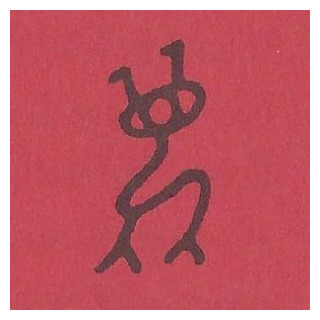
This is filled with photographs and sketches of artifacts with inscriptions as well as hand-written examples of the various letters, signs, and symbols as they morphed from one shape to another, which really helped me picture what was going on. Though not always. Check out this figure that seems to depict a giant eye with two hooked antenna coming out the top, a single curving line for a body, and two legs:
I saw that and I was like: Forget the Egyptians and their pyramids, the ancient Chinese were clearly consorting with aliens. I didn't know what else it could be. Maybe a llama. But that might also require alien intervention as I don't think China had access to llamas back then. Whatever it is, the book declines to speculate, identifying it only as a "primitive Chinese monogram."
~Mysteries of the Alphabet~
But, listen, I spent days thinking about this, and I started wondering what if it wasn't a thing, but a verb? I don't technically know any Chinese, but I do know a little about Japanese, and I immediately thought of how the kanji for "see"—as in "to look"—is literally an eyeball on two legs. 見 is made up of two components or radicals. The top boxy part divided into three equal horizontal sections means "eye," and what looks like a JL coming out the bottom of the box is the "legs" radical.
Japanese kanji were adopted—and adapted—from Chinese hanzi. This same character in Chinese also means "see" as in "to look" and uses the same eyeball radical and legs. So I turned to the wonderful Kanji Portraits by Noriko Kurosawa Williams to see if I was onto something, and shazam: An earlier form of 見 was indeed an eyeball on legs. So it's very possible that big eyed alien with the horns (eyelashes??) could be an even earlier form of this character or something else in that family of words that have to do with eyes or seeing.
~Mysteries of the Alphabet~
The second half of the book walks us through the 26 letters of the Western European alphabet, describing the journey each letter took from its start in the proto-Sinaitic alphabet through Phoenician, Greek, Etruscan, and out the other side to Latin and modern Hebrew. Though not all letters made stops in all these places, and not all letters have a traceable path.
There was more speculation in this part than I would like, though it's understandable that we might have to do some guessing when it comes to the origin of these letters. But the endless philosophizing about the symbolism behind, for example, the horns of the ox (aleph, which eventually became "A") going from pointing up to pointing down, indicating a shift from the godly to the earthly...look. Sometimes when I'm writing quickly in my mix of print and cursive, I'll leave out an i and just dot the space where it should have gone. It's got nothing to do with a rejection of yod's outstretched hand, the likely origin of the I. I'm just being sloppy. When you get lots of people writing down letters they're going to change in the use. I mean, sometimes we spell the letter O with a zero now.
I did learn that the Ancient Egyptians had a hieroglyph specifically for the penis and it's exactly what you'd think: an erect penis pointed to the left or right with two little balls tucked up underneath it. The version in the book is kind of adorable. Like a little cartoon dick. The Egyptian version goes on at length, clearly compensating for something. It also comes in a jizzy version.
~Mysteries of the Alphabet~
The third part of this is unmitigated nonsense about "archeography," Freud, and God, and includes the misapprehension that the violin has five strings. It has four. It was at this point I stopped trying to understand whatever his point was about how the letters in our name can have therapeutic importance and just looked at the words until I reached the end. Then I wrote my name in proto-Sinaitic, which was pretty fun, and called it a day.
I was here to learn about the English alphabet and where it (probably) came from, and I (mostly) got that. It just had a little too much god in the mix.
Endnotes—in a thin, wavery, minuscule font—were at the end of each section to provide further context, additional reading, and sources, and at the back are image credits and an extensive bibliography, but it has no index, and no translator's notes.
Contains: God; references to (and pictographs of) genitals; some of the print is very small and difficult to read, made worse by it occasionally being in white italics on red paper.
Ouaknin offers a fascinating "archeography" of the alphabet, tracing the origins of the shapes of our letters back to proto-Sinaitic pictograms, and explaining their transformations over time.
The first section offers the history of Alphabets, and Writing from pictograms, ideograms, and phonograms. The second section, the greater meat of the work purports to examine the Latin alphabet, however, the author does go through the development of the lettering from Egyptian, Phoenician, Greek and then Hebrew as an inheritor of the first three uses, the mystical meanings of Hebrew to explain English lettering. Thus, when, as is inevitable, the text comes to a point where a letter appears that is not in the Hebrew language, the author refers back to a related symbol as its root and leaves the meaning at that. This happens for I,Y,J; U,V, W; K for Y; and G for Z.
Perhaps, if one were considering only the structure, and shape of the letter, this method can yield some insight, however, in my opinion, when the author doesn't even refer to words in English but words the letter being studied refers to in Hebrew, one loses relevance. I understand those that work in the Western Mystery Tradition that relies heavily upon the Golden Dawn-shaped Tree of Life, and its usage of Hebrew letters for significance may find this style appealing. If one does, there is a good grounding here. The format is set with the name, original form in proto-Sinaitic, classic form in modern Hebrew, original meaning, derivative meaning, acquired meaning in the Hebrew language, and the numeric value. For English lettering as it is, one is better served looking through Greek for these associations. I do believe that the modern usages, and their German-Latin roots is vital to working best with this alphabet. In the case of those that use the Latin alphabet, such as those with with roots in Germanic, or Romance languages- among others, slightly different methods would be used because of the change in pronunciation, words linked with the sound/letter, and what one's own culture and history offers to compound affect, and effect of these words created from these representations.
Being more focused on the work from an English language perspective, and not using Hebrew at all, I had hoped for more from this work. For such a long book, there is not as much content as I would have liked; each entry for the letters is only a few pages. The art, and images are large and attractive. It does include a general bibliography.
Un percorso affascinante che ci riconduce alle origini delle familiari lettere usate ogni giorno per parlare e scrivere. Una vera e propria avventura archeografica tra confronti e scoperte, analogie e simboli spiegati con chiarezza e semplicità, in una veste grafica molto accattivante.
Fun, a sort of whimsical art book, full of examples of early letters and artsy renditions of modern ones, showing the pictograph history of Latin letters (early chapters also look at cuneiform, Chinese, Egyptian hieroglyphs, and Arabic). The book focuses on Hebrew as the proto-Semitic base of the alphabet, rather than Phoenician, since it has a modern life as a language. There can be a romantic feel to the text; for instance, the author also attributes poetic characteristics and personalities to each letter, which felt like a stretch to me. Still, it was fun to see ways letters have evolved, and how letter came from pictographs for things like oxen, eye, hand, praying man, water, etc.
Upea, ilmava taitto ja mielenkiintoista asiaa. Juutalaisuus ja heprean kieli saavat väliin häiritsevänkin suuren roolin, koska suoraa yhteyttä latinalaisiin aakkosiin ei ole.
This book is so beautiful, and I have used it as a reference in my art making. The author has compared symbols in letters from the beginning of man, up until now.
This book explores the alphabet from its origins in the pictograms of 3500 years ago that reproduced a material object. In brief, this led to phonograms, that no longer referred to an image, but a sound. This evolved into marks depicting partial images known as acrophonic, giving rise to the system of signs known as an alphabet. The book is fascinating in its exploration of the written word.
Very intriguing history of the alphabet. The author traces written language from it's earliest forms to its modern equivalents and does a pretty good job of showing how alphabets evolved from descriptive pictures (pictograms and ideograms) to the letters we have today (phonograms which represent sounds). This is more of an academic resource than a book.
This book brings the alphabet to life connecting letters back to their pictogrammic sources and tracking their evolution and transformation. I found some good ideas here. It's an easy read.
If the alphabet is your thing it's a real page turner. I'm not sure exactly how scholarly the book is but there is an obvious progression and some very valid and illuminating points.