Jump to ratings and reviews
Rate this book

Ralph Eugene Meatyard

Rate this book
The photographs of Ralph Eugene Meatyard defy they have been called visionary, surrealistic, and meditative. Whatever the label, these evocative images of friends and family and the natural world around his home illustrate a delicate psychology of human interaction. Meatyard was trained as an optician, a profession that he maintained all his life in Lexington, Kentucky; he bought a camera in 1950 for the sole purpose of photographing his first-born son. But shortly thereafter, he joined the Lexington Camera Club and developed a friendship with his photography teacher Van Deren Coke, as well as a circle of local writers and photographers, including Guy Davenport, Thomas Merton, Wendell Berry, Jonathan Williams, and Minor White. Family and friends freely participated in Meatyard's staged and mysterious images, which often involve masks and abandoned spaces, and obliquely reference social, political, and cultural issues. A key subject in Meatyard's work is the natural environment, which is featured in his Light on Water series, in which long exposures seem to create calligraphic texts, and his No-Focus series, in which he deliberately photographed stems and twigs out of focus. In one of his last series titled Motion-Sound, the pictures were made by moving the camera gently, creating multiple exposures of the woodland scenes that suggest abstract sound patterns. The book accompanies an exhibition organized by ICP Assistant Curator Cynthia Young with acclaimed writer and Meatyard friend, Guy Davenport, who also wrote the text. Also included are the exhibition history, chronology, and bibliography.

Paperback

First published January 1, 1974

2 people are currently reading
132 people want to read

About the author

Ralph Eugene Meatyard

17 books7 followers
Meatyard purchased his first camera in 1950 to photograph his son, Michael. He eventually found his way to the Lexington Camera club in 1954, and at the same time joined the Photographic Society of America. It was at the camera club that Meatyard met Van Deren Coke, an early influence behind much of Meatyard's work. He even exhibited work by Meatyard in an exhibition for the University entitled 'Creative Photography' 1956.

During the mid 1950s he would attend a series of summer workshops, run by Henry Holmes Smith and Minor White. Minor White in particular fostered Meatyard's interest in Zen Philosophy.

He continued to make work, usually in bursts during holidays, in his makeshift darkroom in his home, until his death in 1972. His approach was somewhat improvisational and very heavily influenced by the jazz music of the time.[1]

Ralph Eugene Meatyard's death in 1972, a week away from his 47th birthday, came at the height of the "photo boom", a period of growth and ferment in photography in the United States which paralleled the political and social upheavals of the 1960s and 1970s. It was a time of ambition, not reflection, a time for writing résumés, not thoughtful and inclusive histories; in the contest of reputation, dying in 1972 meant leaving the race early. It was left to friends and colleagues to complete an Aperture monograph on Meatyard and carry through with the publication of The Family Album of Lucybelle Crater (1974) which he had laid out and sequenced before his death.

While he lived Meatyard's work was shown and collected by major museums, published in important art magazines, and regarded by his peers as among the most original and disturbing imagery ever created with a camera. He exhibited with such well-known and diverse photographers as Edward Weston, Ansel Adams, Minor White, Aaron Siskind, Harry Callahan, Robert Frank, and Eikoh Hosoe. But by the late 1970s, his photographs seemed consigned to appear mainly in exhibitions of "southern" art. In the last decade, however, thanks in part to European critics, Meatyard's work has reemerged, and the depth of its genius and its contributions to photography have begun to be understood and appreciated. In a sense Meatyard suffered a fate common to artists who are very much of but also very far ahead of their time. Everything about his life and his art ran counter to the usual and expected patterns. He was an optician, happily married, a father of three, president of the Parent-Teacher Association, and coach of a boy's baseball team. He lived in Lexington, Kentucky, far from the urban centers most associated with serious art. His images had nothing to do with the gritty "street photography" of the east coast or the romantic view camera realism of the west coast. His best known images were populated with dolls and masks, with family, friends and neighbors pictured in abandoned buildings or in ordinary suburban backyards.

Ratings & Reviews

What do you think?
Rate this book

Friends & Following

Create a free account to discover what your friends think of this book!

Community Reviews

5 stars
75 (76%)
4 stars
16 (16%)
3 stars
7 (7%)
2 stars
0 (0%)
1 star
0 (0%)
Displaying 1 - 11 of 11 reviews
Profile Image for Mir.
4,977 reviews5,330 followers
September 6, 2014
This is an excellent overview, including samples of Meatyard's various collections and themes.

The essay by Guy Davenport, who was a friend of Meatyard and his family, is brief but interesting and intimate.

The interview with Davenport: I don't know what Young's qualifications are aside from being an assistant curator, but she sucks ass at interviewing. Here's a typical exchange:
GD: The found object was very much in the air in the sixties and I know that Gene was interested. A writer from New York came down here, and Gene and I went together to hear his lecture. He inventoried a large worktable in an almost anthropological way. He tried to account for every single thing on the table: where the pencils came from, where the erasers came from, where the books came from and why he owned them, paperclips, friends' letters, and so on. I am not remembering his name, and his vogue has passed. And then Jonathan Williams himself, who was doing concrete poetry, and Gene and Tom Merton were both very much interested in concrete poetry. And there is Mary Ellen Solt, up in Indiana, a scholar of concrete poetry, Ronald Johnson and one figure overseas, I am Hamilton Finlay. We were all fascinated by Finlay. I was in contact with him and was getting photographs of things he was doing with his famous Garden of Apollo there in the suburbs of Glasgow. In fact, there was an evening at the University when Gene and I both agreed that all the poets who were doing a series of poetry were dull as dishwater. And we devised our own show, which was well attended, where we prerecorded on Gene's tape recorder various kinds of music, very lively music, Francis Poulenc, military music, bagpipe, all sorts of things. I read poems of Finlay against the music. Gene and I had practiced this and we were well-cued. One of the things we were determined to do is have the poetry surrounded completely by silence, because most of the amateur poets and many of the big poets, I'm afraid, spent most of their time telling anecdotes on how a poem came to be. You know, "My wife has said...", "I was led..." Gene and I had contempt for this tradition, and gave what I hope was a rather startling performance.
CY: So you had fun together and did creative projects together.
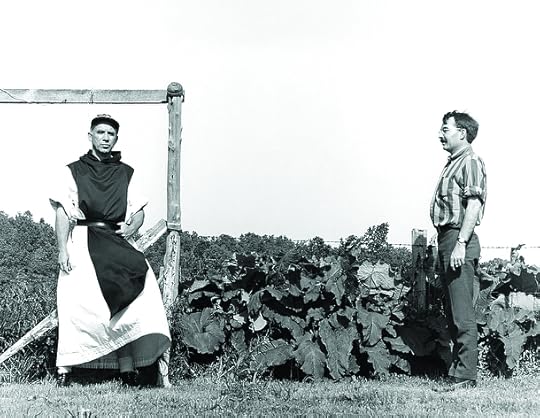


Thomas Merton and Guy Davenport
Profile Image for Eddie Watkins.
Author 27 books5,558 followers
October 8, 2014
One of the stranger names in recent art, and, strangely, Ralph Eugene Meatyard himself liked to collect strange names. He was a self-taught photographer who lived his whole life in Kentucky working as an optometrist, while maintaining close friendships with artists and poets and thinkers like Guy Davenport, Jonathan Williams, Thomas Merton, Denise Levertov, et al.

One of the introductions to this book is a meaty interview with Guy Davenport who comments on how Meatyard didn't like to talk about or explain his art (contrasting him with Stan Brakhage who annoyingly talked his ears off), and this unexplained mysterious quality permeates his photographs. Though they are clearly the result of exhaustive thought and contemplation the photographs themselves elude encapsulation in ideated thought, as should all true art. His work is a balance of conflicts and contradictions - serenity & restlessness, staginess & spontaneity, specificity & ambiguity, etc., and binding it all is a royally mysterious aestheticism.

His most famous photographs are probably those in his Lucybelle Crater series in which he takes portraits of individuals and families, all of whom are named Lucybelle Crater and are wearing a grotesque mask. For example, one photo is entitled Lucybelle Crater and her 15 yr old son Lucybelle Crater, both of whom are wearing identical masks. Beyond the gimmick they are genuinely funny and intriguing and make some kind of comment on Southern Gothic culture (I'd rather not go there).

But his body of work beyond this series is very large and varied and is worth long contemplation, with wonderful shots of untamed nature, records of explorations of run-down towns and abandoned structures, plus pure abstractions and shots of nothing but light interacting with water, and a fascinating series called Motion/Sound where he vibrated the camera while snapping the shot. Even with all these experiments he still had the policy of never cropping; he was like a shutterbug Zen warrior - first shot best shot. One series is actually called Zen Twigs, which are extreme close-ups of naturally twisted twigs partially in and partially out of focus, many sentiently straining toward the lens.

The record of photographs he left is inexhaustible and is evidence of his profound eplorations of individual solitary perception within a deep commitment to family and community, a thorough integration of art and life. Mr. Meatyard you died way too young, though you left a complete body of work in your wake.
Profile Image for Eric.
342 reviews
October 13, 2021
"Read" (as a cantankerous undergraduate) in the stuffy subterranean stacks of the Arts Library at UCLA in, probably, the fall of 2013. Have been on the lookout ever since for an affordable copy out here in the real welt.
Profile Image for ?0?0?0.
727 reviews38 followers
April 11, 2017
Looked through this collection too many times to count, every time re-reading it, I never want it to end. Gorgeous. Mmmmm.
Profile Image for Jeff Jackson.
Author 4 books529 followers
February 16, 2013
For some reason, Goodreads thinks this is the same book as Gene Meatyard's Aperture collection from the mid 1970s. Not so. As the title suggests, this 2012 volume focuses on images of dolls and masks, carefully chosen from both familiar and previously unseen images. Beautifully reproduced, these are some of Meatyard's strongest photographs. Great essays that discuss the alchemy of lavender jelly etc. provide suitably offbeat entry points into this mysterioso work.
Profile Image for Krista.
41 reviews2 followers
March 17, 2010
This was eerie and interesting, although a lot of his photographs are of people wearing masks. I usually don't like that kind of thing. Such a lunge at being "weird." Just be weird without props. Be weird in your own face.
Profile Image for Cary.
62 reviews
July 2, 2009
The very first photo book I fell in love with. Ah, young love. So pure. So earnest.
Displaying 1 - 11 of 11 reviews

Can't find what you're looking for?

Get help and learn more about the design.