Vita Sackville-West wrote Saint Joan of Arc in 1936 at the age of 44, & had, at that point, already been writing for 30 years. At 14, Sackville-West published her first book, & at 14 Joan of Arc first heard the voices. Joan was 17 when she took command of the armies of France--a peasant girl in the early 15th century in charge of a nation's forces. At 19 she was captured by the British & tried as a witch by a church court. Before her 20 birthday she was burned at the stake. In 1920 she was canonized by the Roman Catholic Church as a saint. In a clever, brisk voice, Sackville-West tells the triumphant story of a French peasant girl raised in a country torn apart by the 100 Years' War who rose from poverty to military greatness. With dazzling insight & clarity, Sackville-West breathes new life into Joan of Arc's beautiful & tragic story.
Novels of British writer Victoria Mary Sackville-West, known as Vita, include The Edwardians (1930) and All Passion Spent (1931).
This prolific English author, poet, and memoirist in the early 20th century lived not so privately. While married to the diplomat Harold Nicolson, she conducted a series of scandalous amorous liaisons with many women, including the brilliant Virginia Woolf. They had an open marriage. Both Sackville-West and her husband had same-sex relationships. Her exuberant aristocratic life was one of inordinate privilege and way ahead of her time. She frequently traveled to Europe in the company of one or the other of her lovers and often dressed as a man to be able to gain access to places where only the couples could go. Gardening, like writing, was a passion Vita cherished with the certainty of a vocation: she wrote books on the topic and constructed the gardens of the castle of Sissinghurst, one of England's most beautiful gardens at her home.
She published her first book Poems of East and West in 1917. She followed this with a novel, Heritage, in 1919. A second novel, The Heir (1922), dealt with her feelings about her family. Her next book, Knole and the Sackvilles (1922), covered her family history. The Edwardians (1930) and All Passion Spent (1931) are perhaps her best known novels today. In the latter, the elderly Lady Slane courageously embraces a long suppressed sense of freedom and whimsy after a lifetime of convention. In 1948 she was appointed a Companion of Honour for her services to literature. She continued to develop her garden at Sissinghurst Castle and for many years wrote a weekly gardening column for The Observer. In 1955 she was awarded the gold Veitch medal of the Royal Horticultural Society. In her last decade she published a further biography, Daughter of France (1959) and a final novel, No Signposts in the Sea (1961).
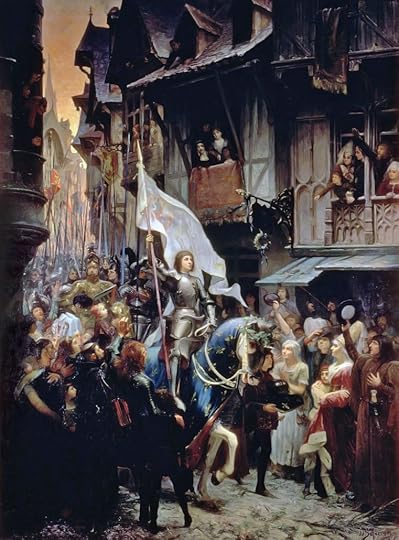
"Partida de Vaucoulleurs", por Jean Jacques Scherrer, 1897
SANTA JOANA D'ARC Queimada como herege em 30 de Maio de 1431 Canonizada em 16 de Maio de 1920
"...estava-se numa época em que os visionários eram vulgares ainda que, normalmente, pouco eficazes. Eram tempos em que a superstição prosperava, a Fé era uma força suprema..."
"A sua posição de comando era ímpar. Isto sem ser um militar profissional nem mesmo, em qualquer dos casos, um soldado; nem sequer era um homem. Ignorava as artes da guerra. Não passava de uma rapariga equipada com armas. Mas ela acreditava e fazia com que os outros quisessem acreditar, que era um Instrumento de Deus."
Há três vias narrativas que partem da figura de Joana d'Arc: a religiosa, a mítica e a histórica. Vita Sackville-West dá praticamente igual destaque a cada uma delas: desmistifica muita credulidade dogmática; elucida muitas ambiguidades históricas; desfaz muitos mitos bacocos, tudo sem desvalorizar a real importância da personagem principal na história e na política, e a mulher que foi Joana-a-Donzela.
Porque o seu processo de creditação [de Joana d'Arc], de jovem camponesa baixa e pouco atraente, e não elegante e feminina; morena e não loira; crestada pelo sol e não nívea, não se fez nas parangonas de um jornal - incluiu inquéritos judiciais e religiosos, confirmações de sexo e de virgindade (físicas e obviamente consideradas muito menos invasivas e inapropriadas do que hoje em dia). Todos estes processos Vita denuncia e desmistifica - com recurso a infindável documentação que existe e não requer um criativo preenchimento de lacunas como aquele que se tende a denotar nas suas biografias.
"Joana tinha de ajudar a mãe, nas lides domésticas e na fiação, e o pai e irmãos nas colheitas. Dedos rugosos, pele avermelhada pelo sol e estragada pelo mau tempo, membros estólidos e músculos tensos, as inevitávels consequências de semelhante vida, dificilmente poderão ter incrementado os atractivos femininos de uma rapariga que, se eventualmente os possuía, eles nem sequer são nunca mencionados por aqueles que, desde o início, a conheceram e amaram."
Sobre tudo isto, Vita é de uma erudição tremenda - o trabalho de recolha a que se prestou; a investigação que fez (ajudada por especialistas); os conhecimentos de história e línguas que demonstra (o seu domínio do francês medieval é absoluto - e benditas notas de editor que traduzem francês arcaico e extensos textos em latim por igual!) capacitam-na para a escrita de uma biografia refrescante e profissional, longe da biografia ficcionada ou do romance histórico em que poderia desembocar esta empresa.
"Ela [Joana d'Arc] era capaz de se mostrar suficientemente sensata em crises imediatas mas, em relação a problemas mais latos, dá a impressão de que, com excessiva frequência, era vítima das suas próprias idées fixes. Parece-me, demasiadas vezes, uma pessoa inspirada mas de capacidade de julgamento variável; alguém com um objectivo mas sem uma política reflectida; uma pessoa que se lança a galope por uma estrada estreita, sem nunca erguer os olhos para a paisagem que a espera; alguém cuja própria fraqueza servia de base à sua força, cuja força era a sua fraqueza."
Enquadrado na guerra dos cem anos, o relato de Vita é minucioso e abarca tanto detalhes bélicos como de quotidiano, aponta dados históricos e políticos concretos (para lá da mística que reveste hoje o nosso conhecimento leigo da época medieval); não cede a romantismos ou à tentação de olhar de forma comprometida uma época feita de polarizações religiosas.
(Sobre a guerra dos cem anos) "...analisando em retrospectiva um estado de coisas que nos parece desconfortável e complicado quando observado em pormenor, devemos procurar preservar um certo sentido de equilíbrio existente entre os factos tal como nos surgem impressos e como, provavelmente, pareciam aos que por eles passaram. Os padrões do comportamento humano adaptam-se muito rápida e surpreendentemente e uma pessoa que tenha sido criada no meio do desconforto de uma vaga, ainda que ininterrupta, de guerra, vinda do tempo dos seus avós, de certeza que aceita essas condições com certo espírito de aquiescência e filosofia e com tanta naturalidade como as vicissitudes da agricultura, ou as variações climatéricas."
(Sobre vida quotidiana) "Devemos (...) ter em conta que os hábitos de higiene pessoal pouco significavam para uma mentalidade medieval. Se os italianos, que eram mais civilizados, se mostravam chocados com os costumes desagradáveis da aristocracia francesa, até mesmo já no final do século de Joana, ao ponto de os hóspedes franceses dos palácios italianos terem de ser convidados a não assoar o nariz aos cortinados das camas, como não seriam os hábitos do proletariado francês no inicio desse mesmo século!"
Assim se percorre a vida de Joana-a-camponesa desde o momento em que abandona Domremy, a sua terra natal, até que se junta ao exército francês pela libertação nacional.
(Sobre o cerco de Orleães) "Aquilo que ela fez foi resolver, em poucos dias, um confronto que já durava há seis meses. E conseguiu-o, acredito, inteiramente por meio da sua influência pessoal. Ao mesmo tempo, creio também que ela lá chegou naquilo que se designa actualmente por momento psicológico.(...)O autêntico feito de Joana não foi a libertação de Orleães, mas sim a regeneração da alma de uma França desanimada."
Quando chega ao julgamento de Joana, o relato de Vita torna-se ainda mais desapaixonado e "científico", descrevendo ipsis verbis as atas do julgamento, e tentando compreender, pelas palavras da acusada e dos acusadores, as reais implicações da sua condenação - a conclusão roça o ridículo: o seu travestismo parece de maior importância para os inquisidores do que o ato de alta traição que protagoniza quando se opõe à ocupação inglesa do território francês; as acusações de bruxaria são levantadas e mantidas pela sua recusa em reconhecer a igreja terrena como representante da celestial... A fantochada habitual levada a cabo por homens ignorantes, medrosos e perversos.
"...os ingleses não tinham intenções de libertar a sua prisioneira. Podiam tê-la confiado, por conveniência, ao tribunal eclesiástico nomeado pela Universidade de Paris; isso era uma questão de forma e, desde que a Donzela fosse morta, pouco Ihes Importava quem a tinha condenado. Mas, desde o início ficara bem explícito que, se ela não fosse considerada culpada de crimes contra a Fé Católica, seria devolvida ao poder secular personificado pelo rei de Inglaterra, o que era equivalente a dizer-se que, no caso de a não conseguirem apanhar por uma via, a apanhariam por outra."
"Não dispunha de quem quer que fosse para a sua defesa. Carlos VII, seu natural protector, desaparecera por completo do quadro. Não lhe haviam concedido o direito a um advogado durante o julgamento: nem uma só testemunha foi chamada a depor a seu favor; nem um único membro do partido que lhe era favorável se encontrava entre os seus juízes; ninguém se atreveu a erguer a voz, para a auxiliar ou orientar; todos se mostraram intimidados por Cauchon [bispo de Beauvais e juíz de Joana d'Arc] ou pelos ingleses, frequentemente por ambos; nenhuma acusação formal lhe foi lida até ao final; os juízes fizeram tudo o que puderam para a confundirem, por meio de um bombardeamento de inconsequentes e aparentemente irrelevantes perguntas, cujo fluir deve ter-lhe tornado difícil em extremo percebê-las; sozinha, sem saber ler ou conferir os documentos que lhe eram apresentados para assinar, teve de enfrentar toda aquela assembleia de homens cultos, treinados, desprovidos de escrúpulos e cobardes."
Vita Sackville-West fez um trabalho louvável e escrupuloso; optou pelo relato imparcial (tanto quanto lhe foi possível); ofereceu-nos mapas e apêndices que tornam a leitura clara, embora exigente; posicionou-se como informadora e não intérprete da história.
Enquanto biografia histórica, sujeita a contínuos acrescentos e descobertas, talvez a atualidade da sua obra não seja a mais fácil de manter - mas, de 1936 aos dias de hoje, esta continua a ser uma leitura indispensável que não se atém somente à veracidade ou não das profecias de Joana-a-Donzela, mas à tentativa de compreender os efeitos que essas profecias têm sobre os grandes decisores (rei, comandantes etc) que rodeiam Joana e por ela são influenciados a agir de acordo com os seus intentos - em suma: Vita explora a mentalidade medieval, o poder que a religião e a política têm sobre ela.
"...as virtudes humanas dessa época rude não tinham mais que um peso insignificante e, quando se contrapesava a ameaça constituída pelos Poderes das Trevas, poucas dúvidas poderiam restar, quanto a qual dos pratos da balança iria baixar. É preciso aceitar-se, a priori, o princípio de que Joana tinha de ser encarada ou como uma santa, ou como um demónio. Nada de meios termos."
Por se identificar com Joana d'Arc (enquanto feminista e mulher), questões como a prova de virgindade ou a insistência eclesiástica na falta cometida pela sua adoção de trajes masculinos são forte e corretamente censuradas pela autora, e Joana (-a-Mulher) devidamente louvada como temerária, corajosa, confiante. O seu fascínio pelo mito de Joana-a-Donzela expõe a hipocrisia da igreja e o poder que, enquanto entidade, esta exerce sobre o mundo da Idade Média. [Note-se a prepotência masculina no número de personalidades associadas ao julgamento de Joana (jovem de apenas 19 anos), que supera em muito o número de cem, entre juízes, doutores de igreja, bispos, abades, padres etc.]
"Que a mulher vulgarmente chamada Joana-a-Donzela... será denunciada e declarada feiticeira, adivinha, pseudo profetiza, invocadora de espiritos do Mal, conspiradora, supersticiosa, implicada em e dada a práticas de magia, erradamente orientada em relação à nossa Fé Cristă, cismática quanto ao artigo Unam Sancta, etc., mostrando-se, quanto a diversos outros artigos da nossa Fé, céptica e desviada, sacrílega, idólatra, apóstata, abominável e nociva, blasfema para com Deus e os Seus Santos, escandalosa, sediciosa, perturbadora da paz, incitadora à guerra, cruelmente ávida de sangue humano, provocadora de derramamento de sangue, tendo completa e vergonhosamente abandonado a decência própria do seu sexo e adoptado, de modo imodesto, o vestuário e postura de homem-de-armas; por isso e por outras coisas, abominadas por Deus e pelos homens, uma traidora às leis divina e natural e à disciplina da Igreja, sedutora de príncipes e da populaça, que se permitiu, troçando e desdenhando de Deus, ser venerada e adorada, ao dar as mãos e roupas para serem beijadas, herética ou, em qualquer dos casos, veementemente suspeita de heresia, por isto será punida e submetida a correctivo, em conformidade com as leis divinas e canónicas..."
Assim, a 30 de maio de 1431, Joana d'Arc, libertadora da França, é queimada pela Santa Igreja, tanto como pelos poderes seculares, como herege.
Prior to reading this, I had only read Vita Sackville-West’s novel The Grand Canyon, which I was not terribly impressed by. Ironic that this work of non-fiction should read as smoothly as a novel! Joan of Arc, or Jeanne d’Arc, has long been one of my favorite historical figures, but before reading this the deepest I had dived into her life’s story was Andrea Dworkin’s essay “Virginity.” It’s not written for the scholar, but for the general reader, as is stated upfront and in Chapter 2 when Sackville-West refers to the complexities of the 100 years war. She explains the complex historical context easily for a reader with zero familiarity, with lots of 4th wall breaking.
This book chronicles Saint Jeanne’s brief life from birth to death. From the outset, the sections about her early life are charmingly written. In the middle when she’s traveling around and assembling the army was a bit boring, and a lot of the more political parts of the book were a drag, albeit necessary. By the time she got to the Siege of Orleans, it was as gripping as the best fantasy novels. Speculations about peoples’ characters (not just Joan’s) made it feel like it was about real people, and not just general groups moving about on a chessboard. For example, Sackville-West psychoanalyzes the Dauphin, King Charles VII who Joan would eventually win the throne. Such intimate personal detail escapes most historians. Her rise was cathartic, and I didn’t want it to end even though I knew what was coming. I was familiar with the details of her trial through Carl Theodor Dreyer’s The Passion of Joan of Arc, but the most heartbreaking part I didn’t know about was how all her allies including King Charles dropped her one by one.
Critics have smeared Vita Sackville-West’s account of Saint Jeanne d’Arc as inaccurate, perhaps because of a close relationship between biographer and subject. Some things may be invention, but she’s always clear about what’s her own speculation and what’s drawn from historical record. Sackville-West cites barely any other biographies, and the vast majority of the book is drawn from primary sources (left untranslated in the original French… she assumes you understand it, which I do, but even so the regional dialects and archaisms were difficult). How can you say it’s inaccurate when so much of it is Joan’s own words? I don’t see why people got so mad, though. The book doesn’t suggest Joan was a lesbian, like everyone claims. Perhaps if it was published under a different name they would not have such objections; if the author was not a queer woman it would not invite so much criticism. Perhaps it’s in the interest of the Catholic Church to claim this is an inaccurate depiction, because it doesn’t fully and unanimously suggest the divine— medical explanations are given when Jeanne jumps off a tower to escape the English for example, but Sackville-West also gives Jeanne the benefit of the doubt because it’s told from her perspective. Sackville-West does not fully share her own opinion until the last chapter, in which she gives both psychoanalytical and spiritual explanations for Jeanne’s miracles… but she does not outright reject either, letting the reader make their minds up. If that offends you, just skip the last chapter, but don’t discredit the rest of such a well-researched book because of it! This was genuinely one of the most inspirational books I’ve ever read, and it has something to say for everyone, whether you’re christian or atheist, feminist or otherwise.
This is a sympathetic and well-written account, though occasionally more opinionated and less objective than I'd like. However, I've read several reviews which point out misrepresentations and mistakes in Sackville-West's citing of the evidence. I think I'd like to read Marina Warner's book on Joan of Arc, which seems generally better reviewed.
i love saint Joan but the writing of this was hard to stay interested in. too many breaks into untranslated paragraphs of text in latin, french, german, etc, that took me out of the flow of reading. i also really didn't like how often the author would mention something and then say that it wasn't worth going into here, but trust her, it totally happened. will be reading more about saint Joan, but not more by vita sackville west.
Joan of Arc is one of the few saints that most people have heard about, but may not know much about except that she was burned at the stake as a heretic. The poet and novelist Vita (Victoria) Sackville-West, a published poet at 14, writes with style and verve about this remarkable young woman, and her remarkable life and death. In some respects the book asks as many questions as it answers. Sackville-West leaves open the question of whether Joan was a saint, but there is no doubt she was an amazing woman, who was able to move men, kings, armies and whole nations to her will when she was just 17. She was also incredibly brave and, during her trial, intelligent and amazingly witty. Just one example: She was questioned about the appearance of Saint Michael the Archangel, one of the saints who appeared to her. She states that she knew nothing of his garments, the judge then asked, "Was he naked?" Her reply, "Do you think our Lord has nothing to dress him in?" Next question, "Had he any hair?" Answer, "Why should it have been cut off?"
This book was written in the 1930s, so of course there is later scholarship that may disagree with some of her comments and conclusions. That being said, I thoroughly enjoyed the book and am glad that a friend gave it to me to read.
VSW has quickly become one of my favourite writers. Even if I never read anything else by her (or, hopefully not, read it and hate it) this work has solidified her status for me. Credit to her genius, she manages to entirely naturally incorporate the words "silly sally" and "shilly-shally" within a three-page-period, and maintain a sharp, sensitive, and honest portrait of her main historical characters.
VSW never directly admits to her reader whether she ended this academic work as more "credulous" or more "scientific" (to borrow her phrasing) than when she started, but I would like to think (and would place my bets on) the former.
EDIT: it has since come to my attention that this work was criticised by contemporaries because of its hinting (explicit or otherwise) of Jeanne being a lesbian. Such hinting (explicit or otherwise) escaped me.
A well thought out biography of a mysterious figure in history. Joan of Arc is half religious figure, half historical personality. When writing such a biography it is difficult for an author to walk the line between stating purely factual information and not offending those who view the figure in religious terms. The author states both cases by discussing her miracles and offering plausible but difficult to prove theories on how those miracles could have been performed in more secular terms.
"Truly, even if you were to tear my limbs asunder and drive my soul out of my body, I could not speak otherwise" (359).
What an exultant and heart-wrenching journey. I brought my weathered Penguin first edition with me from Edinburgh to Paris to Mont Saint-Michel (for Fête de Jeanne d'Arc) and back again. How utterly perfect to finish this read after the solstice, greeting the arrival of summer and Sunday.
Jeanne is so special to me—if I were Catholic, she would be my confirmation saint. It is impossible not to cry at the description of her upon the pyre. Jeanne possessed a fiery heart tempered by innocent devotion. I think her rapid ascendancy in French politics and her aptitude for military strategy cannot be explained outside of divine intervention, in addition to the accurate predictions of her "Voices" (Saint Michael, Saint Margaret, and Saint Catherine). As a young illiterate woman in the Middle Ages, all odds were against her. In prison, she was degraded and deprived. Even during the height of her influence, cowardly King Charles VII dragged his feet and spoiled her plans and momentum.
This text (written by Vita, another feminist icon) increased my regard for Jeanne's story and filled in many details I had been lacking, including French quotes cited from primary sources.
"Then she knelt and prayed aloud to God, and asked that all manner of people might show her mercy, whether of her own party, or of the other, and would pray for her, for she forgave them all the harm they had done to her. She went on in this way for about half an hour, till even the judges were in tears and some of the English" (377).
In sum, I was absorbed, awed, appreciative. There is such a clear parallel between a) the start of Jeanne's mission and the Annunciation and b) her martyrdom and Christ's sacrifice. It gives me chills.
"He told them that... he could not reduce her heart to ashes" (380).
slow going at first, but the last several chapters were very enjoyable. the writing was rather technical especially towards the beginning in order to set it up, but towards the end i began to really appreciate the attention to detail and accuracy that sackville-west gave the story :)
I'll be totally up front and say that I am possibly the biggest VSW fangirl in the world at the moment, thanks to a promise to read all of Virginia Woolf's works and getting totally side-tracked and enamoured by the life-force that was Vita!
I love the tone of her writing - clipped, witty and learned. She has little interest in giving us a history of the One Hundred Years War other than how it helped give rise to La Pucelle. I found the whole book engrossing because I had no idea that there was so much original information about Jeanne and her trial out there. Everything from the painting on her standard to the colour of her horse was meticulously noted down.
My French is not great, so the parts of it that Vita doesn't translate were a bit lost on me, but mercifully, this doesn't happen too often - there is often some sort of translation. And reference to the document that it was drawn from, for accuracy's sake.
Much has been made of the trouser-wearing rebel that Vita was and her writing about Jeanne who dressed in men's clothing and cut her hair. Some are disappointed that Jeanne is not explicitly described as a lesbian, but the facts are, there is nothing at all to state that she was. YES - when she was boarding in various places she had a woman in her bed which seems odd to us, but apparently wasn't that odd at the time. She was billing herself as Jeanne the virgin, so it makes perfect sense that this virginity was to be preserved at all costs - so having a woman with her seems to have been the way to do it. Indeed, her terms of endearment are not exchanged with women, but with the Duc D'Alencon. Although there is again nothing to indicate that their relationship was nothing other than soldier to soldier, saint to believer.
The book was published in 1936 at a time when (male) homosexuality was still illegal. Being a lesbian was not illegal, but I believe it would be a brave publisher who encouraged an author (such as Vita, with rather an unusual life of her own!) to promote Jeanne as a gay woman a scant 16 years after The Maid had been canonised.
I loved this book - we think we know the story of Jeanne of Arc, but the details are what take France's national saint and transform her back into a driven teenaged girl who was shamefully abandoned by the powerful men who could have helped her.
What student of English literature hasn't felt the slightest prurient interest in the personal lives of the Bloomsbury group? My fascination with Vita Sackville-West stems, of course, from her role as muse to Virginia Woolf's Orlando, but I found her own novel, All Passion Spent, to be tedious rather than reflective. But here in this biography of St Joan of Arc, one sees clearly Ms Sackville-West's genius, in presenting with clarity and sympathy -- though not unduly so except at times, I felt, with Cauchon -- the known facts and reasonable suppositions that can be drawn therefrom of the life of one of the most remarkable women to ever live. The only failing of the book is hardly the fault of the author, in that the medical and psychological advancements of her time would not be able to advance other theories of Joan that have come since to supplant or support some of those Ms Sackville-West discusses. Overall, though, this is an excellent biography of a controversial figure, well-researched and -written, intelligent and illuminating and, above all, interesting from start to end.
It also really, really made me miss my Fantasoix RPG character.
So not much of a spiritual reading. It's funny b/c the front of the book discusses the "reverence" the author has for St. Joan of Arc, but I found that this book often disparaged her. I mean the entire first chapter focuses on whether or not Joan was beautiful or ugly, to which the author concludes that she was below average/unappealing just because her armymen didn't try to assault her???!!!
With that being said, as much as I would give the content of the book itself, with all its unnecessary interjections on Joan, a 1...the writing itself is relatively good. I find the word she uses to describe things sensational (perhaps why she does take a disparaging tone; I would almost classify this as a hate-read. There were various points in which I wanted to put the book down and just move on to one of the other St. Joan of Arc books I have, but I didn't simply due to the writing itself.)
Overall, though, if you are looking for something actually reverent of who Joan is and what she represents and how she inspires, this is NOT the book to get lol.
I had some trouble getting into it, as it starts out a little slow and very "academic." But after about 40 pages, I was captivated and read it in about 3 days. It is amazing how many actual accounts they have regarding the 19 years of life of this peasant girl instructed by saints to intervene in french history. I also love the writing of Sackville-West who employs incredible humor, insight and personal opinion into her books, daring to reveal her own thoughts and conclusions. She also provided a wonderfully descriptive historical setting for Joan's life, which was not easy to do given the complexity of the 1400's in mainly France and England.The book also raises lots of questions about religion, spirituality, God, the saints, prayer and receiving guidance and direction from those who have gone before us. I used my highlighter throughout the whole book, with great intentions of going back to sort through it all one more time.
Although this book has a lively writing style, historians have criticized it for its many erroneous claims, especially the implication that Joan of Arc was a lesbian and the explicit claim that she had an "unattractive", mannish appearance. Both of these claims have been debunked thoroughly by historians. Wikipedia has a good summary at: St. Joan of Arc by Sackville-West
Vita Sackville-West's scholarship is extensive and presented joyfully--although it's been challenged by later scholars--but the greatest value I took from this book was her application of the novelist's aptitude for character to Joan, whose character was in many ways the great miracle. Also, Sackville-West's prose is delicious.
Biography. Vita Sackville West unabashedly moons over Joan of Arc in this biography, but the book is a fun, easy, reverent read for those interested in a breezy Joan bio. Brush up on your French before reading it, as the author sprinkles her writing with untranslated French passages.
An interesting a well written biography with a good amount of background information about the political climate of the time. I enjoyed reading it and keep it on my shelf, so I will likely reread it at some point.
I've never delved much into Jehanne d'Arc's story, though I have seen Dreyer's and Besson's films, but I saw that it was her purported birthday and so took down this volume from my shelves where it has waited for some years. It starts out in an intriguing style. It's as if you are in a comfortable private library, on opposite sides of a desk, and Sackville-West is pulling out folders with notes and sources and examining them with you from all angles, trying to discern the verity that might be found within, weighing the probity of the evidence and the motives and psychologies that might underlie testimonies. Her voice is direct, conversational, and draws you in, and many of her statements on human character are perceptive (albeit often couched in an abrasive classicist manner). Also, she relies almost exclusively on original sources, which is a strength (though I believe I read somewhere that further documentary sources have been uncovered in the nearly 90 years since this was written).
Unfortunately, it soon becomes clear that when it comes to Jehanne herself, the author is not quite as able to maintain an objective weighing of facts, and for this reader at least she steadily loses credibility as a biographer. In discussing her father's dream that Jehanne would ride off with soldiers, the author reasonably discusses that it might be the natural fear of a father during a time of prolonged military actions, where local girls become camp followers. But then instead of offering that such a dream, as relayed by the mother to Jehanne, may itself have been a catalyst for Jehanne's own thoughts on riding with soldiers (but as their captain), the author instead wildly offers that "it may not be too fanciful to suggest that some curious sympathetic bond existed between Jeanne and her father ... which can only be explained by assuming some telepathic communication between them." That is quite an extraordinary leap into pseudoscience for a biographer to make, in order to deepen the mystery surrounding her subject.
The oft-repeated characterizations of Jehanne's personality are also closer to that of a novelist than a biographer with very limited, and always questionable, source material. "Jeanne was sagacious always; the sagacity of the peasant was hers, as well as the inspiration of the mystic." But when the author holds up her own dubious character portrait to bat away likely challenges to the facts, it becomes too much to bear. Noting claims that Jehanne herself may have buried a sword at the church of St. Catherine Fierbois which she later mystically tells others to dig up for her, the author says such claims "may be dismissed: it in no way accords with anything that we know of her character." That is beyond the pale, given how utterly impossible it is to discern what her true character was and whether everything she claimed was in fact made in good faith (even if merely induced by psychiatric or other medical maladies). Sackville-West practically admits how she herself views her subject not as a real person but as a dramatic character. "Jeanne d'Arc was meant to, dramatically, die ... Jeanne's life had been led on the high planes of feeling, and it was fitting that death should meet her in the same high key; her career, if it was to be rounded off into the unity which it dramatically demanded, must end in an early and tragic death." Facts, events, lives - they happen. They are not "meant" to happen. To clothe the factual arc of her life in the ornate trappings of a plotted out theatre piece is a disservice to history.
But such supernatural baggage, and pulling of strings from beyond, continue to go unchallenged by Sackville-West. In recounting the claims that Jehanne knew Compiègne would be relieved before St. Martin's Day, the author writes "It seems to me, for instance, highly significant that her voices ... could still inspire her with the gift of prophecy ... a thing that no one could exactly have foretold ... yet she appears to have known." Yet in the very next sentence the author admits that Jehanne only related this so-called foreknowledge "after the event". It would around suspicion, she allows, "over anyone less impeccable: where Jeanne is concerned, we may, I think, take her word for any such serious statement." I would have liked to have had the opportunity to sell a certain bridge to Ms. Sackville-West!! Such steadfast belief and trust in the character of someone entirely unknowable, even in the face of unreasonable claims and medieval supernatural trappings, is patently ridiculous. I don't know whether I'll ever feel the need to read another volume on Jehanne's life, but I wish I had read Helen Castor's Joan of Arc: A History instead.
Es la primera obra que leo de esta autora y la primera biografía de Juana de Arco. No lo tenía en mente, pero no me pude resistir a una bonita portada de la heroína extraída de un óleo sobre pergamino del siglo XIX o del XX.
Lo primero que hace Vita es romper con la imagen que se ha creado de Juana en las portadas de libros, obras de arte o en el cine. De su apariencia física sabemos a través de los registros históricos y las declaraciones de quienes la conocieron. No existe una imagen real de ella.
Después hace un breve resumen de la Guerra de Los Cien Años, ambientación necesaria para entender la situación de Francia en ese momento y la actuación de Juana de Arco.
Esta biografía, está basada en la documentación histórica que hay disponible en los registros del juicio de condena de 1431 y del segundo juicio que tuvo lugar en la década de 1450. Ambos juicios proporcionan testimonios directos de personas que la conocieron o participaron en su proceso. Me gusta el estilo literario de Vita, la manera en que reconstruye la vida de Juana que parece de novela. Algunos detalles históricos están incompletos, y la autora rellena esos huecos con suposiciones fundamentadas. No inventa nada.
Es fácil captar el carácter fuerte de Juana. Habla de ella con mucho cariño, como si en el proceso de documentación hubiera incrementado su admiración por ella.
En esta lectura me he preguntado cómo una joven inexperta en la guerra y la estrategia militar pudo llegar hasta el Delfín Carlos VII y convencerle de que la apoyara; cuando aprendió a montar a caballo; cuando a manejar una espada. Es un detalle que a Vita no se le ha escapado, porque a ella también le surgieron las mismas dudas. Ha sido un alivio comprobar que no he sido la única.
He llegado a la conclusión de que la empresa emprendida por Juana de Arco solo pudo estar motivada por su convicción religiosa. Y el hecho de que tantos la siguieran y creyeran en ella me ha generado cierta incertidumbre. La forma en que se hizo valer frente a un mundo de hombres no tuvo que ser fácil, aunque según narra la autora, Juana nunca mostró dificultades en este aspecto. No era una mujer atractiva a los hombres y así lo declaran algunos testigos.
Es llamativo el giro que se produce en la vida de Juana tras la coronación de Carlos VII en Reims. Hasta ese momento, su fe la había guiado y fue aclamada por el pueblo, los soldados confiaron en su valor, y aunque el rey la respaldó sin demasiado interés, fue crucial para alcanzar sus objetivos.
Es posible que su propósito divino, unido al hecho de que Juana se relajara en su misión pudo afectar a su determinación y la forma en que los demás la percibieron. El objetivo principal de coronar al rey se había cumplido.
Que Juana de Arco murió quemada en la hoguera no es nada nuevo, y conocer los detalles de un juicio injusto y amañado me ha impactado. En las actuaciones de los jueces mientras se celebró el juicio se percibe el miedo que le tenían, sobre todo por lo que representaba. Su imagen era poderosa y no se podían permitir que continuara siendo un símbolo de resistencia para Francia.
Conocer el proceso de Juana a través de Vita Sackville-Wes ha sido magnífico. La narración es sencilla, clara y cómoda de leer. Pero también me ha quedado un regusto amargo por como se desarrolló este. No me quedaron ganas de continuar leyendo lo que viene después.
Lo triste es ser consciente de que la juzgaron y condenaron con la intención de borrar su memoria. Había que encontrar una excusa para condenarla y la encontraron. La duda y el miedo la hicieron flaquear, dándole una oportunidad para salvarse aun sabiendo que traicionaba sus convicciones. Ante la insistencia de los que no deseaban que esto ocurriera volvieron a la carga, y Juana no se doblegó por segunda vez.
Decidió morir por lo que ella creía. Su historia deja claro que la grandeza no siempre es recompensada, que el poder y la ambición pueden llevar a los hombres a cometer actos atroces, pero ella ha sobrevivido a quienes intentaron destruirla.
Is This An Overview? Joan of Arc, or rather more appropriately, Jeanne d’Arc, was a source of inspiration for France during The Hundred Years’ War. A war in which the sovereignty of France was being fought over by the French and the English. Jeanne d’Arc was a peasant from a devoutly Catholic family, who claimed to be visited by spirits, by Angels. Jeanne d’Arc had become the chosen of the King of Heaven. Meant to liberate Orleans and crown the king of France. Jeanne d’Arc was the Pucelle, the maid, the virgin. A feature that meant the Devil could not have corrupted Jeanne d’Arc, that the voices heard were not from the Devil.
Jeanne d’Arc had unquestionable conviction, which was able to convince others to join the cause. Jeanne d’Arc made an audacious request to be introduced to the Dauphin, the heir to the throne of France. An absurd request for a peasant to make, but eventually obtained the introduction. Jeanne d’Arc claims were tested, and seeming miracles were performed. One test included the Dauphin pretending to not be the Dauphin, but Jeanne d’Arc was still able to identify who the Dauphin was. Knew of the Dauphin’s secret. Jeanne d’Arc became recognized by the Dauphin, and became an official savior.
Jeanne d’Arc was not a military commander, Jeanne d’Arc did not have military experience. Jeanne d’Arc’s achievement was not in military prowess. Jeanne d’Arc’s achievement was psychological. Jeanne d’Arc encouraged and inspired the military forces. The inspirational efforts enabled the military to end the siege of Orleans. During the siege, Jeanne d’Arc was brave, and wounded in a manner that Jeanne d’Arc prophesied.
After the siege of Orleans lifted, the Dauphin was crowned, as King Charles VIII. Further advances were limited. After a failed attempt to take Paris, Jeanne d’Arc was captured. Charles VIII owed everything to Jeanne d’Arc, but did not attempt a rescue. Jeanne d’Arc was put on trial for heresy, blasphemy, idolatry, and sorcery. The trial garnered the attention of various powerful institutions, but the outcome of the trial was preordained. The trial was based on religious authority, not political. But the people in charge of the trial, supported the English cause. Jeanne d’Arc was convicted, and burned to death as a heretic. Centuries later, canonized as a saint.
What were the characteristics of Jeanne d’Arc? To be part of the army, Jeanne d’Arc dressed in masculine clothes, and favored masculine clothes. Jeanne d’Arc had feminine traits such as a womanly voice and was ready to tears.
Jeanne d’Arc reputation was spreading, even before Jeanne d’Arc did anything worthy.
Religious observance was more important than military strategy. During a Sunday, Jeanne d’Arc enabled enemy to escape.
During the trial, the questions asked were meant to expose Jeanne d’Arc for sacrilege. Questions meant to trap Jeanne d’Arc into professing guilt. Jeanne d’Arc was able to evade traps with sagacity. But, provided many other responses which condemned Jeanne d’Arc.
Caveats? The book can be difficult to read. What Jeanne d’Arc did might be known, but not how. What is not known is how Jeanne d’Arc survived certain events, or known certain information. Jeanne d’Arc was able to convince others, but what is not known is how Jeanne d’Arc convinced others or why they were convinced.
I do love historians from the times before anodyne modern historicity made everything so dull. Our gal Vita spends a huge portion of the opening chapter speculating on what colour hair Jeanne d’Arc had (probably brown). While acknowledging it as such, Sackville-West does a lot of speculating, which is only fair because the 1430s were not notable for their record-keeping. And in the days when we record our every move yet can’t get consensus on how many people attended an inauguration, I’m hesitant to be too critical of the contemporary chroniclers, or of people interrogating the primary sources.
Would I have read this book if it wasn’t written by Victoria Woolf’s girlfriend and I found it on the hospital’s free (i.e. left behind) bookshelf? No and no, but it was entertaining. I had almost no knowledge of this piece of history and am surprised that Jeanne attained sainthood, given the lack of miracles. One flaw in the conclusion is that Vita never explains how Jeanne got from being burned by the English at the connivance of the French king and court, to becoming not only a saint but France’s favourite saint. It might have been interesting to get her flavoursome take on that. Also, unrelatedly, it’s so weird to see someone in 1935 talk about WWI as ‘the European war’.
Some of my favourite of her digressions:
‘At any rate, [Isabeau] allowed it to be understood by all those who could read between the lines of the Treaty of Troyes that the parentage of her son was, to say the least of it, doubtful. Neither the first nor the last woman to entertain such doubts, she stands out in history as one of the few women so brazen as to declare those doubts in an official document.’
‘One cannot help feeling that such a mother, who, although ill, bothered the Pope to that extent, was a mother worthy to engender the daughter she did engender, and that perhaps justice has never been wholly done to her.’
‘When one believes oneself to hold visual, audible, and tactile communion with saints, one no longerr cares much for such frivolities as hanging wreaths on boughs to please the fairies.’
‘Cows might inexplicably die; hayricks catch fire; crops be ruined by drought or hail; soldiers come and set fire to half the village – it was all in a day’s work. Life was like that, and so it had to be. It had been like that ever since the oldest inhabitant, and his father before him, could remember.’
This entire review has been hidden because of spoilers.