Jump to ratings and reviews
Rate this book

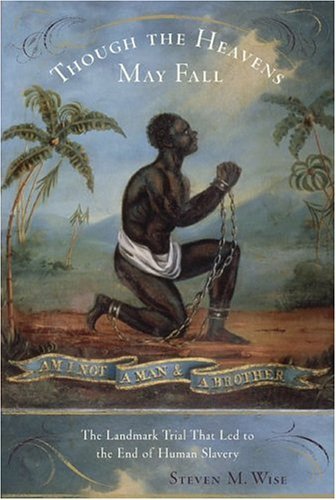
By Steven M. Wise Though the Heavens May Fall: The Landmark Trial That Led to the End of Human Slavery (export ed) [Hardcover]

Rate this book
The case of James Somerset, an escaped slave, in June of 1772 in London's Westminster Hall was a decisive turning point in human history. Steven Wise has uncovered fascinating new revelations in this case, which statesmen of the time threatened would bring the economy of the British Empire to a crashing halt. In a gripping, hour-by-hour narrative of the trial and the inflamed participants, Wise leads the reader to the extraordinary and unexpected decision by the great conservative judge, Lord Mansfield, which led to the United States' own abolition movement. As the case drew to a close, and defenders of slavery pleaded with him to maintain the system, Mansfield's reply has resounded down through more than two "Let Justice be done, though the Heavens may fall."

Unknown Binding

First published January 2, 2005

5 people are currently reading
141 people want to read

About the author

Steven M. Wise

12 books24 followers
Steven M. Wise (born 1952) is an American legal scholar who specializes in animal protection issues, primatology, and animal intelligence. He teaches animal rights law at Harvard Law School, Vermont Law School, John Marshall Law School, Lewis & Clark Law School, and Tufts University School of Veterinary Medicine. He is a former president of the Animal Legal Defense Fund, and founder and president of the Nonhuman Rights Project. The Yale Law Journal has called him "one of the pistons of the animal rights movement."

Wise is the author of An American Trilogy (2009), in which he tells the story of how a piece of land in Tar Heel, North Carolina, was first the home of Native Americans until they were driven into near-extinction, then a slave plantation, and finally the site of factory hog farms and the world's largest slaughterhouse. Though the Heavens May Fall (2005), recounts the 1772 trial in England of James Somersett, a black man rescued from a ship heading for the West Indies slave markets, which gave impetus to the movement to abolish slavery in Britain and the United States (see Somersett's Case). Drawing the Line (2002), which describes the relative intelligence of animals and human beings. And Rattling the Cage (2000), in which he argues that certain basic legal rights should be extended to chimpanzees and bonobos.

Wise received his undergraduate education at the College of William & Mary. While at William & Mary, Wise first became interested in politics through his involvement in the anti-Vietnam War movement. Wise was awarded his J.D from Boston University in 1976, and became a personal injury lawyer. He was inspired to move into the area of animal rights after reading Peter Singer's Animal Liberation (1975), often referred to as the bible of the animal liberation movement. A practicing animal protection attorney, he is president of the nonprofit Nonhuman Rights Project, where he directs its Nonhuman Rights Project, the purpose of which is to obtain basic common law rights for at least some nonhuman animals. He lives in Coral Springs, Florida.

Wise teaches “Animal Rights Jurisprudence” at the Vermont, Lewis and Clark, University of Miami, and St. Thomas Law Schools, and has taught “Animal Rights Law” at the Harvard Law School and John Marshall Law School. He is also working on a fifth book, which will be a memoir about the Nonhuman Rights Project.

He has authored numerous law review, encyclopedia, and popular articles. His work for the legal rights of nonhuman animals was highlighted on Dateline NBC and was the subject of the documentary, A Legal Person.

He regularly travels the world lecturing on animal rights jurisprudence and the Nonhuman Rights Project, and is a frequent guest on television and radio discussing animal rights law and the Nonhuman Rights Project.

Ratings & Reviews

What do you think?
Rate this book

Friends & Following

Create a free account to discover what your friends think of this book!

Community Reviews

5 stars
18 (28%)
4 stars
21 (32%)
3 stars
20 (31%)
2 stars
4 (6%)
1 star
1 (1%)
Displaying 1 - 14 of 14 reviews
Profile Image for Brok3n.
1,448 reviews111 followers
July 25, 2025
Astonishing that this happened at all

To me, the most fascinating thing about the Somerset case is that it happened at all. I knew, of course, that slavery was outlawed in England long before (1772) it was abolished in the USA (1865). If you read much history or even historical fiction, you know that for much of the 19th century the English navy attempted to suppress the slave trade. (It's rather astonishing, when you think about it, that the English felt they had the right to forcibly interrupt the trade of other sovereign nations, although that trade was legal by the laws of those other nations. But Britannia ruled the waves -- the English Navy could say "You are not going to trade slaves". They couldn't quite make it stick, but they could at least make the slavers uncomfortable.)

Before reading Though the Heavens May Fall, I assumed that England abolished slavery in much the same way that the USA eventually did -- through legislative actions of elected government (the 13th amendment to the US Constitution). It didn't happen that way. Slavery was outlawed in England, against vocal opposition by wealthy and powerful people, through a single trial, even though it was customary and there was no law on the books against it. The judge, Lord Mansfield, wrote,
The state of slavery is of such a nature that it is incapable of being introduced on any reasons, moral or political, but only by positive law, which preserves its force long after the reasons, occasions, and time itself from whence it was created, is erased from memory. It is so odious, that nothing can be suffered to support it, but positive law. Whatever inconveniences, therefore, may follow from the decision, I cannot say this case is allowed or approved by the law of England; and therefore the black must be discharged.
In effect, he said, "This is wrong -- we will not allow it any more. I don't care how many of you it bankrupts".

How could this happen? Going back to ancient times England had a tradition of "common law". As Rudyard Kipling describes it in Puck of Pook's Hill
His Saxons would laugh and jest with Hugh, and Hugh with them, and—this was marvellous to me—if even the meanest of them said that such and such a thing was the Custom of the Manor, then straightway would Hugh and such old men of the Manor as might be near forsake everything else to debate the matter—I have seen them stop the Mill with the corn half ground—and if the custom or usage were proven to be as it was said, why, that was the end of it, even though it were flat against Hugh, his wish and command. Wonderful!
That decision written, it set a precedent and was the law. (I'm simplifying, and in any case IANAL, so take my explanation with a whole dump-truck full of salt.)

The account I have given gives far too much credit to Mansfield. He deserves credit, but James Somerset, the slave, deserves more. He fought for his freedom, and for the freedom of other English slaves. He knew exactly what he was doing and was a savvy litigant and propagandist. I say propagandist, because Somerset knew well he needed the public on his side and published broadsides to accomplish that as well. Though the Heavens May Fall tells of that, as well as the trial itself.

Readers less ignorant than me might find this less interesting than I did. But I was fascinated.

Blog review.
Profile Image for Adam S. Rust.
59 reviews7 followers
January 12, 2017
This book is an excellent overview of the famous Somerset case that abolished slavery in Britain. This book provides an excellent overview of the legal background and fall out to the Somerset case, a landmark case in the history of the abolition of slavery. Other reviews have criticized the book for its focus on legal doctrine. However, this seems essential for case that so heavily turned on the interpretation of English common law, rather than the particular facts of the case. If anything, the book would have benefited from more background on the structure of British courts circa 1770. I found myself occasionally lost at sea with the various titles given to particular types of attorneys and the (seemingly) musical chairs fashion in which various attorneys and judges changed their position in the court system.

At the end of the day, here is the question: do you want to know about history of slavery under British common law and how it played out in an iconic case that ended slavery in Britain and impacted how American courts viewed the status of slavery up to the Civil War? If you answered yes, then I heartily recommend this book. If you answered no, I would suggest a more politically slanted history of British abolition such as Adam Hochschild's Bury the Chains.
Profile Image for kingshearte.
409 reviews16 followers
December 11, 2009
"Perhaps no trial changed the course of history as much as one that took place in London in 1772; the case of James Somerset, a black man rescued from a ship bound for the West Indies slave markets. At this landmark trial, two encompassing worldviews clashed in an event of passionate drama and far-reaching significance."

The jacket goes on to say how Wise "recreates each exciting moment," and calls the book a "gripping narrative." Sadly, it didn't *quite* live up to that hype. It was pretty good, and certainly informative, but it was less interesting than I'd hoped. I'm not sure that's entirely the author's fault, though. It's a legal story, and those always involve all kinds of legal precedents and other stuff that I for one didn't always understand fully. It's also hard to tell the story in a "what happened next" kind of linear fashion - again, because of the nature of legal stuff, and that also made it a little harder to follow and really get sucked in.

That said, it wasn't too bad. I think when most of us think of the end of slavery, we probably think mostly of the Civil War, but it's good to be aware that the ball started rolling a long time before that.
Profile Image for Andrew.
87 reviews1 follower
September 30, 2023
I had high hopes for this book. It is well-written and, for the most part, well-researched. At some points, though, it seemed to go off on tangents. The author might be describing what was happening leading up to the trial, but then go on for a few pages about something in British history that was relevant somehow. That’s all well and good, but eventually I found myself having to flip back like “Ok and what was happening now?”

One admittedly nitpicky detail that just stuck in my proverbial craw was when the author said that John Adams, while serving as VP, corresponded with someone regarding slavery and the law and that Adams did so “Looking back from Washington, DC in 1795.” There’s just one problem with this: While Adams was still VP in 1795, Philadelphia was still the capital of the United States at that time. DC was still being built and Adams didn’t move there until 1800. It’s a small detail, but when you find a historically inaccurate statement in a book that’s literally about history, it stands out.
Profile Image for Bill.
72 reviews6 followers
October 24, 2011
This is a good read if you like your history delivered in the narrative style. It is pretty well written considering the tall order of making a ore-OJ court case interesting.

It would be better if the author wasn't trying to convince the reader that modern-day pets and livestock share a similar fate with 18th Century people held in slavery.
108 reviews5 followers
January 21, 2015
In depth review of how slavery ended from a legal perspective. It was the interpretation of the law that changed, not the law itself. The author, who is a Harvard law professor, is currently working on how to use this same principal to outlaw keeping animals in captivity. Truly fascinating.
Profile Image for Dorian Santiago.
40 reviews1 follower
July 22, 2025
I was quite excited to read this book, to really get a captivating narrative on how slavery ended in England through the landmark 1772 Somerset v. Stewart trial. It started off as a promising historical narrative, with legal explanations of personhood characterizations (e.g., villains and slaves), then it turned into a largely legal framework. Admittedly, it took me some research in real time to conceptualize the legal infrastructure of England at the time, and how British common law works in contrast to American law in order to better understand this.

Wise ended up becoming a bit more dry as he continued, which made it a slightly less invigorating read for me. I’m still glad I read it, as it is history that I have not grown up learning.
Profile Image for Eileen.
35 reviews
August 7, 2009
The topic here - the 1772 Somersett judgment that declared that there could be no slavery in England - is an important one. It is also a very interesting and engaging one, involving not only an uncertain (at the time, obviously) outcome but also a series of important historic figures and quirky characters. Unfortunately, as a writer Wise is dry, gets bogged down in unnecessary and apparently random detail (do we really need to know about the draperies in court?), and manages to consistently confuse the reader and complicate the text. The book is not nearly engaging enough for a general audience, and also lacks sufficient analysis for a specialized academic audience. This is regrettable, for if it was better written it would have made a great companion to Adam Hochchild's excellent "Bury the Chains."
Profile Image for Adam.
503 reviews59 followers
December 19, 2012
I greatly respect Steven Wise for taking on this powerful landmark of history - and doing so with scholarly integrity. Unfortunately, it made for very dense reading, not so much because of the legal and philosophical topic plumbed (he did that quite well), but because of the circus of characters involved in the story. I found myself unable to keep track of who was who, and lost in the forest of historical figures. I got nearly halfway through before resigning myself to giving up. A shame, since it's a topic I'm greatly interested in. Perhaps an appendix listing the key figures?
47 reviews
April 12, 2012
This facinating explanation of the English justice system in the 1700 may bore a general reader. Getting a case before the courts trial turned on whether a habeus corpus writ could be obtained for a slave -- because if this concerned property, the writ was not available, and if a person, it was. So in essence, the ultimate question had to be decided for the writ to issue.
Profile Image for Jim.
74 reviews
February 26, 2010
Story of the 1772 trial that ended slavery in England. Read because of another book that argued that this trial convinced the southern states to split from England, concerned that slavery would be outlawed in America. They made deals with Adams, etc. to preserve it. Kind of a dull book, though.
Profile Image for Craig Bolton.
1,195 reviews85 followers
Read
September 23, 2010
Though the Heavens May Fall: The Landmark Trial That Led to the End of Human Slavery by Steven M. Wise (2005)
Profile Image for Hope Ferdowsian.
Author 2 books19 followers
June 9, 2015
Phenomenal historical account, filled with intriguing characters and stories. A story that needed to be told.
Displaying 1 - 14 of 14 reviews

Can't find what you're looking for?

Get help and learn more about the design.