

What do you think?
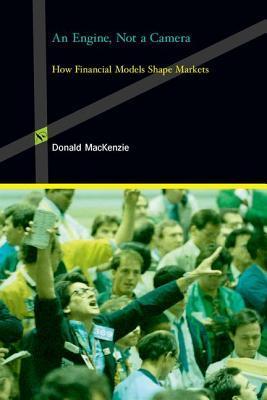
An Engine, Not a Camera: How Financial Models Shape Markets
In An Engine, Not a Camera , Donald MacKenzie argues that the emergence of modern economic theories of finance affected financial markets in fundamental ways. These new, Nobel Prize-winning theories, based on elegant mathematical models of markets, were not simply external analyses but intrinsic parts of economic processes. Paraphrasing Milton Friedman, MacKenzie says that economic models are an engine of inquiry rather than a camera to reproduce empirical facts. More than that, the emergence of an authoritative theory of financial markets altered those markets fundamentally. For example, in 1970, there was almost no trading in financial derivatives such as "futures." By June of 2004, derivatives contracts totaling $273 trillion were outstanding worldwide. MacKenzie suggests that this growth could never have happened without the development of theories that gave derivatives legitimacy and explained their complexities. MacKenzie examines the role played by finance theory in the two most serious crises to hit the world's financial markets in recent the stock market crash of 1987 and the market turmoil that engulfed the hedge fund Long-Term Capital Management in 1998. He also looks at finance theory that is somewhat beyond the mainstream -- chaos theorist Benoit Mandelbrot's model of "wild" randomness. MacKenzie's pioneering work in the social studies of finance will interest anyone who wants to understand how America's financial markets have grown into their current form.
377 pages, Hardcover
First published April 14, 2006
About the author
Donald Angus MacKenzie
7 books21 followersDonald Angus MacKenzie FBA FRSE FAcSS (b.1950) is a Professor of Sociology at the University of Edinburgh, Scotland.
His work constitutes a crucial contribution to the field of science and technology studies. He has also developed research in the field of social studies of finance. He has undertaken widely cited work on the history of statistics, eugenics, nuclear weapons, computing and finance, among other things. Works
His work constitutes a crucial contribution to the field of science and technology studies. He has also developed research in the field of social studies of finance. He has undertaken widely cited work on the history of statistics, eugenics, nuclear weapons, computing and finance, among other things. Works
Ratings & Reviews
Friends & Following
Create a free account to discover what your friends think of this book!
Community Reviews
Displaying 1 - 14 of 14 reviews

July 7, 2007
In many ways I've modeled my dissertation after this book. It's contemporary economic sociology at its best, I think.

March 12, 2013
This is a wonderfully informative book on the history and sociology of financial theory. The author shows a great command of the subject matter, which I found impressive as he is a sociologist by training.
The big idea of this book is that the models that financial theorists introduce to their MBA students (Black-Scholes, CAPM, etc.) end up impacting the prices of the very securities that they are supposed to value. In this way, finance practitioners mistake these models as being a "camera" that is used to mistakenly assess the world than an "engine" used to understand how markets operate. MBAs then use the snapshots from this "camera" in order to force prices of different securities in line with what the models suggest they should be. This can result in systemic mis-pricings and other problems.
MacKenzie does an impressive job of teasing out the implications of this through extensive research and interviews with academics and practitioners. The book reminded me of an updated version of Bernstein's "Capital Ideas," a history of financial theory that came out some time in the 80's. MacKenzie is more academic and draws more heavily on sociological theory, but it makes the text no less readable, in my opinion.
Strongly recommended for anyone interested in finance.
The big idea of this book is that the models that financial theorists introduce to their MBA students (Black-Scholes, CAPM, etc.) end up impacting the prices of the very securities that they are supposed to value. In this way, finance practitioners mistake these models as being a "camera" that is used to mistakenly assess the world than an "engine" used to understand how markets operate. MBAs then use the snapshots from this "camera" in order to force prices of different securities in line with what the models suggest they should be. This can result in systemic mis-pricings and other problems.
MacKenzie does an impressive job of teasing out the implications of this through extensive research and interviews with academics and practitioners. The book reminded me of an updated version of Bernstein's "Capital Ideas," a history of financial theory that came out some time in the 80's. MacKenzie is more academic and draws more heavily on sociological theory, but it makes the text no less readable, in my opinion.
Strongly recommended for anyone interested in finance.

June 15, 2020
i’m still dipping in and out of this book, but i’ve been thinking a lot about the almost cyborg-construction of economic agents IRL and this quote from Glen Weyl’s twitter:
‘I've been going over how strange and fundamentally anti-technological and radically conservative the whole framing of mainstream economics is. After all, economic systems are basically information and communications tech.
Essentially ways of transmitting information about human value and identity over long distances...something widely understood in the field. And yet the whole field is built around the notion that some system roughly approximating those prevalent today is "optimal" and that any deviations from this are weird "market failures". Compare this to any other area of ICT and it just seems totally bizarre. Imagine that in the late 19th century people assumed that the telegraph basically captured all one could hope for from ICT and all that was left were tweaks to get it "just right"...or what would AI be like if we assumed that existing computers basically were the human mind, up to some fine tuning.”
—
I was reading parts of Joel Mokyr’s Lever of Riches this morning and it struck me that this was one of the few case studies where you see the economic impact of technology in day to day action, as agencements/enhancements. Looking forward to continuing to read!
‘I've been going over how strange and fundamentally anti-technological and radically conservative the whole framing of mainstream economics is. After all, economic systems are basically information and communications tech.
Essentially ways of transmitting information about human value and identity over long distances...something widely understood in the field. And yet the whole field is built around the notion that some system roughly approximating those prevalent today is "optimal" and that any deviations from this are weird "market failures". Compare this to any other area of ICT and it just seems totally bizarre. Imagine that in the late 19th century people assumed that the telegraph basically captured all one could hope for from ICT and all that was left were tweaks to get it "just right"...or what would AI be like if we assumed that existing computers basically were the human mind, up to some fine tuning.”
—
I was reading parts of Joel Mokyr’s Lever of Riches this morning and it struck me that this was one of the few case studies where you see the economic impact of technology in day to day action, as agencements/enhancements. Looking forward to continuing to read!
April 16, 2021
Fascinating throughout, and makes subtle but crucial conclusions on how economics and finance develop. Curious whether the author has written any kind of follow up from the GFC given that this book was published only a couple of years before (2006).

February 21, 2024
The history of ideas section on the development of various financial models was a tad dry, although probably provided needed context for the books later ideas which were fascinating.
I was aware Barnesian Performativitg before I knew the word for it, but I hadn’t thought about it’s implications for the importance of studying the development of economic thought. It also made me appreciate the normative ethics involved with the development of financial and economic models due to their potential impact.
The explanation of Long Term Capital Management’s decline was fascinating, as were the discussions on this era of financial history, which I would argue is often overlooked. I also enjoyed the short snippet on the roles of short-selling for market correction, and why the lack of risk-free short selling opportunities helps explain the cyclical nature of business cycles.
Overall very interesting, I would like to read more about economic sociology and anthropology in the future.
I was aware Barnesian Performativitg before I knew the word for it, but I hadn’t thought about it’s implications for the importance of studying the development of economic thought. It also made me appreciate the normative ethics involved with the development of financial and economic models due to their potential impact.
The explanation of Long Term Capital Management’s decline was fascinating, as were the discussions on this era of financial history, which I would argue is often overlooked. I also enjoyed the short snippet on the roles of short-selling for market correction, and why the lack of risk-free short selling opportunities helps explain the cyclical nature of business cycles.
Overall very interesting, I would like to read more about economic sociology and anthropology in the future.

January 2, 2019
A lot of economic sociology tends to lament the mathematization of economics without really assessing the usefulness of math applied and to dismiss its models on the grounds of its unrealistic assumptions, shouting with a revelatory passion that the homo economicus does not really exist (you don't say), juxtaposing the rigid, rational worlds of economics and "irrational" embeddedness of the social.
In contrast, MacKenzie goes to great length to understand the models, which history he's discussing and approaches the field charitably. He also shows that the social and the rational are not two opposable logics, but that the social can often be acomodative and facilitative of the formal models employed by economists.
The book treats the subject matter in a very extensive way which makes it quite long. I suppose that the chapter on Mandelbrot could easily be a footnote.
In contrast, MacKenzie goes to great length to understand the models, which history he's discussing and approaches the field charitably. He also shows that the social and the rational are not two opposable logics, but that the social can often be acomodative and facilitative of the formal models employed by economists.
The book treats the subject matter in a very extensive way which makes it quite long. I suppose that the chapter on Mandelbrot could easily be a footnote.

September 16, 2021
Wonder what MacKenzie would say about modern markets: There's a potential example of Barnesian performativity in the modelling of order flow and dealer gamma arising from the hedging of short-term option demand.

March 28, 2020
Oh my lordy. What a book. Who knew such simple models would have such profound effects. Inspirational.
I'd write a proper review but I'm watching Vertigo and Scottie is under trial.
I'd write a proper review but I'm watching Vertigo and Scottie is under trial.

April 20, 2020
Explains rather well how the Chicago neo-classical models came to dominate finance and how these models became self-fulfilling prophecies.
December 12, 2020
So good

Currently Reading
July 24, 2023Uh oh. Started two books at once

June 25, 2026
After very briefly attempting to earn money as a theoretical physicist, and failing, after a couple of false starts I found myself writing software in a bank to implement some of the mathematical valuation models described in this book. Although I am aware of the theory, I knew very little about the history of how the theory developed. Financial economics is a very new field.
As a history of the subject, this is very good, although it must be very hard going if one is not familiar with the CAPM, mean variance theory, the various strengths of the efficient market hypothesis, and the implications of volatility skews and smiles, which must make the target readership alarmingly small, to the publishers at least.
I haven't finished, so I'll try to update this when I have, but I found it surprising that these theories met such scepticism when they were first proposed, and that Fisher Black never really accepted the Merton risk-neutrality derivation of the Black and Scholes equation, preferring a CAPM-based derivation, that I was not even aware of.
The book is very good on giving credit to the less well-known names. I was surprised at how big a role Paul Samuelson and Edward Thorpe had. Samuelson seems to have been the first to propose a log-normal distribution for stock prices, for example.
The book talks a lot about Barnesian performativity, which is an interesting concept, but does not, in my opinion, play a central role in financial economics, at least I don't think it plays any bigger role than any economic theory, such as Keynesian demand management does. Maybe I missed something.
I keep thinking about the ideas in this book, as they apply to fields outside financial economics. I believe that actually a lot of sociological theories do shape the behaviour of society. A lot of Keynesian theory has shaped political action and policies, and that itself has fed back into the economy behaving more in the way that Keynes predicted than would otherwise have been the case. It's different to physical sciences, as I said earlier, and it's the reason that sociology is so difficult and so elusive.
As a history of the subject, this is very good, although it must be very hard going if one is not familiar with the CAPM, mean variance theory, the various strengths of the efficient market hypothesis, and the implications of volatility skews and smiles, which must make the target readership alarmingly small, to the publishers at least.
I haven't finished, so I'll try to update this when I have, but I found it surprising that these theories met such scepticism when they were first proposed, and that Fisher Black never really accepted the Merton risk-neutrality derivation of the Black and Scholes equation, preferring a CAPM-based derivation, that I was not even aware of.
The book is very good on giving credit to the less well-known names. I was surprised at how big a role Paul Samuelson and Edward Thorpe had. Samuelson seems to have been the first to propose a log-normal distribution for stock prices, for example.
The book talks a lot about Barnesian performativity, which is an interesting concept, but does not, in my opinion, play a central role in financial economics, at least I don't think it plays any bigger role than any economic theory, such as Keynesian demand management does. Maybe I missed something.
I keep thinking about the ideas in this book, as they apply to fields outside financial economics. I believe that actually a lot of sociological theories do shape the behaviour of society. A lot of Keynesian theory has shaped political action and policies, and that itself has fed back into the economy behaving more in the way that Keynes predicted than would otherwise have been the case. It's different to physical sciences, as I said earlier, and it's the reason that sociology is so difficult and so elusive.
May 17, 2024
Thought-provoking. One of the most impactful books (on my worldview) I’ve ever read. It’s niche so it’s unlikely many people will find it, but if you do happen to stumble upon it and be reading this, check it out.
February 13, 2011
a canonical, must-read in the social studies of finance.
Displaying 1 - 14 of 14 reviews