When Henri Deplis becomes the canvas for the final masterpiece of the great tatoo artist Andreas Pincini, he finds that life as a living work of art is far from easy.
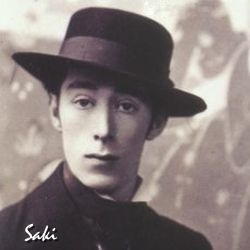
British writer Hector Hugh Munro under pen name Saki published his witty and sometimes bitter short stories in collections, such as The Chronicles of Clovis (1911).
His sometimes macabre satirized Edwardian society and culture. People consider him a master and often compare him to William Sydney Porter and Dorothy Rothschild Parker. His tales feature delicately drawn characters and finely judged narratives. "The Open Window," perhaps his most famous, closes with the line, "Romance at short notice was her specialty," which thus entered the lexicon. Newspapers first and then several volumes published him as the custom of the time.
The Fall of Icarus, Italian Late Mannerist and Early Baroque painter Giovanni Baglione (1566-1643)
French author Maurice Leblanc created dozens of provocative short stories featuring a gentleman thief and master of disguise by the name of Arsène Lupin. In a somewhat similar vein, by my reading, British author Hector Hugh Munro aka Saki (a name taken from the poetry of Omar Khayyam) wrote his short fiction featuring a narrator as refined aesthete, either telling his tale in objective third person or taking on the role of an actual character within the story itself.
As the Leblanc tales revolve around crime, so the Saki tales revolve around an aesthetic moment, usually touching directly or indirectly on art, music or literature or those other cultivated British arts: civilized conversation and social interchange. True, these Saki tales may include elements of satire and biting social commentary but they also contain great humor and wit rendered in highly polished, tasteful, elegant prose.
“That woman’s art-jargon tires me,” said Clovis to his journalist friend. “She’s so fond of talking of certain pictures as ‘growing on one,’ as though they were a sort of fungus.” So begins The Background, from Saki’s book, The Chronicles of Clovis, a stunning three-page tale where, prompted by Clovis’ statement, the journalist relates the story of one Henri Deplis, a native of Luxemburg who inherited a modest sum of money impelling him to a seemingly harmless bit of extravagant behavior when in Italy: he made his way to the tattoo parlor of Signor Andreas Pincini and for six hundred francs had his entire back covered with the artist’s version of The Fall of Icarus.
As the journalist continues, Signor Pincini died shortly thereafter and following some bad blood about monies owed for the tattoo, the artist’s widow donated The Fall of Icarus (considered her husband’s masterwork) to the city of Bergamo.
Events transpire against Henri Deplis: he is forced to leave a public sauna since the proprietor will not allow such a work to be placed on display, the Bergamo authorities prohibit Henri to expose his back in the sun so as to damage their art, he is even prevented from crossing the border since by law Italian works of art must remain in the country. Poor Henri! You will have to read for yourself to find out how the tale takes a few more unexpected, rather brutal twists (link below).
What a story; what a tattoo! I’m left with a question: If I had my own back covered with such a tattoo, what work of art would I choose. Of course this is only a fanciful “what if” since no tattoos for me, thank you. For starters, I am not a big fan of pain. However, if I were to imagine my back covered, what would be the tattoo? Well, as per below, I know three pieces of art I wouldn’t choose:
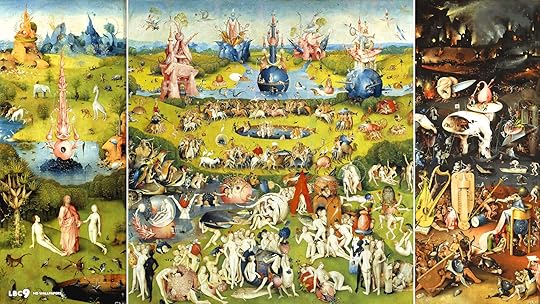
The middle panel of Hieronymus Bosch’s triptych, The Garden of Earthly Delights – If the tattoo artist also needled the left panel and right panel on two other willing subjects, in all likelihood, museum curators would insist all three of us tour together so the entire triptych could be placed on display.
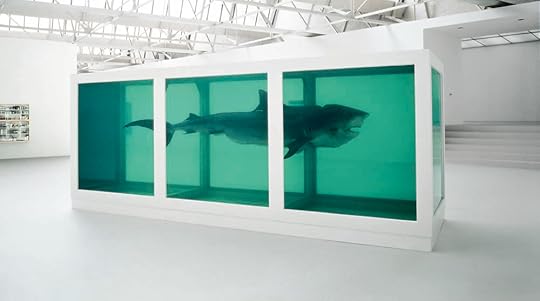
The tiger shark from Damien Hirst’s The Physical Impossibility of Death in the Mind of Someone Living - A really bad choice since I’d have to immerse myself up to the neck in a tank of formaldehyde to replicate the original.
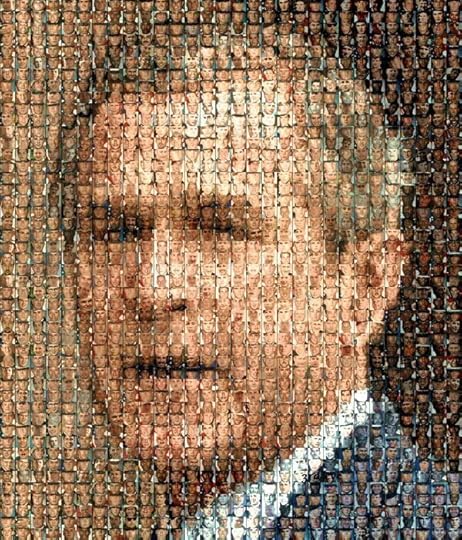
Graphic Designer/Artist Joe Wezorek’s picture of 670 faces of soldiers who lost their lives in Iraq during George W. Bush’s war - I wouldn't want to carry such a powerful political statement around on my back.
That was a… story i guess? It just felt like a really short autobiography that was 4 pages long :D! Some of it was funny, but other than that, i didn’t really understand the point of it being a short story!!
One of my favorite stories from Saki: a tattoo on a man's back becomes traveling artwork owned by government flunkies. This author can amazingly do so much in just a few pages.
A satirical short story about a man and the unpaid-for work of art tattooed on his back by an Italian master tattoo artist and the continent-wide crisis caused by the tattoo.