Mind of the Raven, by Bernd Heinrich
A great scientific study of Ravens. The observations gave me a clear picture of the animal that played a crucial role in human history, inspired trickster myths, and stirred our collective imagination. I read this book along with Lewis Hyde's Trickster Makes this World, and they are excellent companions. Hyde's book is an excellent exploration of trickster mythology, but he does not credit the animals spirits themselves for enough inspiration and interplay that they gave to our ancestors and still give to us. He seems to think that our ancestors imposed allegories of our imagination onto random animal figures, but I disagree, as I discuss later, and Bernd's work supports my ideas.
Among my favorite observations of his are that no two Raven's are alike. They are both a creative species, and creative individuals, who differ from each other as much as they differ from other species. Very little of their learning appears to be pre-programed, they problem solve and imagine solutions for themselves as they grow.
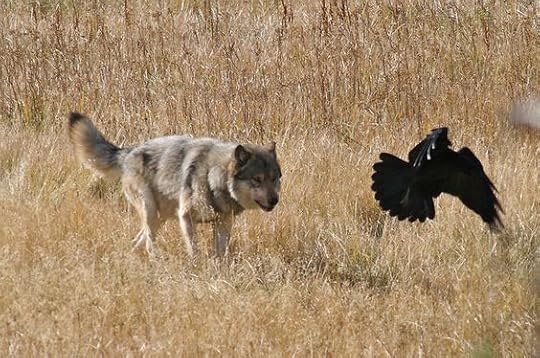
One of their most intelligent adaptations has been to learn to lead carnivores like wolves and men to hunting grounds so that they can scavenge remains, and also to lead these same carnivores, once they trust the birds' signals, into traps so they can eat the carnivore. In this way they escape from the predator-prey dichotomy, are an agent of neither side, but remain in a constant, undefined flux. I believe that our ancestors observed this, which inspired their trickster myths, and those that learned the deepest lessons of these myths, kept their societies in flux, so as not to create any strict laws, for eventually a situation will arise where exceptions need to be made to even the laws that sound most basic, otherwise tragedy will ensue. Think “thou shall not kill” and abortion, the death penalty, doctor assisted suicide. The individual and culture that does not keep a nimble enough mind to deal with all of these situations as they arise will crumble, govern with a cold, iron hand, or worse...
Some thoughts inspired by some of the observations:
132: Sharks are not fast enough to catch dolphins, so they don't try. Dogs are not fast enough to catch squirrels so they try and fail. Raven are not fast enough to catch squirrels, so they change the rules. They anticipate where one will run if chased. One Raven waits there while another gives chase, knowing he cannot catch the squirrel but also knowing that the other Raven will catch it and share it.
Hawks can catch squirrels and Ravens can watch. A Raven cannot kill a hawk, but they can try hard enough to distract the hawk while another Raven, hiding and waiting, steals the squirrel.
145: We respect the Raven spirit when we are Ravenous. He leads us to meat, teaches us the tricks to hunt for ourselves. When we become too settled, we frame him differently, we see his mischievousness as a threat to our order. Our mind-forged manacles make us short-sighted.
While reading this book and Trickster Makes this World, refining my ideas about the trickster spirit, I had a deep personal dilemma as my ideas (or idealizations) conflicted with the concerns of my daily life. My neighbors were burglarized, and this stressed me out far more than it needed to. I was not robbed, but I stayed awake at night, listening for the tiniest noises, and researched tenants' rights during the day. This was largely because our building is not secure (the front door is not self-closing or self-locking) and our super was suspected of committing the burglary. The incident vilified a trait I admire and strive to emulate. Raven would not work hard, stockpiling his goods and believing they could never be taken from him. Beaver would, and Raven would steal from him, proving him wrong. Man thought everything was perfectly arranged, living in a tightly shut clamshell, until Raven smashed that clam, killing those who clung to the shell, but exposing the survivors to the greater world.
Of course, whoever burgled my neighbors' apartment does not live outside the system. By robbing them, the entered the criminal justice system, the policed predator-prey relationship. Thieves are not present day tricksters. They never were, with the possible exception of Robin Hoods. Still, there is something to be learned from this: it is foolish to feel too secure in ones system of order. In our culture of multiculturalism, thousands of them collide at every crossroads (in this case, the domestic (me), the criminal (my super), the capitalist (my landlord), the state (the police), under a huge umbrella of a huge fucked up system that disenfranchised the Puerto Rican that probably robbed my two white neighbors). Raven is the God of the Crossroads. Here, all interesting revelations can emerge. Questions of whose things were stolen – who has rights to a computer while others don't anyway? - arise.
My neighbors can afford new things and if my super stole them, it is because he has HIV, two pregnant teenage daughters, and an addiction. Raven would see there are larger problems to be dealt with than theft. Dealing with them requires much more imagination than buying another lock – but no one will be truly safe until we do.
Bernd's observations in the last few chapters are profound. After painstakingly documenting Raven behavior and intelligence through most of the book (which was nearly as painstaking to read) he pulls his observations together and reflects deeply on evolution, consciousness, and intelligence. His best point about animal intelligence, is that it is silly to assume animals have an entirely other sort of consciousness than ourselves because the vast majority of our intelligence developed along with/through them.
One of his last points is that Raven, dolphin, and ape consciousness is most like our own because of their ability to predict situations – to “create memories,” as he puts it. For some reason, the most obvious, important word to describe their behavior eludes him: imagination.
Ravens can accurately imagine how other animals and objects will react to their actions without pre-programming or trial-and-error. There are obvious reasons that accurate imagination would be beneficial in the evolution of Ravens – for example, they need to be able to feed among carnivors, so they must be able to imagine how certain predators such as wolves and humans will react to their presence, both as a species and individuals.
Play has an obvious role in the development of the imagination. Bernd makes the interesting observation that 'play' is defined as activity that has no material benefits, but upon closer investigation it has vast benefits. Play often develops muscles, reactions, and reasoning that will ultimately benefit species and individuals materially. It makes individuals and species happier and more well-adjusted: 2 crucial elements to future success. And perhaps most importantly, it stimulates and sharpens the imagination.
Both species and individuals that have accurate, active imaginations are more successful and have more to teach us, which ties into Lewis Hyde's discussion of the trickster. Hyde notes the individuals with the trickster spirit who expand our consciousness, but I think he misses the 'species' side of things. He glosses over the animistic trickster and anthropomorphizes them to say they are merely representations of human attributes like Hermes. But they are more. Like all good metaphors, they are first and foremost their physical reality. The cold, we snow that falls all over Dublin at the end of The Dead may represent death or paralysis or whatever, but it is first and foremost cold, wet snow. Joyce's clear image, crafted from his playful penmanship, can mean so much more than its material reality because of Joyce's accurate, active imagination (even if he claimed never to have one).
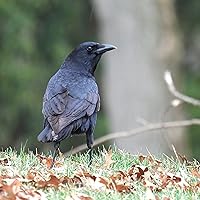
Raven is first and foremost a big black bird with an active, accurate imagination. Our ancestors saw the genius of his imagination. He became the hero of their stories because they saw his wisdom, and by watching him closely they learned much about their own trickster spirits and the world itself. They did not simply impose their trickster imagination on a random animal. I wish Hyde would have made this concession, but if you read Bernd's book along with it, the point will become clear.