Sometimes a planet must die before it is discovered...
This dystopian space adventure is an entertaining, witty, and insightful satire on humanity. It questions, what if we are more alien than we think and what would happen if we encounter a race who are in fact, human?
Earth is dying. A scientific breakthrough allows the harnessing of warp capable space creatures for interstellar voyages. The first flight carries Earth's evacuees to a pristine planet, Ostara. During the voyage, a mass psychosis spreads in which everyone appears more beast than human.
When the ship reaches Ostara, natives already inhabit the planet. Contention is inevitable.
The ship's Commander seeks to avoid the mistakes of colonization, yet, the situation goes awry.
Ostara natives claim that the People of the Canyon will squash the newcomers like vermin. Who are these People of the Canyon, and what do they know about the impending alien invasion on Earth?
Worm-moles, wormholes and first contact - with humanity.
The tiger head, with whiskers, tufted ears, and huge golden eyes was lost in another visual shimmer...
A vessel formed from modular units attached to the back of a living space creature, piloted by middle-aged women, cruelly given the popular label of 'crones', takes the hopes of humanity to a new planet. The worm-mole literally progresses by eating its way through space. There are strange hallucinations being reported by those aboard the colony ship and then one of the crones dies in mysterious circumstances.
The world they are heading for is not an empty utopia, it already has inhabitants who seem maybe even more human than those coming from earth. The meeting of humanity with humanity is unexpected and its consequences change the course of both civilisations forever. This is very good sci-fi, one of those rare books which is something really unique. It is most decidedly a 'first contact' novel but the way it is written leaves one wondering who the aliens in the meeting are and who the humans. It has a tremendous amount to say about the formation of prejudice and how easily we humans will seek those of our own kind and be quick to draw lines of 'us' and 'them' when we come under pressure.
This is the day the surreal has come to look normal.
The book is very well written. The use of language is fluent and effective, drawing a reader in and carrying that reader effortlessly through the pages with no moments of jarring discordance. The characters are mostly all fully fleshed out individuals, their back-stories revealed only in so far as we need to know their motivations as they touch on the development of the plot.The pace is just about perfect. The tension is maintained, the moments of suspense and the unfolding of the deeper intricacies of the plot well timed and believable.
I loved the ending. It was unexpected and I felt it showed up the profound differences between the characters and their respective journeys through the story.
This universe is turning out to be an unfriendly place...
On the negative side there was very little, mostly quibbles with the very notions which underlay the basis of the story that I struggled a bit to buy into and which another reader may find no issue with t all. For example, the whole concept of the worm-mole somehow eating its way through hyperspace and having what one of the characters in the book describes as 'saddlebags' attached to carry people lost me at the start. There were a few other points of personal dissonance, but to go into them would be spoiler territory and, as said, others might well find them positives rather than negatives in the story.
Overall this is a something many readers of science fiction and science fantasy are going to love. Great characters, interesting concepts and excellent writing. I recommend it!
Somewhat to my surprise, I really enjoyed this book. All too often, genre books tend to come across as a bit formulaic (which is not necessarily bad - readers know what to expect). But this book was different - it went off in directions I did not expect and I found it very interesting.
Both the editing and the writing were good - no worries there. My only problem is that it felt a bit unfinished, like it was the first in a series. I never did understand why certain physical changes happened and what initially seemed like a major sub-plot (involving the ship's pilots) was never explained.
You may wonder why I would give four stars to a book that felt 'unfinished'? Very simple - it held my interest (and that's something relatively few books do nowadays). I enjoyed reading it and wish it had been longer. And if there's a continuation, I will buy it. (And that's something I definitely don't say very often.)
If this were the first in a series - and more books were available - I'd rate it five stars.
If I had to write an abbreviated review of this story I could do it in just 3 words: TAS, FAN, and TIC (thought not necessarily in that order). More savvy readers will want an elaborated review consisting of something between 5 and 10 words, but if I'm going to put that much effort into it, why stop there?
I have a very high opinion of this story, despite the fact that author Chance Maree continues a trend of leaving out a critical story element essential to a reading experience through which the reader can guess at the entire arc of a story simply by reading the first paragraph: the electric trombonist. I'll do my best to avoid sounding like I'm pandering, but if I happen to slip into a state of clear adulation, don't blame me, blame the author.
Maree's narrative has achieved that sought-after balance, giving just enough information without giving too much. The dialogue and plotting is crisp and taut as a bowstring. Maree does not overwrite, or show off, though she is clearly capable of the latter if she chooses, and that kind of restraint tends to make the best stories.
If I had to make a comparison, both in tone and sharpness, it would probably be Joe Haldeman's The Forever War. In both, humanity as a collective is an abrasive and destructive species. In Maree's story, people have exhausted their own world and intend to populate others as hurriedly and perhaps recklessly as possible, resulting in conflict between settlers and natives; in Haldeman's they've come across an alien species they naturally deem hostile when they retaliate after being attacked. Some of Maree's characters have a very strong sense of Manifest Destiny, which is all the more enjoyable when things don't go exactly as planned.
Apart from the greased-lightning pace of the work, Maree begins very early on teasing with a few curious mysteries: a murder, a shared hallucination, a worldwide evacuation, a boy with mysterious powers, and . All of which give additional giddyup to the story. To say these are the only mysteries, however, would be a great disservice.
Like all futuristic sci-fi works, a story has to make some bold projections that can be cynical or optimistic, but ultimately realistic if the work is to remain compelling and believable. If it isn't believable, it's no longer science fiction, it's fantasy, and it may as well have elves and magic, and therefore may as well have a THIS SPELL WINS EVERYTHING conclusion because there's really no boundaries to prevent it from happening. Happily, Undazzled manages its cynicism, optimism, and prognostications very well, raising eyebrows but never creating a moment where the reader thinks: "Oh, well that would never happen in the real world."
Considering the sci-fi aspect of this work, it was also pleasant to see the characters behaving sensibly, motivated by genuine human concerns, and a plot structured around these concerns (or vice versa) in convincing fashion. Not all sci-fi tales are fortunate enough to have Maree as their author.
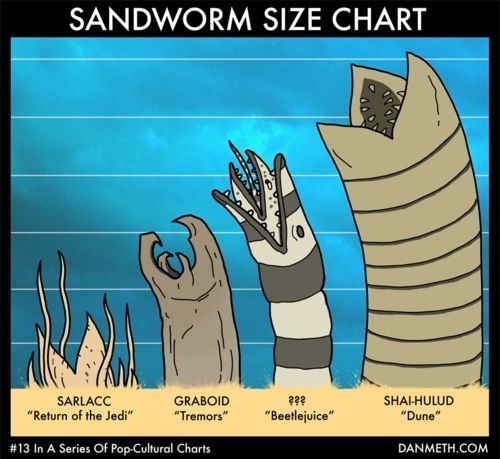
Perhaps the most hard-to-swallow aspect is the idea of a giant worm-like creature that actually eats tunnels in the space-time continuum, creating wormholes--it is essentially a pun come to life. Of course, the Functional Worm is by now a staple in the sci-fi/fantasy canon.
Not shown: Space-time-continuum-eating worms (e.g., Worm Mole)
Stated as such in a vacuum, that probably seems, at the least, improbable. But details are so well-chosen, the description of the process so visceral and tangible, that it seems entirely possible. After all, technology, while becoming more complex, becomes so as a consequence of finding simpler ways to do complicated tasks. Once, computers filled entire rooms because we needed fist-sized transistors to create on-off values (e.g., 0 or 1) to represent "data" or "no data". One transistor amounted to one "bit". When we realized we could make transistors by passing electrons through silicon, we could fit hundreds, thousands, millions of on-off switches on a chip the size of a fingertip. So it may go with space travel. A colossal quantity of energy might be required to pinch two points of space time together in order to shorten the trip, but what if there was a creature that did so naturally?
Perhaps the strongest component of the story is a subtle undercurrent of profundity. There is a wealth of allusion to digest and dissect in an effort to reach the full meaning of the story. Encampments are named after physicists, astronomers, etc.; the hallucinations are very specific and curiously restricted; the parallels to European colonization of the Americas is hard to miss. Just to name a few. It's possible there is no added meaning to these things, but such is the strength of so many other aspects of the story that you just have to wonder whether or not every piece of the tale is not some carefully chosen note, selected for the specific purpose of filling an important slot in the stave of a fascinating and mind-stretching symphony.
Ultimately, in less deft hands, this tale could have been a mess. Instead, it was well balanced, swift, compelling, and made the machinery of my head pump and smoke as it searched for meaning in every allusion. It's a book that I not only enjoyed and recommend, but one I might spend my limited reading lifetime reading again.
So I had a tough time deciding whether or not I should give three or four stars to this book. I wanted to be honest about how I felt but I also wanted to be fair. Because I don't personally like sci-fi but I do think it's possible to write a good review about a book in that genre.
I'll start by stating why I wanted to give this a three star rating. The way it started off was a complete turn-off for me. There was no build up, no introduction, and no explanation. The book opens in the middle of some sort of sciencey fight scene...or something...I've reread the first two chapters three times and I still can't tell you what happened. That's why I didn't like the beginning, I really don't like being thrust into a story like that. It's like...I don't know these characters, so why should I care what they're fighting for or if they win?
And the whole book is pretty much like that.
Lots of things happen but no real explanation or reason as to why. Until the situation or the chapter is over. And then it's like...well it's over now so who cares why this happened? But this whole lack of explanation thing seems to be a trend in sci-fi (which is why I don't read it) and I think I'm the only one who doesn't like it.
Now...after almost two paragraphs of complaints, why did I decide to give this book 4 out of 5 stars? Because it was written well. How could a book with little to no explanation be well written? That's hard to explain but I will try.
What I mean is that it was very crisp in terms of format and grammar. I didn't spot any misplaced or missing words, and the text looked good on my phone. No awkwardly spaced paragraphs or massive indentations. I thought the dialogue was good as well.
The characters were believable and enjoyable as each one had a distinct personality. There were no cliches in this book, it was full of originality and perfectly placed humor that was actually humorous. I was confused for like 80% of the time but I do think the little bits I pieced together made for an interesting story. It was complex and layered and the ending felt kind of open--not cliff hanger but there's definitely room for more. Plus the cover looks great, it's simple but it loudly speaks to readers as it grabbed my attention.
You can tell the author put a lot of planning and a lot of heart into the book, that was evident in the depth of the plot and the characterization. Even though I had a hard time figuring out that plot, I still found myself turning the pages.
What I especially appreciated was the historical blend of the Native Americans. I love diverse books but the inclusion of the Natives could have easily been disastrous. But I think it really turned out well. Being Lakota Sioux myself that was enough for four stars right there.
All in all, this book may not have been my personal cup of tea but I think others will enjoy it--especially those who are big fans of science fiction, space travel, apocalyptic reads and such. There are good things about Undazzled and I think it deserves each of the 4 stars I gave it. I would recommend this to others and I wouldn't be surprised if they enjoyed it.
*I received a free copy of this book in exchange for an honest review*
This was an enjoyable read. I found the characters well imagined and the idea that an alien creature, a space-mole, could bore its way from the solar system to Tau Ceti, from earth to Ostara, most intriguing. Alpha Horizon munches and crunches her way through a worm-hole [?] of her own making. (Another space-mole, Beta-2-Nun, with its load of refugees from a dying Earth is launched ahead of schedule with a hundred thousand passengers, ten times the load on Alpha Horizon.) The space moles are piloted by crones--women over forty and childless. They have an elite job requiring rapport with the bizarre creatures from space--that they "physically meld with the creature's sensory input and corporal impulses."
Then one of the pilots/crones dies; it was Maggie, a "52-year-old earth mother with flaming red hair," who suffered internal injuries caused by "blunt force trauma." Everyone is stunned, especially the other crones. Counselling is prescribed though Pots, a crone and major character, is observed to have "a deep fear mastered. Discovering one's own courage in the face of mortality was life changing."
The hallucinations begin and different characters increasingly assume features of five animal groups--reptiles, ruminants, birds, cats and dogs. Celine for instance, the mysterious "entertainer" who had achieved her objectives with "little effort and much cleavage," was revealed to have feline/tiger features. The purpose of these hallucinations escapes me as it seems to nullify the efforts of the author's descriptions of, say, Barbara the corporate agent with her "glaringly blue eyes and broad smile" or of Josh, "a man in his twenties with espresso black hair, hard-to-miss biceps, and classic tube baby-perfect profile." Perhaps the hallucinations are supposed to prefigure the transformation of the humans like Odysseus' men bewitched by Circe.
The author's writing is commendable. Laughter is qualified as "a sound from that slim space between humor and pain." The Commander's frustrations are graphically represented by his stomach hurling "hot coals into his throat." Of all the things the new planet had to offer, one character remarked, perhaps the best was that there were no commercials--billboards, corporate logos, etc. Unfortunately, there are also nits; past tense mixed with participles, three characters walk in and the discussion involves four names, someone's "lab lie [lay] in the pathway of possible destruction." Simply mysterious is the frequent mention of foil wrapped rations and the occurrence of "poker games with whiskey and cigars."
But the story, with its overtones of the mess that was the opening of the Wild West in America--the reference to Wounded Knee and the trail of tears, hangs together.
I was given a free copy of this book in exchange for an honest review.
Undazzled, is an exciting, fully modern. science fiction/fantasy (SFF) novel written in a style I would call 'classic sff'. The story has more of Ray Bradbury and the Martian Chronicles than it does of any shiny future-tech tales by Arthur C. Clarke. In classic SFF of the Bradbury variety, the science is just enough to take us to a new place that provides a stage for a new perspective on the human condition and, when required, provides a possible deus ex machina to confront any plot problems with an appropriate SFF 'scientific' solution.
Of course, in keeping with 21st century SFF values, author Maree leaves out any stated moral conclusion. Instead, she provides the reader with moral dilemmas, based upon the differing perspectives of various characters. Maree uses 5 or 6 major characters to react to the actions of plot. Basically, an action occurs that advances the plot, several characters respond differently to that action, which advances the plot, a new circumstance occurs, multiple characters react to it, and so on. This use of multiple points-of-view, in front of a solid 3rd-person (omniscient) narrative, keeps the story moving--even though, as the story advances, the reader needs to work a bit to keep track the various character opinions and relationships, but it is worth it.
Without giving away too much, the exodus from a dystopian Earth takes colonists to Ostara, an earth-like, pristine world that is empty of other humanoid inhabitants. Of course, it isn't empty. Once the humans begin to colonize Ostara, the first moral dilemma they face is what to do about the native inhabitants who suddenly appear. The conflicts earthlings experience provide the story with a second dystopian-within-dystopian plot circle. Plot reversals ensue and what you expect doesn't happen--instead, the opposite happens. The unanswered moral question the author leaves hanging is, was the defeat/victory justified or not and from who's perspective? Very modern.
The author keeps you guessing, as she plys her trade, bouncing between illusion and reality in the thoughts of the characters. In keeping with this theme, story imagery often reads like a trippy hallucination, which reminds you that rabbit holes and worm holes are not really very different.
If you are a reader looking for a new story with more to offer than a simple pulp fiction read, like good-being-chased-by-evil across 300 pages, this story is for you.
I have a confession. I have not read sci-fi in any form since 19mumble mumble, when I ran thru Isaac Asimov, Frank Herbert, Arthur C. Clarke and any number of other classic sci-fi authors to keep up with my brother. It was a short-lived passion, and one that I left long ago in deep space. Until now. Chance Maree’s Undazzled has reawakened my appreciation for the scope that sci-fi can bring to literature, the opportunities to build worlds parallel to Middle Earth, and the ability to present satirical commentary on a par with Phillip Pullman. And, best of all in my opinion, in Undazzled she has evolved the genre to appeal to women with her masterful plot line and charismatic heroine.
From the moment she introduced us to the “crones”, peri-menopausal women riding their huge pink worms fully naked through space, I thought, aha. We have something here. And she didn’t disappoint. Ms Maree has created a plot where females control the destiny of their race (although it took a little self-realization for them to get there) and in doing so, we experience through their eyes the horrific perspective of colonialism at its worst.
Ms Maree then treats us to another layer of complexity where the “human” race assumes animal identities – the parallel to Native American totems is not lost – and we begin to question every assumption we made from the beginning of the novel. There’s plenty of action, some clever dialogue, and the world building is very clearly thought through. I thoroughly enjoyed this book on so many different levels, and found it a well-written and entertaining read. And, when I wasn’t reading it, I was thinking about it. That’s a really good sign.
Most of all, I’d like to thank Ms Maree for reintroducing me to the pleasures of sci-bio-fantasy-dystopic fiction. It doesn’t need any more of a label than “a really enjoyable book.” And I hope she writes a sequel.
I received a free copy of this book in exchange for a fair review.
This is the second book from the quill of Chance Maree, following the innovative metaphysical delight that is "Alexios, Before Dying". I criticised that wonderful book for a lack of plot and an over-brevity of description, whilst praising it as a truly creative and original work. This book has gone a step further. The plot is detailed, unpredictable, and exquisitely constructed. The reader has to keep the elements together, but the effort of memory is truly worth it. There is still a fashionable under playing of description, which so plagues modern writing; but there is enough structure to free our imaginations without allowing the reader to run away form the author's control. I can never see the point of using such brevity that we can all mould vital scenes as we want, rather than accurately read the mind of the writer. Chance at least gives us most of the colours to fill in the drawing, though she still leaves a little danger of some of her bright contrasts being smudged. The accuracy of the writing is very good, except in a very few places that I interpreted as confusion caused by savage editing rather than faulty original script. The few confused sentences were just too uncharacteristic, too out of style, to have been those of the author. Perhaps another beta reader was needed before publication, or were there actually too many kitchen assistants? I am so looking forward to Maree's next book, which I'm sure to like even if it is half as good.
I thoroughly enjoyed this book. Undazzled offers an interesting and unique take on dystopian sci-fi and the writer delivers the story in trim, no-nonsense style that is so easy to read, you hardly notice you have a book in your hands. She also shares the point of view limelight between multiple characters, each one well thought-out and intriguing in their own way. You can see which character the book is following before the chapter starts, because the writer has used a simple system of titling each chapter with their name. So I found myself happy to see my favorite characters pop up at the start of a chapter, and secretly hoping my least favorites would finally meet their demise when their names came up.
The story tells the tale of an Earth ravaged by the human race, and the survivors setting off for the stars. They travel through wormholes in space, that have been created by giant space worms of course, and arrive on their new home planets to begin colonization. Although things start to go south very fast, even before they set foot on the ground. Not everything is as we thought it was in the beginning, and by the end of the book there have been many twists before the truth of our hero's predicament becomes known.
I give this book 5 stars because I enjoyed it cover to cover, and cannot recall a single page where I glazed over or skipped ahead. This is definitely an author to watch.
One of the downfalls in Science Fiction for me is when the author introduces so much futuristic and imaginative technology that I become numb to it. Of course, the story ends as it does, because there is one more, technological rabbit-in-the-hat that is revealed in the final chapter that makes it so.
And I admit, at one point, I thought Undazzled might be headed down that path, with the revelation of the nature of the Commander’s son. I am not totally sure why the author included this technology, unless it was to cement our views of the commander and the society from which he came. But still, it seemed more gee-whiz than necessary to the storyline.
But I also admit that this issue is slight, even in my view. And overall, the story is entertaining, inventive, and tightly woven. It draws creatively from physics, philosophy, psychology, and medicine. I particularly liked the way all these elements were drawn together in the end. Hopefully, humankind is more than what Undazzled suggests it might be, but in any case, it may give you pause to consider our true place in the natural order that is our universe.
For a fun, creative science fiction read, with more food for thought than many in this genre, I recommend Undazzled.
I was given a copy of this book in exchange for an honest review.
Fleeing from a dying Earth, the protagonists in Chance Maree's Undazzled settle on a supposedly-uninhabited planet named Ostra. The story follows Pots Kahn-Anderson, one of the pilots, as she struggles to fit into this new society that she helped her people to find. As you might already have guessed, the planet isn't really uninhabited, and the race of sentient beings they find there leads to a morality play as Khan-Anderson and her people try to decide how to deal with the natives. Of course, not all of the humans are as eager to "play fair" as is Kahn-Anderson. To say more would be to spoil the plot.
Maree's writing is tight and fun, and she definitely does the plot justice. There are a few sub-plots that feel rushed or never resolved, but overall this is a really good read. If you enjoy Dystopian science fiction, definitely give Undazzled a read.
I really enjoyed Undazzled and will definitely check out Maree's future work. Please note that I received this book in exchange for a fair, unbiased review.
As the planet Earth is dying, it appears that we've come full circle. We're again using beasts of burden for transport. However, these aren't earth hugging camels and mules, but space travelling “worm-moles” – so named because they bore worm holes to distant parts of the gallaxy. They're gigantic creatures, and they wear what would make up the rest of the space ship, like a collar. How were they discovered? Hold that question for the last and climactic chapter of the book.
The people best equipped to pilot a worm-mole are upper middle-aged women, dubbed “crones”. A part of the worm-mole's brain extends into the bridge deck like an easy-chair, and the “crone” sits naked in it as it engulfs her body, except for her face, so she can communicate with the creature through her skin.
Pots Khan-Anderson is a crone, who pilots Alpha Horizon – “Alphie” for short. Earth is dying, and the race is on to relocate as much of humanity as possible (or a chosen representation thereof) to three habitable planets in a different part of the galaxy. These planets are thought not to be already inhabited by intelligent life. The Alpha Horizon is taking the first load.
Something very surreal begins to happen along the way – in fact, very weird – which almost gives the story a fantasy edge. Then, when they arrive, they discover, they aren't alone. Another race, closely approximating humans, inhabits the planet – a primative tribe not much different from Native Americans (at least that's how they struck me as I read it). In fact, because of the surreal thing that happened along the way, they look more human than the newcomers.
There are a number of narrative points of view, each told in the third person. Each chapter is named for the POV. The first is Pots, followed by the commander, Gunner Dovmont, and then the teenager who is thought to be his son, Tyr Dovmont. Among later chapters are Ata, a pre-teen girl, a native of the planet.
Commander Gunner meditates on Taoist proverbs. Each chapter contains at least one quotation. Despite that, he's the villain. We find out early in the narrative what he intends to do about the native population – but not so early that telling you wouldn't be a spoiler. But from the first, we see that he and Pots definately don't get along. Since Pots isn't military personel – rather works directly for NASA, which has become privatised – that's okay. Montalbam, the captain of the Alpha Horizon is her boss. Commander Gunner's command is over the actual settlement on the new planet.
Tyre is a hybrid human, the product of an experiment that had to be aborted when the public found out about it. The other young subjects, believed not to be human, had to be put down. Gunner knew the doctor in charge of the project, and managed to keep Tyre for his own purposes. However, we soon find that Tyre, though a deadly weapon in the wrong hands (namely Gunner's), does have feelings and a mind of his own whenever he has control over his own actions.
Those who understand the history of Native Americans and the rise of the U.S., will get a lot out of this. While Gunner and his colleagues seek to avoid some of the same mistakes, things still go awry – human nature hasn't changed. There are the same questions: Whose land is it? How can we co-exist when earth-human survival is the priority? Plus a few more: Who are the fabled “people in the canyon”, whom the local tribesmen threaten will squash the newcomers like vermin if they infest the land? Are they no more than a local legend, or is there something more...? And that surreal effect I mentioned earlier...
Chance Maree handles her characters very well. One of my favourite scenes is the screening of The Planet of the Apes on the new colony. Things have happened, people are upset with each other for various reasons, and Chance masterfully plays two or three conversations at once while keeping us aware of what Charlton Heston is doing during the opening scenes of the film.
Earth has become uninhabitable, polluted, diseased, festering, beyond overcrowded, all resources pillaged by Mankind, now in full flight from the planet through wormholes (short cuts through space/time) conveyed by worm-moles, domesticated space creatures of vast dimensions piloted by women colloquially known as Crones nestled in the mole’s brain. Pilot Pots Kahn-Anderson guides Alpha Horizon, cargoed with a chosen cross-section of humanity, headed for planet Ostara, there to embark on that most seductive of all human enterprises, the Fresh Start.
This naming of the planet, along with the author’s clue, ‘Sometimes a planet must die before it is discovered’, seems to indicate that, when landed, they have in fact returned to Earth. Of the three planets designated as marked for colonisation, Pilot Pots and company return to the possibility implicit in the name, Ostara - Easter, resurrection. The others also return to the positive potentials implied by the names Gaia, both primal mother, and recognition of Earth as living organism requiring cherishing. And Atlas, the masculine element, symbolic of maintaining order through his role in supporting the firmament lest it crash to earth. The three planets comprise a family unit, mother, father, child, potential for new beginnings.
This bio-scifi recounts the immigrants adventures as, traumatised by collective guilt, wondering if in fact they have brought Hell with them, due punishment for their crimes on Earth, (unaware they have returned there) confronted with the subtle threat of pristine innocence, they struggle to establish new colonies. Doomed, it seems, to repeat their abominations and in consequence invoking the wrath of innocence’s lethal guardian, will some survive and in due course establish the matrix for a viable New Eden, this time sans Serpent?
The mission is under the overall command of the fascinatingly complex Commander Gunner Dovmont who, intriguingly, is a disciple of Lao-Tzu, founder of Taoism. Which, courtesy of Professor Google, I discover to be a philosophy claiming (Earthcare: An Anthology in Environmental Ethics, by David Clowney) that ‘there is no unbridgeable chasm between man and nature’ and that ‘beings are ontologically equal because they are formed through a process of self and mutual transformations’.
I must say, had I realised the significance of Gunner’s Lao-Tzu enthusiasm, my enjoyment of Undazzled would have been even greater; as it is, appreciation of this element casts an illuminating afterglow on various happenings alluded to by other reviewers and makes the work an even more impressive achievement.
In her Acknowledgements, the author thanks ‘those who have assisted her in developing a plot with characters that will resonate with a diversity of readers’ and she has succeeded remarkably in this. Chance has created a beautifully written, hugely entertaining, witty and insightful satirical novel. One which never preaches but coolly allows various parallels to emerge for the reader's enjoyment, while providing thought provoking comment on the underlying nature of the sentient entity - human or animal simply being alternating labels derived from conditioning, habit and false perspective.
I received a copy of this book in exchange for a fair review.
Get Ready For Absorbing Spells By Your Winter Fire Undazzled by Chance Maree revels in sophisticated satire on human nature expressed in world building on a scale not seen by this reader since appraising Gulliver's Travels by the deft pen of Jonathan Swift. A slow burn that builds in complexity and depth as it develops best describes Undazzled. How? On one level, an important player, the commander, sneaks up on the reader at first as a cardboard military person that gradually arcs into a multi-faceted, Taoist monk seeking a peaceful, centered environment. What's more he has the power to accomplish his desires. Ooops! No more spoilers. You have to pick this one up to see for yourself. On another level, like Gulliver on his travels, we visit a world full of microcosms, each containing its own contradictions and surprises. At first flush, these self-contained and self-regulating spaces appear simple. They are anything but as readers witness the author unfolding them in all their hidden complexity. On the journey from a deathtrap earth readers see a mass migration where worms, reminiscent of Frank Hebert's, Dune Series, burrow into space instead of sand, ridden by specially-trained pilots-all woman. Then, after viewing a unique new form of space travel made commonplace by Chance Maree's grasp of her world, the reader traipses unawares into the amorous intensity of space flight. What next? Think of Swift and of coping with mass psychosis in an animal kingdom! I'll leave it to you readers to figure that one out. For a modern metaphor, look no further than the recent Sci-Fi wonder, Avatar, for comparative world building. What more could happen? Try a mirror image of human nature in the form of a village full of peace-loving, four-fingered natives protected by the Canyon People. The real beauty of this story lies in its unexpected, sometimes startling revelations on both the societal and human stage, for that matter, at every altitude imaginable. I am looking forward to reading more from this rising star. Watch for a Hugo from Chance Maree.
I found this read to be very intriguing. The storyline was gripping and gritty. I loved the female lead, Pilot Pots. I always like a story with a strong female character. She was sassy and fun.
The story tells of a group of survivors, lead by Commander Gunner Dovmont, who have evacuated a desolate and dying Earth to find another sustainable planet in which to live. I’m not sure if I would class him as a saviour or criminal. He comes across as being a bit of both, but I’m not sure which way I would have gone. Tyr, his genetically engineered son was a victim of his machinations, and all he wanted to do was live his life in piece without being forced into doing things that he didn’t want to do.
The survivors are transported, in what appear to be organic, living beings called worm-moles. Alpha Horizon is one such creature, piloted by crones…female pilots, in other words, which includes Pilot Pots Kahn-Anderson.
The closer the survivors get to their destination, the more their physical appearance changes…from human to animal. But as the book went on, I was wondering whether or not the survivors were actually human at all.
On landing on the planet of Ostara, they encounter the inhabitants of the planet, who appear more human than the survivors. They try to coexist, but Gunner Dovmont makes it very difficult, bringing about a turn of devastating events.
In some areas, I was a little confused with where the story was going, and certain aspects just crept up on you from out of nowhere.
Overall, I thought the story was well written and really enjoyable to read. It certainly kept my interest.
It also looks like the author has left it wide open for a follow-up. That would be quite interesting to see.
Undazzled was great fun. It went in a totally different direction than I was expecting and had strange but cool concepts.
The "hallucinations" that they all experienced was original and compelling. The fact that everyone morphed into specific creatures was odd to say the least, especially since they didn't physically feel the changes on themselves. It did seen a bit odd at times, particularly when there were sexual relations between them while these hallucinations were occurring.
Tyr was incredibly interesting. We only got a small taste of what he could actually do, and I wish we had gotten to see more of his abilities. I also would have enjoyed another description of him after the hallucination. It was only described once but it was so unusual I had trouble remembering it as I continued reading and had to back track. His friendship with Ata was cute and I was happy to see that at least someone accepted him as a friend.
Gunner was fantastic. His plan was evil and pretty darn ingenious. I mean it was going to be found out at some point but it was still pretty smart. He was never impulsive and I think this quality is what made him such a great villain.
I only wish that a little more description had been present in the end. The interview shown explained quite a bit, but I don't know for sure what happened with the natives, with Ata and Tyr, as well as the "hallucinations". Other than that though I enjoyed Undazzled quite a bit. It was original and an interesting sci fi to say the least.
This novel immediately takes hold and refuses to allow you to put it down outside of a heroic force of will. The plot moves along at a swift pace, the author skillfully interweaving back story and world building. That I felt so compelled to read it in a few days argued for giving this book fives stars in spite of a few minor flaws.
Character building was handled well. Characters each exhibited enough flaws to be realistic, and caricatures were avoided.
Dialogue was also handled well though I felt that some of it was vaguely "off." Perhaps it was me or perhaps the author meant to have them speak in some kind of futuristic dialect.
The author shows a highly creative mind as she introduces a problem early in the novel that I don't recall seeing in fiction previously. I at first thought it odd that the characters seemed a bit too accepting of their affliction. There were hints that they were nonplussed and that some had to be incarcerated in some way, but otherwise they seemed to be cool with it. The author also seemed to use the affliction as a commentary on the formation of cliques, though does not really take it very far.
Unless I missed something there was a subplot introduced in the beginning that did not get resolved. Other than that the only other flaws I found were editorial in nature, I just chalked those up to being one of the drawbacks of self publishing.
In Undazzled the planet Earth is dying and the only hope for the survival of the human race is the mass emigration of its population to new worlds. Interstellar travel is made possible by wormholes, but unlike other SF stories these worm holes are not created by technology but by giant space-faring beasts known as worm-moles that eat their way through space and time from star system to star system.
Piloting one of these worm-moles and helping in the evacuation of Earth is Pots Kahn-Anderson. The journey and settlement of the new planet Ostara is not without problems. First the strange hallucinations that afflict the crew and passengers and then the discovery that Ostara is already inhabited by a race of sentient life.
It is around the clash of cultures and civilizations that Undazzled tells its story. Chapters switch viewpoint, with each of the leading characters well defined and enabling the reader to understand what drives decisions that force a growing divide between the people of different races. Although I did feel that when the secret of the People in the Canyon was revealed it felt a little rushed.
The novel shouldn't be seen as Science Fiction as it will easily appeal to readers who want something more than a straightforward story.
I was given a free copy for an honest, non-reciprocal review.
This is a novel about a mission from a dying Earth to colonise a new planet. I began reading an indie book, in which I initially noticed a few stereotypical descriptions, such as men with rippling muscles and a commander who stands with his hands clasped behind his back. However, by the end, this book seemed to have morphed into a sci-fi adventure that could have been from one of the traditional publishing houses. Initial tensions between the crew give way to tension between the colonists and native inhabitants of the planet, but the plot focus remains on how the crew cope with their changing situation. The book engages with a series of mysteries - why are the crew transforming into animals? What is causing the deaths of pilots? Who are the people of the canyon? (Although most of these mysteries remain left to your imagination by the end of it.) The concept of the crew changing into animals fitting their personality types is a memorable one which strengthens the sense of unique identities that the author evokes in her characters. I certainly found it a page-turning read. (I received a free copy in exchange for a honest review)
Undazzled is a very interesting dystopian science fiction novel, with a very original plot. Earth is dying, and citizens are evacuated on large, living space worms, to pristine planets far away. As the evacuees are travelling toward their new home, a mass hallucinations make everyone appear with animal heads. Or is something else going on?
I'm a big fan of science fiction, and I always like to explore new novels within the genre. This one is very special, the plot unlike anything else I've read. That also makes it (for me) a bit difficult to follow, from time to time. I think that's partially the intent of the author - to blur those lines between reality and fantasy. The book also reads as a parallel to the colonization and exploitation of the Americas by European settlers.
This was an enjoyable read, and I recommend it to fans of science fiction, and to those that simply wants to read something fresh and new.
I received a free copy in exchange for an honest review.
I found this book challenging to engage with. The writing is mechanically fine, though the second half needed editing enough for me to notice. However, there's something lacking in its emotional content that left me unable to engage with the characters or care about what happened to them. The plot moves along at a fast clip, and the action is well done. The scenes between, where characters should be exposing themselves and their relationships with each other, are dry and stilted.
This isn't a bad story, it's just one that feels like a first draft. It has interesting ideas and a good, solid framework, but the foreshadowing is lacking, the plot is somewhat confusing, the timeline is odd, the pacing is off, the characters aren't fleshed out, and the end is abrupt.
Even with all that, I read the whole book. It held my attention and gave me some things to think about. This writer is someone to watch, because I think we can expect interesting sci-fi from them in the future.
I received a copy of this story in exchange for an honest review. Undazzled was a well-written science fiction story that called to mind something like the European settlement of the Americas, where a new group comes in with their own agenda, and their own reasons for being there, and the natives end up suffering for it. Only this time, instead of coming on boats, they came in space-ships. Pots was a well written character, and there was a lot about her that I admired. I felt a lot of pity for Tyr, and I absolutely despised Gunner. The ending gave me chills, and I wonder what he has planned next. There was a lot about the story that surprised me, in particular the way that some people were changed into… Well, I’m not giving that away. There were sexual situations in this story and a few spots where they was some swearing, of which readers may want to be aware.
Well written book with interesting characters and an original plot. The beginning of the book was hard to get into, but I pushed through and was glad that I did.
The earth is dying and people must evacuate. We colonize, but as humans often do when they colonize, we negatively impact the native inhabitants.
The earthlings undergo mass hysteria/hallucinations that start during space travel. Or maybe they are really being transformed into animals? This was both interesting and strange.
The most intriguing characters were Pilot Pots, a strong female character and Tyr, a boy with genetic alterations that result in rapid maturation (and other effects, but no spoilers here). Their personal transformations and allegiances were interesting to follow.
I don't know if a sequel is planned, but Undazzled seems like it needs one!
Undazzled was well paced, and the concepts were interesting - what if we were more alien than we thought, and encountered a race that was as human as we thought we were. There were a couple of areas where I would have liked to see a bit more in depth - I felt the end could have been more engaging and dramatic with a bit more time spend in describing the events that unfolded. Overall, it was a fun read with a touch of food for thought - a good book to read on a relaxing vacation
This was a free giveaway book. Thanks for the opportunity to read this.
I liked the blending of the historical meeting of the Native Americans and the colonists in the 1600-1800s into a science fiction story. For anybody who is into SyFy and history blends, this book would be a good choice.
Eerie and at times gripping, Undazzled is in many ways a good book—but there are flaws that left me somewhat disappointed.
Chance Maree’s Undazzled begins somewhat confusingly. For one, the narration is third-person limited and follows four characters: Pilot Pots, a woman in her mid-forties, who is responsible for flying the ‘spaceship’; commander Gunner Dovmont, a reptilian military figure; Tyr, a teenager and biological weapon; and finally Ata, an Ostarian native girl.
Due to the lack of context, I initially struggled to piece the different narratives together. I was frequently left scratching my head, asking questions such as Who is this person? Why are we seeing the story through their perspective? And what’s their deal?
Further confusion was brought about by the means of transport—our intrepid space tourists are not travelling the stars through anything as banal as a spaceship. Instead, the preferred means of transport appears to be a very large worm-like creature; it is somehow capable of both surviving the vacuum of space (with its absolute zero temperatures, radiation, and lack of any obvious food source) as well as travelling at approximately 24 times the speed of light.
Suffice to say, I would have appreciated some explanation. What kind of being was the space worm? How did it achieve such extraordinary speeds? How did it survive in space? The explanation that was provided—where there was any—was vague to say the least.
Anyway, back to the characters, and to the progression of the plot. Several intriguing events occur soon within the book. To begin with, a pilot dies under mysterious circumstances; it is not known how and why she died, but it is implied that the space worm has some degree of culpability.
This serves to highlight the difficult relationship between pilot Pots (the only woman brave enough to continue piloting the ship) and commander Gunner. The two have a significant emnity—the commander is controlling and demands respect; the pilot doesn’t give a shit.
I have to admit, I did find Pots likable in some ways. She was stubborn, determined, and had an irreverance for authority that proved both admirable and useful in the circumstances she found herself.
Nonetheless, I disliked her in many ways as well. She was, to put it bluntly, not that bright. For one: she was unable to fully grasp the true nature of the commander until late in the book. For two, she lacked something in personality: leadership quality, let’s say.
As for the commander, well, his was perhaps the most complex character in the book. On one level, he’s an evil bastard: he engages in an act that could at least be called unpleasant and antagonistic, or even genocidal. And yet on another level... I found myself putting myself in his shoes and understanding him. His was a difficult job; he acted in the best interests of the human race.
There was also something about him—not only his ruthlessness, but also his bravery and sheer determination to not give up. Excluding Tyr, he was the bravest character in the book, and I’d say the second most interesting.
But yes: Tyr. Although possibly Dovmont’s biological son (the commander has such a relationship with him, and yet it was never made clear if there was any biological link between the two men) he is altogether different. He is kind where his father is ruthless; and grief-stricken where his father is unconscionable.
What makes Tyr interesting is that he is designed to be a biological weapon. I won’t go into all the details (that would be spoiling things) but suffice to say that they are impressive. When you combine them with Tyr’s personality—well, let’s just say that the combination is poignant.
Lastly, some introduction to Ata’s character. She’s... well, she’s not much. I’m sorry to say this, but I found her character by far the most disappointing of what was an otherwise intriguing cast. Perhaps it’s due to her age—she appears to be quite a young child—or perhaps the author did not really think that much about her, but there’s little I can say about her.
She plays little part in the plot, and has no strong personality that comes across the page. I would classify her as an afterthought.
Anyway... this is proving a lengthy review, so let me get down to the meat of things.
The plot I found enjoyable. There was always something going on—a nefarious scheme, an unexpected disaster, or a grisly end to a character. There were some pacing issues, however. One such was the passage of time: in the space of a few pages, a baby was conceived and then born. Tyr aged several years in normal human development.
This was, once again, confusing for me as the reader; there was hardly anything to explain the passing of time. Even a reference to the changing seasons, or a glimpse into the building of the cities, would have sufficed to add some clarity.
Another issue was the lack of a proper finale. Oh, don’t get me wrong: there was plenty of action, but it had a tendency to occur at (irregular) intervals. The final events certainly grabbed my attention, but they could have been even better foreshadowed and built up to.
On the whole, though, I found the plot to be exciting and compelling.
The characters, as I have already explained, fascinated me to various degrees. Tyr was the most compelling character; Ata comparatively failed to impress. There was one another character I have not mentioned: a psychologist by the name of Byrd, who was aptly named. Though minor, I did enjoy reading his parts, and found him well-written and intelligently portrayed.
I will also address a spoiler, which requires some mention.
The writing I have hitherto not addressed. It was, for the most part, highly competent—at times quite good. The language of the characters, and the way they were written, served to clearly delineate their personalities. There was no ‘purple prose,’ although the author did throw in some humorous Shakespearean references.
If there is any criticism I would make, it’s that the imagery did not always live up to the events unfolding. I did not really know what the space worms looked like; the world of Ostara was described in detail, but the detail did not have that phantasmagoric quality we expect from the masters in the genre.
As for the world building, I found it extraordinarily interesting—but as I have repeated often enough in this review, the reader simply lacked the full context to appreciate it.
Let me now, at long last, come to the conclusion. Undazzled is best described as a work of speculative fiction. The concepts, ideas and characters are compelling, and at times vivid and complex. But it’s let down by a few things.
Firstly, the lack of context too often leaves the reader confused. Secondly, while some of the characters were very compelling—Tyr and Gunner in particular—the narrative voice, the dilution with other less interesting characters, and a certain degree of impersonality in the way we come to know them left me feeling it could have been so much better.
A final point I would make is that the book as a whole lacked a certain coherence. There was something missing—an overarching narrative arch I couldn’t sense, or some detail that made the events all fit together.
I wanted to like this book. In many ways, I did. But somehow, I came to be a little disappointed by it. I’m not precisely sure why: I’ve given many reasons, but none of them really encapsulate my feelings. Maybe I’m just not the best admirer of this kind of SciFi—although I am a SciFi and fantasy author myself. Or maybe there was some magic ingredient, some spark that went missing. (I could hazard a guess at romance, or perhaps Tyr’s character should have been a stronger focal point.)
I don’t ultimately know. All I’ll say is that this has the makings of a great book, and that you may enjoy it more than I did.
Five Category Rating System: Concept: 1/2 Star Writing: 1/2 Star Structure: 1/2 Star Credibility: Character: Star ------------------------- Total: 2 1/2 Stars
Audience Suitability: Young Adult - Profanity, Adult Situations
Earth is dying along with its billions of humans. A biological/technical breakthrough that makes possible the harnessing of warp capable space worms for interstellar voyages allows the evacuation of the people of Earth to three pristine worlds. One of these planets is Ostara. Unbeknownst to the human colonists, there is already a human presence on this planet. Contention for living space is inevitable. How each side and their allies play out their roles in this conflict determines their fates.
On the plus side, the writing is crisp and has an excellent flow. The central characters are fairly well developed. In particular Pilot Pots and teenager Tyr are sympathetically drawn and it is easy to become involved in their destinies. Some of the Science Fiction concepts are imaginative and well conceived.
On the minus side, the writing contains a reasonable number of grammatical and typographical errors and a few malapropisms that get in the way of the narrative flow. Elements of the basic concepts are more Fantasy than Science Fiction and seriously lack credibility as either. Although conflicts between characters within species are compelling, sophisticated, and believable, conflicts between species are unilateral and rather flat.
Although the writing shows some admirable qualities, due to its intrinsic shortcomings, I cannot recommend this book to readers of Science Fiction.
Undazzled has a lot of very unique science fiction worldbuilding in it, but not much else going for it. It's well edited and clearly thoughtfully told, but I found the story to be slow and meandering, the characters rather uninteresting, and the dialog stilted and off-putting. This book spends a lot of time being very interested in the meanings and import of the actions its characters take, but I flat out didn't like any of them, including Pots, who is one of the main perspectives. If I don't like anyone in the story, then I don't care what happens to them, and the dialog between them is weak and unappealing on its own. Its broad concepts and ideas that build the universe of the book are good and interesting, and if finding out the next cool concept is enough to make you want to turn the page, this book has a lot for you. But as far as having an engaging set of characters who I want to hear from and listen to, and whose relationships with each other are important to me, I found it wanting.
I received a free copy of this book in exchange for an honest review.
I enjoy having dreams. Vivid, lucid, entangled. They make me feel good as I sleep, embracing the fantasy of it all.
Yet, when I wake up, and try to write down my dream, it seems disjointed, confusing, and bizarre. That's how I feel about this book.
I could not be hooked to this story. I wasn't sure where the story was going or what was the ultimate conflict or narrative. The writing is crisp and the author obviously has talent, but I just didn't care much for this story. This had a psychedelic feel to it.
Ultimately, I did not care for the characters, or their predicament. Other readers who like tease within their stories would love it, but I usually prefer a road map. The road map may be varied, but at least I know where the story is going. Sorry, I know the author has talent, and I love science fiction and speculative fiction, but this story just wasn't for me.