A vivid and compelling biography of Benjamin Robert Haydon—historical painter, polemicist, diarist, friend of the famous, and genius Haydon's first attempt at suicide ended when the low caliber bullet fired from his pistol fractured his skull but failed to penetrate his brain. His second attempt also a deep slash across his throat left a large pool of blood at the entrance to his studio, but he was still able to reach his easel on the opposite side of the room. Only his third attempt, another cut to the throat which sprayed blood across his unfinished canvas, was successful. He died face-down before the bespattered "Alfred and the First British Jury," his final bid "to improve the taste of the English people" through the High Art of historical painting. Such intensity, struggle and near-comic inability to succeed encapsulate Haydon's career. Thirty years before his death his huge, iconic paintings had made him the toast of early 19th-century London, drawing paying crowds to the Egyptian Hall in Piccadilly for months and leading to nationwide tours. However, his attempt to repeat such success three months before his death was to destroy barely a soul turned up, leaving the desperate painter alone, humiliated, and facing financial ruin. In "A Genius for Failure" Paul O'Keeffe makes clear that the real tragedy of Haydon lay in the extent to which his failures were unwittingly engineered by his own actions - his refusal to resort to the painting of fashionable portraits, for example, and his self-destructively acrimonious relationship with the RA. The company he kept - Keats, Shelley, Wordsworth, Sir Robert Peel and the Duke of Wellington, among many others - and the momentous events he lived through - The Battle of Waterloo, the Coronation of George IV, and the passing of the first Parliamentary Reform Bill - make "A Genius for Failure" not only the definitive biography of this fascinating and tragic painter, but a stirring portrayal of an age.
Benjamin Haydon breaks my heart to smithereens, and the credit goes to Paul O’Keefe, who tracked down every surviving painting in every obscure hall and basement (the better to prove that what we fear is true—fate was cruel to Haydon in the future as well as the past ) and read, it would seem, every pained, overwrought word of the many thousands that Haydon wrote about art, debt, love, bitterness, failure, ambition, and faith. To be loved enough (pitied enough?) by a talented, tireless biographer is to achieve some measure of what Haydon sought in his lifetime, surely, and yet there is something so deep and dark and lost about Haydon’s life, and the life of his children and wife, that I feel both exhausted and in need of some further spell, some gentler, less-true story that would mitigate their suffering, somehow, because although it was mostly caused by Haydon himself, it was also caused by whatever made Haydon Haydon, and whatever makes us us.
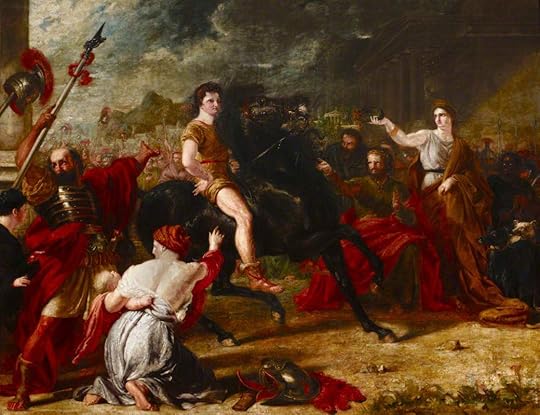
After studying the canvas [Alexander Taming Bucephalus] for some time, [George Wyndham, 4th Earl of Egremont] asked: ‘What have you been about all your life?’ ‘Painting large pictures in hopes of the sympathy of the Public, my Lord.’ ‘That was imprudent,’ Egremont replied. ‘It was,’ Haydon agreed.
Benjamin Robert Haydon was a 19th‑century English artist who devoted himself to colossal historical and religious subjects. He wanted to rouse the culture he lived in, to elevate the public mind through art on a grand, moral scale. It was an admirable calling, and he pursued it with a kind of furious, self‑sacrificing conviction. But this noble charge smashed him against two immovable obstacles.
Houston, we have a problem . . . The first obstacle was money. Who was going to pay for this? Haydon, feeling himself superior to his fellows and anointed by God, borrowed extravagantly. He expected a lifetime of patience from his creditors. As he saw it, he was working selflessly for their benefit. His pictures would raise the collective aesthetic. They wanted to see that happen, didn’t they? Some did, but not enough. He was arrested and confined in debtors’ prison, several times.
He wasn’t the first artist, or the last, to live by his wits and his worthless credit. Oscar Wilde and James McNeill Whistler ran aground with their creditors, although neither were confined in debtors’ prison, as Haydon was. Some credit thieves are better at the game, better at calming their victims than Haydon. His abrasive personality surely made matters worse for him.
The second obstacle was talent. For his pictures to achieve the impact he imagined, they needed to dominate their age the way Michelangelo and Raphael dominated theirs. Haydon simply couldn’t reach that height. He was good — sometimes very good — but not great, and no amount of labor could bridge the gap. He worked night and day, improving steadily, yet he never produced a canvas that made his nation kneel.
Haydon’s imperfections shine brightly, due to his enormous ambition. His compositions embraced hundreds of human figures, horses, landscape and architecture. Imagine trying to draw all that, in correct proportions, and also making it breathe with the drama happening on the canvas. The vast majority of artists run from this kind of project, the difficulty would crush them. Haydon demonstrated great courage, but courage wasn’t enough to elevate him to the realm of the art gods.
All his life [Haydon] had utterly mistaken his vocation. No amount of sympathy with him and sorrow for him in his manly pursuit of a wrong idea for so many years – until, by dint of his perseverance and courage it almost began to seem a right one – ought to prevent one from saying that he most unquestionably was a very bad painter, and that his pictures could not be expected to sell or to succeed. . . [Haydon’s art is] quite marvellous in its badness. —Charles Dickens
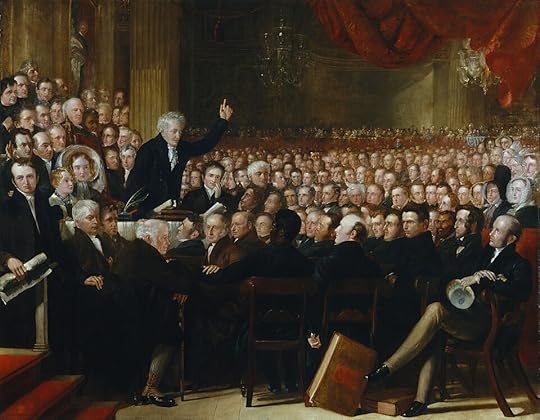
Let Mr Haydon rather write than paint . . . His pen is sometimes his friend – his brush is always his enemy. —London Morning Post, reviewing Haydon’s ‘Great Picture of the General Anti-Slavery Convention’, 1841
When I read these reactions, which I must agree with, I literally hurt for poor Haydon. Shockingly, his injuries were only beginning. When his delusional self-love could no longer shelter him from another stint in prison, he brought the curtain down on his life. But wait, it gets still worse. He meant to kill himself with a bullet to the head, but only grazed his skull. He soldiered on, finishing the job with a razor to his own throat. Are we done yet? Sorry, read on:
[Haydon] derived considerable comfort from the knowledge that none of his children had inherited his love of art. ‘I pray God,’ his journal recorded in 1842, ‘that he will, in his mercy, inflict them with every other passion, appetite, misery, wretchedness, disease, insanity, or gabbling Idiotism, rather than a longing for Painting.’
Alas, Haydon’s two remaining sons died miserably, one in Bedlam, insane, and the other a suicide like his father. His daughter became a domestic nurse and died single, at age thirty-five. The book describes each of these as an honest, well-meaning, hard-working human, just like their father. In a fair world, each would have lived comfortably and died of old age. All our good work may be nullified by fate. Before we embark, our destination was already chosen for us.
What did it all mean? I’m old enough now to notice that many of my heroes didn’t live as long as I have already. Many of my cherished ambitions will never materialize.
And you, gentle reader — do you pause and gaze into the yawning gap between the life you wanted and the life that actually happened? Way down there, in those depths, lurk important lessons. We don’t know ourselves. We don’t know the world. We’ve been flying blind the whole time, so it’s not surprising we fell short of our goals. On the contrary, it’s a miracle we accomplished anything. I find this observation encouraging and discouraging by turns. When the discouragement wins, remember our fellow soldier, Benjamin Robert Haydon, and try to keep your sense of humor.