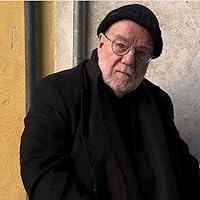
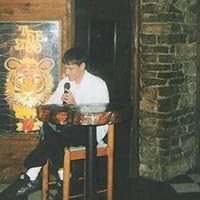
EDWARD FIELD was born in Brooklyn, and grew up in Lynbrook, L.I., where he played cello in the Field Family Trio which had a weekly radio program on WGBB Freeport. He served in WWII in the 8th Air Force as a navigator in heavy bombers, and flew 25 missions over Germany. He began writing poetry during World War II, after a Red Cross worker handed him an anthology of poetry. But it was not until 1963 that his first book, Stand Up, Friend, With Me, won the Lamont Award and was published. In 1992, he received a Lambda Award for Counting Myself Lucky, Selected Poems 1963-1992. Other honors include the Shelley Memorial Award, a Prix de Rome, and an Academy Award for the documentary film “To Be Alive,” for which he wrote the narration. In 1979, he edited the anthology, A Geography of Poets, and in 1992 with Gerald Locklin and Charles Stetler, brought out a sequel, A New Geography of Poets. He and his partner Neil Derrick, long-time residents of Greenwich Village, have written a best-selling historical novel about the Village, The Villagers. His most recent book is his literary memoirs, The Man Who Would Marry Susan Sontag, and Other Intimate Literary Portraits of the Bohemian Era. After the Fall, Poems Old and New, will be published by the U. of Pittsburgh Press in October, 2007.
Edward Field's poetry is not erudite or verbose or stilted; it is as free of pretension as one could ever really hope for. Unlike much of what was being published by his contemporaries, Field's poems do not attempt to be outwardly flamboyant or inflammatory; instead, they are quiet and sure of their meaning(s). Lawrence Ferlinghetti, in the introduction to his translation of Jacques Prévert's Paroles, spoke at length about the conversational tone of the poems. This could easily be applied to the poems in this collection as well, as Field doesn't require that his reader be well-versed in the classics, in ancient mythology, in lesser known artifacts of pop-culture, etc. Each poem is all-inclusive, and creates and sustains its own little world, completely independent of any external information. There are no complex metaphors, there are no controversial opinions expressed, there is no didactic tone—there is only the image of a melancholy and introverted man trying to articulate observations and experiences that meant something to him. And this melancholy is particularly striking because it is often so ingrained in the text, that it disappears completely. But disappears is an incorrect term, I think; it disperses and is diffused within the content of the poems, and leaves only the smallest bit of evidence that it was ever there. Looking through these poems, I am unable to find a single happy one, but, by the same measure, none of them are ostensibly sad, either. They are simultaneously veiled and confessional. Such is the voice of Edward Field.
Aside from one poem (A Birthday Poem for My Little Sister)—which, in my opinion, is the most perfectly realized poem in the collection (and of which more will be said)—there are no moments of great cathartic release. There are no real howls of rage or sorrow or frustration, nor are there instances of ecstasy or excitement. Everything is quiet and gentle and cognizant of its own frailty and feeling. Field's verse is not flowery or dazzling or even really that pretty; it describes what's around it, and that's all. But this very plainness, this attempt to be as direct and accessible as possible, infuses it with a magical and affecting quality. Field breathes life into events and things so commonplace and insignificant (e.g., trees, a dirty floor, a sibling's birthday, subway graffiti, the barges making their way up and down the Hudson, etc.) that less than being even consciously ignored, they aren't even thought of. And it is with these seemingly frivolous bits of contemporary life, that Field says the most. Trees transcend their physical forms and become a breed of giants, prompting Field to wax poetic on man's relation to nature and the universe. A crude and childish example of subway graffiti becomes a lament at the passing of youth and sexual vitality. The Hudson barges that Field sees through his office window remind him of man's ignorance and modern consumerism. These feelings set off such a stab of pain in him, that he is forced to turn his gaze inward, illuminating the (his) mercurial self—a self among so many others. And the occasion of his little sister's birthday causes a feeling of grief and longing so intense that it descends into a sort of dream logic just to keep from imploding. A Birthday Poem for My Little Sister is really the only felt poem in the collection. This is, of course, not to say that the others are lacking in feeling; however, even the most dour (Icarus) and the most sentimental (Donkeys) poems lack the urgency and visceral anguish of the birthday poem.
A Birthday Poem for My Little Sister is a marvel. It's truly one of the best poems I've read all year, and perhaps one of the best I've ever read. It's so full of innocence and anxiety and frothy, vibrant life. The first three lines are really the only poetic lines in the whole book:
Ball of cold metals, shooter of nerve rays, Moon, Be god yet for poets and their strange loves Call in the tides of madness that trip us on our way...
Sounds pretty Ginsberg-ish, right? But immediately following these opening lines, Field loses this beat tone, and returns to his familiar conversational style:
And help me send a poem of love to my sweet sister Still darling like when she was a baby Although now woman-shaped and married.
Impersonal fluid groove gives way to commonplace sound and content. Word.
There are no verbal gymnastics, no great feats of linguistic virtuosity—just a feeling (feelings, perhaps) distilled down to its most necessary and affecting components:
When you were twelve I saw your intellectual possibilities And took you to a difficult play Where you fell in love with the big faggot actor. Then I tried modern poetry on you, The Love Song of J. Alfred Prufrock; You listened very seriously and remembered the refrain like a jump-rope poem: It was odd to hear a little girl reciting those lines.
[...]
And suddenly you grew up and went out with boys... strangers And you spoke to them in a language like a code I mean you became a woman, so I'll never have you again...
[...]
The last stanza condenses a life of hurt and longing into nine lines; it was quite difficult to read:
But you grew up and went away and got married As little girls grow up into women Leaving us gasping and desperate and hurt. And we recover and forget, or half-forget Until sitting down to write a birthday poem we remember everything— A little girl on her potty hunched seriously to the business Or holding all of you at once in my arms, colt, calf, and pussy-cat: All I mean is, I miss you my little sister.
What makes this the perfect example of Field's aesthetic, is that, beyond the obscenity and melancholy of the poem's content, Field gets at a really fundamental truth: growing (up, older, apart) hurts more than anything in the world. That childhood ends, that teenhood ends, that young adult life bleeds into middle age and beyond. That as you get older, everything slowly loses its freshness, and the world begins to look dull and hopeless. That's what it's all about.
I don't think I can explain how much this book meant to me as a sexually confused young college student, living away from home for the first time in my life, searching through the card catalog (an antique piece of furniture that held individually hand-typed cards--oh, never mind) or through the library stacks by trial and error, hoping and needing to find something, some voice that expressed a "fellow feeling" (Richard Howard's lovely phrase). For me, and others like me, "gay" meant "H" in the card catalogue, which meant "homosexual," which meant our high school typing teacher who committed suicide.
How lucky, how fortunate, to find this book, along with a few others by Ron Schreiber, Paul Goodman, and (eureka!) Allen Ginsberg. Many years later, when my own book was a finalist for the Thom Gunn Award in Poetry, I experienced a gorgeous "full-circle" moment: standing on stage next to Edward Field, who'd received a lifetime achievement award (and who'd started his acceptance speech as "Eve Harrington"--a priceless moment! Tonguetied, all but speechless, I couldn't tell him how his work had saved me. He's been consistently one of my favorite poets through all my adult life. He is a national treasure.
This is the book, right after Allen Ginsberg's Howl and other poems, that pointed the way for me as a poet. Field and Ginsberg made it seem possible. I didn't have to have T.S. Eliot's erudition and Harvard education. I could be a working class boy from Brooklyn and still be a poet. When I first read Edward Field, I was in thrall to the American poets I found in A Controversy of Poets, particularly John Ashbery--especially the poem "Europe." There was a comment in the introduction to another anthology that included both Ashbery and Field that made me rethink what was and wasn't radical. Whose poetry smells more like lamplight, Asbery's or Fields. No question that it's Ashbery. Seeing the most recent pulitzer prize winner in hot pursuit of a young black man at a gay bathhouse, and knowing that such a scene would never be allowed into his precious poetry, confirmed me in my belief that the poetry I valued most was rooted in real life. Even Rilke is grounded. There were plenty of Asbery imitators around already. There was no need for another. I've never regretted selecting Edward Field as my first master.