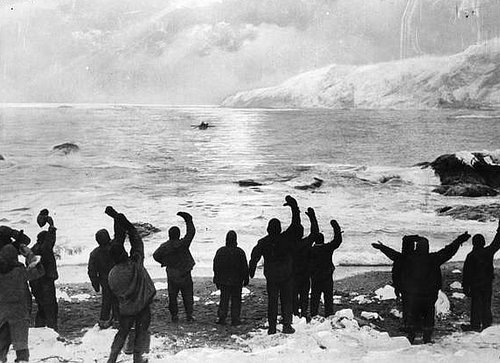
What an incredible story! This was my introduction to Shackleton, and I am left reeling from the experience.
I chose Endurance to add symmetry to my list. Earlier this year I read In the Kingdom of Ice, Hampton Sides' excellent book about a doomed expedition to the North Pole, and I thought I should balance the hemispheres by reading about a South Pole expedition. Lansing's book was highly rated by GR friends, and justifiably so.
What struck me about the writing was how modern it was. Lansing had good descriptions, great storytelling and created a powerful momentum to the events. These techniques are now widely used in narrative nonfiction, especially among popular history writers such as Sides, Nathaniel Philbrick, and Laura Hillenbrand. I mention this because Lansing's book was originally published in 1959, but didn't become a bestseller until decades later when a publisher who was a fan decided to reprint it. Lansing was definitely ahead of his time.
[Sidenote: In the 2014 edition that I had, Philbrick wrote a great introduction about Lansing and his book, and it included this bit of wisdom: "One of the biggest challenges for a writer of nonfiction is to avoid using too much of his or her hard-won material. A great and enduring book isn't comprehensive; it is highly, even ruthlessly, selective, zeroing in on the most evocative and illustrative moments while dispensing with the clutter that might prevent the high points from resonating to maximum effect."]
But back to the adventure! In 1914, Ernest Shackleton wanted to make the first land crossing of Antarctica. The South Pole had previously been discovered, but Shackleton hoped to lead an expedition from sea to sea. However, his ship never reached the continent — it became stuck in ice in the Weddell Sea, and was eventually crushed and destroyed by the ice pack.
Shackleton and his men had to camp on an ice floe, and slowly drifted out to sea. When the floe became unreliable, they set out in lifeboats in hopes of reaching an island.
(At this point, this book was so compelling that it was affecting my sleep. I dreamt that I was stranded on an iceberg, and was relieved to wake up in a bed, in a house, on land, in a warm climate and with food readily available.)
The men reached Elephant Island, which was remote and unlikely to be visited by any other ships. Shackleton and a few men then set out again in a lifeboat for South Georgia Island, which was about 800 miles away. Amazingly, they reached the island, despite wicked winds and dangerous seas, and then had to make a difficult land crossing to the other side to reach a dock with some whaling ships.
After several attempts, Shackleton was finally able to procure a ship that was sturdy enough to rescue the men stranded on Elephant Island, making for an emotional reunion. If you think I reached the end of this adventure without getting a little misty-eyed, you would be wrong.
Shackleton was such an inspirational leader that I understand why he has become so revered. Lansing did some impressive reporting by interviewing the survivors of the expedition, and he also had access to numerous journals and logbooks. I listened to this on audio, narrated by Simon Prebble, and it was excellent. I also recommend looking through a print copy of the book to see the photographs from the expedition, including some jaw-dropping photos of the ship stuck in ice.
I highly recommend this book to fans of history or true adventure.
Favorite Quotes
"Few men have borne the responsibility Shackleton did at that moment. Though he certainly was aware that their situation was desperate, he could not possibly have imagined then the physical and emotional demands that ultimately would be placed upon them, the rigors they would have to endure, the sufferings to which they would be subjected. They were for all practical purposes alone in the frozen Antarctic seas. It had been very nearly a year since they had last been in contact with civilization. Nobody in the outside world knew they were in trouble, much less where they were. They had no radio transmitter with which to notify any would-be rescuers, and it is doubtful that any rescuers could have reached them even if they had been able to broadcast an SOS. It was 1915, and there were no helicopters, no Weasels, no Sno-Cats, no suitable planes. Thus their plight was naked and terrifying in its simplicity. If they were to get out — they had to get themselves out."
"In all the world there is no desolation more complete than the polar night. It is a return to the Ice Age — no warmth, no life, no movement. Only those who have experienced it can fully appreciate what it means to be without the sun day after day and week after week. Few men unaccustomed to it can fight off its effects altogether, and it has driven some men mad."


 come to my blog!