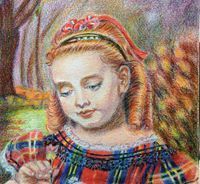
The broader Regency period 1795-1820 stands alone as an incredible moment in fashion history unlike anything that went before or after. It was the most naked period since Ancient Greece and before the 1960s, and for the first time England became a fashion influence, especially for menswear, and became the toast of Paris. With the ancient regime deposed, court dress became secondary and the season by season flux of fashion as we know it came into being, aided and abetted by the proliferation of new ladies' magazines. Such an age of revolution and innovation inspired a flood of fashions taking influence from everything including the newly discovered treasures of the ancient world, to radical new ideas like democracy. It was an era of contradiction immortalized by Jane Austen, who adeptly used the newfound diversity of fashion to enliven her characters, Wickham's military splendor, Mr. Darcy's understated elegance, and Miss Tilney's romantic fixation with white muslin.
Sarah Jane Downing’s tiny book—64 pages, lavishly illustrated—is both more and less than a history of fashion in the late eighteenth and early nineteenth centuries (mostly in England).
On the “more” side, it places fashion in the context of the shifting ideas and historical events of the age: for instance, the simple, high-waisted shifts that came into the mode for women in the 1790s are seen as reflecting ideas about liberty, interest in neoclassicism, and changing notions about child-rearing. This wide lens is the book’s greatest strength. Sometimes the brush may be a little too broad, the depiction of historical ideas too simplistic, but this explanation of context certainly helps the modern reader understand why clothes were what they were.
On the “less” side, the limitation of the book’s size leads to limits in the range of clothing depicted. We get a few examples of dresses for the haut ton for each, shall we say, quintile of the period 1790 to 1820, but not a thorough survey of the changes in style year by year. The lower classes are overlooked altogether; men are given a bit of attention, but not enough to get a real sense of male styles.
So this book is more a frame than a portrait—a very useful and concisely drawn frame, and I highly recommend the volume on that basis. But I would have liked more to have been put in it! If one had access to issues of fashion magazines from the time period covered, one could easily flesh out the high fashion side of things, but I looked in vain for some of the less easily accessed information.
This is a small compendium on Regency fashion that provides an overview of the history, reasons for the fashion and some rather interesting nuggets of information. I wanted to read it, so I would have a better understanding about the clothing of the period when reading. I enjoyed the references to Jane's letters to her sister, Cassandra, regarding fashion and the pictures showing some examples. There are some beautiful paintings included along with some rather amusing caricatures and fashion plates of the times. It helped me to better understand some of the terminology of the pieces as well (i.e. Redingote, Pelisse, Spencer to name a few). It is definitely a handy reference book. This has just whetted my appetite for more information and pictures showing further examples and details.
I'll admit that a lot of the historical references went over my head, but overall this was super informative despite its brevity--not to mention filled with a variety of wonderful pictures. I was generally interested in the fashion of the Regency era, but having a book focus on the fashion of Jane Austen and her books specifically was perfect.
I am a fanatical reader of Jane Austen's books, which is why I expect to love their films and TV adaptations. In these adaptations I have always been impressed by the protagonists' clothes, which is why I learned a lot more about them. This book deals with this issue in much more detail and contains a wealth of information accompanied by very enlightening images. I especially like that it is talking about the political dimension of fashion at that time, with the French Revolution giving the inspiration for clothes more simply and with classicism giving them a special beauty. in the end it also mentions why this fashion was abandoned. A very enlightening book, an ideal supplement for the books of the great author.
Είμαι φανατικός αναγνώστης των βιβλίων της Jane Austen, για αυτό αναμενόμενα αγαπάω τις κινηματογραφικές και τηλεοπτικές μεταφορές τους. Σε αυτές τις μεταφορές πάντα μου έκαναν εντύπωση τα ρούχα των πρωταγωνιστών, για αυτό στη συνέχεια έμαθα πολλά περισσότερα πράγματα για αυτά. Αυτό το βιβλίο ασχολείται πολύ αναλυτικότερα με αυτό το θέμα και περιέχει πλήθος πληροφοριών που συνοδεύονται με πολύ διαφωτιστικές εικόνες. Μου αρέσει ιδιαίτερα που μιλάει για την πολιτική διάσταση της μόδας εκείνης της περιόδου, με τη Γαλλική Επανάσταση να δίνει την έμπνευση για ρούχα περισσότερο απλά και με τον κλασικισμό να τους δίνει μία ξεχωριστή ομορφιά. Τελειώνοντας αναφέρει και τους λόγους που αυτή η μόδα εγκαταλείφθηκε. Ένα πολύ διαφωτιστικό βιβλίο, ιδανικό συμπλήρωμα για τα βιβλία της μεγάλης συγγραφέως.
Very informative guide to European fashion i During Jane Austen's era. The photos are helpful also. Great resource for my upcoming novel Champagne Widows.
A good overview of fashion spanning the late 1790s through to the early 1820s. Definitely aimed at those who have a basic understanding, but not for those looking for a very detailed breakdown of fashion per decade. I learnt a fair bit from the book, but it felt rather a broad brushstroke at times. Although it did cover fashion from each of the specified decades, it didn’t go into specifics of fashion for each decade. I like very clear cut explanations of the differences between each one, and I found I had to reread passages just to be fully clear which part related to which, and even now it still seems a little muddled in my mind. Overall though, I really enjoyed it, and it was a good length and not too wordy.
Loved it! Amazing in depth look at the styles of the time period, with a TON of primary sources - some fantastic paintings and drawings that really showed the varieties and intricacies of the style, both for men and women. Loved seeing both what it influenced later and what was influencing its inception.
Muy buen resumen de la moda en la época de Austen, con referencias a sus libros y cartas, con explicaciones sobre el momento histórico, ideas, revoluciones, estatus económico y más. Son 64 páginas repletas de información y muchas ilustraciones.
It's a very good read with wonderful illustrations and quite full of detail. My only wish is that it had told more of the period, 1790s, when Miss Jane wrote her first drafts of "Sense and Sensibility," and "Pride and Prejudice" with more insights given into that period instead of mainly the Regency, 1811 to 1820. We would have been given a more well rounded feel for the true era of her young adulthood which makes for better research whether learning or for confiding. I have been looking into researching books of Jane's young adult years for my own novel and it's been difficult for me but I never give up and I do say this book has helped me. Therefore, "Fashion In The Time Of Jane Austen" did supply some of the details of the period (late 1790s) of which I speak, only I wished for more insight. But, I do give this book a five star rating because it can be very difficult to write a historical time capsule on a period far removed from our own. Doug.
Peacock feathers, fruit in hats, fans with political messages that replaced biblical ones... Fashion, history, politics, philosophy, literature and culture! Great read! I wouldn't have understood half of it were it not for the paintings.
'Men and women were becoming polarised: once men had realised the comfort and camaraderie of their own company they were less keen to adopt the 'full dress' and fine manners necessary for female society. Women lost any freedoms they may have gained with the rise of evangelicalism and sentimentality, when it was remembered that women were 'inherently sinful' and the only way they could redeem themselves was through a life of modesty, sobriety, charity and silence.' -pg 62
A little glistening jewel of information on British fashion during the Georgian and Regency periods
“Revolution had changed the world and fashion had dressed it accordingly.” Sarah Jane Downing
It is hard for me not to think of a Jane Austen movie adaptation and not remember how fashion influenced my enjoyment of the film. Some of my most vivid memories are of Elizabeth Bennet walking the verdant countryside in her russet colored spencer jacket in Pride and Prejudice 1995, Marianne Dashwood spraining her ankle and being carried to safety by Willoughby in her rain drenched white muslin frock in Sense and Sensibility 1995, or Mary Crawford ready to pounce like a black widow spider in her cobwebby evening dress in Mansfield Park 1999. Much of how we perceive Regency fashion today is from film costume designer’s interpretations of the fashions during Jane Austen’s time. I admit to admiring the fine cut of a gentleman’s tailored redingote or the elegant flow of a ladies formal evening dress as much as the next Janeite, but am totally clueless about why and how fashion changed so drastically since the heavy brocades, embroidered silks and powdered wigs of pre-revolutionary France.
As an introduction to Georgian and Regency fashion, this slim 63 page volume answered many questions and gave me a better understanding of the evolution of fashion, its importance in society and how English style influenced the world. The chapters are neatly broken down into seven significant categories: The Age of Elegance, The Rise of English Fashion, A Fine Romance, Beau Brummell and the Great Renunciation, Rousseau and Fashion Au Natural, Reticule and Ridicule, and After the age of Elegance. Throughout are beautiful (but small) images from original sources such as the popular women’s fashion magazines Ackermann’s Repository and La Belle Assemblée, portraits by the leading painters of the day Sir Henry Raeburn, Jean Auguste Dominique Ingres and Sir Thomas Lawrence, and photographs of vintage clothing from the era. Interspersed throughout the text are references to Jane Austen, her family and characters in her novels to tie into a description of clothing or styles. A brief index at the back allows for quick reference by topic, person or place.
As part of the popular Shire Library series, Fashion in the Time of Jane Austen is a little glistening jewel of information on British fashion during the Georgian and Regency periods. For the novice historian it will inform and whet your appetite. For the veteran it will be a great refresher. For each, you will appreciate Downing’s straight forward presentation of material and her handling of the sense of the ridiculous that fashion can take by including Gillray caricatures and comical anecdotes. From the perspective of a Jane Austen enthusiast, Downing does state some eyebrow raising facts that to my knowledge have yet to be proven. As much as the Austen descendants would like the “Rice portrait” to be of Jane Austen, even my rudimentary knowledge of Regency fashion styles and math calculate the portrait to be much later than the 1792-93 range evaluated by experts, and the James Stanier Clarke portrait of a lady with a fur muff could be Jane Austen, but we shall never know for sure. (Best to say possibly Jane Austen to be safe and raise your credibility.) A small quibble in an overall splendid little treasure trove sure to please the Austenista in all of us.
Ok SO. I love fashion history. I like history in general, but fashion history is my THING. I own a lot of books about it, and yes I have read them too! I didn't have anything about the romantic period yet, so I thought this one would be amazing. Unfortunately, it isn't.
Now, on the back of the book it doesn't state that this book would just be about Jane Austen and her books, nor does the title imply it, but I feel like the book needs a new title: "Fashion in the Books of Jane Austen" would be better than TIME of Jane Austen, as this implies that it would be about the period when she lived. And I do not like her writing at all. Every three sentences the author wanted to make sure that we knew that they were Jane Austen's biggest fan, and it was so incredibly annoying. Did I learn anything about what I actually got this book for? Yeah, kinda, but it got ruined by mentioning fictional characters all the damn time, so I forgot most of it all ready.
If you are an Jane Austen fan this might be a good book for you, if you want to get this book because you like fashion history like me, just skip this. There are better Shire Books out there!
A book writtend for the popular audience without foot/end notes. The omission of the latter made me give it 4 stars, but it is full of information and is well-illustrated, in color. I would have liked information on who created the paintings or sources of the illustrations. The fashion is, of course, limited to the upper 10,000 (as the phrase went), but does include attention to the attire of the children of the gentry and nobility. I would have liked a definition of the difference (or a statement that essentially there was no difference) between morning dress and walking dress. The author, however, clearly shows the sensuality embodied in Regency clothing and gives details as to what types of fabrics were used.
I read this slim volume in one sitting. It's great because I didn't want to read a giant tome about Regency fashion and its political and sociological implications - I just wanted a primer and this is it. This book explains why and how fashion changed so abruptly for both men and women.
A mere wisp of a book at only 63 pages, but it is informative and engaging with plenty of illustrations. I was left wanting more, but was pleased with what was provided.
A small book (more of a pamplet, really) that only takes into consideration certain aspects of "fashion". Of course the authoress is only concerned with what the upper middle classes (like Austen's family) and those above them were wearing, but even so she misses a few points of interest--such as the fact that a "lady's" sleeves, be they long or short, were set in such a way that it was difficult for her to raise her arms above her head. It was considered that she would have someone else (a servant, or at the very least a sister) to help her dress and do her hair, and that all she needed to do was raise her hand to her lips to eat or drink, and maybe do a little sketching or embroidery and play a musical instrument. Given the exiguous length of the booklet, Downing ignores the clothing of the working classes, which was very different (as shown in her remarks about bucks "dressing like grooms"--but not a word about working women's clothes!). There are many illustrations which are nearly indecipherable in the ebook edition, but can be found online with a quick websearch.
The authoress takes no trouble to define what she means by "Vandycked lace and rouleaus" and other specific fashion vocabulary of the time, making her little booklet even more superficial. At least she debunks the old urban legend that claims that women wore no underwear at that time--in fabrics as sheer as book muslin, they would have to! However, what cost the most stars was the occurrence of several howlers such as saying that women and men "both habituated the same drawing rooms"--instead of inhabited. To habituate means "to become accustomed to" or "to form an addiction."
All in all, a fast, superficial little read that I enjoyed for what it was worth--but was glad I could borrow instead of purchasing.
From muslin gowns and hats decorated with ostrich feathers, and all the way to frocks and footwear, Sarah Jane Downing takes the reader on an interesting journey to witness the fashion trends of early nineteenth century England.
At that time fashion and clothes were not only important for the society, they also had political significance. The book talks about lady's fashion, men's clothes, boots breeches, and clothes designed for children.
The book is full of paintings and illustrations of different items. However, the arrangement of the book was quite off. It jumped from one item to another, sometimes between male and female clothes within the same section, and the photographs and paintings displayed didn't always match the item discussed.
Es un libro muy cortito pero con mucha información condensada. Me quedo con ganas de más explicaciones, aunque tiene muchas ilustraciones de moda o cuadros pero de vez en cuando algunas descripciones sin imágenes se me quedaban cortas (como las medias con 'clocks', las había visto en otros sitios pero no sabía que se llamaban así), pero bueno, existiendo Google no nos vamos a quejar.
Habla de la evolución de la moda para hombres, mujeres y niños apoyándose en el contexto histórico e intercalándolo con fragmentos de las novelas de Jane Austen (que de moda hablaba poco, así que tiene mérito) y con cartas de Jane a Cassandra. Muy bonito. Me quedo con ganas de más.
I read this book for my Jane Austen book club. This was an informative and well-written layman's account of the fabrics, styles, and influences on fashion during the Regency. There are references to Jane Austen and quotations from her letters commenting on clothing styles, but the main focus is on describing fashion from the period and explaining how fashion developed based on historical events. It's beautifully illustrated. It's not for someone looking for lots of historical context or extremely detailed examinations of fabrics, etc, but for readers interested in the Regency more generally, it's an enjoyable book.
A perfectly tidy primer on Regency fashion, from the cutaway Redingote to the silk pelisse. The visuals are delightful, including a few amusing caricatures drawn by sartorial satirists of the day. This thin volume hits all the right notes while describing the vanities of the gentry in Jane Austen's era. Who knew that men and women both availed themselves of "falsies"--from wax bosoms to padding that made everything from a sunken chest to bow legs look more muscular. Proving that fashion was just as ridiculous in the 19th century as it is now. Loved this!
In all honesty, I already knew everything in this book when I read it a couple years ago.. However, what I appreciated was the structure of how the information was laid out which allows me to keep coming back to double check my work, remind myself of a date, etc.
For a beginner, this is a fabulous book to get readers started. It's written in an approachable style that doesn't treat clothing like it existed in a bubble.
This was an assigned book for a class about Vienna during the 19th century, however I still enjoyed this read a lot and I loved the pictures added in this book. You definitely learn a lot about fashion and different fashions worn in different time periods during the 19th century. It was a short, nice read! :)
A very short primer on fashion during the Regency, replete with tons of illustrations from the time and a few pictures of shoes and dresses of the period now at museums. What's best, Sarah Jane Downing goes into why certain fashions were adopted and eventually abandoned, from the writings of Rousseau to growing evangelicalism.
This was a really interesting look into the various fashion trends during the Regency period that Jane Austen and her sister probably would have worn during the time period. I have to say what prevented from loving this book is that it does get slightly dry in places. Worth checking out if you're interested in historical fashion.
This is beautifully illustrated and contains many interesting titbits. However, I found the text disjointed in parts and while the anecdotes were interesting, I had been hoping for more actual explanatory content. Some of the layout could also have been improved to allow for an easier read.
Good overall overview of fashion during the Regency. I liked the quotes and anecdotes regarding Jane Austen of course. Sometimes it's vastly generalised, but an okay start into the topic. I like other eras better though.