

What do you think?

Six Wives: The Queens of Henry VIII
No one in history had a more eventful career in matrimony than Henry VIII. His marriages were daring and tumultuous, and made instant legends of six very different women. In this remarkable study, David Starkey argues that the king was not a depraved philanderer but someone seeking happiness -- and a son. Knowingly or not, he elevated a group of women to extraordinary heights and changed the way a nation was governed.
Six Wives is a masterful work of history that intimately examines the rituals of diplomacy, marriage, pregnancy, and religion that were part of daily life for women at the Tudor Court. Weaving new facts and fresh interpretations into a spellbinding account of the emotional drama surrounding Henry's six marriages, David Starkey reveals the central role that the queens played in determining policy. With an equally keen eye for romantic and political intrigue, he brilliantly recaptures the story of Henry's wives and the England they ruled.
Six Wives is a masterful work of history that intimately examines the rituals of diplomacy, marriage, pregnancy, and religion that were part of daily life for women at the Tudor Court. Weaving new facts and fresh interpretations into a spellbinding account of the emotional drama surrounding Henry's six marriages, David Starkey reveals the central role that the queens played in determining policy. With an equally keen eye for romantic and political intrigue, he brilliantly recaptures the story of Henry's wives and the England they ruled.
896 pages, Paperback
First published February 28, 1999
About the author
David Starkey
138 books468 followersDavid Starkey is one of Britain's foremost historians, renowned for his commanding expertise on the Tudor period and the English monarchy. A Cambridge scholar, he established his academic reputation with rigorous work on the Tudor court, particularly Henry VIII's privy chamber and the role of faction in politics. His major works include Six Wives: The Queens of Henry VIII, Elizabeth: Apprenticeship, and Monarchy: From the Middle Ages to Modernity.
A gifted communicator, Starkey became a familiar television presence through documentaries including David Starkey's Monarchy and Henry VIII: Mind of a Tyrant. His style is unapologetically forthright, combining scholarly rigour with bold interpretive claims that challenge received wisdom. He was appointed CBE in 2007 for services to history.
A gifted communicator, Starkey became a familiar television presence through documentaries including David Starkey's Monarchy and Henry VIII: Mind of a Tyrant. His style is unapologetically forthright, combining scholarly rigour with bold interpretive claims that challenge received wisdom. He was appointed CBE in 2007 for services to history.
Ratings & Reviews
Friends & Following
Create a free account to discover what your friends think of this book!
Community Reviews
Displaying 1 - 30 of 389 reviews

February 16, 2013
MARRY, KISS OR KILL : THE SIX WIVES OF HENRY VIII
A play in several indecent acts
ACT ONE
Scene 1
The Year : 1500. Plymouth Docks
Catherine of Aragon (aged 16) : So this is England... (She is violently ill).
Scene 2
The Year : 1501. London
Chuck Berry : It was a teenage wedding and the old folks wished them well
You could see that Young Arthur did truly love the mademoiselle
Catherine : Like, what are you, 15?
Arthur: Well, yes… (begins crying).
Scene 3
The Year : 1502. Ludlow Castle, Wales
Arthur : I’m going to bed. I’ve got the collywobbles or something.
Later that evening.
Lady in Waiting : Oh la, Princess Catherine, Prince Arthur has just died.
Catherine : Come on, you’re pulling my plonker. I only just got here. We’ve only been married like five minutes. Oh my God, what a fucking disaster. Now what?
Scene 4
The Year 1502. London
Henry VII : We deeply regret the death of our heir and first born, the right noble Prince Arthur. But good news is, we have another one.
Catherine: What? No, don’t make fun of me, I’m a young Spanish girl and apart from my 65 servants I’m completely alone in your creepy country.
Henry VII : No, straight up. Take a look.
Enter Prince Henry, skipping. He has his crown on backwards.
Prince Henry : Hey sire. Hey Kath. Wassup?
Catherine : Hey, Hal. Wanna game of badminton? Wait…. Oh wait a moment… (speaks to Henry VII) … tell me this is a joke, right? You don’t mean what I think you mean?
Henry VII : Smiling broadly I knew you’d catch on! So what do you think? He’s a likely lad ain’t he – look at those plump calves, give him a poke in his middle there, he’s a likely lad alright. (Winks)
Catherine (now in a towering Spanish rage) : He’s ten years old you old English perv!
Henry VII : Calm down dear, I didn’t mean now, obviously not now. You’ll have to wait around a bit. But you know, you’ll get to be Queen! It’s all good!
Catherine: Well how long do you suppose I’ll be having to hang around then?
Henry VII : Oh, er… how does seven years sound?
Catherine (sings) : It might as well rain until 1509.
Scene 5
The year 1521. London.
Henry VIII: Look, you can’t say I didn’t give her a fair crack of the whip. But I got to say, it looks like God didn’t want me to be married to this one. How many times has she been up the duff? About a zillion? And how many sons do I have? About none? Am I right?
Cardinal Wolsey: Okay boss, but we can’t do nothing without the word.
Henry VIII: The word?
Wolsey : Yeah. From R-O-M-E.
Henry VIII: Well, what do I pay you for? Get it done. And ask the Lady Anne to join me in my privy chamber. I wish to fumble with her lambkins.
Henry VIII (soliloquy)
She comes around here just about midnight, ha
She make me feel so good,
I wanna say she make me feel all right.
Comes a-walkin' down my street,
then she comes up to my palace,
She knock upon my door
and then she comes to my privy chamber,
Yeah an' she make me feel all right,
And her name is
A-N-N-E B-O-L-E-Y-N
I'm talkin' bout B-O-L-E-Y-N
Shout it out now
ACT TWO
Scene 1
The Year 1522. London
Catherine of Aragon (soliloquy) :
Boleyn, Boleyn, Boleyn, Boleyyyyyyyyyyn
I'm begging of you, please don't take my man
Boleyn, Boleyn, Boleyn, Boleyyyyyyyyyyn
Please don't take him just because you can.
Your beauty is beyond compare
With flaming locks of coal black hair
With ivory skin
And eyes of emerald green
Your smile is like a breath of spring
Your voice is soft like summer rain
And I cannot compete with you, Boleyn
Boleyn, Boleyn, Boleyn, Boleyyyyyyyyyyn
I'm begging of you please don't take my man
Well you could have your choice of men
But I could never love again
He's the only one for me, Boleyn
And I had to have this talk with you
My happiness depends on you
And whatever you decide to do, Boleyn
Scene 2
The year 1529. London
Enter Catherine.
Catherine : Greetings, most bountiful Lord, my dear husband.
Henry VII: Good morrow, lodger.
Catherine : Lodger? Nay, wife, I trow.
Henry VIII: Lodger.
Catherine : Wife!
Henry VIII: Lodger.
Catherine: Don't give me this crap. My lord, we have asked the Pope these several times and he says our marriage is a true and indissoluble bond fused in the highest heavens which can never be broken asunder.
Henry VII: Yeah, well, I will crush the Pope’s brains with my own two hands.
Scene 3
Later that day.
Anne Boleyn : Look, I’m not getting any younger.
Catherine of Aragon: We all noticed that.
Anne : Shut your trap you fat slag.
Henry VIII : O who shall envieth the King of England who like a badger entrapp’d by hounds turns now to the left hand and now to the right yet seeest no sky. This lodger of mine has my balls in a Spanish salt grinder.
Enter Wolsey.
Henry VIII : Well, what have you got for me?
Wolsey: Well, it’s complicated. It looks like the Pope’s not playing ball. (Dies.)
Enter Thomas Cranmer
Cranmer: I have an idea. It could be the Pope is a heretic.
Henry VIII: I like that. Talk to me, Thomas.
Anne (to Henry VIII) : You got to do something that no one else did
Friends say that it can’t be done
But all my love you know you've won
So third finger, left hand
That's where you gotta place the wedding band
The Vandellas : Oooo - oooh
Henry VIII : Yeah, yeah, I get it.
Scene 4
The Year 1530. London
Enter Thomas Cromwell
Cromwell : Sire, I have a crazy idea but it just might work. Why don’t… you be the Pope. Of England. The Pope…of England! Yeah. Like that. It be cool.
Henry VIII : By my trow, that man hath the sow by the right ear.
Scene 5
The Year 1536. The Tower of London
Anne Boleyn : How did the old fool find out? I was so discreet with Mark Smeaton, Sir Henry Norris, Sir Francis Weston, Sir Richard Page, Sir Thomas Wyatt, my brother, Sir Francis Bryan, the Spanish ambassador, oh my he was good...
Thomas Cromwell( listening at the door): Aha.
Henry VIII:
Various cardinals and courtiers chaunting doo wop a wop in the background
Here's the moral and the story from the guy who knows
I fell in love and my love still grows
Ask any Protestant in the land
They'll say keep away from-a Runaround Anne
She likes to travel around, yeah
She'll love you and she'll put you down
Now people let me put you wise
Anne goes out with other guys
Scene 6
The Year 1536. Tower Hill, London
Executioner : Don’t worry, I’m good at this. You won’t feel a thing.
Anne : Slag.
She is beheaded. The Executioner holds up her head and shows it to the crowd
Head : Slags!
ACT THREE
Scene 1
Next day.
Henry : Oh Jane.
Jane Seymour : Oh Henry.
Scene 2:
Later that same year
Cromwell : Sire, my liege, most gracious Highness, do you want the good news or the bad news.
Henry : Oh the good news, you know me.
Cromwell: You have a son!
Henry : At last! Brilliant! What’s the bad news – has it got two heads?
Cromwell : No, it’s okay but your wife kind of died.
Scene 3
The Year : 1537. Some palace in England, who cares
Henry : Mail order? What do you mean?
Cromwell : Well, you look at the pix and you decide which one you like and then they ship her over.
Henry (not convinced) : What if the pictures are attainted – suborned – photoshopped?
Cromwell : You send Hans Holbein over, he does you a quick portrait, and Bob’s your uncle.
Henry : Well, okay… (thumbs through the book) – what about that one?
Cromwell : Oh, sorry – dead of plague.
Henry : That one?
Cromwell : Ah, yeah, she was cute. Look at those tasty wambles. But, er, they burned her for heresy only last week.
Henry (not known for his patience) : Then that one.
Cromwell : Okay! Saxony here we come!
Scene 4
The Year 1539. Rochester.
Henry is peeking through a heavy curtain.
Henry : Oh my God! Is that her? Tell me it’s not so! She looks like a monkfish. I’ve seen prettier partially eaten dead donkeys. I wouldn’t touch that one with a ten foot pole. My dick has shrivelled off and is now running away at great speed. I’m going to have Hans Holbein’s guts on toast for dinner.
Cromwell (singing frantically and capering about)
If you wanna be happy for the rest of your life
Never make a pretty woman your wife
So from my personal point of view
Get an ugly girl to marry you
Scene 5
The Year 1540. A street in London
Courtier 1: I heard he hated her but he couldn’t get out of it.
Courtier 2 : Yes, and I heard from a very good source that he couldn’t get it up – I can’t say I’m surprised, did you see her yet? The actual words he used were (whispers) “I could not in any wise overcome that loathsomeness in her company and be provoked or stirred to that act”!
Courtier 1 : Oh I say… what a disahster – what does she say about it?
Courtier 2: Well, what I heard was, that she was such an ignorant German goose that she wondered why she didn’t get with child even though all he ever did was say Madam, I bid thee goodnight!
Courtier 1 : Well I can’t say I’m surprised that nobody had explained the birds and the bees to her before. I mean, why would you need to bother?
Courtier 2: I know. Isn’t it just too delicious.
Scene 6
The Year 1540. London.
Cromwell : Sign here…. Here…. And here.
Anne of Cleves : Er – how much a year did you say?
Cromwell : £4000.
Anne : Das ist das beste Angebot, das ich hatte das ganze Jahr über haben.
She signs.
Scene 7
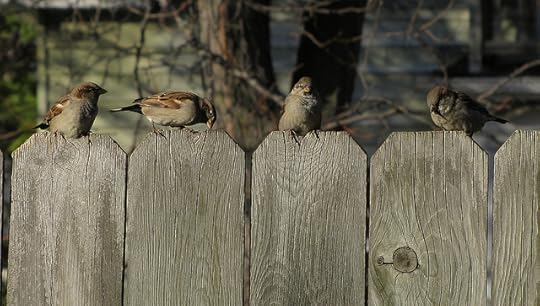
The Year : 1541. A fence in Pall Mall, London
First sparrow : So much for the new queen then.
Second sparrow : I here she’s happy enough where she is.
1st sparrow: What, rolling around in a basket?
2nd sparrow: Huh? No, she has a nice house, she’s okay.
1st sparrow: They chopped her head off.
2nd sparrow: They did? Wow, I did not hear that. Was it because she was so damned ugly?
1st sparrow: No, idiot, she was a pretty little thing.
2nd sparrow: What Anne? She was a dog!
1st sparrow : No, not Anne, Catherine!
2nd sparrow: Who’s a idiot? Catherine’s long gone. I’m talking about Anne. Of Cleves.
1st sparrow: Oh – I get it – you’ve been away… you missed a whole queen! Yeah man, they come and go quick, you blink and you miss a whole queen! Ha ha, that’s kind of funny.
A 3rd sparrow flutters down to join them.
3rd sparrow : Hey this new queen’s all right. Dunno how long she’ll last though.
1st sparrow : She already got the chop, bro. Dead ‘n’ gone, deader ‘n’ dead.
3rd sparrow: What Catherine?
1st sparrow: Yep, Catherine.
3rd sparrow: Catherine Parr?
1st sparrow: No, what, who’s she?
2nd sparrow : Ha ha, youse guys, this is the most ridiculousest conversation I ever heard between London sparrows.
A 4th sparrow flutters down to join them
4th sparrow : Hey, Henry’s dead, guys.
All : Henry who?
A play in several indecent acts
ACT ONE
Scene 1
The Year : 1500. Plymouth Docks
Catherine of Aragon (aged 16) : So this is England... (She is violently ill).
Scene 2
The Year : 1501. London
Chuck Berry : It was a teenage wedding and the old folks wished them well
You could see that Young Arthur did truly love the mademoiselle
Catherine : Like, what are you, 15?
Arthur: Well, yes… (begins crying).
Scene 3
The Year : 1502. Ludlow Castle, Wales
Arthur : I’m going to bed. I’ve got the collywobbles or something.
Later that evening.
Lady in Waiting : Oh la, Princess Catherine, Prince Arthur has just died.
Catherine : Come on, you’re pulling my plonker. I only just got here. We’ve only been married like five minutes. Oh my God, what a fucking disaster. Now what?
Scene 4
The Year 1502. London
Henry VII : We deeply regret the death of our heir and first born, the right noble Prince Arthur. But good news is, we have another one.
Catherine: What? No, don’t make fun of me, I’m a young Spanish girl and apart from my 65 servants I’m completely alone in your creepy country.
Henry VII : No, straight up. Take a look.
Enter Prince Henry, skipping. He has his crown on backwards.
Prince Henry : Hey sire. Hey Kath. Wassup?
Catherine : Hey, Hal. Wanna game of badminton? Wait…. Oh wait a moment… (speaks to Henry VII) … tell me this is a joke, right? You don’t mean what I think you mean?
Henry VII : Smiling broadly I knew you’d catch on! So what do you think? He’s a likely lad ain’t he – look at those plump calves, give him a poke in his middle there, he’s a likely lad alright. (Winks)
Catherine (now in a towering Spanish rage) : He’s ten years old you old English perv!
Henry VII : Calm down dear, I didn’t mean now, obviously not now. You’ll have to wait around a bit. But you know, you’ll get to be Queen! It’s all good!
Catherine: Well how long do you suppose I’ll be having to hang around then?
Henry VII : Oh, er… how does seven years sound?
Catherine (sings) : It might as well rain until 1509.
Scene 5
The year 1521. London.
Henry VIII: Look, you can’t say I didn’t give her a fair crack of the whip. But I got to say, it looks like God didn’t want me to be married to this one. How many times has she been up the duff? About a zillion? And how many sons do I have? About none? Am I right?
Cardinal Wolsey: Okay boss, but we can’t do nothing without the word.
Henry VIII: The word?
Wolsey : Yeah. From R-O-M-E.
Henry VIII: Well, what do I pay you for? Get it done. And ask the Lady Anne to join me in my privy chamber. I wish to fumble with her lambkins.
Henry VIII (soliloquy)
She comes around here just about midnight, ha
She make me feel so good,
I wanna say she make me feel all right.
Comes a-walkin' down my street,
then she comes up to my palace,
She knock upon my door
and then she comes to my privy chamber,
Yeah an' she make me feel all right,
And her name is
A-N-N-E B-O-L-E-Y-N
I'm talkin' bout B-O-L-E-Y-N
Shout it out now
ACT TWO
Scene 1
The Year 1522. London
Catherine of Aragon (soliloquy) :
Boleyn, Boleyn, Boleyn, Boleyyyyyyyyyyn
I'm begging of you, please don't take my man
Boleyn, Boleyn, Boleyn, Boleyyyyyyyyyyn
Please don't take him just because you can.
Your beauty is beyond compare
With flaming locks of coal black hair
With ivory skin
And eyes of emerald green
Your smile is like a breath of spring
Your voice is soft like summer rain
And I cannot compete with you, Boleyn
Boleyn, Boleyn, Boleyn, Boleyyyyyyyyyyn
I'm begging of you please don't take my man
Well you could have your choice of men
But I could never love again
He's the only one for me, Boleyn
And I had to have this talk with you
My happiness depends on you
And whatever you decide to do, Boleyn
Scene 2
The year 1529. London
Enter Catherine.
Catherine : Greetings, most bountiful Lord, my dear husband.
Henry VII: Good morrow, lodger.
Catherine : Lodger? Nay, wife, I trow.
Henry VIII: Lodger.
Catherine : Wife!
Henry VIII: Lodger.
Catherine: Don't give me this crap. My lord, we have asked the Pope these several times and he says our marriage is a true and indissoluble bond fused in the highest heavens which can never be broken asunder.
Henry VII: Yeah, well, I will crush the Pope’s brains with my own two hands.
Scene 3
Later that day.
Anne Boleyn : Look, I’m not getting any younger.
Catherine of Aragon: We all noticed that.
Anne : Shut your trap you fat slag.
Henry VIII : O who shall envieth the King of England who like a badger entrapp’d by hounds turns now to the left hand and now to the right yet seeest no sky. This lodger of mine has my balls in a Spanish salt grinder.
Enter Wolsey.
Henry VIII : Well, what have you got for me?
Wolsey: Well, it’s complicated. It looks like the Pope’s not playing ball. (Dies.)
Enter Thomas Cranmer
Cranmer: I have an idea. It could be the Pope is a heretic.
Henry VIII: I like that. Talk to me, Thomas.
Anne (to Henry VIII) : You got to do something that no one else did
Friends say that it can’t be done
But all my love you know you've won
So third finger, left hand
That's where you gotta place the wedding band
The Vandellas : Oooo - oooh
Henry VIII : Yeah, yeah, I get it.
Scene 4
The Year 1530. London
Enter Thomas Cromwell
Cromwell : Sire, I have a crazy idea but it just might work. Why don’t… you be the Pope. Of England. The Pope…of England! Yeah. Like that. It be cool.
Henry VIII : By my trow, that man hath the sow by the right ear.
Scene 5
The Year 1536. The Tower of London
Anne Boleyn : How did the old fool find out? I was so discreet with Mark Smeaton, Sir Henry Norris, Sir Francis Weston, Sir Richard Page, Sir Thomas Wyatt, my brother, Sir Francis Bryan, the Spanish ambassador, oh my he was good...
Thomas Cromwell( listening at the door): Aha.
Henry VIII:
Various cardinals and courtiers chaunting doo wop a wop in the background
Here's the moral and the story from the guy who knows
I fell in love and my love still grows
Ask any Protestant in the land
They'll say keep away from-a Runaround Anne
She likes to travel around, yeah
She'll love you and she'll put you down
Now people let me put you wise
Anne goes out with other guys
Scene 6
The Year 1536. Tower Hill, London
Executioner : Don’t worry, I’m good at this. You won’t feel a thing.
Anne : Slag.
She is beheaded. The Executioner holds up her head and shows it to the crowd
Head : Slags!
ACT THREE
Scene 1
Next day.
Henry : Oh Jane.
Jane Seymour : Oh Henry.
Scene 2:
Later that same year
Cromwell : Sire, my liege, most gracious Highness, do you want the good news or the bad news.
Henry : Oh the good news, you know me.
Cromwell: You have a son!
Henry : At last! Brilliant! What’s the bad news – has it got two heads?
Cromwell : No, it’s okay but your wife kind of died.
Scene 3
The Year : 1537. Some palace in England, who cares
Henry : Mail order? What do you mean?
Cromwell : Well, you look at the pix and you decide which one you like and then they ship her over.
Henry (not convinced) : What if the pictures are attainted – suborned – photoshopped?
Cromwell : You send Hans Holbein over, he does you a quick portrait, and Bob’s your uncle.
Henry : Well, okay… (thumbs through the book) – what about that one?
Cromwell : Oh, sorry – dead of plague.
Henry : That one?
Cromwell : Ah, yeah, she was cute. Look at those tasty wambles. But, er, they burned her for heresy only last week.
Henry (not known for his patience) : Then that one.
Cromwell : Okay! Saxony here we come!
Scene 4
The Year 1539. Rochester.
Henry is peeking through a heavy curtain.
Henry : Oh my God! Is that her? Tell me it’s not so! She looks like a monkfish. I’ve seen prettier partially eaten dead donkeys. I wouldn’t touch that one with a ten foot pole. My dick has shrivelled off and is now running away at great speed. I’m going to have Hans Holbein’s guts on toast for dinner.
Cromwell (singing frantically and capering about)
If you wanna be happy for the rest of your life
Never make a pretty woman your wife
So from my personal point of view
Get an ugly girl to marry you
Scene 5
The Year 1540. A street in London
Courtier 1: I heard he hated her but he couldn’t get out of it.
Courtier 2 : Yes, and I heard from a very good source that he couldn’t get it up – I can’t say I’m surprised, did you see her yet? The actual words he used were (whispers) “I could not in any wise overcome that loathsomeness in her company and be provoked or stirred to that act”!
Courtier 1 : Oh I say… what a disahster – what does she say about it?
Courtier 2: Well, what I heard was, that she was such an ignorant German goose that she wondered why she didn’t get with child even though all he ever did was say Madam, I bid thee goodnight!
Courtier 1 : Well I can’t say I’m surprised that nobody had explained the birds and the bees to her before. I mean, why would you need to bother?
Courtier 2: I know. Isn’t it just too delicious.
Scene 6
The Year 1540. London.
Cromwell : Sign here…. Here…. And here.
Anne of Cleves : Er – how much a year did you say?
Cromwell : £4000.
Anne : Das ist das beste Angebot, das ich hatte das ganze Jahr über haben.
She signs.
Scene 7
The Year : 1541. A fence in Pall Mall, London
First sparrow : So much for the new queen then.
Second sparrow : I here she’s happy enough where she is.
1st sparrow: What, rolling around in a basket?
2nd sparrow: Huh? No, she has a nice house, she’s okay.
1st sparrow: They chopped her head off.
2nd sparrow: They did? Wow, I did not hear that. Was it because she was so damned ugly?
1st sparrow: No, idiot, she was a pretty little thing.
2nd sparrow: What Anne? She was a dog!
1st sparrow : No, not Anne, Catherine!
2nd sparrow: Who’s a idiot? Catherine’s long gone. I’m talking about Anne. Of Cleves.
1st sparrow: Oh – I get it – you’ve been away… you missed a whole queen! Yeah man, they come and go quick, you blink and you miss a whole queen! Ha ha, that’s kind of funny.
A 3rd sparrow flutters down to join them.
3rd sparrow : Hey this new queen’s all right. Dunno how long she’ll last though.
1st sparrow : She already got the chop, bro. Dead ‘n’ gone, deader ‘n’ dead.
3rd sparrow: What Catherine?
1st sparrow: Yep, Catherine.
3rd sparrow: Catherine Parr?
1st sparrow: No, what, who’s she?
2nd sparrow : Ha ha, youse guys, this is the most ridiculousest conversation I ever heard between London sparrows.
A 4th sparrow flutters down to join them
4th sparrow : Hey, Henry’s dead, guys.
All : Henry who?

January 14, 2013
I find it hard to believe that none of the goodreads reviews that I read about this book mentioned his horribly sexist and patronizing attitude. It starts with his insulting characterization of a female historian as being able to get access to archived material because she's "pretty," and just gets worse from there. His constant editorializing about his personal views on marriage and society are also offensive and unprofessional for a writer of history. (Sample passage: "He expected marriage to make him happy, rather than merely content, which is the most that sensible people hope for.... The result nowadays is a soaring divorce rate and a looming crisis of marriage.") Oh, and men die left and right because of "lust" and "over-enthusiastic consummation of the marriage." Really? These constant asides and "interpretations" just make Starkey sound ridiculous.
Meanwhile, the book meanders, includes tons of irrelevant detail without keeping the narrative moving forward, and are repetitive and tedious when Starkey isn't busy commenting snarkily on the character of various historical figures.
I thought the book was just awful and didn't bother finishing it. Highly disrecommended for anybody who doesn't share Starkey's sexist, antiquated views of women's role in the world.
Meanwhile, the book meanders, includes tons of irrelevant detail without keeping the narrative moving forward, and are repetitive and tedious when Starkey isn't busy commenting snarkily on the character of various historical figures.
I thought the book was just awful and didn't bother finishing it. Highly disrecommended for anybody who doesn't share Starkey's sexist, antiquated views of women's role in the world.
March 24, 2013
THE REASONABLY SENSIBLE REVIEW
(Having had some
crude knockabout fun with this book I thought that it deserved a reasonably straight review too. )
As Shakespeare didn’t say, some are born weird, some achieve weirdness, and some have weirdness thrust upon them. This is English history as Mexican soap opera. It’s compelling stuff.
THE BOOK
David Starkey is a loathesome right-wing creep who gets invited onto British political discussion programmes because producers know he’ll say something outrageous and all the liberals will be hissing about him the next morning. But he’s a solid historian who attacks his field (monarchy in general, Tudors in particular) with gusto and narrative energy. Mostly, he’s a good read. In this book he includes way too much detail about the pomp ‘n’ ceremony and the royal progresses (the King on tour) and the protocols and suchlike, mainly, I think, aside from the possibility that he’s in love with all this stuff, because it’s like what used to be called Kremlin-watching. When you can’t get the inside dope, you have to infer what’s going off in the court by who sits with who and who visits who and for how long.
It’s not all like that – we do have lots of juicy bits too.
So I would have cut this book by about one third – it’s a bugger to lug about – but it becomes easy to spot which bits can be skipped. And even when you do all the ceremony-skipping, it’s still really long.
But the story is very remarkable, and the psychology is all intact for the armchair student.
GOD WARS
As we know, when kings marry it’s not for love, it’s all part of the dynastic chess game. Henry broke this rule a couple of times and did marry for love, and see how that turned out – not well.
There were two main problems for Henry’s wives – producing sons (only one managed to do that, and only one son), and figuring out their place in the ongoing religious hoo-hah called the Reformation.
This needs a word of explanation. I had been thinking before reading this book that when Henry decided the Pope was never going to give him a straight answer about his divorce, and told the Pope to take a running jump, and declared himself to be the supreme head of the English Church, that this was the English Reformation, and the country then became Protestant. Not so. Henry didn’t change anything, he was just as Catholic as the next Pope. He dissolved the monasteries but that was purely for money. So the Protestants were laying out their theologies (that transubstantiation did not exist, that only faith got you to heaven, etc) but Henry was burning them for it. The reformation in England happened after Henry. It was a complicated piecemeal affair. But Henry’s wives were all caught up in the whole religious war, which was sometimes hot, sometimes cold, always subversive to personal lives, always cruel, never merciful. They each had their beliefs, or they thought they did, and they perforce had to get involved in all the manoeuvring once they became Queen. It wasn’t pretty. It was the end for more than one of them.
THE WIVES
1) Catherine of Aragon. Well, she had a strange life. She was a piece on the diplomatic chessboard, moved around by her parents and by Henry VII and then by his son. She never got to do much of anything she actually wanted to do. She was Spanish, and was betrothed to Arthur son of Henry VII at the age of three (he was 2). When she was 16 she went off to England to be finally married. The groom was 15. Less than a year later he died. So now what? Bright idea from Henry VII – she should stick around in England and marry his other son, Henry. Who was ten at the time. She had no choice. So when he was 17 and she was 24, they married. She had umpteen pregnancies, produced only one daughter and no sons, and Henry became convinced she was a dud and that someone else should get the job. The way he was going to dump Catherine was to say that they were never married – he found a verse in the Bible saying marrying your brother’s widow is wrong (there’s another verse saying marrying your brother’s widow is compulsory) so he decided the marriage was never legal. He just had to persuade the Pope, who was a political pawn of Catherine’s uncle and who took 7 years to not make a decision. So Henry dumped the Pope then dumped Catherine. Good news, he didn't kill her.
2) Anne Boleyn – after Penelope Cruz came Elizabeth Taylor. Henry couldn’t keep up. Eventually he decided either she was getting way too Protestant and radical so he got Cromwell to fit her up with some bogus adultery charges, or she really had been spreading herself around the court. Who knew. She got the chop.
3) Jane Seymour – After Penelope Cruz and Liz Taylor came Bridget Jones. Henry really liked her ordinariness. She liked him too. Life was good. Then she got pregnant. Better still. Then she had a boy. The best queen ever! Then a week later she died.
4) Anne of Cleves - This was where Henry selected her out of several foreign possibilities based on portraits. Turned out she was so ugly he almost couldn't look at her - the Flanders Mare. But he took pity - explained to her (via a translator) that her looks prevented him from getting an erection and that therefore the marriage was annulled, and she could stay in England and be his sister instead.
5) Catherine Howard. - Then came Lindsay Lohan. She lasted 18 months. Boy bands have had longer careers. Her head rolled.
6) Finally Catherine Parr who actually outlived - survived - Henry by about 18 months. She came close to getting the chop but did some fast talking. Immediately - in a matter of weeks - after he died she married the guy she really loved, then became pregnant, then died. It was dangerous being female in the 16th century. 500 years later in a lot of places not much has improved.

August 28, 2018
I got off on the wrong foot with Mr. Starkey's work by page 3 of his introduction, in which he oh-so-faintly disses Antonia Fraser's and Alison Weir's books on Henry's 6 wives, both of which I greatly enjoy, refer to often and have proudly nestled in my bookshelves side by side.
After that, it was all downhill. IMO, his offering doesn't hold a candle to theirs in terms of scholarship or readability.
Needless to say, his book won't be nestled between Fraser's and Weir's on my Tudor shelf...😑
After that, it was all downhill. IMO, his offering doesn't hold a candle to theirs in terms of scholarship or readability.
Needless to say, his book won't be nestled between Fraser's and Weir's on my Tudor shelf...😑

January 15, 2011
I'm finding it difficult to assess this book because I found the forward to be so incredibly off-putting. Starkey comes across as arrogant and contemptuous of all biographers who have come before him, and this impression is reinforced by occasional subsequent comments by him in the rest of the book. Starkey inserts himself at points to congratulate himself on new interpretations of primary sources, and he also lumps together and denigrates all the "others" who held a different view. While he may be correct, the effect is obnoxious. His coverage of Catherine of Aargon and Anne Boleyn is incredibly detailed, but the other four wives are given a very superficial telling. While I appreciate Starkey's defense that Catherine and Anne had much bigger roles to play, there are key events in the lives of the other four wives that are entirely skipped here. Starkey likely will roll his eyes and dismiss me with a derogatory comment, but I much preferred Alison Weir's Six Wives.
October 27, 2015
I enjoyed reading this. I know a lot of people find Starkey off putting but I like to see a bit of personality in an information heavy read. The main complaint I've seen is that he blows his own trumpet a bit too much. Im not bothered by that. He's a well accepted authority on Tudor England and he's got other books to sell. A bit of in-book marketing is all I see. If information or an interpretation thereof is new then why not point it out. If you've nothing new to say then you're just relaying information available.
I found it to be very comprehensive. I broke it up and read a wife at a time while reading shorter novels in between and it was a more manageable task that way. Reading it the whole way through would have been too much for me.
If you need to know about the wives this is the place to start.
I found it to be very comprehensive. I broke it up and read a wife at a time while reading shorter novels in between and it was a more manageable task that way. Reading it the whole way through would have been too much for me.
If you need to know about the wives this is the place to start.

December 30, 2015
I had to make an 'unfinished' shelf just for this book. I stopped reading at the preface due to Starkey's derogatory comment about Agnes Strickland: 'She charmed (she was very pretty, especially for a scholar) her way into the national archives of both Britain and France.' pg xviii.
I felt it wasn't necessary to continue reading his work if he felt it necessary to make comments about another historian's appearance and how that influenced her work, as it is supremely irrelevant. His tone throughout the opening chapter I found condescending and seeing as this book was all about women, I chose not to finish because I had a strong feeling his views on what makes a woman successful (her appearance) would crop up again. I also thought it was interesting that in a book about all six of Henry's wives, over 500 pages were dedicated to Catherine of Aragon, a lengthy chapter on Anne Boleyn, then his other four wives (Jane Seymour, Anne of Cleves, Catherine Howard, Catherine Parr) were lumped together in a tiny chapter at the end. Supremely disappointed.
I felt it wasn't necessary to continue reading his work if he felt it necessary to make comments about another historian's appearance and how that influenced her work, as it is supremely irrelevant. His tone throughout the opening chapter I found condescending and seeing as this book was all about women, I chose not to finish because I had a strong feeling his views on what makes a woman successful (her appearance) would crop up again. I also thought it was interesting that in a book about all six of Henry's wives, over 500 pages were dedicated to Catherine of Aragon, a lengthy chapter on Anne Boleyn, then his other four wives (Jane Seymour, Anne of Cleves, Catherine Howard, Catherine Parr) were lumped together in a tiny chapter at the end. Supremely disappointed.

November 28, 2020
898 pages
5 stars
This is a most excellent and accessible history. Mr. Starkey made it very readable and spoke in a conversational tone, rather than a dry, preachy one.
For the most part what I read was not new, but I did read some very interesting tidbits in this book. The dispute over the disposition of Catherine's plate and other goods at the time of her marriage was both childish and more than a little ridiculous.
Mr. Starkey puts forth that it was Anne who put the whole idea of the divorce in Henry's head. That it was she who came up with the “reasons” for the action. (I have a strong hunch that the author did not care for Anne.) In fact he seems to believe that it was Anne who more or less told Henry what to believe and do. The author details the long and drawn out “Great Matter.” The road to Henry's “divorce” from Catherine was arduous and fraught with difficulties.
Catherine and Anne take up a great deal of the book, naturally. For the split between Catherine and Henry portended the split between England and the Catholic Church.
There are many such moments and they are telling. Mr. Starkey must have done exhaustive research for this book. Perhaps years of research. His attention to detail was beyond compare. I was truly entranced with all the data and the conversational manner in which he wrote.
I have long been a Tudor aficionado, and very much enjoyed reading this book. I immediately went to Amazon to peruse Mr. Starkey's other books.
5 stars
This is a most excellent and accessible history. Mr. Starkey made it very readable and spoke in a conversational tone, rather than a dry, preachy one.
For the most part what I read was not new, but I did read some very interesting tidbits in this book. The dispute over the disposition of Catherine's plate and other goods at the time of her marriage was both childish and more than a little ridiculous.
Mr. Starkey puts forth that it was Anne who put the whole idea of the divorce in Henry's head. That it was she who came up with the “reasons” for the action. (I have a strong hunch that the author did not care for Anne.) In fact he seems to believe that it was Anne who more or less told Henry what to believe and do. The author details the long and drawn out “Great Matter.” The road to Henry's “divorce” from Catherine was arduous and fraught with difficulties.
Catherine and Anne take up a great deal of the book, naturally. For the split between Catherine and Henry portended the split between England and the Catholic Church.
There are many such moments and they are telling. Mr. Starkey must have done exhaustive research for this book. Perhaps years of research. His attention to detail was beyond compare. I was truly entranced with all the data and the conversational manner in which he wrote.
I have long been a Tudor aficionado, and very much enjoyed reading this book. I immediately went to Amazon to peruse Mr. Starkey's other books.

April 4, 2010
I am a Tudor History Buff aka nerd. If it's about Henry VIII, his wives, Elizabeth I, etc, I will read it. On my bookshelf, I have Alison Weir's Six Wives of Henry VIII. I had seen David Starkey's PBS documentary before, and I was interested in reading the book. So I checked it out of the library....all 600 plus pages of it!
I felt he spend too much time on the lives of Catherine of Aragon and Anne Boleyn. True, these are the most pivotal queens in Henry's life and English history, but Jane Seymour and Catherine Parr should have had more. I was also disappointed that there was about two paragrahs of Catherine's life after Henry's death.
It is a very thorough look at Henry and his wives. There is numerous examples to letters and other court documents. After just coming off the book at the other look at Anne Boleyn, I was a little disappointed in the way her story was treated. He would mention her a few pages and then go back to Catherine of Aragon's story. It was an odd way to flashback rather than take each Queen's story.
Overall, I feel Allison Weir's book was much, much better.
I felt he spend too much time on the lives of Catherine of Aragon and Anne Boleyn. True, these are the most pivotal queens in Henry's life and English history, but Jane Seymour and Catherine Parr should have had more. I was also disappointed that there was about two paragrahs of Catherine's life after Henry's death.
It is a very thorough look at Henry and his wives. There is numerous examples to letters and other court documents. After just coming off the book at the other look at Anne Boleyn, I was a little disappointed in the way her story was treated. He would mention her a few pages and then go back to Catherine of Aragon's story. It was an odd way to flashback rather than take each Queen's story.
Overall, I feel Allison Weir's book was much, much better.

October 20, 2012
I've read several books about King Henry VIII and some of his wives/mistresses (I.e. Catherine of Aragon, Anne and Mary Boleyn) but this is my first that covers all of the wives. I'm afraid it was pretty dull. I was put off immediately by the arrogant tone of the writing, David Starkey sounds like he things an awful lot of himself. The writing was peppered with little asides similar to 'all other historians think this, but they were wrong, here's what really happened'. As if Mr. Starkey was there and has some great insight that no one else does. So yeah, the writing style irked me.
I also didn't like how the flow of the book was put together. It makes perfect sense to have six sections (i.e. one for each wife) but I didn't like how there was no interconnectedness between the overlapping wives, particularly Catherine and Anne. Anne was a huge part of Henry's life and a major influence during the divorce, but the book went all the way through Catherine (hardly mentioning Anne) and then when the section on Anne began we went back in time to when the affair with Anne started and then Catherine was barely mentioned. I think it would have made more sense to have a seventh section here (perhaps titled 'the divorce'?) where the overlapping nature of these two relationships was explored together rather than separately.
I also think that there was a lot of extraneous detail. Things like who rode their horse where, how long it took, and whether it was a rough ride or not because of the weather. I could have probably edited about one or two hundred pages of stuff that really doesn't matter and doesn't appear to have anything significant to do with Henry's wives (i.e. the title of the book). I also just have to point out, there was one whole section on a bowel movement that Henry had. No joke. I read it and the sections before and after it a couple of times to figure out why the hell it was there, I never could figure it out.
On a high note, I think that this book represents a lot of thought and research on the part of David Starkey. There were sections where he mentioned that the following material had never been presented before and he does offer differing opinions (I think he would consider them fact, I consider them opinion) than what you can find in other resources. If I were reading this book for it's scholarly value and depth I would give it a higher rating. Alas, I'm a simple layperson reading about a time in history that I'm interested in and would therefore give it 2 stars and not recommend it for folks like me.
I also didn't like how the flow of the book was put together. It makes perfect sense to have six sections (i.e. one for each wife) but I didn't like how there was no interconnectedness between the overlapping wives, particularly Catherine and Anne. Anne was a huge part of Henry's life and a major influence during the divorce, but the book went all the way through Catherine (hardly mentioning Anne) and then when the section on Anne began we went back in time to when the affair with Anne started and then Catherine was barely mentioned. I think it would have made more sense to have a seventh section here (perhaps titled 'the divorce'?) where the overlapping nature of these two relationships was explored together rather than separately.
I also think that there was a lot of extraneous detail. Things like who rode their horse where, how long it took, and whether it was a rough ride or not because of the weather. I could have probably edited about one or two hundred pages of stuff that really doesn't matter and doesn't appear to have anything significant to do with Henry's wives (i.e. the title of the book). I also just have to point out, there was one whole section on a bowel movement that Henry had. No joke. I read it and the sections before and after it a couple of times to figure out why the hell it was there, I never could figure it out.
On a high note, I think that this book represents a lot of thought and research on the part of David Starkey. There were sections where he mentioned that the following material had never been presented before and he does offer differing opinions (I think he would consider them fact, I consider them opinion) than what you can find in other resources. If I were reading this book for it's scholarly value and depth I would give it a higher rating. Alas, I'm a simple layperson reading about a time in history that I'm interested in and would therefore give it 2 stars and not recommend it for folks like me.

June 30, 2014
Reading other reviews on this book, I am struck how the reviewer focuses on the author rather than the work. I don't agree with the author policitically but found no evidence whatsoever in this work of any misogyny, as other reviewers have. At nearly a 1000 pages long, six wives:The queens of Henry VIII, is a rolling, tumbling, lop - sided book. The first two of Henry's queens, albeit probably the most famous, take up the vast majority of this book. Catherine of Aragon, is treated with kindness and almost pity by Starkey, as he goes into intimate detail into the now famous divorce. The one distinct exception is the reformation which Starkey paints as almost a forgotten side show in this carnival of Love, depression, obsession and betrayal. Anne Boleyn is treated with almost contempt and you feel the tone of the book lift as the sword of the executioner falls to remove her head. It is here that the book speeds up. Jane Seymour, Anne of Cleeves and Catherine Howard are dealt with in the blink of an eye. Catherine Parr, who outlived Henry, similarly is dispatched quickly. No study of the six Queens woud be complete without the mention of the king, and Henry is shown to be capricious, over bearing and at times almost pocessed there is almost an unmentioned sympathy towards the king in places. In short; if you're looking for a quick study of tudor life, there are better, easier and more accessible works out there. If on the other hand the daily life at Tudor court and the policital complexities of the time draw you in, Six Wives is a good place to start.

September 15, 2016
Well..very rarely does this happen to me, but its not a first time...i am presently and for the nearest future officially giving up on a book about one of my fav topics of historical discussion.
This is impeccably researched, and obviously written by someone with decades of knowledge on the topic, however, the author has failed in engaging my attention and interest...and this is like the 20th book on the Tudors i have had in my hands!
David Starkey seems to "suffer", at least in my opinion, of a small problem called - i am awesome in my field of expertise but lack the ability to transmit my wisdom in a human, modern, interesting, engaging way!
Since i have read only half of it i am sticking to the 2 stars - the writing frankly bored me to death, and that is one expression i never thought i would use regarding anything about Henry VIII!!
I will get back to it eventually..no mountain should be left unconquered...but for the time being i am changing topics and directing my attention towards a nice gory bloody murder mistery:)
This is impeccably researched, and obviously written by someone with decades of knowledge on the topic, however, the author has failed in engaging my attention and interest...and this is like the 20th book on the Tudors i have had in my hands!
David Starkey seems to "suffer", at least in my opinion, of a small problem called - i am awesome in my field of expertise but lack the ability to transmit my wisdom in a human, modern, interesting, engaging way!
Since i have read only half of it i am sticking to the 2 stars - the writing frankly bored me to death, and that is one expression i never thought i would use regarding anything about Henry VIII!!
I will get back to it eventually..no mountain should be left unconquered...but for the time being i am changing topics and directing my attention towards a nice gory bloody murder mistery:)
March 15, 2013
The title of this book was misleading; I expected more information about the personal lives of Henry's queens instead of the politics involved in each marriage. I did learn a lot about the religious issues that became central to policy-making during Henry's reign. By which, I mean A LOT - too much for me; I found it difficult to keep track of what was happening and who was on what side. I did not care for Starkey's writing style; it was rather pedantic and he seemed very full of himself. He may be the foremost scholar on Tudor lives; I still found it difficult to accept his version of events over those of "most modern historians" (and that's a quote from the book). He used a lot of direct quotes from the people involved; I guess I'm just not good at understanding the language of that era because I was not sure of what was being said. Overall, I did learn things about Henry's life and those of his queens. Just would rather have learned it from a more interesting writer...

January 2, 2009
Well, I only got halfway through this complete snoozer. I guess I'll never know what happens to Anne Boleyn (hah!). I looked at other reviews of this book, and I wonder why I felt so differently. First off, there was way too much editorializing. I understand historians write to make a point, but the constant comparisons between Anne Boleyn and Princess Diana were aggravating. And the ego involved! Every single page the reader is treated to insights, facts and discoveries that only David Starkey has made or uncovered. I can understand presenting your own documentary can fluff you up a bit, but I could do without the diva-esque asides. I'll have to find another book about these six women.

July 3, 2008
His writing style is not as easy to get through as Alison Weir. However, his take on events surrounding these women and the court of Henry the VIII offer more information from the political, less emotional side, thus making this book a good companion to the Alison Weir bios (which are the gold standard, to me, of english biographies)

November 12, 2010
This review was originally published in The Christian Science Monitor.
Following his father’s passing in 1509, the 17-year old Henry Tudor, now King Henry VIII, married his brother’s widow, Catherine of Aragon; she was the daughter of Ferdinand and Isabella, sponsors of Christopher Columbus and more controversially of the Spanish Inquisition.
Then some 16 years later, one daughter and many miscarriages later, Henry laid eyes on Anne Boleyn–Anne, dazzling Anne, witty, beautiful, highly intelligent, musical, the perfect court lady according to the standard of the day. Henry was besotted. But this Anne was also an early convert to the new Protestantism which was sweeping Europe–a reform movement that favoured individual good works and piety over pilgrimages and papal tradition. The stage was set.
But divorce from Catherine was eight frantic years in coming. And that was only the beginning of Henry’s marital meanderings and the process that would sever England from the Catholic church and see Henry marry five more wives. For somewhere along the line, Henry also fell deeply in love with falling in love.
Now to be frank, I don’t like the Tudors. In fact, I scrupulously avoid them. Rather like stinging nettles. For their reigns were so brutal, so full of connivers and conniving–and their greed was so greedy. And power struggles against them were invariably and messily fatal. So I eschew them (in favour of the far calmer waters of the Napoleonic Wars.) Thus it came as a bit of a surprise to me (and when I say surprise, what I really mean is huge shock) to find myself entranced by David Starkey’s intimate biography, Six Wives, the Queens of Henry VIII.
My downfall started early, on page one, with Dr. Starkey’s style. His writing is so amiable yet intelligent, so conversational, so entirely engaging that my anti-Tudor avoidance mechanism was fully disarmed: he doesn’t drone on, he doesn’t witter, he doesn’t lecture.
Instead of the arid historical cant of previous generations of Victorian and neo-Victorian historians, he begins his magnum opus this way: “The Six Wives of Henry VIII is one of the world’s great stories: indeed, it contains the whole world of literature within itself. It is more far-fetched than any soap-opera; as sexy and violent as any tabloid; and darker and more disturbing that the legend of Bluebeard. It is both a great love story and a supreme political thriller.”
You see? This is only the first paragraph and I’m hooked! He muses, he speculates, he invites you to think, to consider and reconsider, to reason with him. His language is fresh, alive, current, intoxicating even–to quote Evelyn Waugh, it’s like “drowning in honey, stingless”. And it only gets better. Far, far better.
Because Dr. Starkey is also quite a sleuth. Or do I mean terrier? For there is no fragment of information too small, too foreign, too illegible, too out of sync to escape his notice. Whether it was an obscure letter from Catherine of Aragon to her father which proved, among other things, that she knew well how to be economical with the truth; or the illegible (and thus never bothered with) transcript of Thomas Culpepper’s ‘confession’ about his relationship with Catherine Howard (Henry’s wife number five) which sent her to the executioner’s block.
Whatever and wherever it is, Starkey ferrets it out and makes sense of it.
Possibly the greatest strength of Starkey’s work though is that he remains steadfastly focused on these six women–despite the lodestar of Henry’s dominating presence–revealing so much about them that was previously unknown and unfathomed, but also disproving many of the prominent myths. None of these women were the brainless ciphers that history has cast them as.
Anne Boleyn has always been portrayed as the vamp, which perhaps she was a bit; but she was also active in importing proscribed anti-clerical Protestant books from France and aiding in their distribution. Certainly, she was the driving force who saw Thomas Cranmer, the great reformer, installed as Archbishop of Canterbury.
And Katherine Parr (wife number six) was a highly devout and sincere Protestant, a gifted writer and translator who saw her own work Prayers Stirring the Mind unto Heavenly Meditations published (it was a best-seller) and encouraged her stepdaughters, Mary and especially Elizabeth, to follow her lead. (All of which suggests that perhaps the most important legacy of Henry’s reign was left us, not by Henry, but by these remarkable women.)
David Starkey is regarded as the pre-eminent Tudor historian here in England. But as this impressive biography demonstrates, that’s no media exercise. He has earned his position through his brilliant analyses, his perceptivity, his understanding and his unwavering determination to get to the truth–even when it means sacrificing his own previous theories.
And as for my anti-Tudor prejudice–well, it’s still mostly in place. But how can you resist a historian who writes with the punch of Robert Ludlum and the fluidity of P.G. Wodehouse? You can’t. (And yes, I will be reading Starkey’s next promised biography of Henry VIII; I’ll be among the first.)
Following his father’s passing in 1509, the 17-year old Henry Tudor, now King Henry VIII, married his brother’s widow, Catherine of Aragon; she was the daughter of Ferdinand and Isabella, sponsors of Christopher Columbus and more controversially of the Spanish Inquisition.
Then some 16 years later, one daughter and many miscarriages later, Henry laid eyes on Anne Boleyn–Anne, dazzling Anne, witty, beautiful, highly intelligent, musical, the perfect court lady according to the standard of the day. Henry was besotted. But this Anne was also an early convert to the new Protestantism which was sweeping Europe–a reform movement that favoured individual good works and piety over pilgrimages and papal tradition. The stage was set.
But divorce from Catherine was eight frantic years in coming. And that was only the beginning of Henry’s marital meanderings and the process that would sever England from the Catholic church and see Henry marry five more wives. For somewhere along the line, Henry also fell deeply in love with falling in love.
Now to be frank, I don’t like the Tudors. In fact, I scrupulously avoid them. Rather like stinging nettles. For their reigns were so brutal, so full of connivers and conniving–and their greed was so greedy. And power struggles against them were invariably and messily fatal. So I eschew them (in favour of the far calmer waters of the Napoleonic Wars.) Thus it came as a bit of a surprise to me (and when I say surprise, what I really mean is huge shock) to find myself entranced by David Starkey’s intimate biography, Six Wives, the Queens of Henry VIII.
My downfall started early, on page one, with Dr. Starkey’s style. His writing is so amiable yet intelligent, so conversational, so entirely engaging that my anti-Tudor avoidance mechanism was fully disarmed: he doesn’t drone on, he doesn’t witter, he doesn’t lecture.
Instead of the arid historical cant of previous generations of Victorian and neo-Victorian historians, he begins his magnum opus this way: “The Six Wives of Henry VIII is one of the world’s great stories: indeed, it contains the whole world of literature within itself. It is more far-fetched than any soap-opera; as sexy and violent as any tabloid; and darker and more disturbing that the legend of Bluebeard. It is both a great love story and a supreme political thriller.”
You see? This is only the first paragraph and I’m hooked! He muses, he speculates, he invites you to think, to consider and reconsider, to reason with him. His language is fresh, alive, current, intoxicating even–to quote Evelyn Waugh, it’s like “drowning in honey, stingless”. And it only gets better. Far, far better.
Because Dr. Starkey is also quite a sleuth. Or do I mean terrier? For there is no fragment of information too small, too foreign, too illegible, too out of sync to escape his notice. Whether it was an obscure letter from Catherine of Aragon to her father which proved, among other things, that she knew well how to be economical with the truth; or the illegible (and thus never bothered with) transcript of Thomas Culpepper’s ‘confession’ about his relationship with Catherine Howard (Henry’s wife number five) which sent her to the executioner’s block.
Whatever and wherever it is, Starkey ferrets it out and makes sense of it.
Possibly the greatest strength of Starkey’s work though is that he remains steadfastly focused on these six women–despite the lodestar of Henry’s dominating presence–revealing so much about them that was previously unknown and unfathomed, but also disproving many of the prominent myths. None of these women were the brainless ciphers that history has cast them as.
Anne Boleyn has always been portrayed as the vamp, which perhaps she was a bit; but she was also active in importing proscribed anti-clerical Protestant books from France and aiding in their distribution. Certainly, she was the driving force who saw Thomas Cranmer, the great reformer, installed as Archbishop of Canterbury.
And Katherine Parr (wife number six) was a highly devout and sincere Protestant, a gifted writer and translator who saw her own work Prayers Stirring the Mind unto Heavenly Meditations published (it was a best-seller) and encouraged her stepdaughters, Mary and especially Elizabeth, to follow her lead. (All of which suggests that perhaps the most important legacy of Henry’s reign was left us, not by Henry, but by these remarkable women.)
David Starkey is regarded as the pre-eminent Tudor historian here in England. But as this impressive biography demonstrates, that’s no media exercise. He has earned his position through his brilliant analyses, his perceptivity, his understanding and his unwavering determination to get to the truth–even when it means sacrificing his own previous theories.
And as for my anti-Tudor prejudice–well, it’s still mostly in place. But how can you resist a historian who writes with the punch of Robert Ludlum and the fluidity of P.G. Wodehouse? You can’t. (And yes, I will be reading Starkey’s next promised biography of Henry VIII; I’ll be among the first.)

August 23, 2022
Very informative but slow paced

November 4, 2025
This was interesting! I wished it went more into detail about Henry's relationships with his wives, it was more focused on the political happenings.

September 2, 2026
Maybe unnecessarily long but I can see why everything is included. King Henry hating powerful and influential women and punishing them for their reactions to his horrible world and reign. Toxic masculinity and hypocrisy at its finest. The women of the Tudor era deserved more. Would love to pursue this area of history more from woman authors.

March 13, 2012
I love David Starkey's writing. It's exciting and detailed, and Starkey offers new opinions on all of Henry VIII's wives. Starkey is often controversial – he often speaks his mind, and people don’t always agree with his opinions and outspokenness. He can be a little sexist in places which brings the tone down. It is an engaging book generally, however, broken down into lots of small sections which works well, particularly if you want to dip in and out.
Obviously his chapters on Katherine of Aragon and Anne Boleyn are the longest, as the most is known about them and most of the interpretation is based around them. However, the chapters on Jane Seymour and Anne of Cleves in particular are barely worth having. The Katheryn Howard chapter is also short. The chapter on Kateryn Parr is a little longer, but I think Starkey could have better used the available information on these wives, particularly Kateryn Parr as there is more information on her.
I also wish Starkey had gone into more detail about the lives of his wives after Henry, like Katherine of Aragon's time in seclusion after the divorce, Anne of Cleves' life after her divorce, and Kateryn Parr's life after Henry. It felt like that was missing a little. But his references are fairly comprehensive, and there is a detailed index which I love.
When Starkey is examining sources and witnesses, his academic rigour comes through and his experience in historical analysis. If you can overlook some of Starkey’s sometimes sexist opinions and focus on the history, you’ll get so much out of this. The book was first written in 1999 so is perhaps a product of its time in terms of viewpoints of the women. Starkey’s historical analysis is first-rate, I just wish it had been more balanced with more information on the last four wives.
Obviously his chapters on Katherine of Aragon and Anne Boleyn are the longest, as the most is known about them and most of the interpretation is based around them. However, the chapters on Jane Seymour and Anne of Cleves in particular are barely worth having. The Katheryn Howard chapter is also short. The chapter on Kateryn Parr is a little longer, but I think Starkey could have better used the available information on these wives, particularly Kateryn Parr as there is more information on her.
I also wish Starkey had gone into more detail about the lives of his wives after Henry, like Katherine of Aragon's time in seclusion after the divorce, Anne of Cleves' life after her divorce, and Kateryn Parr's life after Henry. It felt like that was missing a little. But his references are fairly comprehensive, and there is a detailed index which I love.
When Starkey is examining sources and witnesses, his academic rigour comes through and his experience in historical analysis. If you can overlook some of Starkey’s sometimes sexist opinions and focus on the history, you’ll get so much out of this. The book was first written in 1999 so is perhaps a product of its time in terms of viewpoints of the women. Starkey’s historical analysis is first-rate, I just wish it had been more balanced with more information on the last four wives.

August 13, 2007
I really enjoyed the documentary TV series based on this book, which aired on PBS a few years ago, and did much reading on Wikipedia afterward, trying to fill in some of the gaps. So when I saw the book a few months later ON SALE (only $6.99 - hardcover!) in my local book store, I snapped it up. What an absorbing read. I m ashamed to say that I didn't care for the subject of History when in school, being more absorbed in Theater and the Sciences - so reading this book was part of my ongoing conversion to the cult of History Lovers. It painted such a vivid portrait of the times, the social mores, the place of women, the aristocracy, the shenanigans going on between those openly wielding power and those in the shadows pulling strings, as well as how people are people no matter what age they live in. All of the wives come alive in these pages - some are to be admired, all are to be pitied. It was not an enviable position to fall under fat, diseased Henry's lecherous gaze.

October 28, 2007
I found this incredibly fascinating, although I did come in without a great deal of factual historical background. It was interesting to me the way the book seemed to sort of follow the pace of Henry's life, whether or not that was intentional. The Catherine of Aragon and Anne Boleyn sections were by far the most gripping and engaging, and of course, the longest. By the time Catherine Parr rolled around, the narrative - and, of course, Henry himself - really starts winding down. It does have it all, though, as Starkey correctly advertises in his introduction, and so if you are interested in war, politics, intrigue, sex, deception, adultery, religious reform, and most importantly, the idea of six women who learned to bandy up their virtues and their bodies as the ultimate currency in a fluctuating courtly marketplace, this is a really worthwhile read.

September 19, 2009
I shouldn't have read the Introduction to this book, because it made me too aware of the author. I mean, it's all well and good that he gave his reasons for the times he diverted from tradition (things like: Catherine was not raven-haired and dark-complected, but fair of skin and hair) but he came off a little too self-important.
But, the introduction aside, I really enjoyed this non-fiction. It was nice to take the focus off of Henry and put it onto the women (and not just Anne Boleyn, for once).
Much as they've been written about, I even learned some new things (or new ways of looking at things?) regarding the whole Catherine/Henry/Anne saga. And that's all I ask from a non-fiction, if it's a topic I've read to death.
As always, I was disappointed when the mention of Richard III made him into a murdering ogre. (Damn you, Shakespeare)
But, the introduction aside, I really enjoyed this non-fiction. It was nice to take the focus off of Henry and put it onto the women (and not just Anne Boleyn, for once).
Much as they've been written about, I even learned some new things (or new ways of looking at things?) regarding the whole Catherine/Henry/Anne saga. And that's all I ask from a non-fiction, if it's a topic I've read to death.
As always, I was disappointed when the mention of Richard III made him into a murdering ogre. (Damn you, Shakespeare)

August 3, 2014
It's a hell of a long read but David Starkey (despite his not so pleasant persona) s how to tell history extremely interestingly.
It can be read in handy six chunk size. One for each wife. Henry V111 goes from dashing, intelligent and charming to obese, ulcered bully and the wives are amongst the casualties as well as Catholicism in England.
Catherine of Aragon takes up the biggest chunk but that's fair enough as her marriage to Henry lasted longer than all the others put together. All the wives are strong women or girls (in the case of Catherine Howard) and are not mere pawns to 'old fatty!'
The Tudors are endlessly fascinating and Starkey's book adds to their romantic and terrible allure.
It can be read in handy six chunk size. One for each wife. Henry V111 goes from dashing, intelligent and charming to obese, ulcered bully and the wives are amongst the casualties as well as Catholicism in England.
Catherine of Aragon takes up the biggest chunk but that's fair enough as her marriage to Henry lasted longer than all the others put together. All the wives are strong women or girls (in the case of Catherine Howard) and are not mere pawns to 'old fatty!'
The Tudors are endlessly fascinating and Starkey's book adds to their romantic and terrible allure.
April 23, 2021
I love Tudor history and have had this book sitting on my shelf to be read for probably 15+ years. Unfortunately this was a let down and I do not recommend it. The author is blatantly sexist and patronizing. His comments throughout the book regarding women are deplorable - you should know as soon as you read the intro and he makes this bizarre comment about a female historian getting access to archives because she is pretty that he is up to no good. There are a lot more comments like that to come.
The actual content is just not enjoyable either - didn't focus on the aspects I actually care about or am interested in.
The actual content is just not enjoyable either - didn't focus on the aspects I actually care about or am interested in.

August 11, 2011
Very thorough and detailed. The author is clear about his own conclusions but discusses and evaluates other people's ideas carefully.

August 31, 2020
I’m not at all qualified to critique this scholarly work, but I can say that it brings the Tudor period to life. I was taught the basics at school, but the reality is that Henry was less an instigator of the break from Rome and more of an opportunist who wanted personal freedom.
He had his divorces, instigated spousal beheadings, but the truth is very much more complex. He married clever women and what would be called tarts in today’s world. They all left their mark, but Henry left his mark indelibly over the following century.
This period was much more tumultuous than the history I was taught and as such, it so much more interesting. I need to read so much more of this period to moreover my understanding.
In all honesty, I am still reeling from reading this. There is so much to take in and it’s all fascinating.
He had his divorces, instigated spousal beheadings, but the truth is very much more complex. He married clever women and what would be called tarts in today’s world. They all left their mark, but Henry left his mark indelibly over the following century.
This period was much more tumultuous than the history I was taught and as such, it so much more interesting. I need to read so much more of this period to moreover my understanding.
In all honesty, I am still reeling from reading this. There is so much to take in and it’s all fascinating.
July 25, 2024
this is not really a book about the six wives of Henry VII so much as about the paperwork around their marriages. there is no beating heart of humanity or real narrative in this book. hope you enjoy 400 pages of tedious detail on the great divorce seasoned with some sexism - Catherine of Aragorn's tone being "shrewish" or "strident" - "caught between two such women, one almost feels sorry for Henry", Howard being "wilful and sensual" at age 12, etc., etc.

August 20, 2023
Loads of information, but a solid half of the book was devoted to the Anne Boleyn years - frustrating, as I was equally interested in all six of the women involved. As others have noted, the casual sexism is painful and unnecessary, and he seems bent on claiming discovery of certain heretofore unknown historical facts. A tiresome-at-times book, but I did finish it and feel somewhat more informed than before.
Divorced, Beheaded, Died
Divorced, Beheaded, Survived
Divorced, Beheaded, Died
Divorced, Beheaded, Survived
March 3, 2025
I guess the first thing to say is that this is a long book. I wanted to explore a factual account of the period having so much enjoyed Hilary Mantel's fictional account of Anne Boleyn's fall from grace in her book 'Bring up the Bodies'. In the latter her 'inability' to produce a male heir for Henry is portrayed as the main reason for her demise. Whilst this contributed significantly, my impression from the factual account was there were other factors at play, not least Henry's roving eye and his infidelities. Additionally court politics played a role, with Anne’s initial favoured position with the King, the source of enmity from other courtiers, not least Cromwell, the architect of her downfall.
Overall, for those involved, existence seemed precarious. Assuming you survived childhood and avoided death from infectious diseases (the plague flared up periodically during this time), then if you did find favour from the King, this was by no means permanent. Several favourites (including his wives) found themselves out of favour almost on a whim. Jealousy, religious differences, political machinations on the part of others, and wealth all influenced Henry. The upshot was incarceration in the Tower, a trial (or more likely a show trial) on charges of treason and execution. Beheading was reserved for nobles. Others were less lucky suffering a prolonged death by hanging and evisceration.
An interesting period of history which the author covers comprehensively including some different interpretations of events from his academic perspective. Despite its length it was an interesting read in the main. My only difficulty was following the large number of characters involved. Mantel solved this problem in her fictional account by providing a list of these at the beginning of her book. This would have helped orientate me if provided for this book.
Overall, for those involved, existence seemed precarious. Assuming you survived childhood and avoided death from infectious diseases (the plague flared up periodically during this time), then if you did find favour from the King, this was by no means permanent. Several favourites (including his wives) found themselves out of favour almost on a whim. Jealousy, religious differences, political machinations on the part of others, and wealth all influenced Henry. The upshot was incarceration in the Tower, a trial (or more likely a show trial) on charges of treason and execution. Beheading was reserved for nobles. Others were less lucky suffering a prolonged death by hanging and evisceration.
An interesting period of history which the author covers comprehensively including some different interpretations of events from his academic perspective. Despite its length it was an interesting read in the main. My only difficulty was following the large number of characters involved. Mantel solved this problem in her fictional account by providing a list of these at the beginning of her book. This would have helped orientate me if provided for this book.
Displaying 1 - 30 of 389 reviews