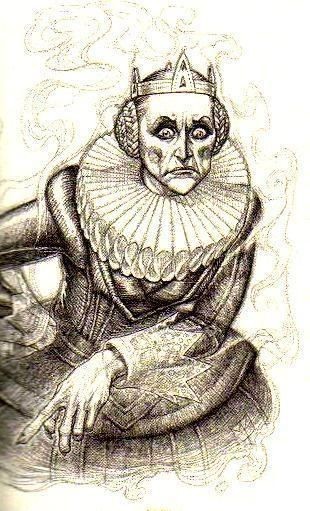
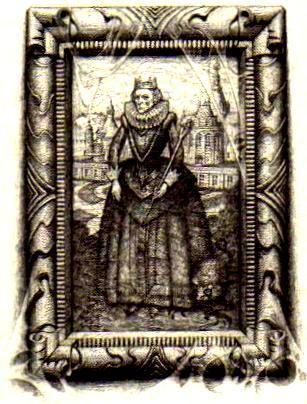
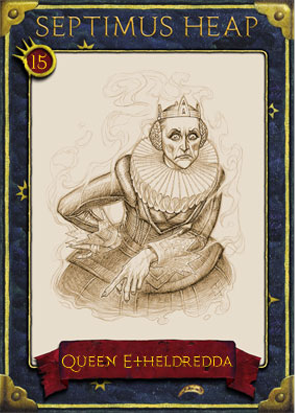
The third entry in Angie Sage's seven-book Sepimus Heap series, Physik (2007), begins with Septimus' feckless father Silas the Ordinary Wizard and his coarse "friend" Gringe the North Gate Gatekeeper (two of the many fallible adults whose mistakes make life interesting for Sage's child heroes and readers) "UnSealing" a Sealed room in the palace attic so that Silas may keep safe there his prized colony of sentient board game counters. By opening the Sealed room, the clueless men release two malevolent Substantial Spirits, the ghost of the wonderfully named Etheldredda the Awful, who has been waiting with her pointy chin, pointy ears, pointy shoes, and disapproving expression for 500 years to become Castle Queen again, this time forever, which may involve getting rid of any troublesome princesses in her way, and the ghost of her pet Aie-Aie, a red-eyed, snake-tailed, single-toothed creature with a penchant for spreading disease. Thus begins an exciting and unpredictable plot of multiple point of view characters and two time streams, one in the present and one 500 years in the past.
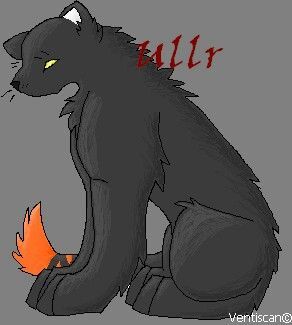
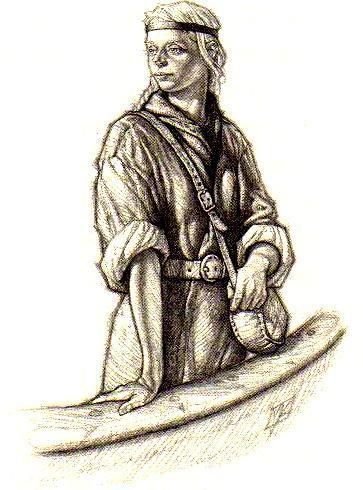
Sage introduces neat new characters, like the 14-year-old Hanseatic League Northern Trader Snorri Snorrelssen, who's come to the Castle of the Small Wet Country Across the Sea for the first time, partly in search of the ghost of her father. Snorri is great, with her attractive Scandinavian lilt, Spirit-Seer abilities, spunk ("No one told Snorri Snorrelssen what to do"), "white-blond hair," "translucent blue eyes" (Sage's fantasy world is quite white), and feline protector Ullr, a small orange cat by day and a powerful black panther by night. And the Last Alchemist Marcellus Pye, a selfish, decrepit, and senile 500-year-old who only breathes once every ten minutes and shuffles around under the moat at night looking for gold coins, is creepy and sympathetic.
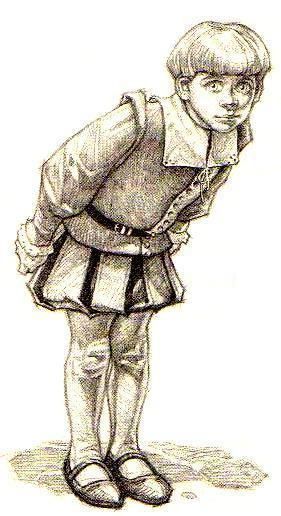
Sage develops former characters in neat ways, too, like Uncle Alther and Alice Nettles, whose cross-existence romance is wistful and sweet. She does a bit more with the ghost of Jenna's mother, the assassinated Castle Queen, who is still not ready to Appear before her daughter. Spit Fyre, Septimus' pet dragon, is growing apace, needing more food, producing more droppings (and burps, farts, and snot, Sage indulging the child reader's sense of potty humor), and learning how to ignite his gassy breath. Sage's protagonist Septimus Heap, seventh son of a seventh son, the Apprentice to the ExtraOrdinary Wizard, Marcia Overstrand, grows, too. He is covertly interested in Physik, which Marcia believes is too close to the dodgy (if not Darke) Alchemy. In this novel the boy will learn everything he ever wanted to know about such subjects, in addition to Time.
Sage interestingly plays with time: "Time Glasses" through which people may step (or jump or fall) into "the liquid cold of time" and end up elsewhen; the vertiginous and identity-threatening aspects of suddenly finding oneself in the distant past; and the debilitating effects of living forever without youth. She also makes explicit the Rules of Ghosthood. Spirits must stay for one year and a day in the same place where they died, after which they may move around, but only to places they visited when alive. They may only be seen by people they choose to Appear before. And although they may pass through anything or anyone and vice versa, they intensely dislike the nauseating experience.
Sage writes a lot of great lines (especially in context), like: "Ghosts must put up with the bad habits of the living," and "Even Alchemy Scribes had to sleep some time." And she writes many vivid and evocative descriptions (Sage's writing is more magical to me than Rowling's):
--"The barge was decked out in flags that fluttered in a wind that had died long ago."
--". . . the lingering smells of decaying spells …"
--"The low yellow stone building was ablaze with light, its wide lawns spread out before it with their fresh snowfall like a crisp white cook's apron."
--". . . there were things--soft, squishy things--floating in the water; he could feel the ends of his oars touching them."
Such rich writing outweighs Sage's few missteps, like similes whose anachronistic vehicles violate her fantasy world, as when Spit Fyre moves his tail back and forth "like a great windshield wiper," or as when Etheldredda's voice "has the penetrating quality of a dentist's drill."
Sage writes an archaic style to estrange the Castle of the past from her characters and readers. Although some of it sounds dodgy, like "Now, hie thee to the Great Gates, thee to the stables and thou, fools, take thy great flat feet to the river" (thee, thou, and thy should maybe be for singular cases), it often sounds fine, like "Whereupon Mary didst wail, like the pigs do wail when they see the meat cook's cleaver."
The book concludes with Sage's fun epilogue, "Things You Might Like to Know More About," recounting the fates or backgrounds of several characters.
Readers like me who were put off by the manufactured action and unpleasant character development and lack of consistency and charm of the second book, Flyte, should try this third one, because Physik is excellent. Moments like Jenna rescuing a plucked duckling from a scalding orange sauce and later falling asleep with it are charming; moments like Septimus walking into the Great Hall of the Wizard's Tower 500 years ago and deceiving himself that he's in his own time are moving. Readers who like imaginative and humorous YA magical fantasy with a Darke streak should enjoy Physik and the series in general.