Laaabai miela ir informatyvi knyga apie astronomiją ir įvairius būdus stebėti dangų: infraraudonuosius spindulius, radijo bangas, mikrobangas ir pagaliau – gravitacines bangas. Knygos tonas labai pagaulus ir paprastas: kai pradėjo nuo to, kas yra ir šviesa, ir nuo Aristotelio, bijojau, kad bus PERNELYG paprastas, bet ne – sužinojau labai daug, o žinios buvo inkorporuotos natūraliai, tarsi pokalbio metu, beveik nepastebint. Autorius pasakoja apie atradimus astronomijoje, neina itin giliai į “daiktų prigimtį” (pasako, kad apie šviesą galima galvoti ir kaip apie bangą, ir kaip apie dalelę, bet išryškina vienai ar kitai idėjai svarbesnį aspektą, užuot ėjęs į ontologinius svarstymus), kas mane kitu atveju gal būtų nuvylę, bet čia atrodė kaip tiesiog gerai suvaldyta medžiaga, o tos medžiagos yra DAUG!
Keli dalykai, kuriuos pasižymėjau skaitydama: nebūtinai reprezentatyvūs visai knygai, bet mane nustebinę ir nudžiuginę (daug apie saulę, gal kad skaičiau žiemą):
• Na, turbūt visi žinome, kad be šviesos, kurią matome, yra ištisas nematomos šviesos spektras. Kodėl matome būtent tokį? Dėl saulės – sako autorius. Jos paviršiaus temperatūra generuoja bangos ilgį tiksliai mūsų matomo šviesos spektro viduryje. Jei orbituotume daug karštesnę ar šaltesnę žvaigždę, greičiausiai matytume visai kitą šviesos spektrą.
• Kodėl dangus mėlynas, o saulėlydžiai raudoni? Trumpesnio bangos ilgio (mėlyna) fotonai lengviau išsisklaido, susidūrę su atmosferoje sklandančiomis dalelėmis (vandens garais, dujomis etc), todėl, kai saulė mums virš galvos, matome mėlyną dangų. Kai saulė arti horizonto, jos šviesai reikia pereiti didesnį atmosferos sluoksnį, kol pasiekia mūsų akis, per tą laiką visi “mėlynos bangos ilgio” fotonai išsisklaido ir mus pasiekia tik “raudoni”.
• Vėl saulė. Žinom, jog ji dega, nes jos viduje taip karšta ir suspausta, kad vyksta branduolinės reakcijos – vandenilis virsta heliu. Bet aš nežinojau, kad tos reakcijos vyksta dėl tikimybinės kvantinių reiškinių prigimties: vandenilio atomai šiaip vienas kitą nustumtų, bet, kadangi kiekvienas jų egzistuoja ir kaip tikimybinis “debesėlis” (autorius sako, jie “pusiau egzsituoja keliose vietose vienu metu”), kartais, visai atsitiktinai, tas kvantinis pusiau egzistavimas užkelia vieną jų ant kito ir įvyksta reakcija! Tikimybė, kad taip nutiks, LAABAI maža (1 iš 1028), bet saulėje vandenilio atomų tiek DAUG, kad šita reakcija vyksta trilijonus kartų per sekundę. Argi ne nuostabu? Man tai žiauriai nuostabu.
• Kodėl negaliu sutraiškyti akmens rankoje arba pereiti kiaurai sienos? Medžiagoje erdvės tarp atomų yra pakankamai daug, kad iš principo pavyktų tai padaryti, bet trukdo cheminiai ryšiai tarp atomų. Jei spaustum labai labai stipriai, tau pavyktų (deja, net jei pavyktų tiek prisikačialinti, kad įgytum didelės žvaigždės jėgą, sutrikdytum visos Saulės sistemos gravitacinę pusiausvyrą). Nu va, tai taip susidaro baltosios nykštukės – žvaigždės iš atomų, sugrūstų vienas ant kito.
• Kas toliau? Toliau žvaigždei spaustis trukdo – IR VĖL – kvantinis reiškinys, t.y. Paulio principas, kuris sako, kad du fermionai negali būti toje pačioje būsenoje tuo pačiu metu: jei vienoje orbitalėje telpa du elektronai, tai jie turi turėti priešingus sukinius. Šitas elektronų pasipriešinimas veikia daug mažesnėje skalėje ir yra daug stipresnis už cheminius ryšius, taigi jį nugalėti gali tik labai masyvi žvaigždė – bet gali, ir tada jie susipaudžia iki neutroninės žvaigždės (kurios tankis toks didelis, kad, jei stovėdamas ant jos numestum pieštuką, jis trenktųsi į žvaigždę 5 milijonų kilometrų per valandą greičiu). Neutronai dar labiau negu elektronai nenori susispausti, bet jei gravitacija nugali ir jų pasipriešinimą, atsiranda… Teisingai, juodoji skylė!
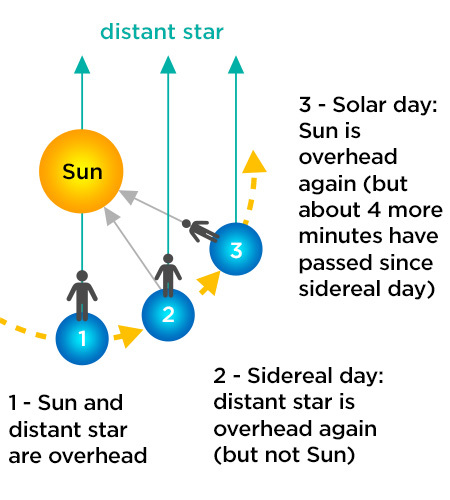
• Radijo bangų astronomijos atradimas: 1930iniais toks Janskis aptiko radijo signalą, kuris kasdien pereina per žemę iš rytų į vakarus. Gal saulė? – galvojo jis. BET! Janskis pastebėjo, kad signalas kartojasi kas 23 valandos 56 minutės, taigi ne tiksliai kas parą. Kaip čia yra? Janskis surado labai fainą ir logišką paaiškinimą: mes skaičiuojame parą tada, kai Žemė atsisuka į saulę tiksliai toje pozicijoje, kur buvo (pvz nuo tada, kai saulė buvo tiksliai virš galvos, iki tada, kai ji vėl tiksliai virš galvos). Bet juk Žemė sukasi ne tik apie savo ašį, bet ir keliauja aplink saulę! Taigi pilnai apsisukusi aplink savo ašį ji turi padaryti dar mažytį papildomą pasisukimą, kad saulė grįžtų tiesiai virš galvos. Nu krc, labai sunku papasakoti, bet va schema: Kaip bebūtų keista, Janskio atradimu niekas pernelyg nesusidomėjo, kol 1940inių viduryje prie tos pačios užduoties prisėdo astronomas-mėgėjas Reberis atrado, kad tas radijo signalas sklinda iš (mūsų galaktikos centre esančių?) kosminių dulkių, kur gimsta naujos žvaigždės.
• Didžioji knygos dalis kalbėjo apie elektromagnetines bangas: šviesą, infraraudonuosius spindulius, mikrobangas, radijo bangas. Bet dabar turime naują “mediją” stebėti astronominius reiškinius – gravitacines bangas, kur “vibruoja” ne elektromagnetinis laukas (kaip šviesos atveju), o pats laikas ir erdvė. Labai patiko visa istorija apie LIGO gravitacinių bangų detektorių! Įvykis, kurį jie siekė išmatuoti – laiko ir ervės susitraukimas ir išsiplėtimas, per Žemę pereinant gravitacinei bangai iš tolimų susijungiančių juodųjų skylių – buvo itin “mažas” (tūkstantoji protono skersmens dalis, tai tarsi bandyti išmatuoti atstumą nuo Žemės iki saulės vieno atomo tikslumu), taigi reikalavo labai gerai apgalvoto eksperimento ir labai tikslių matavimų. Patys detektoriai buvo du skirtingose vietose (jei nepraeina per abu, vadinasi, tai ne gravitacinė banga), kiekvienas iš jų turi dvi keturių kilometrų ilgio “rankas”, sudėtas statmenai viena kitai (nes bangai einant viena susitrauktų ir išsiplėstų, tada kita). Matavimas vyko siunčiant šviesos signalus pirmyn atgal ir atspindint juos veidrodžiais, kad jie vėl grįžtų ir susijungtų – per mechanizmą pereinant gravitacinei bangai susijungimas būtų kiek pavėluotas. Maža to, mokslininkų komandoje buvo “slapti” žmonės, kurie turėjo karts nuo karto į duomenis įmaišyti klaidingai teigiamą (neva kad atrado bangą) signalą – vokas, kuriame parašyta, kuris signalas buvo tyčia netikras, buvo užantspauduojamas ir atidaromas tik tada, kai mokslininkai, manydami atradę gravitacinę bangą, jau būdavo ir parašę publikavimui paruoštą straipsnį apie ją. Tai turėjo užtikrinti, kad visi itin kruopščiai patikrins bet kokį rezultatą – niekas nenori veltui vargti rašydamas straipsnį. Galiausiai, po dviejų detektoriaus upgrade’ų, 2015-aisiais atrasta pirmoji gravitacinė banga.
• Tą bangą sukėlė dvi 30 ir 35 saulės masių juodosios skylės. Joms susijungus iš to liko 62 saulės masių juodoji skylė. Kur dingo trys likusios saulės masės? Jos virto gryna energija, kuri ir sukėlė LIGO susektą laiko ir erdvės bangavimą. Masę galima paversti energija, – sako autorius, – bet jos tada išeina LABAI DAUG. Pavyzdžiui, Hiroshimos bombos sprogimas į energiją pavertė 0,7 gramo masės. Nepilną gramą! O dabar įsivaizduokime, kas nutinka į energiją pavertus tris saulės mases!
Buvo dar labai įdomių pasažų apie “cosmic candles” ir tamsiąją energiją, bet pabaigsiu su paskutiniu (ir labai gražiu) palyginimu:
• Jei Saulės sistema būtų monetos dydžio, kur Neptūno orbita atitiktų monetos kraštelį, kaip manote, kokio dydžio būtų mūsų Paukščių Tako galaktika? Galim spėlioti, kad futbolo aikštės ar net miesto dydžio, bet ne – jei Saulės sistema būtų kaip moneta, mūsų galaktika būtų EUROPOS DYDŽIO!
Man labai patiko šitas, tuo pat metu suvoki ir savo menkystę, ir tik dar labiau žavi astronomijos ir kosmologijos pasiekimai. Juodosios skylės fotografija, gravitacinių bangų detektorius, už 13 milijardų šviesmečių esančių galaktikų stebėjimas, Didžiojo sprogimo reliktas – cosmic microwave background… Visa tai mes, kaip žmonija, kažkaip išsiaiškinom, o mane tokios knygos įkvepia gyventi sveikiau, kad išgyvenčiau iki kitų didžiųjų atradimų apie Visatą.
While there's little in this book that I haven't encountered in other pop-sci volumes, Bothwell is such a wonderful and enthusiastic communicator that every page is infused with the light of new perspectives. Bothwell explains fundamental facts of physics like the electromagnetic spectrum and general relativity in clear, readily understandable ways that are both jargon-free and refreshingly visualizable. This is one of those books where the reader joins the voyage of curiosity rather than just hearing the tales afterward. I thought he did a great job. Highly recommended for a good overview of the current state of knowledge in astronomy and cosmology. I'll definitely be looking out for his future works.
Matthew Bothwell's "The Invisible Universe: Why There's More to Reality than Meets the Eye" takes readers on an awe-inspiring journey into the depths of our universe, uncovering the hidden wonders that lie beyond what our eyes can perceive. With a captivating blend of scientific knowledge, vivid storytelling, and philosophical insights, Bothwell expands our understanding of the cosmos, challenging our preconceived notions and inviting us to explore the mysteries that lie beyond the boundaries of human perception.
In this book, Bothwell, an astrophysicist at the University of Cambridge, delves into the realm of invisible phenomena that shape the universe. He embarks on a mission to demystify complex concepts and presents them in an accessible manner, making this book a must-read for both science enthusiasts and casual readers seeking to expand their horizons.
Bothwell's writing style is engaging and approachable, seamlessly blending scientific explanations with personal anecdotes and historical context. He weaves together a narrative that is both educational and entertaining, taking readers on a thrilling expedition through the invisible realms of the universe.
One of the book's strengths lies in Bothwell's ability to break down complex scientific concepts into digestible pieces. He employs clear and concise language, making even the most intricate ideas comprehensible to readers without an extensive scientific background. Whether discussing dark matter, black holes, or the expansion of the universe, Bothwell demonstrates his knack for simplifying complex theories without oversimplification.
Furthermore, Bothwell's enthusiasm for his subject matter shines through in every chapter. He conveys a genuine sense of wonder and curiosity, infecting the reader with his own awe for the invisible forces shaping our universe. This passion for discovery is contagious, creating a sense of excitement that carries readers from one page to the next.
"The Invisible Universe" also excels in its meticulous exploration of scientific evidence and discoveries. Bothwell draws upon a wide range of studies, experiments, and observations to support his arguments and unravel the mysteries of the hidden universe. He guides readers through groundbreaking research, explaining how scientists have pieced together the puzzle of the invisible cosmos over the course of history.
Moreover, Bothwell skillfully addresses the limitations of human perception and the tools we use to explore the universe. He delves into the history of scientific instruments, from Galileo's telescope to the Hubble Space Telescope, highlighting how technological advancements have played a crucial role in uncovering the invisible aspects of our universe. By emphasizing the iterative nature of scientific progress, Bothwell instills a sense of optimism and possibility, encouraging readers to embrace the unknown.
In addition to the scientific content, Bothwell integrates philosophical and existential reflections throughout the book. He contemplates the nature of reality, the human role in the universe, and the meaning we derive from our explorations. These philosophical interludes offer a refreshing perspective, elevating "The Invisible Universe" beyond a mere scientific exploration and turning it into a profound contemplation of our place in the grand scheme of things.
Another commendable aspect of the book is Bothwell's commitment to inclusivity and diversity. He acknowledges the contributions of scientists from diverse backgrounds and shines a light on the often overlooked or underrepresented voices in the field. By doing so, Bothwell demonstrates that scientific progress thrives on diversity and encourages readers to appreciate the wealth of perspectives that shape our understanding of the universe.
However, it's worth noting that "The Invisible Universe" may not satisfy readers seeking a comprehensive understanding of every topic discussed. Given the vastness and complexity of the subject matter, Bothwell understandably prioritizes brevity and accessibility, occasionally sacrificing in-depth explanations. While this approach benefits casual readers, those well-versed in astrophysics may find themselves craving more detailed information. Nonetheless, Bothwell provides ample references and further reading suggestions for those who wish to delve deeper into specific topics.
Overall, "The Invisible Universe: Why There's More to Reality than Meets the Eye" is an excellent book that is well worth reading. It is informative, engaging, and beautifully illustrated. Bothwell's expertise and enthusiasm shine through on every page, making this a must-read for anyone interested in the mysteries of the universe.
I was looking for a book about dark matter and dark energy and pre-ordered this based on the title. What I got was much more than I expected. There is a whole journey across the entire electromagnetic spectrum with its fascinating history, incredible revelations and groundbreaking discoveries before the book even starts discussing the very latest understanding and theories of both dark matter and dark energy. The writing is very fluent and whilst much in the earlier chapters will already be known to readers interested in this area of science there is definitely plenty of new information as well as a real interest in the background story of discoveries to make this a very worthwhile popular science book indeed. My only criticism is that the picture section is not linked to the text and the beautiful colour images are of course not coming across on the Kindle e-reader and will need to be viewed using the Kindle app on another device with a colour screen, ideally a big one! All in all a brilliant book which at the time of publishing really is up-to-the-minute with regards to the science it conveys.
I listened to From Eternity to Here and this one back to back on a road trip last week. Here is what I spoke into my notes as I was driving after finishing both (with some punctuation added after the fact):
"It's kind of depressing thinking about this stuff because in the late '90s when I was really getting into it, the theory of the universe ending with a big crunch was popular. But now I guess that's not going to happen. There's no big crunch. What's going to happen is it's going to keep expanding and expanding until it's just this cold nothingness because everything's so far apart, and then all the stars are going to die, and the only things left are going to be black holes, and then even those are going to combine until it's just one enormous super duper massive black hole that over an unimaginable amount of time will also be reduced to nothing and will disappear forever. I don't know which is worse, frankly, a crunch or nothingness like that I mean I guess it all ends the same way right back to nothing dust to dust bowl of April that is not what I said this text is this speech to text is wrong oh my god I declare all right that's it"
But anyway. This book was way more fun to listen to as a fan of physics and not a scholar for the obvious reason that Eternity was more technical and detailed, so if you're into that, you're in luck. This one focuses on radio waves and other invisible parts of the spectrum while the other book is mostly about entropy. There was some overlap - anecdotes of those crazy physicists and some current and recently-debunked theories.
I've always loved the ends of these kinds of books when they get into the questions plaguing scientists today like: What exactly is x? Why is x? Can x prove y? And the answer is always
Tough one to rate, but I thought it was a great foundational summary that was nearly perfectly written. There was a mild downside of having read of a lot of what was covered before, but because he explains things better than my prior exposure, it wasn't annoying in the least. Bothwell has a particular talent for vivid metaphors.
The Invisible Universe explains things like you are a 5th grader while not treating you like a 5th grader - which appears to me to be much harder than it looks for specialists in complex fields.
Perfect book for precocious tweens to non-STEM grownups who are interested in cosmology/astronomy.
Fabulous - Extremely comprehensive and provoked so much excitement in me. This book reveals the huge potential for scientific discovery over the coming years; I’m beyond thrilled to have read about them so that I can keep an eye open and witness them happening in real time!
The Invisible Universe: Why There’s More to Reality than Meets the Eye by Mathew Bothwell
“The Invisible Universe” is a fascinating “look” into the cosmic reality we can’t see. Astronomer and science communicator based at the Institute of Astronomy and the Kavli Institute for Cosmology at the University of Cambridge, Mathew Bothwell provides readers with an engaging and accessible guide to the invisible universe. This enlightening 308-page book includes the following nine chapters: 1. What is light?, 2. The hidden infrared cosmos, 3. Microwaves and the start of the Universe, 4. Monsters in the dark: the quest to find the Universe’s hidden galaxies, 5. Black holes: agents of destruction, agents of creation, 6. Astronomy at the longest wavelengths, 7. Dark matter: a cosmic ghost story, 8. Ripples in space and time and 9. Dark energy, and the future of our Universe.
Positives: 1. Engaging and well-written book. Bothwell does a wonderful job of guiding the reader through complex topics at an accessible level. 2. The fascinating topic of the cosmic reality we can’t see. 3. Bothwell’s expertise and background as an educator lends itself well for guiding the general public on what otherwise are complex topics. His writing style is engaging, accessible and with a touch of humor. 4. Good use of diagrams and photos to compliment the excellent narrative. 5. Describes light. “The best answer we can give – and this is still deeply mysterious and confusing – is that it is both at the same time. It’s a wave, and also a particle, all at once.” 6. Understanding the three categories of infrared. “Using these ideas, we can broadly categorise the near-, mid- and far-infrared into rough temperature ranges. Near-infrared light will be emitted by things which are fairly hot – not quite as hot as our Sun, but still very hot by Earth standards, at hundreds or thousands of degrees Celsius. The mid-infrared will be emitted by things which are, more or less, around a comfortable room temperature. And the far-infrared, in turn, will trace the very coldest corners of the Universe.” 7. Does a wonderful job of explaining key concepts concerning the life and death of stars. “This nuclear reaction, in which four atoms of hydrogen are crashed together to produce an atom of helium (and a bit of leftover energy), is what powers the Sun, and is responsible for all life on our planet.” 8. Tells the story of modern cosmology. “Cosmology and astronomy are subtly different things: while astronomy is the study of the constituents of the Universe – like stars, planets and galaxies – cosmology concerns itself with the Universe as a whole.” 9. Hubble’s most famous result discussed. “Hubble’s most famous result – and one of the most important astronomical results of all time – came when he compared the speeds of these galaxies with their newly measured distances. The results were clear and striking: firstly, all galaxies seemed to be moving away from us. Secondly, and most importantly, the further away a galaxy was, the faster it seemed to be travelling.” 10. Throughout the book the author discusses astronomical discoveries that feeds on previous discoveries and help confirm scientific theories. “The existence of this ‘afterglow’ radiation – a fossil from the young, hot Universe – was a specific prediction of the Big Bang theory.” 11. A wonderful analogy that resonated and that and that I use to explain the immensity of the universe. “Galaxy is to imagine shrinking everything down, until our Solar System is the size of a ten pence coin (with the Sun a tiny burning dot in the centre, and Neptune orbiting around the outer edge). Imagine this coin-sized Solar System lying on the floor in front of you. How big would our Milky Way be in this model? A few hundred metres? Several kilometres, even? In actual fact, on this scale the Milky Way would be roughly the size of Europe.” 12. Describes the main purpose of the James Webb Space Telescope (JWST). “Webb’s primary science goal, however, is to look back further than ever before and finally glimpse the primeval stars and galaxies that produced the first light in the Universe.” 13. A “look” at black holes. “The answer is that we can’t see the black hole itself, but we can certainly see the effect the black hole has on the things around it. And black holes, having the most powerful gravitational fields in the Universe, have an effect on their surroundings that is hard to miss.” 14. The key substance of the universe. “Hydrogen is both the simplest and most abundant substance in the Universe. It is, in fact, the simplest substance that can possibly exist: one proton, with one electron orbiting it, and nothing more. This simple stuff makes up around seventy-five per cent of all the normal matter in the Universe (I’m using ‘normal matter’ here to mean ‘baryons’, the physics term for normal material made up of protons and neutrons – we’re not counting stuff like dark matter here, which far outweighs everything else put together).” 15. The evidence for dark matter discussed. “A lot of the evidence for the mysterious stuff astronomers came to call ‘dark matter’ is based on the behaviour of gravity.” 16. The predictive power of science. “Given that they had a good understanding of how gravity should work, their best guess was that there had to be something out there they could not see, tugging on Uranus and causing it to do unexpected things. And they were completely right: Neptune turned up, exactly as predicted.” 17. The search for gravitational waves. “The third grand revolution in astronomy happened at 4:50 a.m. on 14 September 2015. In January the following year (such a significant discovery needed to be checked and rechecked, of course, which took a few months), my Cambridge colleagues and I sat in a packed lecture theatre to hear the historic live-streamed announcement: a team of astronomers had detected gravitational waves, a completely new way to see the Universe.” 18. The grand theory of General Relativity by Einstein. “Using General Relativity, we can now give Newton an answer. Gravity is not a mysterious pulling force which acts at a distance; it’s just what happens when you move through curved space.” 19. The enlightening topic of dark energy. “Dark energy, on the other hand, is far more mysterious. It could well be some sort of springy ‘pushing force’ built into the very fabric of the Universe itself (I’ll get to some ideas for how that might work below). They even act in opposite ways: dark matter attracts, while dark energy repels.” 20. Includes a Suggestions for further reading section. Negatives: 1. I would have added a timeline of major cosmological events. 2. Some extras like a glossary of key terms would have been beneficial.
In summary, an excellent book on astronomy/cosmology that focuses on the invisible spectrum of the universe. Mathew Bothwell is indeed a gifted writer; he takes complex concepts of science and makes it accessible to the layperson. The book keeps your interest without bogging you down with formulas. Bothwell is an excellent communicator and I look forward to more books in the future. So much to like here, I highly recommend it!
Further recommendations: “Universe in Creation: A New Understanding of the Big Bang and the Emergence of Life” by Roy R. Gould, “A Universe from Nothing” by Lawrence Krauss, “Until the End of Time”, “The Elegant Universe” and “The Hidden Reality” by Brian Greene, “The Big Picture: On the Origins of Life, Meaning, and the Universe Itself and “From Eternity to Here: The Quest for the Ultimate Theory of Time” by Sean M. Carroll, “Origins: Fourteen Billion Years of Cosmic Evolution” by Neil deGrasse Tyson, , “To Explain the World: The Discovery of Modern Science” by Steven Weinberg, “Why Does E=mc2?” and “Wonders of the Universe” by Brian Cox, “Longitude” by Dava Sobel, “Cosmos” by Carl Sagan, and “The Grand Design” by Stephen Hawking.
The word "Invisible" in the title of the book reveals the perspective which the author used in explaining how some of the astronomical phenomena were discovered, detected, explored and confirmed through the invisible (to human eyes) spectrum of the whole electromagnetic spectrum. These invisible spectrum sections include gamma-ray; X-ray; ultraviolet; infrared; microwave and radio waves.
The book is structured with chapters progressively in the relevant astronomical discoveries along with the technologies (especially telescopes) that leveraged different invisible spectrums ... X-ray, infrared, microwave and radio waves. Among all features of the universe, the invisible spectrum led us to the existence of CMB (Cosmic Microwave Background), pulsars, neutron stars, black holes, dark matter, gravitational waves and dark energy.
The excerpts below in the Conclusion of the book gives an overall achievements on the use of the invisible spectrum:
"We search for exoplanets in visible light, and use infrared light to probe their atmospheres, while radio telescopes examine them for the chemical building blocks of life. We use X-rays to search for scorching hot gas swirling around black holes, while radio waves reveal what those same black holes are spitting out. We pore over microwave maps of the early Universe, and match the patterns we see to the grand structure of the Universe around us, as seen in visible light ..."
This book maps the different invisibilities within our known universe from the shortest wavelengths to the longest. And, throughout, the question around our explorative instinct whispers as it calls the reader forward.
Excellent book on how astronomers use the different wavelengths of light to discover the truth about the universe,from supermassive black holes in gargantuan ancient galaxies,to the quantum particles that are threading and weaving our reality.
It’s quite understandable if you’re just getting into astrophysics and the science is really easy to get behind.
Favourite quotes:
“Cosmology and astronomy are subtly different things:while astronomy is the study of the constituents of the Universe-like stars,planets and galaxies- cosmology concerns itself with the Universe as a whole. … While astronomy and physics grapple with the constituents of the Universe,cosmology is the quest to answer some of the most fundamental questions it is possible to ask.”
“The very sparse gas that exists between galaxies (known as the InterGalactic Medium,or IGM) will affect radio waves just like a prism affects sunlight,by slightly slowing down the longer wavelengths. The effect is called ‘dispersion’…”
“Newton’s law of gravity says that gravitational force from an object depends on just two things: the mass of the object,and how far away it is(plus something called the ‘gravitational constant’,which is a number seemingly built into the fabric of the Universe itself that dictates exactly how strong gravity is). Increase the mass of the Sun,and it’s gravitational pull gets stronger. Move further away from the Sun, and the gravitational pull gets weaker. This formulation,put into mathematical terms,is all you need to explain the motion of the Moon around the Earth, and the Earth around the Sun.”
“Any object in the Universe will warp and curve the space-time around it. And anything travelling through this curved space is going to have its motion affected.”
“Space and time are a flexible fabric,and gravity is a measure of how severely this fabric is curved.”
“…this very early era,just a couple of billion years after the Big Bang,represents a time before dark energy kicked in and started speeding the Universe up. For the first couple of billion years the expansion of the Universe was indeed slowing down,just as everyone had originally expected. But,around eight billion years ago,the Universe had got big enough for dark energy to start to have an effect, and the expansion of began to accelerate.”
“Another critical thing you might want to know about a growing galaxy is how fast it is making new stars - how rapidly the engine of galactic growth is churning over. For that,we need to turn to a new wavelength. Far-infrared light,collected from a spacecraft above Earth’s atmosphere,reveals the coldly glowing dust which cocoons the stellar nurseries in this distant galaxy. Carefully analysing this far-infrared light gives us an idea of how many of these stellar nurseries there are, and how actively they are forming stars. These long wavelengths give us another piece of the puzzle: along with how many stars there are in total, we now know how fast new ones are being born. Using radio telescopes,we can listen out for the telltale signatures of supernovae,as electrons get whipped around by the magnetic fields of these dying stars, and by observing high-energy X-rays we can probe the behaviour of the supermassive black hole,looking for signs that the central monster might be active and affecting the core of the young galaxy. Each wavelength has its own story to tell, and each provides a different piece of the puzzle. By looking with the light our eyes can see,we might be able to tell that the galaxy exists-but not much more. But by harnessing the full power of invisible light across the entire spectrum,we can weigh,measure and inventory this ancient galaxy,top to bottom.”
Matthew Bothwell takes you on a grand tour of the universe (and its unknown mysteries)
Note: This is a no obligation honest review of an ARC of the book sent to me by the book’s publicist: the final published edition (hardcover out Dec 7th, 2021) may differ from the copy I am reviewing.
Dr. Matthew Bothwell joins a growing group of scientists turned science communicators, writing excellent non fiction science for the general public making modern science interesting and more accessible. In The Invisible Universe, his first book, he takes us through the main tourist attractions of our cosmos: a highly recommended and enjoyable read, especially if this is your first guidebook to the universe. If, like me though, you are an avid space enthusiast (e.g. own and use a telescope, have a subscription to Sky and Telescope, watch Cosmos for fun, etc.) you’re less likely to see/learn anything new but still enjoy the refresher and a new anecdote or two.
A Familiar cast of characters
The book title and premise/promise is a revelation of things in the sky that we cannot see with our eyes—the visible part of the electromagnetic spectrum being but a thin sliver of its entire span. As Dr. Bothwell helpfully explains that is akin to hearing music from only one octave of a giant piano that actually contains sixty five octaves—a novel and memorable analogy that is based on current commonly detected photon wavelength spans (from Gamma to Radio waves) But this by itself should not be news to most: medical diagnosis uses a variety of signals from X-rays to ultrasound to study ourselves. So it should be no surprise that our understanding of our universe comes from using every possible means available to study it.
Wow, wow, wow. Stunning. The author so beautifully explains the cosmos, in a simple, understandable way. The chapters follow each other like beads on a string, logically, so there are no gaps or parts that are missing in order to understand something; everything is connected. The book highlights the most important discoveries in astronomy, from explaining what light actually is; throughout the invisible parts of the light; pulsars, hidden galaxies, and black holes, to the most complex things such as quantum mechanics, dark matter, dark energy and gravitational waves. He explains something from its very beginnings, what led to some discovery, who did it, what were the challenges and struggles, what is its scientific background, and how is it actually important to astronomy. He goes from the prism, through the first optical telescopes and telescopes dedicated to detecting other wavelengths, to the most advanced and sensitive instruments ever built; and how all of these things helped us understand the Universe. Throughout the whole book, you can feel the passion and thrill the author shares with us, and actually gasp at some parts. A beautiful gift of storytelling and communicating science. A big plus, I would add, is acknowledging the struggles of females in science and recognizing it; as well as, providing resources for further reading (since I'm in search of more books like this). The only thing that I would change is adding pictures in the text, not at the end of the book, and more schemes when a complex thing is explained.
He provides a very good explanation of light, the visible and invisible spectrum and the importance of relating images taken using different wavelengths. He starts with basic simple studies on light.
We live in an expanding Universe. As light travels through the universe, energy drops. I like his diagrams explaining a time line from the Big Bang about 13.7 billion years ago, the hidden galaxies some 10 billion years ago, and Earth formed 4 billion years ago -- Galaxies are made of gas and dust and hundred of million of stars and dark matter to hold them together. Using infrared, astronomers can se the hidden stars being formed within the dust in a galaxy like our Milky Way or any other galaxy. **NASA’s James Webb Space Telescope, the 6.5 meter (21 feet 4 inch) launched in Dec 25 2021 looks at (among other jobs) the supermassive black hole at the heart of our Milky Way galaxy. Much testing was done to be close to the conditions that Webb would experience so the observatory would be fully prepared for its science mission one million miles away from Earth. We on Earth might just as well read the NASA website to keep up with what's new in Galaxy studies -including warped space time and worm hole technology.
This is an excellent book. I read this book as part of our "DEAR" programme at school (Drop Everything And Read). It was a quick choice, with little thought behind it. What a lucky decision. The book elegantly uses the unseen parts of the electromagnetic spectrum to show the reader the contents of our universe. It is both a book about physics, mostly waves, and a book about the cosmos. But it doesn't just cover the em spectrum, neutrinos, gravitational waves, dark matter and dark energy are also described. So the reader is being simultaneously educated about two things as they progress through the book. The writing is clear and the pace is good. Just enough detail is gone into, but not too much. The author knows how to write. I have to confess one of the reasons I like this book so much is that is is very suitable for the GCSE and A level students I teach. There is the wow factor; pulsars, black holes, dark matter; but there is also real hard science here. I hadn't quite grasped how much larger the infra red section of the spectrum is compared to the tiny size of the visible spectrum. Not only will my students be "wowed", but they will learn physics that is relevant to their exams.
This was quite fun. Very accessible, given the discussions of spacetime, gravity waves, dark matter, dark energy and the like.
The "why there's more to reality" in the subtitle is a bit of an overclaim, though - this is really about *how we know there's more to reality*. A subtle difference, but an important one, as this book is more about the advances in astronomy over the last century or so, and how's that's shifted out understanding of how the universe seems to work.
This doesn't, however, fully explain *why* the universe works the way it does, because there are still vast gaps in our knowledge and understanding.
It's still fascinating, though - especially how recent much of this is. I've had another book on astrophysics knocking around somewhere for a few years, waiting for me to finish reading it. That came out in 2004. This one came out in 2020. The 2004 one's already kinda obsolete, as gravity waves weren't conclusively proven until 2019. And it's likely this one's also already out of date in some areas by now.
Still, this *is* interesting. Even if I couldn't help but ask myself "so what?" throughout. What practical purpose does this knowledge serve?
a hard read but well worth it. after reading more about our solar system, infrared, dark matter vs dark energy, cosmic dust, black holes, stars and how we measure how far away something is and how we calculate the weight of the sun, after learning about all that and then to be told on the last page that it’s a fact we have only discovered 5% of the universe is bonkers. ‘we don't even know what ninety-five per cent of our reality is made from.’ - direct quote. and there will be some things that we will never discover bc it’s so far away from earth, by the time the light reaches us, we’ll be long gone. WHATTT?????? actually wtf
Very long winded. I learned some things but mainly because I googled questions that arrose from something he said, but didn't answer. Also drifted of during some of the chapters. Not sure if the material is really that boring or just not suited for listening to.
At one point he mentions that Stephen Hawkins had advised that for every equation you put in your book, your sales will be halved. This book seems to have been written entirely in that spirit. It sounded like the irony of mentioning this equation in his book was lost on Bothwell, but maybe I am not giving him enough credit.
An excellent exploration of astronomy and cosmology, written with impressive accessibility and a lot of heart. It covers many of the usual highlights of space stuff — pulsars, black holes, galaxies, dark matter and so on — but the distinguishing lens of the book's coverage is its focus on the process of how astronomers & physicists made their findings by taking advantage of infrared, X-rays, and other non-visible forms of detection. This contained a lot of interesting information about how key scientific discoveries were made, and really grounds the scientific practices that made these findings possible.
I'd recommend this book both to newcomers to the field of astronomy and longtime space enthusiasts — I'm firmly in the latter camp but learned a lot & enjoyed myself throughout this book.
Every one who can read need to read this .... everybody else is a looser. In simple terms author takes reader on a trip down universe (like taking you down town of the down town you remember). The author does not use 'notes attached' and remind you of a previous point made which make reading for me easy. What is the space and time of simply LIGHT and the impact had on humanity. My ignorance could not fathom this. I have no doubt this will be your most important book in your life.
Makkelijker voor mij om te lezen omdat ik een minor heb gedaan in precies dit vakgebied. Daarnaast wel een boek met heel veel stof, maar als de geboorte van sterren en universa, zwarte gaten, en andere sterrenkundige verschijnselen je interesseert dan zeker een aanrader. Geeft goed perspectief in hoe GROOT alles is en hoe klein wij zijn, door middel van voorbeelden. Ook wat info over hoe telescopen om bvb zwarte gaten te detecten gemaakt zijn. Al met al een boek waar ik vaak na het lezen van een pagina even uitzonede om er over na te denken.
Unlike the universe, this book is not infinite in length, which was a great pity to me. I thoroughly enjoyed the author's gentle explanations of the seen and unseen and unseeable forces that govern our cosmos, and the kind approach to illuminating topics like dark matter, which had previously mystified me. Thoroughly enjoyed and highly recommend if you are interested in space, astronomy or our universe
A brilliantly written book for complete "beginners". I've only read one book vaguely related ("The Afterglow of Creation") but I found this very accessible for the general reader who's interested in Astrology and Cosmology. Probably a good read before diving into anything more specific (I think ideally I'd have read this first). It was light enough that I was able to read a fair bit at a time before needing a brain-break.
I'm not very familiar with astronomy but I felt like I could follow the structure of the book and grasp the points that were being made. Overall I found this interesting and a good introduction in some of the topics of cosmology and astronomy. I do think he could have done better in the discussion of the anthropic principle but that is a side element to the book so I don't think it is important.
A solid read that delves into the ‘unseen’. What exists beyond our perception. Science is simply amazing to me. The what, when’s and why’s of the Universe and how it works. If your at all interested in what lies beyond what can be seen with the Human eye this book will provide a primer for what is there yet not seen. Enjoy!
This is popular science writing at its best. Starting from first principles, the author explains the topics and builds up on them in a clear and accessible way, repeating basic ideas only when necessary without bludgeoning us with repetition, and makes radio astronomy sound way cooler than I ever imagined it to be. Excellent writing, and I sincerely hope that he writes another one!
This book is a marvelous journey through the whole electromagnetic spectrum and its importance describing different events in the universe: newborn stars, black holes, beginning of the universe, pulsars and the specific type of non-visible spectrum that goes with the identification of each one of them. I really enjoyed Bothwell’s writing style and the topic was very interesting.