Jump to ratings and reviews
Rate this book

The Tudors: The Complete Story of England's Most Notorious Dynasty by G. J. Meyer

Rate this book
For the first time in decades, here, in a single volume, is a fresh look at the fabled Tudor dynasty, comprising some of the most enigmatic figures ever to rule a country. Acclaimed historian G. J. Meyer reveals the flesh-and-bone reality in all its wild excess.In 1485, young Henry Tudor, whose claim to the throne was so weak as to be almost laughable, crossed the English Channel from France at the head of a ragtag little army and took the crown from the family that had ruled England for almost four hundred years. Half a century later his son, Henry VIII, desperate to rid himself of his first wife in order to marry a second, launched a reign of terror aimed at taking powers no previous monarch had even dreamed of possessing. In the process he plunged his kingdom into generations of division and disorder, creating a legacy of blood and betrayal that would blight the lives of his children and the destiny of his country.The boy king Edward VI, a fervent believer in reforming the English church, died before bringing to fruition his dream of a second English Reformation. Mary I, the disgraced daughter of Catherine of Aragon, tried and failed to reestablish the Catholic Church and produce an heir. And finally came Elizabeth I, who devoted her life to creating an image of herself as Gloriana the Virgin Queen but, behind that mask, sacrificed all chance of personal happiness in order to survive. The Tudors weaves together all the sinners and saints, the tragedies and triumphs, the high dreams and dark crimes, that reveal the Tudor era to be, in its enthralling, notorious truth, as momentous and as fascinating as the fictions audiences have come to love.

Paperback

First published February 23, 2010

959 people are currently reading
16269 people want to read

About the author

G.J. Meyer

8 books232 followers
G. J. Meyer is a former Woodrow Wilson Fellow with an M.A. in English literature from the University of Minnesota, a onetime journalist, and holder of Harvard University’s Neiman Fellowship in Journalism. He has taught at colleges and universities in Des Moines, St. Louis, and New York. His books include A World Undone: The Story of the Great War, Executive Blues, and The Memphis Murders, winner of an Edgar Award for nonfiction from the Mystery Writers of America. He lives in Goring-on-Thames, England. (source)

Ratings & Reviews

What do you think?
Rate this book

Friends & Following

Create a free account to discover what your friends think of this book!

Community Reviews

5 stars
3,160 (34%)
4 stars
3,589 (39%)
3 stars
1,888 (20%)
2 stars
372 (4%)
1 star
128 (1%)
Displaying 1 - 30 of 538 reviews
Profile Image for Claire M..
Author 14 books37 followers
December 4, 2013
I was a history major at U.C. Berkeley, and my specific field was English Tudor-era history, so you can imagine that a huge hunk of my bookshelves are devoted to this subject. There is something of an embarrassment of riches on this topic, from J. J. Scarsbrick's definitive biography on Henry VIII to Antonia Fraser's book on Mary, Queen of Scots. I can say with confidence that there isn't a popular history of the Tudors that has been published that I haven't read, and I've read a great number of the academic studies as well. So yeah. I get them, I know them, and I looked at this book sitting on the shelf of my local bookstore and thought, please, do I need to read yet another book on the Tudors?

Yes, I did, as it turns out.

Other reviews that I've read focus on the problem with the scope of this book, with literally half of the content devoted to Henry VIII. Which begs the question, why is it called "The Tudors"? I won't say that it's not a problem. Clearly, Meyer is fascinated with Henry VIII and the courtiers surrounding him (Woolsey, Cromwell, and More are not your run-of-the-mill bureaucrats), and I think that he very much shortchanged the last fourth of the book, which is devoted to Elizabeth Tudor. I get the sense he was exhausted and gliding over events that really could have used some of his tremendous insight and turn of phrase that makes the first two-thirds of this book so enjoyable.

Because really, when you've read as many books as I have on the Tudors, it's the writing that becomes paramount, and this man can write. He's got an ease and facility for taking fairly complicated events and parsing them down to the bones. His chapters regarding Cromwell's stealth and ever-increasingly fatal attacks on the Catholic church are so well done that it's worth buying this book for those chapters alone.

There are a series of sidebars that I know annoyed some people, but I liked them. They take you out of the "story" to a certain extent, but I didn't mind. For an overview history, you don't NEED to read them, but they are, in and of themselves, interesting. The out-take on exactly what societal functions the Catholic church performed and how the break with Rome and cannibalization of the Church as a way to seriously pump-up Henry's power and coincidentally boost the Crown's coffers is especially well done.

I think that the point of the structure (front-loading the book with so much "Henry") is that Henry VIII so fundamentally changed the nature of kingship--castrating the Catholic Church in the process--that his heirs were not only dealing with the usual problems of a small island nation trying to play with the big boys (Spain and France), but faced the double whammy of trying to establish order in the wake of Henry's determined (some might say maniacal) juggernaut to establish his dynasty, regardless of the cost. And this book explains that cataclysmic upheaval (on all levels of society) very nicely with Henry's heirs struggling to impose order on a society where all of a sudden the rules have changed.

I only gave this four stars because I do think the section on Elizabeth could have benefited with a more rigorous treatment. Having said that, Meyer's writing is engaging, witty, and humorous, with a fresh take on a topic that has been revisited many times in the last twenty years. I found myself smiling and enjoying every word. Highly recommended.
Profile Image for Mara.
413 reviews309 followers
May 14, 2020
While author G.J. Meyer would be the first to admit that there is no way to cram the minutiae of more than a century of history into a single volume. However, he's captured a whole heck of a lot in this book. Furthermore, as promised, The Tudors: The Complete Story of England's Most Notorious Dynasty is not just the Henry VIII and Anne Boleyn show. Frankly, “The King's Great Matter” (the euphemism employed by those in the know to refer to the whole Catherine/Anne-annulment debacle) doesn't even begin to capture the full gamut of skullduggery of Tudor times.

It's hard to know where to begin with this debauched dynasty. Henry Tudor's ascent to the throne was rife with baggage and bloodshed. One might think that, five hundred years after the Battle of Bosworth , interest might have waned, but we're still running baby-daddy tests and bickering about that debacle. But Henry VII took the throne by combat, so let's skip the genealogy bits.
Henry VII and Elizabeth of York
Henry VII actually did a pretty good job setting up shop. Love and romance aside, getting married was something akin to signing a treaty and/or taking a hostage, so Elizabeth of York was the perfect bride for an upstart king looking to shore up his royal status.

Meanwhile, Henry had to figure out how to keep the royal coffers full. The classic serfdom pyramid scheme took a hit when the black death swept through, dead serfs can't exactly work the land. With help from the Council Learned in the Law , Henry cooked up some new ways to put the kingdom “in the [monetary] black.”

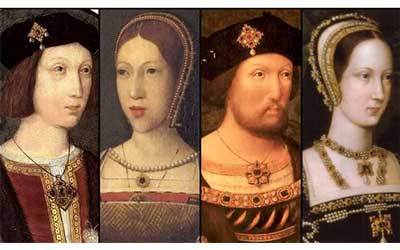
Neonatal care being what it was (and with that dastardly X chromosome popping up all over the place), producing an heir was no easy feat. H7 and EoY did pretty well for themselves in whelping four royal offspring beyond infancy (below from L to R): Arthur, Margaret, Henry, and Mary Tudor.
Tudor Heirs 1st Generation Arthur Margaret Henry Mary
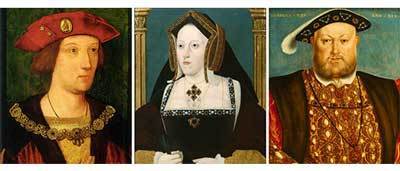
Primogeniture put the smart money on Prince Arthur (below, L) to be the next in line for the throne, and he was groomed for the role from the start. Duke of Cornwall at birth, and toddling into his role as Prince of Wales, the plans for Arthur's marriage to Catherine of Aragon (below, C), which would seal the deal for an Anglo-Spanish alliance, were set in motion faster than you can say “child bride” (though they waited until the betrothed were of a respectable tween-age to exchange vows). Alas, Arthur died before the couple could make it to their first anniversary.
Arthur Catherine Henry
Courtesy of protracted negotiations with the Spanish court and a papal dispensation (Catherine's family being super Catholic and such), Arthur's widow and Henry VIII (above, R) were wed in 1509 just months after the death of Henry VII. Though the common folk weren't exactly sad to see Henry VII go, Henry VIII could have benefitted from a few of his father's faults.

The story of Henry the Eighth, “great matter” and all, is far more complex than I ever would have imagined. Meyer does an excellent job of putting the case of Henry v. the Church in the broader context from whence it came. While the religious upheaval in England and central Europe were separate, it wasn't a coincidence that these schisms happened around the same time. Let's just say it went beyond the issues of trophy wives and whether or not Jesus Christ could actually turn into a wafer cracker ( transubstantiation if you want to be fancy about it).

The six wives are but drops in the sea of people who were totally screwed over by King Henry VIII. There's really no one who wins when a king introduces “treason by thought.” From scapegoating Cardinal Wolsey to leaving his son with a government that was, essentially, bankrupt, the impact of Henry VIII knew few bounds.
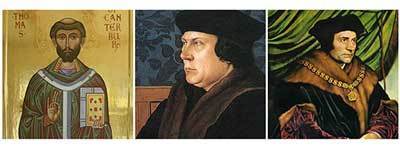
Thomases Becket Cromwell and More
Standouts from the hit parade of the damned? Well, let's start with people named “Thomas.” As it turns out, this list includes the Thomas responsible for the name's popularity, Thomas Becket (above, L). Perhaps you think that, on account of being both a saint and dead, Becket would evade Henry's grasp. Wrong! If Henry calls you to court, you best come correct, otherwise he'll take your treasure, dissolve your shrine, and burn your bones!! TomCrom (Thomas Cromwell; above, C) was no saint, but he was certainly one of Henry's head henchmen—in the eyes of Henry, the Bro Code was meaningless. Thomas More (above, R), a man popular among the people, also did a bid in the Tower and exited via the stairway to heaven for refusing to take the Oath of Submission.
Mary Tudor Portraits
Mary (above, all), Henry's daughter, seems a particularly tragic character in it all. Sure, she'd ultimately earn the moniker Bloody Mary as queen for her cruelty in burning protestants en masse (including a Thomas or two), but the girl had some serious daddy issues. Separated from her mother, subjugated to her infant half-sister, and forced to sign an oath against everything she believed, it's not exactly surprising that Mary would become unhinged. Also, she may or may not have had an hysterical pregnancy when she first married Philip, but I'd have to do some fact-checking on that.

Here I've promised you a dynasty, and find myself more impressed than ever with Meyer's ability to steadily distribute material across the Tudor succession! My apologies for skipping ahead…
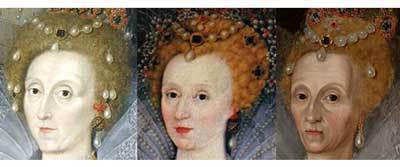
Portraits of Queen Elizabeth I
Queen Elizabeth I (in stark contrast to her predecessors) acknowledged that a monarch reigns with “popular consent.” Unfortunately, her exit from the world wasn't particularly picturesque. Scarred by smallpox in her youth, the Queen tried to hide behind ceruse—a makeup made of lead and vinegar (and you thought eating paint chips was bad). I imagine her physical devolution (above) being a sort of Tudor-Era analogue to that of Michael Jackson.
Profile Image for John.
2,154 reviews196 followers
May 27, 2010
Historically accurate perhaps, though incredibly slanted.

Henry VIII was a bully/monster/tyrant. Period. End of Story. Most of the coverage of his reign focused on the men around him, and their roles in enforcing the break with Rome, as well as persecution of monks during the dissolution of the monasteries.
Edward VI was a fervent Protestant, but ... that was okay as he truly respected his sister Mary (in spite of their religious differences) - not a syllable to acknowledge the fact that (according to other books), he genuinely liked Elizabeth.
Mary was a well-meaning, tragic figure, in spite of all those unfortunate burnings, which, yes, were ultimately her responsibility, but weren't really so bad, especially compared to the brutality of her father and sister.
Elizabeth was Bad News - no two ways about it. So bad, that it might've been better for Jane Grey to have remained, and her heirs to follow, even if that meant sacrificing Mary in the process. Seriously! Meyer does his best to portray Mary Queen of Scots as a sensible, trustworthy counter-figure; the wrong chick got the chop (conveniently omitting that although Walsingham gave her the bait, she fell for it). We hear how the Jesuits sneaking into England were there only to minister to the oppressed minority, no threat at all. The author conveniently neglects to mention that by the 1580's, the Pope was crying for Elizabeth's head, strongly encouraging her assassination. There was indeed anti-Catholic sentiment among (at least some of) Elizabeth's advisers, but Meyer would have the reader believe that was entirely the result of xenophobia and bigotry. Regarding the St. Bartholomew's Day slaughter of French Huguenots, which influenced Elizabeth in favor of those advisers, Meyer maintains "they asked for it in displaying their wealth" (paraphrased).

As a rough parallel: Henry VIII = Reagan (bad!); Edward VI = Bush daddy (bad, but you can't help feeling a little sorry for him); Mary = Clinton (good intentions, but things didn't work out as well as they should've); and Elizabeth as Bush Jr. - just plain awful, including a sly comparison of her speech at Tilbury to the Armada troops (play acting), and her refusal to care for the returning diseased veterans.

Now you know what to expect.


Profile Image for Rebecca Huston.
1,063 reviews181 followers
March 5, 2014
This book is bad. It reeks, it is derogatory to its subjects, it insults the reader, and the author is pushing his own agenda here. I really wanted to like this one, and went into it with some optimism that I could learn something new. But no, the author is fixated on religion here, especially in what makes evangelical protestantism different from everyone else. I could have handled this much better if the same amount of space and effort had been devoted to five (almost six) Tudor monarchs -- Henry VII, Henry VIII, Edward VI, (Lady Jane Grey), Mary I and Elizabeth I.

But no. We get the same hyperbolic crap to be found in most bad novels about the Tudors. Even worse, the author focuses nearly entirely on Henry VIII and Elizabeth I. Henry VII gets a smidgen of a mention -- namely his origins and Bosworth. Then we whip right along to Henry VIII, Katherine of Aragon, a little about Anne Boleyn, and an awful lot on monasticism, various cardinals and popes, those English noblemen who were protestant leaning, and even more about Religion, and why Catholicism is bad. Alright, not so much on that, but that is certainly the feeling that I had when I finished the book. Even the last four of Henry's wives were barely mentioned, beyond their names and what happened to them. Edward VI isn't given much mention either, just what he did to support protestantism, his Seymour uncles and then John Dudley and Lady Jane Grey. Mary I is treated as a near-hysteric, and then there's her marriage to Philip II of Spain.

Did I mention there's a lot about religion in this book?

Then there's Elizabeth I, who gets about the last hundred or so pages. The Armada is dismissed as a lucky fluke for the English, Elizabeth is vain and insecure, and so the Tudors dwindle on out of history. I hated this book by the time that it ground to a finish. The sources he uses are fairly slight, and while he cites sources, most of them secondary -- this amazes me in that there is a host of primary sources out there. It tries to be a popular history, but the end result is boring and flat. Two stars overall, and not recommended at all.
Profile Image for Maja  - BibliophiliaDK ✨.
1,209 reviews968 followers
March 18, 2011
Definitely not impressed. Quite the opposite as a matter of fact. First let me comment on the content of the book. If you're looking for a book describing the Tudors as a dynasty, or the overall Tudor era, you have definitely picked up the wrong book. This one only works with the religious aspect of the Tudor reign. Not much else is a addressed. I was appalled at how little Henry VII was explained, though the author himself notes, that it's a problem, that he is so often ignored by other authors. The first 300 pages are devoted to 'The Kings Great Matter'. Once I reached the point where Henry VIII died I was so looking foreward to abandoning the whole religion-thing. But I was sorely disappointed. Yet again. It continued on through the reign of Edward VI, Lady Jane Grey, Mary I and Elizabeth I. Really, there are so many other interesting things going on at this point in history! Why focus solely on religion? Especially when you've set out to map out the entire Tudor dynasty. Shouldn't you then set your focus a little wider? And then there's whole other thing I'd like to complain about - the author's credentials. Because he has none! Even the biography in the bakc of the book describes him as nothing more than an AUTHOR! Not a historian but only an author, a journalist. My question then remains: How can anyone allow him to write a book like this?! His sources are all secondary, there's nothing original in this book at all. It is entire based on other historian's work. And to top it off, he doesn't seem to have that many sources to begin with. I, for one, doesn't want to believe a word in this book.

If you want to learn about the Tudors, I'd advice you to only pick out this book in order to learn of the books G.J. Meyer has used. DO NOT READ THIS ONE!
Profile Image for SeaBae .
418 reviews20 followers
May 22, 2012
"The Tudors" is not exactly a "complete" story, as the title promises, but it is a very entertaining and illuminating look at the socio-political life and times of the Tudor dynasty (if a family that dies out after three generations can be called a dynasty.)

I'm a huge fan of putting history into context rather than the usual dull recitation of chronological events, and on that account "The Tudors" excels. While Meyer more or less does stick to a chronological approach in his main chapters, he intersperses what he calls "Background" chapters. I found the Background chapters to be fascinating, covering everything from schooling to torture to theatre to the pre-reformation English church to the intricate and never ending maneuvers for power on the European continent between France, Spain, the Habsburg/Holy Roman Empire, the Pope and the Ottoman Empire. This is why I gave the book five stars - in other hands, this important history becomes a jumble of eye-glazing-over names, dates and battles but here, it's entertaining and the reader is quick to grasp the significance.

This is not a comprehensive biography of any of its subjects. In fact, at times Meyer even points out he is glossing over certain events, claiming that to do them justice is outside the scope of this particular book. Therefore, some reviewers appear upset that Elizabeth, in particular, seems to get short shrift. However, for the purposes of this book, which is to look at the power shifts and social development that shaped England under the Tudors, it's perhaps not so important to detail every event of Elizabeth's reign. Besides, most of Elizabeth's actions, as Meyer takes as his thesis, were calculated to keep her alive and secure on the throne, so to go into more explanation would just be more of the same.

Meyer does take a revisionist view of his subjects. As he points out in his epilogue, Tudor England has been the subject of much biography, analysis, propaganda and outright fabrication since the Tudors themselves were on the throne. Therefore, anyone seeking to read this for tales of Gloriana Elizabeth or Bloody Mary are bound to be disappointed.

However, I don't find this book as slanted as some reviewers on Goodreads. Perhaps because I've read plenty of Tudor scholarship (and fiction) over the last few years, I'm rather used to Elizabeth the Insecure and Horribly Self-Centered, Mary Tudor the Misunderstood, Edward the Strong-Willed and Intelligent Who Died Far Too Young. (Henry VIII is always a monster in his sunset years, however - it's just too hard to make excuses for someone who summarily executed everyone pretty much within earshot.)

But those who view Fox News as the holy grail of fair and balanced accuracy should stay far away and perhaps stick to Glenn Beck and Bill O'Reilly for "history."

While Meyer doesn't overtly make the parallels, it's not hard to draw them between Tudor England and the current political climate in the United States. For example, Henry VIII enacted severe penalties for anyone caught homeless and destitute. Meyer writes, "It was the classic case of punishing the victim, singling out for final humiliation the very people left most helpless by the pillaging of institutions that for centuries had attended to the needs of weak and the destitute." Doesn't sound too far off certain policies of certain political parties today.

Later, Meyer writes, "Tudor England was a world in which the rich got richer while the poor got not much poorer but much, much more numerous....There were many reasons why the condition of ordinary English families deteriorated precipitously during the Tudor century: the destruction of an ecclesiastical social welfare system ...; the ongoing enclosure of arable land...; an unprecedented concentration of wealth in the hands of a gentry class that was only a tiny part of the population; and a toxic mix of economic forces that caused real wages to fall decade after decade even as prices relentlessly rose.

"Added to this was the emergence of a new set of social values...that encouraged the prosperous to equate wealth with virtue and to regard the destitute as responsible for (or even predestined to) their predicament."

Well, I guess those who do not learn from history, etc. etc.

So yes, some could claim Meyer has a bias. He is also definitely sympathetic to the Catholics who were killed during Elizabeth's reign; while he points out that hardline Protestant Puritans were also targeted, they don't get the same tear-jerking treatment as, say, devoting a whole chapter to the hunting and execution of a Jesuit priest. This may also account for his rather disdainful treatment of Protestant Elizabeth, while her Catholic sister Mary is more dimensional.

But as a book that looks at the Tudor century from all sorts of (fresh to me) angles - I really enjoyed it.
Profile Image for Emelia .
131 reviews103 followers
April 8, 2017
Murder, mayhem, betrayal, paranoia, curses, and egomania. Sound like a horror story or a who-dunnit? Actually it is the story of the most notorious dynasty ever know, which the title so aptly states.
Beginning in 1485 when Henry Tudor crossed the channel from France and laid claim to the throne of England, this book tells the brilliant story of Henry's son, Henry VIII and his mad quest to keep his line on the throne. In Henry VIII's obsession for a male heir he manipulates, murders, and fabricates every scenario imaginable to rid himself of any wife who fails to give him the male heir he so desperately wants. Only producing girls, Henry VIII's wives find themselves losing their heads over failing to "do what the King demands". Finally after several wives disappoint him, Henry finally gets his wish. A male child is born, albeit a sickly one.
The important line of the story, in my opinion, is not Henry VIII, but the woman and female children in his life that Henry has deemed disposable, not worthy that is until his only son dies. Then and only then are the women brought to power. This is a tale not only of the women who were manipulated before and after claiming the throne, but of England's struggle between Catholic's and Protestant's. Filled with war and violence this book is a sad tale of the lives of these women beginning with Bloody Mary renown for her mass executions, and ending with Elizabeth, the woman who redeems her father's atrocities by becoming one of England's most beloved Monarch's.
856 reviews8 followers
April 10, 2010
Not sure what to rate this book. Meyer promises to write a book that doesn’t dwell on Henry VIII and Elizabeth like all other authors do and then spent about 300 of 569 pages on Henry –focused on the “King’s Great Matter”. Would have enjoyed more on Henry VII.
Elizabeth was not admired at all by this author (actually not too many of the women in power were—John Knox’s influence perhaps) to the point that any characteristic or action of hers was placed in a negative light. But what irked me about Elizabeth’s segment of the book was when Meyer declared that the last 15 years of her story was Essex’s story. Really? Well, Meyer certainly made it that way. Maybe by the time I had gotten to that point of the book, I was pretty irked anyway on his handling of Elizabeth.
That set me up to not fully appreciate when Meyer adapts an admiring view in his epilogue about the illegitimate son of Robert Dudley and his scandalous life.
Yet, the book was well-written, interesting in how the ‘background’ segments were interspersed telling about the history of the time period, and accessible for a general readership. The few ‘typos’ mistakes (like saying Henry II when he clearly meant Henry III or accidentally using Cecil’s name in a paragraph about Essex) were not off putting.
17 reviews
March 4, 2025
I read this to learn enough about Tudor history to read Wolf Hall and understand what’s going on. (I also watched the BBC series, which I highly recommend!)

Overall, I enjoyed it, especially the first half about Henry VIII. Meyer’s prose is engaging, often witty. And it was nice to take a break from contemporary political turmoil and read about political turmoil long-past (though it’s fun to look for parallels too and inevitably they come to mind… Cromwell's inspections to find waste and corruption in the monasteries, kind of like the cretinous DOGE team, anyone?).

I haven’t read any other books about this period, so it’s difficult for me to judge what might be missing or distorted, which interpretations reflect scholarly consensus and which are the idiosyncratic one-offs of an autodidact. I think it was a good first book to read about the subject though, because it made me want to read more about something I had little interest in previously.

As other reviewers point out, the book is highly uneven. The first half about Henry VIII is vibrant. Meyer is clearly fascinated by Henry VIII and all the details of his transformation of the English state. Then, he gets tired or bored or decides he doesn’t want to write the book anymore. The last quarter of the book, about Elizabeth I, reads like a patched together list of bullet points. Even the chapter titles are exhausted (e.g., “Yet Another New Beginning”). One minor annoyance here is that Meyer repeatedly describes Elizabeth as “vain” and “selfish”, but never applies these adjectives to Henry VIII, where they would surely apply just as well. I wish I could give the first half five stars and the last quarter two.

Each chapter is interspersed with short snippets about things like poverty, table manners, torture, the Council of Trent. I loved these and wish that social and economic history were more deeply woven into the main narrative.

Overall, came for Cromwell, stayed for a better understanding of early modern Europe. Also I think it’s hilarious that my copy of this book has a cover that makes it look like a romance novel, when it’s basically the opposite. I wonder how many people have picked this up expecting a very different reading experience.
Profile Image for Raquel.
64 reviews10 followers
July 8, 2012
I've always been interested in the history of the Tudor dynasty, in particular its most notable monarchs, Henry VIII and Elizabeth I, and started reading the book thinking that I was very well informed on the subject. Then I (quickly) realized that I was wrong.

The book demystifies the image that is conveyed in the movies and series and presents a much harder and less glamorous vision of the two monarchs. I saw the Showtime series a few years ago and loved it, only to discover now that it manipulates reality very freely.

The reality is, in fact, very different from fiction. However, it isn’t less interesting. In spite of the flaws of character, the selfishness, the pride and the total disregard for the fate of their subjects, Henry VIII and Elizabeth I are nonetheless fascinating characters that continue to entice the modern world.

The author advances an explanation to justify the interest in these two figures, especially in Henry VIII:

"He has held the world's interest in part because of the question of how such a gifted and fortunate man could have committed such crimes. And because of the related, troubling question of how it is possible is such a thoroughly vicious character to be so... attractive. "

As its title indicates, the book is not only about the aforementioned monarchs, but the whole Tudor dynasty. It also provides fascinating information about the habits, customs, education and life of the sixteenth century England.

Very complete and enriching. I strongly recommend it to all who have an interest in the subject.

From my blog.
Profile Image for Manuel.
23 reviews21 followers
October 17, 2010
I was really pleasantly surprised by this book. I picked it up expecting an ode to joy to the soap opera style of history as told in the silly TV series of the same name.

What I got was a comprehensive look at the background stories often overlooked by many writers, who portray Henry VIII as a romantic rogue or portray Elizabeth's reign as a golden era of domestic bliss.

I must admit my knowledge of Henry VII was sketchy before I picked up Meyer's book. He did a wonderful job laying the ground work and explaining the dynastic tensions between the York and Lancaster families. In addition, Meyer introduces us to the England of the late 15th and early 16th centuries; a small and devoutly Catholic country trying to find a place in a Europe dominated by Spain and France.

What I admire most about the book, is how it answered all those questions I've always wondered about; such as what it must have been like for ordinary English people to suddenly be told their manner of praying to God is no longer accepted by the King, but it is in fact illegal.

Many books have portrayed Henry VIII as a man in love determined to do all for the woman he loves and desires. Meyer's book shows us how Henry VIII was very lucky in choosing his advisers... Cardinal Woolsey, Cromwell and Cranmer. These men made the mistake of telling Henry things he COULD do from things he SHOULD do.

In the end we get a devoutly Catholic king transformed and convinced he is God's chosen vehicle. He becomes a megalomaniac bullying Parliament and the church to get an unprecedented amount of power and wealth. Consequently his family and courtiers live in a constant state of fear all their fates tied to the king's mood, pleasures or fears. Henry would eventually behead two wives and numerous Plantagenet cousins as well as courtiers and friends.

I was surprised at my own reaction to Henry VIII. To me he was always one of the more colorful English kings, after I finished the book I really really despised him.

It must have been incredibly difficult and frustrating to live as a Christian in Henry VIII's reign. For a thousand years England had been a Christian and thoroughly Catholic kingdom. There had been grumblings and complaints about the Roman Church for decades, but mostly from continental Europe, never from England. When Henry broke from the Roman Church, the Church of England was still thoroughly Catholic in form and spirit. Consequently anyone with a genuine reformist attitude was burned for HERESY while those still loyal to Rome were burned for TREASON.

These drastic shifts in religion with each of Henry's children made for a very schizophrenic era. The stakes were not just your soul but your very life. A very readable and fascinating book well worth the read.

There were quite a few surprises to me.
Henry's own sister Margaret had been granted a divorce from the Pope so she could marry her third husband, Henry expected a speedy divorce in turn.

The other surprise was the propaganda coup of Elizabeth's principle secretary Robert Cecil. He managed to portray Mary Tudor as "Bloody Mary" due to the martyrdom of the Protestant leaders of the church, however Elizabeth's reign though longer was just as repressive with an equal number of Catholic martyrs.

I was also surprised at the relationship between Edward and Mary. I had always assumed he was closer to his sister Elizabeth, but he and Mary were very close. As he got older and more headstrong, he developed into a passionate champion of the Evangelical cause, consequently he and Mary became polarized in their convictions. He finally deciding he would change his father's will and change the line of succession to favor his very Protestant cousin Lady Jane. Talk about a very dysfunctional family.

Profile Image for Cathryn Conroy.
1,411 reviews74 followers
January 22, 2022
Beginning with Henry VII and ending with Queen Elizabeth I, this fascinating and highly readable history book on the three generations of Tudors, is a deep dive into one of the most interesting and tumultuous periods of England's royal rulers.

Written by G.J. Meyer, the book focuses on the facts, as all good history books do, which has the effect of upending some of the most delicious Tudor legends and myths. Exhibit A: Henry VIII may not have been the sexual stallion of which he is often portrayed.

Find out:
• How Henry VIII was truly savage and cruel and why his irrational and monstrous behavior was the only way he knew to continually feed his incredible and insatiable ego.

• If you have the stomach for it, you'll learn the many ways King Henry executed his subjects, advisors, and kin, some so gruesome you may need to gently close the book for a few minutes just to take a few breaths.

• Why his lust and desire for Anne Boleyn was only the secondary reason that Henry VIII separated England from the Roman Catholic Church.

• The heartbreakingly sad emotional and psychological state of Henry's only son, Edward, when he became the boy king as a 9-year-old child.

• Why Queen Mary may have been a more accomplished and effective ruler than her sister Queen Elizabeth I—the opposite of conventional wisdom.

• The horrifying story of how Queen Elizabeth I used torture—far more than her father—in both intensity and frequency, as well as the sadist she employed to carry it all out.

• Why Queen Elizabeth I was so vain about her appearance that her daily makeup routine may have led to her death at age 69.

Each chapter ends with a short bonus chapter giving background information, and most of these are truly fascinating—from common foods (no potatoes—they didn't come about for 100 more years) to what it was like inside the Tower of London to why the "sport of kings" was engaging in bloody battles.

This is an accomplished, well-written historical account of England's most famous—and infamous—royal family. If you enjoy reading novels about this period, this history book is a must-read.
Profile Image for Burton Bargerstock.
8 reviews2 followers
July 24, 2011
I enjoyed Meyer's book. It's an extraordinarily accessible piece, demanding little previous study of the period. I agree with others who have pointed out that the author spends most of his time (detail and commentary) on Henry VIII, and that this is unfortunate. After reading it, Henry seemed much more three dimensional than Elizabeth. This is curious, given the author's assertion at the outset of the importance of considering the entire dynasty as a whole. Still, there is much to commend here. I particularly appreciated the treatment of the English monarchy's break with Rome, through its many twists and turns. The thread on the economics of the dynasty was also interesting. Finally, I really liked the form. Meyer's chapters alternate between his continuous narrative and "background" chapters, providing welcomed context. Very nice. I would recommend this book to anyone who has a general interest in the subject matter, but further reading may be desired.
Profile Image for Lisa.
253 reviews1 follower
April 4, 2010
I'm a big Anglophile and especially enjoy reading non-fiction of the different English royal dynasties and this caught my eye at the library as being entertaining as well as informative - good combination when reading about history in general.

I'm about 50 pages into it and am really enjoying it. It's well-written and holds your attention (if you thought political shenanigans of today are out-of-control, believe me, it was just as crazy, if not more so, back then. And extremely brutal and bloody.)Some things never change! Unless you hold a PhD in medieval British history you're never going to remember all the dukes, earls, etc., but it's still very entertaining, enlightening, disturbing and seemingly well-researched (there is a 2-page family tree at the front of the book to help readers keep track of who's who).

Having finished the book, it gave me a clearer understanding of what the reigns of Henry VIII and Elizabeth I were truly like, as opposed to the glorification, at least of Elizabeth, you see in films of her life and reign. It also brought home to me again that, as far as politics go, the haves pretty much disregard the have nots, if they think of them at all, and it's been this way all along. Interestingly enough, for someone like me, not a person of faith, it appalled me to realize that Henry's destruction of the Catholic monasteries (and looting their treasures, $$$, murdering their members for treason), the main source for the poor to receive at least rudimentary education, food and clothing, contributed greatly to the increased desperate poverty of his (and then Elizabeth's, who also couldn't care less about them) subjects through their reigns.
Profile Image for Small Review.
615 reviews222 followers
June 7, 2020
3.5 stars

Well, G. J. Meyer clearly is not a fan of Elizabeth I. He didn't sing Henry, Edward, or Mary's praises either, but their sections were a lot more balanced. Elizabeth, not so much. Apparently, she didn't do anything right and anything good from her era was either propaganda or someone else's achievement.

That aside, this was a nice overview of the Tudor era and worth reading. I liked Leanda de Lisle's Tudor more, but this one is still worth reading. While his Elizabeth section was clearly biased, it was still interesting to entertain that point of view and reexamine the popular narratives.

Chapters alternated between the chronological history (larger chapters) and historical asides (shorter chapters) that often took a deeper look at a particular aspect of the narrative covered in the prior chapter. Sometimes these asides gave insight into a minor player, more often they gave more general historical depth to one of the major issues of the time like corruption in the church, the history of Lutheranism, the Tower of London, Parliament, and so on.

I looked forward to these chapters. They added something to the book that let it stand apart from all the other Tudor books. I also appreciated how they were paired with the greater narrative. Some books just focus on these broader topics (Life in Tudor England type books) or take a whole book to focus on one of those topics, but this combination of royal narrative and supplementary asides helped root them in the larger context, making both sections better as a result.
Profile Image for Harry Allagree.
858 reviews12 followers
February 14, 2014
Having read Meyer's book on the Borgias led me to this book, and he certainly doesn't disappoint. He has an incredibly smooth writing style, repetitious enough on names and dates that you don't get mixed up, yet not overbearing. His portrayal of Henry and Elizabeth, especially, clarified some of my own muddy thinking about them, not to mention his excellent assessment of the years of the whole Tudor dynasty. His research seems extremely current, and he allows for further understanding & interpretation from future historians.

As one who moved from Roman Catholicism to Anglicanism, the book helped me to understand better the dynamics of what led to the break under the Tudors & to eventual developments. The saddest thing is that it really seems to have been individual human ideology, mostly dysfunctional, which brought this about, needlessly, in my humble opinion. But reality is reality. From what I can observe in the book, it occurs to me that the "protesting" ideology of the reformers in England was passed on down to those who eventually fled their home country for America, and their spirit has persisted, pretty much from the beginning of the U.S., especially in the Republican Party and, today especially, in the so-called Tea Party. It is an irrational attitude of self-rightness & an irresponsible refusal to negotiate. Which leads me to believe that our republic, in the end, unfortunately, will probably fare no better than the English system did under the Tudors.
Profile Image for Andrew Obrigewitsch.
951 reviews166 followers
May 17, 2014
The tutor's where blood thirty, back stabbing, highly destructive to their own friends, selfish and above all else foolish.

This book just proves politics haven't changed one bit since then, and that history texts are pretty much just propaganda until enough time has passed that no one will get offended when the truth comes out.

Recommended reading.
Profile Image for Moon Rose (M.R.).
193 reviews42 followers
March 24, 2013
There is truth when they say that history is written by the winners as this obviously factual statement can be rendered best to the enigmatic and short reign of the Tudor clan in England, considered by many as the Golden Age despite the conspicuous evidence provided otherwise...
It matters also that both Henry and his daughter Elizabeth were not just rulers but consummate performers, masters of political propaganda and political theatre. They created, and spent their lives hiding inside, fictional versions of themselves that never bore more than a severely limited relation to reality but were nevertheless successfully imprinted on the collective imagination of their own time.
The purpose of G.J. Meyer is to unravel the many myths blurring the images of these English monarchs that are actually based from the recently upheld scholastic records in a way that would confound the true nature of themselves behind the great drama curtailing the reality of their reign.

The Apocalyptic Henrician Reformation

The definitive aspect of Henry VIII′s reign is the consequential beginning shaping what is to be known as the English Reformation, which in actuality if taken from its roots, is only the direct by product of the King′s "great matter" that refers to the King′s unrelenting desire to divorce his wife, Catherine of Aragon to marry his mistress, Anne Boleyn in a display of unquenchable assertiveness proclaiming his divine right for that privilege as his petition remains unresolved with the papacy in Rome.

This rift of Henry VIII with the pope leads to England′s separation from the Roman Catholic Church, which coincides with the rise of Protestantism in Europe, resulting to the eventual dismantling of Catholic monasteries and churches, of looting and plundering, of murderous persecution of priests and bishops and the mass butchering under the King′s order against those who attempt to defy him as a calculated black death seems to descend upon all of England in fear of this mighty King.

This part of the Tudor history, which appears in Meyer′s narration in its bloodiest and most barbarous acts, is ironically the best and most colorful section in the book as it is filled with a kind of dramatic tension raised in a feverish pitch of suspense reaching far even to the short reigns of Mary I and Edward VI as they both face the full repercussion of their father′s actions as it appears as if surmounted on a theatrical stage for all to see and behold, an ancient reality entertainment of a royal comedy of errors gone wrong and all to satisfy the whim of a King for a young and pretty woman in the absence of a male heir as it becomes the gruesome setting of the apocalyptic end of Catholicism in England.

The Gilded Elizabethan Age

Compared to her father′s infamous misconduct that concurs his avaricious past, Elizabeth I has always been portrayed on a brighter light often in the most positive manner even to the point of divine reverence. In fact, history as it seems has a high regard on her reign as it has always been known and collectively called as the Golden Age of England.

For all those who expect to read about this kind of Elizabeth, which is solidly embossed in the mind of posterity would be disappointed to rediscover her in Meyer′s version as she is cast in a different light or more aptly an Elizabeth in the dark shadow of her well known self. Whether this is the truth or not, is of no importance anymore as the historical truth will always remain debatable as the reality of the past is often lost in the peripheral of time.

In fact, the historical figure of Elizabeth in Meyer′s narration is literally swallowed by the events engulfing her reign appearing in conjunction to the withdrawn image of his depiction as it entirely seems against the formidable revelation of the queen known and accepted by many. Here, she is not describe as the apparition of divine figure, but a beauty ravaged by an early sickness, which explains the necessity of the white substance covering her already spoiled face. Her character is completely veiled as if invisibly moving behind an impenetrable curtain. She is not the queen of firmness, but an aging spinster always awaiting to be ingratiated by young men in court. It seems that throughout her reign and to a certain degree, her only motivation is to stay on the throne as her political decisions are precisely in accordance to its surety and whatever triumph her regime achieves like the defeat of the Spanish Armada is not attributed to her greatness, but to the inclement weather in England. Meyer even started the Tudor part of Elizabeth in the book on her somewhat pathetic deathbed as a woman dying of loneliness, totally alone and withered by old age, falling spectacularly into dark void of depression as her kingdom is left with an almost bankrupt treasury.

If there is an unquestionable authenticity to the sources of Meyer in creating the renowned queen′s alter ego, Elizabeth must be thankful to her father, Henry VIII by now as the severe alteration he made in English history through the pilferage of the Catholic monasteries and churches created a whole "new class" in English society, who through the years after benefiting from the stolen treasury remained faithful to the Tudor clan as they championed their propaganda and whose descendants of nobility filled the pages of Jane Austen as the fortunate minority while the remaining majority to which this book is intended still felt its reverberating aftermath even during the height of Victorian era, inspiring Charles Dickens to depict the poverty infested London amid the filth of the River Thames. ☾☯
Profile Image for Les.
2,911 reviews1 follower
September 9, 2018
Disclaimer I started reading this book last year ... and then for some now unknown reason I let it go. Yesterday I saw the book was on sale on Amazon and clicked on it to learn "You purchased this item on August 18, 2017" (oops) so using my trusty search function I located the book and discovered I was at 91%. I had to decide if I should start over and write a thorough review or just read the final bits and I opted to read the final bits. Which turned out to be 2 chapters taking us to 95% and the remainder of the book was filled with notes and sources.

The final 2 chapters were concerned with Elizabeth's persecution of the Catholics and Elizabeth and Essex. Coincidentally I had just seen some of the Private Lives of Elizabeth and Essex on TCM. To say I don't have specific recall of this book would be an understatement and apparently I made no notes or highlights so I had nothing to rely upon for judgement.

What I do recall is the same complaint other reviewers have shared. The two Tudor 'superstars'; Henry VIII & Elizabeth, take up much of the book.
Profile Image for Kerri (Book Hoarder).
494 reviews46 followers
April 18, 2022
Hmm. I enjoyed this, but got the impression that the author *really* did not like Elizabeth. Which, fine, but there’s a whiff of sexism in the way that the author speaks about her. Since the book ends with her it’s kind of a sour note to finish on!
Profile Image for Lizbet.
1 review2 followers
January 27, 2012
Meyer declaimed several times that THIS book would cover the entire Tudor dynasty. He said that too many books on the period focused on Henry VIII or Elizabeth exclusively, so he wanted to produce a biography of the dynasty rather than of the individual members in it.

I'm less impressed with that from the outset because my first good grounding in Tudor history was the middle book of a trilogy of popular history books by Mary M. Luke. (I never read the first or third as compulsively, but I devoured the middle one.) That book was called "A Crown for Elizabeth" and covered from the death of Anne Boleyn (1536) to the death of Mary I (1558), so I am very used to treating the Tudor era as more of a continuum. You can't read Edward VI's or Mary I's reign out of context with the second half of their father's reign or with each other.

However, that book leaves off Henry VII and the first half of Henry VIII (most of that was covered in the first book of the trilogy, "Catherine, the Queen"), so Meyers' book had that to recommend it -- more detail on Henry VII.

And then he spends about 6 pages total on Henry VII, 4 of which are given equally to providing War of the Roses backstory. Since Meyer's main interest is the religious revolution that occurred under the Tudors, he could have taken one of his "side notes" about the state of Catholic faith in England before Henry VIII started upheaving and integrated it with Henry VII's reign. What was Henry VII's relations with Rome? Paint a picture of the last "normal" reign before Henry VIII if you can't think of anything else to say about Henry VII. (I can't remember who it was who pointed out that Henry VII had the most dramatic rise-to-power (upstart becomes King of England out of nowhere) and he is the only king from John to Henry VIII who does not have at least one Elizabethan or Jacobean play written about him.)

Mostly, the pages on Henry VII served to explain how the treasure of England was stuffed full with coins when Henry VIII came to the throne. That does nothing to either expel or at least deepen the perception of Henry VII as a penny-pinching miser. We gain no inside into the personality of this man. He is just as shadowy a figure after his scant pages are done in "The Tudors" than before I started.
Profile Image for Christine.
7,223 reviews569 followers
April 1, 2011
Well, it isn't really the complete story. It's mostly about Henry VIII, trying to get some of Showtime's bling perhaps. It is a good general study, but it does lose some steam after Henry VIII.

Yet, it is worth reading simply because of the time that Meyers takes with Harry. Instead of focusing on the wives, Meyer focuses more on the politics and the real movers and shakers. In fact, Meyern does this for the whole dynasty (except for Henry VII who seems to get an almost footnoted mention). In many ways, this makes the book a good political biography of the dynasty.

The book does really lose some movement after Henry VIII. It is almost like Meyer found Henry VIII interesting and added the others as selling points to the book. He focuses more on the Seymours than on Edward, Lady Jane Grey is dealt with in this than nine minutes. He spends more time on Mary Tudor, who he seems to be sympathic too yet does not let the sympathy get in the way of a crtique. He doesn't seem to like Elizabeth very much, and in many ways, her section is almost more about the Dudleys.


What Meyer included as well, are brief background sections that help to flesh out the Tudor world. These background sections really make the book worth reading. I would point out, however, that the book works as a somewhat general introduction (though having some background of Henry VIII would be helpful).
Profile Image for Dawn.
1,446 reviews79 followers
June 19, 2015
One of my favorite parts of this authors books are the extra historical content he supplies in between chapters. These often end up being far more interesting and informative than the surrounding chapters.
I consider myself fairly well informed about the Tudors, in a general way, most of the information about Elizabeth, her sister and her father were known to me already.
I didn't know much about the founder of the dynasty and this book did not add to that knowledge much. Very little is said about Henry VII before moving to the more fascinating character of Henry VIII. Edward is touched on briefly, Mary is talked about in a more sympathetic light than usual and Elizabeth I is not treated with as much deference as normal.
I am glad I happen to love religious history because that is what is discussed to a large degree in this book. How Henry and Thomas managed to dismantle religion as it was known and create something very different, in the process enriching themselves, creating chaos for many future generations and leading to a church so changed that in the end even Henry wouldn't recognize it.
All in all a very good book, calling it a complete history might be a bit of a stretch though.
Profile Image for Liviu.
2,520 reviews706 followers
March 25, 2010
History the way it should be written - clear, engrossing and substantial.
Excellent aside sections illuminate a lot of the history before and explain why this or that thing was a big deal at the time. Not particularly flattering for Tudor enthusiasts - if Henry VIII as bloodthirsty tyrant appears sometimes, the somewhat putting down of Elizabeth will probably dismay the admirers of the Queen, but I found the arguments quite persuasive and worth considering
Profile Image for Joe Faust.
Author 38 books33 followers
May 26, 2015
Henry VIII woth not a goode king,
A murd'rous scoundrel and rapscallion he,
Neither prized were his daughters two.
Yet this account of their woes,
By one accomplish-ed scribe,
Fascinates as if passing a wreck-ed ox carte,
And doth not fail to enchant.
Profile Image for Alisa.
1,475 reviews71 followers
September 28, 2018
This is an awesome history of the Tudors. Don’t be scared by its size. It does not get bogged down with too many unimportant details, and moves along quite quickly. I wish I had read this before I visited the UK a couple years ago! The Tower of London would have been way more interesting to me.

I particularly liked how the author wove in contextual information from the time in “background” sections: Calvinists, the education system, health practices, the Ottomon Empire, etc. It paints a much richer picture that shows shades of variation between cultures and periods that we often lump together into “Medieval Europe.” For example, though no one in Europe knew about germs and the medicinal purposes of keeping clean, the English were particularly foul and slovenly compared to their continental neighbors, and it was so bad that visitors wrote home complaining of it. That classic mental image we have of Henry ripping apart a turkey leg with bare hands and spilling flasks of beer down his front is false, however. His clothes were far too precious and costly to be put through that sort of abuse.

This book does include a LOT of church history, more from the political lens than spending much time about the theological nitpicking. I think it was interesting to see how much time, money, and energy was put into the politics of the divisions between Protestants, Catholics, and the nascent Anglican church. This struggle for religious categorization and control eclipsed the entire House of Tudor and thus is a big chunk of their history.
Profile Image for J.
117 reviews
July 31, 2022
Decent history, though it often felt fast, making me realize that it really is quite a long span to cover in one book.

I think this book did some of the things that it would have set out to do, or at least that I would have wanted it to do! It situated the Tudor period more clearly in my mind, from the perspective of understanding the contemporaneous state of England and its position in European politics. It also helped dissuade me of some of my preconceptions about Queen Elizabeth, which seem to be pretty culturally intrenched. Turns out she kinda sucked! Then finally, it helped me get a better handle on Henry VIII’s wives. Though admittedly I’m already starting to forget a bit lol — the first two are easy, but the later ones blur a bit.

But yeah it’s a good summary I think, at the highest level. Definitely does what it sets out to do. Sometimes a bit hard to keep track of all the players but usually not, I think they did an admirable job there, considering we are often talking about multiple generations of interrelated nobles with similar titles etc.


Overall, a good summary of the period.
Profile Image for Karen.
1,254 reviews
March 6, 2021
Non-fiction weighty tome (600+ pages) all about the 5 people who were The Tudors. Even though it's one of my favorite time periods to read about, I sure wouldn't have wanted to live in them. Traitors were boiled in oil, no one had any kind of civil rights at all. A quite different read on King Henry VIII and Elizabeth I as Meyer explains just what tyrants they were, which most authors have a tendency to leave out since they are still two of the most popular royals in British history. Interesting to learn that your rank (cardinal, duke, archbishop, earls, etc) decreed how many dishes you would be served at a meal. Cardinals would be served 9, Earls a mere 6. You brought your own knives and spoons, forks were still exotic and rarely seen. The record survives of the sheer number of people Henry fed in a single day which would consumed 6 oxen, 8 calves, 40 sheep, a dozen pigs, 132 chickens, 7 swans, 20 storks, 34 pheasants, 192 partridges plus additional things! Only reason it was a 4 Star read for me is that I would have liked a little more detail on what went on between Elizabeth I and her cousin Mary, Queen of Scots.
Displaying 1 - 30 of 538 reviews

Can't find what you're looking for?

Get help and learn more about the design.