Jump to ratings and reviews
Rate this book

Diary of a Mad Housewife

Rate this book
Originally published in 1967, this fun and clever story follows Tina Balser, a sophisticated housewife who lives in Manhattan and seems to have everything—money, two beautiful daughters, and a husband who is a successful lawyer. When Tina begins to suspect that she is going mad, she starts a secret diary as a form of therapy and escape. Through the pages of this diary, her fears and neuroses emerge, as well as her sharp and hilarious observations of herself and those around her, which lead to many changes, including an extramarital fling.

Originalmente publicada en 1967, esta historia divertida e inteligente sigue a Tina Balser, un ama de casa sofisticada que vive en Manhattan y parece tenerlo todo—dinero, dos hermosas hijas y un exitoso abogado por marido. Cuando Tina comienza a sospechar que se está volviendo loca, empieza a escribir en un diario secreto como una forma de terapia y evasión. A través de las páginas de este diario, sus miedos y neurosis surgen, así como sus observaciones agudas y cómicas de sí misma y de los que la rodean, lo cual conduce a muchos cambios, incluyendo una aventura extramarital.

306 pages, Hardcover

First published December 31, 1966

61 people are currently reading
3707 people want to read

About the author

Sue Kaufman

16 books18 followers
Kaufman was born in Long Island, New York. She received her degree from Vassar College in 1947. In 1953 she married a doctor named Jeremiah Abraham Barondess with whom she had a son. At Vasser she did some editorial work and went on to writing. Her works appeared in The Atlantic Monthly, The Paris Review, and The Saturday Evening Post. Her first novel came out in 1959. In 1967 she wrote Diary of a Mad Housewife, which would be filmed as Diary of a Mad Housewife. She died in Manhattan in 1977, at the age of 50, after a long illness.[1] The Sue Kaufman Prize for First Fiction is named in her honor.

Ratings & Reviews

What do you think?
Rate this book

Friends & Following

Create a free account to discover what your friends think of this book!

Community Reviews

5 stars
461 (23%)
4 stars
801 (40%)
3 stars
550 (28%)
2 stars
121 (6%)
1 star
25 (1%)
Displaying 1 - 30 of 213 reviews
Profile Image for Oriana.
Author 2 books3,829 followers
September 14, 2011
Oh this book is just terrific. The prose is so light and airy and flows so beautifully... which all belies the pretty serious things that go on.

Written in the late '60s, re-released a few years ago by Thunder's Mouth, this is the story of Bettina Balser, an upper-middle-class housewife who is freaking out about the stifling life she finds herself in the thick of. The characters (her husband, his "classy" friends, the housekeeper, their children and neighbors) are perfectly drawn, and the dialogue is impeccable. This story is wholly believable, and fantastically put together. Highly, highly recommended.

***

Update. You know, this book has really stuck in my head since I recently finished it. And I'm actually pretty unhappy (in retrospect) about the ending. I don't want to ruin it, though this isn't really that kind of book, but basically, everything just gets tied up in a far too terrific way. Bettina and her husband have been in a silent, seething fight for months, the kind of fight that encompases their entire lives, really, where neither would even consider backing down, because it would be anathema to even think that they might be at fault. And but then there's this crazy climax scene where finally everything comes out, kind of, and hubby just breaks down. Not only does he back down, but he completely puts the whole thing on himself, takes responsibility for all the awfulness that they've both been going through. Not that I think he was wrong to do so (obvs, the book is from Bettina's POV, so we're likely going to side with her), but it's almost too wonderful to have him go through such a change of heart like that. It's like a fantasy ending, the kind of resolution that people who happen to be in sometimes-contentious relationships (no one I know, of course) only dream of. Which just made me sadder and sadder the more I've been thinking about it, that Sue Kaufman either just took the happily-ever-after, easy way out, or was so depressed by her own situation (sorry, I read most everything as if it's autobiographically based) that she had to dream up an if-only and put it together, maybe as something to hold up as a beacon of hope.

I still like the book immensely, but I sorta want to retract my earlier rapturous proclamation of its believability and all that.
Profile Image for 5rovsvet.
352 reviews54 followers
December 26, 2020
Verujem da će biti onih koji će smatrati da je besmisleno ocenjivati knjigu koja nije završena, a posebno onu koja je jedva započeta. O knjizi neću dužiti, pročitao sam 64 strane od 285 strana i tu sam stao. Danima sam je držao na polici u nadi da će me nešto privući da joj se vratim, međutim ništa se nije desilo.

Kako se bliži Nova godina, tako se bliže i nove odluke a jedna od njih je da ne trošim vreme na knjige koje me ne privlače, da ne čitam na silu, da ne radim bilo šta na silu. Prosto, želim da uživam koliko god je to moguće i da mi svaki dan bude ispunjen što više stvarima koje će me ispunjavati. A to želim i vama u dolazećoj godini!

Ne mogu da kažem da je knjiga loša, da je očajna, da je bezveze. Stvara se tu lepa podloga za priču. Samo je to sve meni nekako bilo neinteresantno. Možda je do mene i do perioda u kom je čitam, možda je do knjige. Znam samo da sam očekivao zabavniju knjigu sa mnogo više nekih dosetki i misli koje će me zabaviti a to baš i nisam dobio.

Ono što bih posebno istakao kao nešto pozitivno jeste fizički izgled knjige. Dopada mi se što korice imaju i unutrašnji deo, ne znam kako se to tačno zove ali knjiga nekako izgleda luksuznije i bolje. Znam da je to samo za serijal Amerikana, ali bih veoma voleo kada bi Laguna nastavila u tom pravcu sa svim njenim budućim knjigama.
Profile Image for Julio The Fox.
1,715 reviews117 followers
December 16, 2022
I have to tell you the bad news first: There is no cure for the madness of being a housewife. A high-salaried husband, a to-die-for apartment in New York City, maids and butlers and caterers at her service, and a smooth lover in the afternoon are all making this American housewife, and by implication millions of others, mentally and physically sick. Sue Kaufman is to be commended for finding no way out for her housewife: The husband is a moneyed jerk, her lover a narcissistic jerk, her female friends vacuous, and her group psychology sessions resemble the Spanish Inquisition, with her as the sole violator (of American housewife norms) and victim. This is feminist black comedy without feminism as the answer.
Profile Image for Vanessa.
730 reviews109 followers
November 2, 2018
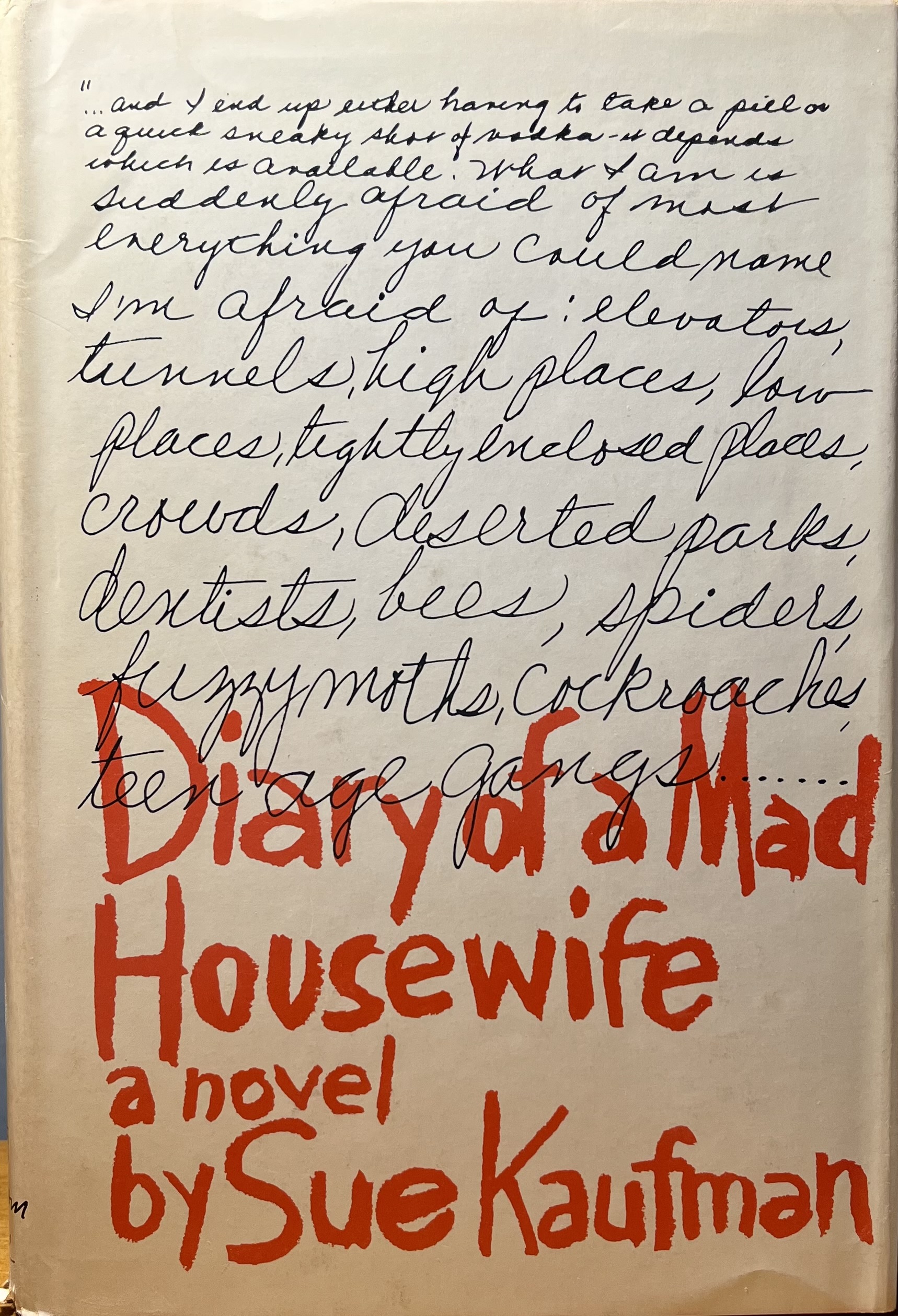
Touchy and disorganized he thinks I am. Jumpy and irritable. What I really am and have been since midsummer is paralyzed. What I am is paranoid as a coot. What I am at times is so depressed I can't talk, so low I have to lock myself in the bathroom and run all the faucets to cover the sound of my crying. What I am at other times is so jazzed up with nerves I can't stand still and everything shakes, and I end up either having to take a pill or a quick sneaky shot of vodka-it depends which is available. What I am is suddenly afraid of most everything you could name.

Earlier this year, my GR friend Julie and I tried to read the feminist roman a clef Fear of Flying and I think it's fair to say we both found it to be punishment. That book was written in 1973; this one, written in 1967, covers similar ground but SO much better.

Tina Balser is a 1960's Manhattan housewife--privileged, the kids would call her today. She has the Mad Men lifestyle: a full-time maid, an apartment on Central Park, a fussy white collar husband who comes home expecting a home-cooked gourmet dinner and an always stocked mini-bar. She has a degree from Smith College and two daughters who can be quite spoiled and condescending (that's dad's influence.) And having given up on life as an artist and spending her post-college single youth working as a secretary, she's expected to become a housewife and hostess until the end of her days. And this, along with her husband who has become quite the elitist starfucker over the last few years, is killing her. So she quietly rebels by writing, by keeping this diary from September to February--and also by having an affair with a handsome, successful playwright who is a shit heel of a different cut.

(At least the sex is good and his feet are clean, unlike in Erica Jong's book. But never trust a man who refers to women as "broads,” ladies.)

If you've seen the great movie adaptation of this (which I watched originally in college because my love Frank Langella was in it as the above-mentioned shit heel), you'll see this book was faithfully adapted. Some things are explained in more detail, mostly her relationship and history with her husband, Jonathan, who is so accurately and repulsively played by Richard Benjamin that it's not clear how they ever got together in the first place. And I found it easier to root for Tina in the book--she's neurotic, but wryly aware of it. And she's not the doormat that she sometimes is in the movie.

When we talk about micro-aggressions today, some immediately roll their eyes and I'll admit the conversation can get a little ridiculous at times. But reading this book...I mean, God bless the women of the 1960's. The condescending male biosphere is thick: if only Tina would just comply with her husband on all matters because he obviously knows best, if only Tina would just agree with her analyst's diagnosis that she just needs a good husband to cure her willful neuroses and this delusion of using that degree for something, if only Tina would just not bristle when her boyfriend (more like a side piece, really) didn't follow a compliment to her with a volley of insults to keep her in her place because he's not misogynous as fuck, he's just a strong male figure and she's a ditzy broad.

(Seriously, "broad" is a red flag!!)

I think this is a split between 3 and 4 stars, and I feel like rounding up instead of angsting about it. Also pretty sure I'll be semi-unironically wearing my "Feminist Icon" t-shirt to work tomorrow because you know what's real?

Profile Image for Xabi1990.
2,127 reviews1,389 followers
December 2, 2020
En 2012, esta fue la review en un Club de Lectura:
Diooossss, entro a matar.

Me congratulo de que Gargamel haya escrito antes que yo, porque veo que no soy un bicho tan raro, antes lo ha sido él. Lo digo porque la tónica general parecía ser que había gustado la novela, los personajes, etc.

Yo creo que el libro no es malo porque me parece bien y congruentemente escrito dado lo que cuenta ... aunque lo que cuenta no sea sino una relación de la rutina casera que cualquiera que viva en pareja y con hijos pueda tener, aderezada con que la tal Bettina tiene unos problemas de cabeza serios.

Yo me pregunto, ¿esto sirvió para dar comienzo a cualquier movimiento sobre la liberación de la mujer?.¿De quien tiene que ser liberada esta tía?. Me explico. Yo no veo sino a una universitaria que fracasa en su vida laboral (parece que a pesar de su carrera, pintar no era lo suyo), que tiene mil miedos y paranoias, que no es buena madre (el abandono a las niñas con fiebre para irse a follar tiene tela) y que aburrida con su vida se dedica a ser infiel (que el marido lo acabe siendo también no exime su "culpa").

Por otra parte yo tampoco veo ni maltratos ni machismo ni violencia de genero ni historias. El marido, ningún santo, lo se, solo la dice lo que la pasa, por mucho que ella lo disimule con excusas como que había sobredemanda de limpiadores, etc, etc.

Resumen : universitaria (¡¡en el 67, vaya privilegio!!) que fracasa ella solita, mala madre (bueno, dejémoslo en no ejemplar), infiel, medio alcohólica y poco social. ¡Hostias, vaya chollo de tia!. Pues bien,¿ eso puesto en un libro parece ser que dio lugar a movimientos de liberación de la mujer?. No lo entiendo. Voy a poner en un diario mi vida, que comienza por levantarme a las "5:55 in the morning" a ver si viene alguien y me libera.

Eso en cuanto a la historia. En cuanto a la forma de narrar, nada que no hayáis dicho ya. Salvo Bettina ("Teen", dioooosssssssss, lo mejor el pedazo de apelativo que utiliza el marido) el resto de personajes con poco relieve.

Por cierto, que rompo una lanza por Jonathan : si pasaran de mi en lo relativo al asunto horizontal como lo hacen con él , yo preguntaría eso de "¿apetece un polvito"? cada 15 minutos, no una vez cada cierto tiempo. Y no he dicho nada en contra de Bettina por este asunto de la ausencia de sexo conyugal (eso si, fuera de casa una fiera) para que ninguna de las chicas me llame nada malo, pero espero los comentarios femeninos sobre el tema.

ale!, me he quedao a gusto.
Profile Image for Núria.
530 reviews677 followers
September 28, 2010
“Diario de un ama de casa desquiciada” de Sue Kaufman está a medio camino entre “La campana de cristal” de Sylvia Plath y la serie “Mujeres Desesperadas”. Es una mezcla de drama sobre frustraciones femeninas y comedia satírica y crítica con las convenciones sociales. La protagonista es Tina Balser, una ama de casa del Manhattan de los años 60 que, como se suele decir, aparentemente lo tiene todo: un marido que es un abogado de éxito, dos hijas bonitas que son unas buenas alumnas en la escuela cara y elitista a la que asisten, y un piso céntrico y amplio, decorado con gusto y equipado con todas las comodidades. Pero, evidentemente, hay algo que no funciona. Es por eso que, un día mientras está comprando material escolar para sus hijas, Tina decide comprarse un cuaderno que utilizará como diario para intentar aclararse y averiguar qué le está pasando, para así quizás poder volver a ser la de antes.

Se han terminado las vacaciones y el otoño está a punto de empezar y Tina (o Teen, como la llama su marido, como si fuera una chiquilla o una propiedad a la que se le puede cambiar el nombre) siente que se está volviendo paranoica y nota que está desarrollando una serie de miedos y fobias que la paralizan. A veces se siente profundamente deprimida y sólo tiene ganas de llorar y otras veces está tan nerviosa que no puede parar quieta ni un segundo. Intenta calmarse tomando una copa o una de las pastillas que le quedaron de la última “crisis nerviosa” por la que pasó. Pero las pastillas hay que racionalizarlas porque se están terminando y su marido, que no sólo quiere que su mujer sea la perfecta ama de casa sino que también sea el alma de las fiestas a las que asisten, parece que empieza a sospechar algo.

“Diario de una ama de casa desquiciada” está escrita con un estilo eficaz que fluye de manera impecable. Es de aquellos libros que uno no tiene miedo a recomendar a cualquier lector. Es de aquellos libros que se dice que enganchan. Pero afortunadamente ésta no es su única virtud; es una novela inteligente y con un sentido del humor sarcástico y delicioso, y tiene una capacidad incisiva envidiable, tanto a la hora de adentrarse en la psicología de la protagonista (con la que es imposible no acabar identificándose, por más que no se compartan experiencias vitales) como a la hora de burlarse de la ambición, la vanidad y otras mezquindades de cierta clase media-alta con ínfulas culturales. Probablemente el único defecto de la obra sea un final demasiado fácil, demasiado feliz. Es imposible, después de la escalada de acontecimientos que llevan a la protagonista a un callejón sin salida, no sentirse decepcionado ante un final tan anticlimático y azucarado. Aún así, el final no acaba de amargar el buen sabor de boca que deja el resto del libro, porque se trata de una novela capaz de retratar la ansiedad, la frustración y la asfixia de una forma perfectamente convincente, pero sin dejar de lado el sentido del humor.
Profile Image for Kim Fay.
Author 14 books410 followers
June 14, 2014
This is the kind of book that I have always envied for its style which I could never pull off. You either have this talent or you don't. And Sue Kaufman has it. My best description would be "controlled stream of consciousness." This story (published in 1967) of a housewife resisting the razor's edge of debilitating anxiety as she goes throughout her daily life is definitely not loosely written. But this isn't a tightly plotted book either, which makes it difficult to describe. I love the period details, and at the same time I appreciate the timelessness of the narrator, Bettina Balser's attempts to maneuver through life and keep her head above water. I was fascinated that (and this is not a spoiler), she became a housewife after living a relatively loose single girl's life because it was seen as a kind of "cure" by her family. It's almost as if Sally Jay Gorce from "The Dud Avocado" had yielded to external pressures to throw off her wicked ways and become what every woman was meant to be: a doting wife and mother. I was also surprised and intrigued by the ending, and have spent time wondering how such an ending was received at the time of publication ... would say more, but that would definitely be a spoiler :)
Profile Image for Emocionaria.
366 reviews87 followers
June 2, 2025
Guau. GUAU! Pero, y este libro? Qué hace escondido, infraleído y nada visibilizado? Lleva 5 años en mi estantería. Cómo es posible que haya tardado tanto en leerlo?

Diario de un ama de casa desquiciada es una tragicomedia que refleja a la perfección cómo el patriarcado te empuja a la locura, a la depresión, a la enajenación más absoluta. Bettina, su protagonista, es una mujer estadounidense de los años 60 que se encuentra atrapada en una vida castrante, con un marido imbécil, egocéntrico, machista e inmaduro, dos hijas a las que cuidar y una casa que dirigir. Cómo sobrevive a las expectativas patriarcales de lo que debe ser una buena esposa, una buena madre, una buena ama de casa? Con sus buenas dosis de vodka, ansiolíticos y una excitante infidelidad. Todo ello aderezado con un humor sarcástico y cínico que hacen imposible no deleitarse con la lectura. Y eso que a veces es difícil, porque el libro pone negro sobre blanco lo absolutamente imposible que es sobrevivir mentalmente sana al patriarcado, que te empuja poco a poco ( o de golpe) al desquicie más absoluto. Estar condenada al ostracismo de la esfera reproductiva, donde tu única identidad se construye en base a los cuidados, donde todo gira en torno a la necesidad del marido, donde es cuestionada y menospreciada a pesar de ser una mujer culta y con inquietudes, donde el mansplaining y el gaslighting son su cotidianidad.

El libro empieza en ese punto en el que Bettina está ya al borde del abismo, absolutamente desquiciada, y nos regala explosiones iracundas cargadas de realidad, momentos divertidos y también reflexivos. Porque Bettina es una mujer inteligente que sabe que algo está fallando. Y ese algo no es ella.

Teniendo en cuenta que es un libro publicado a finales de los 60, creo que tiene un valor infinito, una joya.

Por cierto, su autora, Sue Kaufman, lidió durante años con la depresión, y acabó suicidándose. Me pregunto si entre las páginas de este libro dejó pequeñas pistas, testimonios del dolor que la arrasaba por dentro.

Ponedlo en vuestra lista de pendientes porque es un must absoluto.
Profile Image for Saboteadora.
231 reviews168 followers
December 4, 2020
Añado aquí la reseña que tengo en mi blog de cuando lo leí:

Desde fuera se ve muy claro lo que le pasa, al menos desde mi punto de vista: principalmente a su marido, un gran abogado, se le ha ido completamente la cabeza. Se ha vuelto codicioso y pretencioso, quiere aparentar todo lo que pueda y codearse con "la crema de la crema", comprar lo más caro del mercado y presumir de ello, etc. Ese tipo de personas que tan poco me gustan a mi, porque hacen las cosas para que los demás las vean, no porque quieran hacerlas realmente. La pobre Tina se ve metida en un hogar en el que su marido la ha relegado al puesto de "ama de casa servicial y esposa florero perfecta a mi servicio las 24 horas", y ella no es capaz de plantarle cara o, cuando lo hace, no le dura mucho el coraje y acaba haciendo lo que él dice nuevamente.
Me gusta este libro porque refleja cómo una persona que a primera vista lo tiene todo carece de lo realmente importante: gente que la quiera, que hable con ella (no que decida por ella), poder ser tú mismo, entre otras cosas. Además, aunque puede parecer un libro triste, no lo es, ya que la forma que tiene Tina de explicar su día a día es muy entretenido y perspicaz. Es muy recomendable para cualquier amante de la lectura, entretenido y que a la vez nos hace reflexionar un poco.
Profile Image for Lisa of Troy.
926 reviews8,138 followers
Want to read
November 18, 2024
Added this is a fit of insomnia. Women being wild, I'm there.
Profile Image for Robert.
Author 43 books134 followers
January 24, 2018
A wonderfully sardonic look at the state of late twentieth-century marriage as seen through the eyes of Bettina Balser, a smart, upper-middle class housewife living in Upper West Side Manhattan with her two young daughters, a dog, a maid, and her husband - a sniveling, controlling, insufferable social climber named Jonathan. The book was published in 1967, right before feminism would go mainstream and save a lot of (upper middle-class white) women from Bettina's fate, so everyone keep that in mind before passing all kinds of 2018-era judgements, ok? (If there's one thing that makes me nuts it's people who don't take the era in which books, films, etc were created into consideration/context when reading them in the here-and-now.) Sue Kaufman was a fine and funny writer and I thoroughly enjoyed my second go-round with this, her third novel. Diary is a real keeper, one of my faves. BTW, it was made into a memorable Oscar-nominated film in 1971, which is annoyingly out of print now - hello, Criterion, how about giving it your typically thorough treatment? - but you can watch it in less-than-perfect form on You Tube as of January, 2018. The film and book both get Five outta Five from ol' Rob.
Profile Image for Cristina.
481 reviews75 followers
July 11, 2018
Buen retrato de una época, del matrimonio, de la sociedad en la que se mueve la protagonista (negocios, servicio, hijos perfectos, casa perfecta, esposa perfecta...).
Tina se presenta como una mujer que despierta de todo eso, una mujer que en un momento determinado tuvo inquietudes y ciertos problemas también.
A lo largo de la novela nos cuenta su día a día. Sin embargo, no he conectado con ella ni con sus problemas o inquietudes.
El humor y el sarcasmo me ha parecido interesante, pero me he quedado bastante fría.
Para mí es una novela que recomiendo por el retrato que hace y espero que otro conecte más que yo.
Pese a todo agradezco el haberla leído.
Profile Image for Alan.
1,269 reviews158 followers
January 22, 2022
"Men just aren't the same today," I hear every mother say.
"They just don't appreciate that you get tired.
They're so hard to satisfy"—
You can tranquilize your mind,
So go running for the shelter
Of your Mother's Little Helper...

—"Mother's Little Helper" (1966), by The Rolling Stones

When my friend Kim handed me a worn paperback copy of Sue Kaufman's 1967 novel Diary of a Mad Housewife, it was with this stirring recommendation: "I couldn't finish it. Maybe you'll do better."

And, you know, I did finish and even rather enjoy this one-time best-seller, the basis for a major motion picture—although perhaps not exactly the way a reader would have, back when it was published...

*

Bettina ("Tina") Munvies Balser is immersed in what, to all appearances, is a perfect life. An eight-room apartment on Central Park West; two darling daughters being educated at the exclusive Bartlett School; a handsome husband who's a rising star at his law firm; Lottie the maid coming in five days a week... what's not to like?

Well... here's a telling turn of phrase, from early in the book:
{...}for eleven years I've been functioning beautifully{...}
—p.6


Tina (or "Teen" to her husband Jonathan—which is exactly as dismissive as that sounds) has been "functioning beautifully," surrounded by all the material comforts that mid-20th Century America could devise, but... once she begins thinking about her circumstances—and once she begins recording those thoughts, in clandestine Accounts that Tina herself refuses to call a "diary"—she begins to realize that she isn't functioning well at all. Among other symptoms, Tina's begun snapping at Jonathan; developing a host of phobias (the list she makes on p.5 takes up 2/3 of the page); experiencing insomnia and night terrors (see pp.69-71)—what I have taken to calling "the fourayim". Most damning of all: neglecting her appearance.

And she's running out of pills...

But Tina is not actually mad, of course—she's angry, sure, but not malfunctioning. We can see that, even when she can't; Kaufman's dissection of Tina's psyche is devastating and precise. Her simple, instinctive reaction to a stultifying, intolerable existence—luxurious, but denied essential autonomy at every turn—is to stop tolerating it.

And who could argue with that?

However, this is no fable of feminist awakening. When Tina finally does assert her autonomy, it's via self-sabotage: she falls into an affair with a brutish, coarse-mouthed playwright, whose idea of bedroom banter is "Baby, you're a terrific piece of ass." (p.159).

Don't worry about any explicit scenes of abuse, though—Kaufman keeps actual intercourse resolutely offstage, and all of that tender, erotic wordplay is either pre- or post-coital.

The end result of Tina's infidelity is... well, let's just say that the conclusion of Diary of a Mad Housewife did not sit well with me. I think Tina could've done a lot better for herself—but at least what she chose was her own decision.

*

Viewed from a 21st-Century vantage point, Diary of a Mad Housewife comes across as substantially more well-preserved than I'd expected. Kaufman's novel has become a fascinating time capsule of a bygone era (one in which even wealthy New Yorkers did not have air-conditioned apartments, for example)—but, sadly, its depiction of the sort of well-padded traps we find ourselves in still remains relevant.
Profile Image for Heather.
Author 1 book14 followers
June 13, 2018
THis book was interesting to me in three ways. I had heard of it as a "feminist" book from the sixties/seventies, and hadn't rea it for that reason- most things that are feminist manifestos are distasteful to me, as American style "Men suck" feminism is NOT to my liking, and the empowering French stylyle feminism is not prevalent here, especcailly in older books. However, I was fascinated by this book, and saw little feminism in it... it was, instead, to my mind, a detailed account of descent by a woman untreated for a strong anxiety disorder, whow as self medicating with various forms of drug/experiences, including her journaling, valium like pills, various psychoanalytical counseling sessions (previous, by an obviously mysonigistic counselor, who figured the way to fix her depression was for her to get married and have children. Did people REALLY think that way? Do some still? Horrors.), and finally, an affair. None, of course, cure her, but in the end (spoiler alert?) she realizes that none of the self medicating will help, and that eiter she must bear out her terrors and paranoias (there not being sufficient helps for wha ails her in those days long past... I personally would shove Zoloft at her and encourage her to actually make non socially climbing friends, but she lives in a very different world than we do...)

Basically, because the dialogue is exactly like what my experiences with Lyme anxiety attacks were, the panic portions and fear descriptions of the book were particualry interesting to me. I self medicated with sleep, hiding in my home, journaling, and a lot of "WAHT IN THE WORLD IS WRONG WITH ME," as varied doctors told me I was fine, also. Having, of course, better morals and a non social climbing mysoginistic husband, I did not, of course, resort to an affair, nor would ever, but Bettina is so isolated, both from her radically changed spouse, her children, her "friends" who are really backbiting associates, and even from any spiritual side she might have one had, that she felt there was nowhere else to turn. From a Christian standpoint, it would be easy to see how, being isolated from a loving Heavenly Father, or even from a loving earthy one (her parents, her mother being strange and estranged, her father reaching out towards her but being cut off by distance and by Johnathan's distaste) increases her desperation to spiral out of control. Bettina chose an affair very cleary and consciously- one of the first things she does purposefully as she begins to regain some control in her life- and chooses purposefully someone she canot love and who will not love her back, but who is also controlling... yet does not seek to control her or her lifestyle, like Johnathan does. Therefore, Bettina longs for George, and he, a bit, for her, in non-sexual ways, but their love scenes are especially pg-rated by today's standards.


Except for the fact that my husband is Not a mysoginist sexist pig, like the hubby in this book is,and the lack of an affair, lol, Bettina's life is a lot like mine was a few years ago, when the Lyme panic almost had me house bound and agorophobic and everything else. I am intrigued by Bettina regaining some "control" or sense of self as the book finishes. She and Johnathan make their own decisions, perhaps wisely, realizing they do love one another. Not having a decent family counselor, however, I doubt the ability to heal the relationship
fully.

Literarily, the writing is beautiful, with rich details and a fast moving plotline, although "nothing much" happens... internally, a lot is going on and Kaufman allows us to see Bettina's turmoil without forcing us to internalize it and get back there ourselves. I loved the cockroach analogy at the end. But I still loathe Johnathan.
Profile Image for ♥️Annete♥️loves❤️books♥️.
636 reviews211 followers
February 1, 2018
Μια μέση νοικοκυρά της δεκαετίας του '60,καταρρέει ψυχολογικά και αποφασίζει να ξεκινήσει ένα ημερολόγιο καταγράφοντας όλα εκείνα που της προκαλούν εκνευρισμό και κατάθλιψη.Η καθημερινότητα την πνίγει,ο πολυάσχολος και φαντασμένος νεόπλουτος σύζυγος της,οι κακομαθημένες κόρες της,το νοικοκυριό.Η Μπετίνα Μπάλσερ ασφυκτιά σε έναν κόσμο προσποίησης και καταφεύγει σε αντικαταθλιπτικά και υπνωτικά χάπια,ώσπου δοκιμάζει ένα νέο "σπορ",το κέρατο.
Η Σου Κάουφμαν σκιαγραφεί τη ζωή μιας Αμερικανίδας νοικοκυράς των '60΄ς,η οποία κλονίζεται συναισθηματικά,χωρίς να μπορεί να ξεφύγει απο τον "τέλειο"κόσμο της,που φαινομενικά φαντάζει αξιοζήλευτος.
Με έντονη,σταράτη και σε σημεία ειρωνική φωνή,η Μπετίνα γίνεται το κορίτσι της διπλανής πόρτας που μας ανοίγει την καρδιά της και εμείς την ακούμε σαν να ήταν φίλη ή γειτόνισσα μας.Τέτοιες νοικοκυρές σαν τη Μπετίνα υπάρχουν και σήμερα και ούτε καν στην μακρινή Αμερική,αλλα μένουν δίπλα μας και ονομάζονται Μαρία,Ελένη ή Κατερίνα και δεν ζούμε πλέον στα 60'ς,οπότε όλα τριγύρω αλλάζουνε κι όλα τα ίδια μένουν που τραγούδησε κάποτε και ο μεγάλος Νίκος Παπάζογλου.
Διαβάστε το,αξίζει,ωστόσο δεν πρόκειται και για αριστούργημα.Τρία αστεράκια και πάμε στο επόμενο!
Profile Image for Maggie.
245 reviews18 followers
July 30, 2007
Take one part The Group, two parts Bell Jar, a half portion of voyeurism, a dash of bitters, and you have Diary of a Mad Housewife. Set in the late 60s/early 70s, the novel consists of the secretly scribbled thoughts of Tina, an artist who destroyed her paintings and sought marriage after a nervous breakdown. The tale stretches over roughly a six month period in the middle of her marriage to a successful and self-centered lawyer in the Upper West Side. While the story is a bit dated, there's still enough truth in Tina's challenges (and in the asinine behavior of her husband) to make it somewhat relevant for today. This book made me angry and uppity. You at least have to appreciate that.
Profile Image for Mónica Mar.
93 reviews29 followers
October 24, 2018
A la pobre Tina le limaron los colmillos. Pero la prosa de Kaufman lo compensa. Más afilada que una navaja suiza. Y con un... eso que los angloparlantes llaman timing para la comedia extraordinario.
Profile Image for Jan Priddy.
890 reviews195 followers
May 9, 2012
DIARY OF A MAD HOUSEWIFE by Sue Kaufman (1967) is the novel on which the 1970 film is based. (My husband graduated high school in 1967; I did in 1970 when we saw and loved the film, which is terrific but not available on DVD.) Betinna Balser, called "teen" by her husband, a disappointed liberal-turned frantic capitalist, begins a secret diary as a means of hanging on to the shreds of her sanity in this domestic comedy. I regret it's taken me this long to discover the novel, which is, of course, even better than the film. As best I can recall, the film's dialogue is mostly straight out of this book. Bettina slowly comes unhinged as she tries to accept her role as obedient and supportive wife to her domineering husband without losing herself in the process. It might be a bit dated—I'd like to think women don't do this anymore—but the story still reads as fresh. The film's ending is probably more realistic, but the novel is satisfying and both are wickedly funny.
Profile Image for KJ.
509 reviews30 followers
January 31, 2012
There is much to be said about this book. Unfortunately all that I want to say about it will spoil the story for anyone interested. It kind of touched on a lot of different emotional responses to the characters. First, you want to yell at the main character for being a bit of a spoiled brat. She seems to have everything and even though her life isn't perfect, she doesn't even have to clean her own damn house! Sheesh! Then you go to being astounded at the husband. He was a lovable idiologest in the beginning of their relationship but then he becomes wealthier and loses touch with everything he once was. He, and the society they keep, are phony and she is responding feeling out of control of herself and her life (which she kind of is as she's not working, etc). It was a lot more interesting a story than I thought it would be.
Profile Image for Yurena.
141 reviews11 followers
April 26, 2017
Me ha gustado, aunque los personajes no han terminado de convencerme. Jonathan me cae rematadamente mal, no hay por dónde cogerlo; Tina no tanto, pero tampoco me cae especialmente bien, tiene sus momentos. Lo mismo me pasa con George. Y los demás... pues bueno, sin más.

Pese a ello, me quedo con buen recuerdo del libro, la historia me ha parecido buena. Y la vuelta de tuerca del final, aunque me resulta un poco increíble en algún aspecto, me parece que es muy buena.
9 reviews
August 22, 2010
I adore this book. Some interesting stylistic tics including ironic capitalizations that I didn't see again until bloggery. Written in the 60s, it's surprisingly undated. Pries the dirty tobacco tin lid off marriage and contempt in an amusing way.
Profile Image for Julia.
475 reviews17 followers
July 31, 2023
A very satisfying story. Some reviewers were unhappy with the ending, and it is a rather neat and convenient one, but there are loose threads and messiness enough left over to satisfy me. I think this story is interesting not so much because of the characters (Tina remains somewhat elusive, her husband is infuriating for much of the book, their social circle is unbearable), or the events (though these are amusing enough) but because of how it makes you think about what relationships are all about, and what's important, a person's (woman's) role in the world and how that's changed since the book was published in the mid-60s, about finding your self-identity and being realistic about who you are and what you want, about finding inner strength when, like Tina, all you want is to just stand up and scream, and scream, or alternatively just laugh at the absurdity of life and other people.

Tina is having some kind of undefined personality crisis and her life becomes increasingly unpleasant as her husband becomes increasingly obnoxious, demanding more and more from her, wanting her to be someone she's not, but at the same time she doesn't know what she wants and whom she wants to be. So she goes along with his demands as best as she can, often with amusing results and in slyly rebellious ways, while also occasionally wishing to do bad things to do Jonathan and wondering if the man she fell in love with is still there, inside the obnoxious prick who is her husband.

This book was made into an apparently good movie by the same name, which I can only find on YouTube so I might watch it after I've processed the book a little more.

I've been asking myself if I'd re-read it or if I should donate the book. There's something about this story that crawls inside your mind and hangs on, so I can imagine re-reading it in the future, but I can also imagine not wanting to touch it ever again. It's really 50/50.

I would strongly advise against reading it while going through your own relationship or marriage problems though. This is likely to just make you feel more depressed.
Profile Image for Marisolera.
894 reviews199 followers
February 16, 2017

Busqué este libro tras leer la crítica de Isi y hasta que conseguí arrastrar a mi costillo a la FNAC y convencerle de que lo necesitaba, no paré. Pero, al contrario que a Isi, a mí no me ha parecido divertido, sino triste. Será que vengo de una situación personal un poco triste y desquiciante, que me suena lo del papel "pasivo femenino" que adopta Bettina, tras psicoanalizarse, o será que me pongo de su parte y a mí el marido no me parece estupendo, sino un cretino integral, las hijas unas auténticas déspotas y el entorno social un horror. La única normal de todo el relato es Lottie, la criada. Bettina está neurótica perdida, con todos esos miedos que la acucian (qué buena la escena del incendio en la escalera...) pero es que lucha entre lo que le han inculcado que debe querer y lo que le parece que debería ser normal en su vida. La novela en sí es estupenda, pero claro, tras leer a Isi, yo pensaba que era divertida, y me he encontrado con algo totalmente distinto, una crítica despiadada de la sociedad del momento, pero muy muy llena de amargura. La recomiendo, desde luego, y quien la lea después, que me diga si le pareció más divertida que triste o más triste que divertida.
Profile Image for Mona.
205 reviews3 followers
August 19, 2009
This 1967 gem is one of my all-time favorite books -- which I'm currently re-reading. I originally swiped Diary from my "mudther's" collection of book club books as a tween or early teen. I've always enjoyed the The Balser Family Thanksgiving dinner scene...a true classic, but as an adult, I'm catching so many other nuances I missed the first time around. Have things changed? Not as much as you'd think. The New York City housewife from my mother's generation is a classic archetype, and I was amazed at how much I could relate to her particular problems. Put this on your list for your next book club discussion.
Profile Image for Almu.
78 reviews30 followers
July 22, 2014
La protagonista está harta de no tener la vida que realmente desea y no poder disfrutar de lo que hace. Todo el mundo alguna vez en la vida dice: ¿Por qué estoy haciendo esto si no es lo que quiero? En el caso de esta ama de casa le lleva casi a la locura. O sin el casi...
La historia está contada con mucho sentido del humor pero no deja de ser un tema frustrante. Usa mucho el sarcasmo para burlarse y quitar importancia al estado de nervios de la protagonista. En resumen, salvo por el final que me ha dejado un poco seca, me lo he pasado muy bien leyendo este libro.
Profile Image for Soledad Camps Ramos.
124 reviews9 followers
September 25, 2015
Casi 50 años después de su publicación, este libro sigue estando a la orden del día.
Bettina Balser es una especie de Madame Bovary del siglo XX pero sin el trágico final.
Imposible no sentirse identificada con algunos de sus miedos, con alguna de las situaciones en las que se ve envuelta.
El final me ha dejado un poco fría, hubiera preferido algo más dramático.
Sin duda, recomiendo esta lectura, te atrapa y no te suelta hasta que terminas el libro.
Profile Image for Ashley.
410 reviews7 followers
May 31, 2009
I was appalled at the way this woman was treated by her husband on a daily basis. I was extremely proud of her when she fought back and gave him a piece of her mind, but she caved in too many times and catered to his every want and need. Althought they seemed to reconcile in the end, I was left wondering "How long will it last?"
Displaying 1 - 30 of 213 reviews

Can't find what you're looking for?

Get help and learn more about the design.