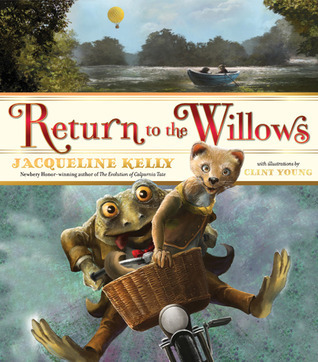
Having recently read The Wind in the Willows for the first time, and being absolutely taken with the characters, I decided to start a mini-project. I've chosen to read three different books, written by different authors, that serve as sequels to the original book, and review each of them in turn. The first one I read was Return to the Willows by Jacqueline Kelly.
In this book, Toad's obsession with motorcars has been supplanted by hot air ballooning. When his nephew Humphrey, who enjoys tinkering around with explosives, comes to stay with him, Toad ends up becoming a bit too fascinated with his nephew's work, and ends up blowing himself up- which leads to an unexpectedly beneficial result. Humphrey befriends a "small, bedraggled weasel" and, over the course of their explorations, ends up a prisoner of the weasels, forced to repair Toad's fallen balloon (which the weasels have taken hold of). Meanwhile, Rat has fallen in love with a baker, Matilda, and Mole feels uneasy about this.
While I greatly enjoyed the beautiful, romantic language of The Wind in the Willows as an adult, and felt that children might not be able to appreciate it as much (despite the book being written for children), Return to the Willows was written in a simpler fashion, clearly oriented towards children of our modern generation. Therefore, some parts of it were a bit too silly/whimsical for me- particularly the entire subplot of Toad becoming a genius, which is kicked off by him receiving a blow to the head (a conceit I've seen used in several cartoons), and mostly consists of him solving the world's greatest questions, such as "what is the sound of one hand clapping?" I'm sure this would amuse kids, but it was a bit too fanciful for me. At the same time, there were several words I felt were too advanced for children, or perhaps I wouldn't have felt that way if it wasn't for the obnoxious footnotes pointing them out every time to explain them. I soon had the overwhelming feeling that either 1. the author shouldn't have bothered to explain them and let the reader look the words up for themselves, 2. the author shouldn't have used words like that if she thought the readers might be confused, or 3. I shouldn't be reading children's books at my age.
Despite these slight annoyances, I found Return to the Willows to be a sweet, charming book. Mole and Badger were depicted perfectly (I particularly liked Badger's straightforward suggestions while the heroes were hatching a plan to free Humphrey, and how he stopped signing onto the letters that Mole sent the weasels, losing his patience), and there was just the right amount of Toad here. I've discovered that Toad is best enjoyed in small doses- even in the original book I found him to be rather overbearing, on the verge of derailing the entire plot- and while a large amount of the story does consist of Toad's adventures at Oxford and his daring return home, it was evenly balanced by Humphrey and Sammy's exploits, and the plan to rescue Humphrey led by Badger, Rat, and Mole. In short, I found it less tedious to read about Toad in this book than in the original. He even struck me as more endearing, perhaps because his massive ego was somewhat toned down.
At first, I wasn't sure if I would enjoy the original characters, but I ended up really liking Humphrey, and I sympathized with poor Sammy. As for Matilda, the mere fact that there was a love interest in this book initially put me off, not only because I'm inherently put off by the addition of a needless love interest into already-interesting narratives, but also because giving Ratty a love interest just felt wrong to me. "Ratty has already met his true love," mind-readers could hear me shouting, "and her name is the River!" But, similar to how Mole fears in the book that Matilda will take his best friend away from him, I was simply being too protective of my favorite character. It also helped to realize that he is #NotMyWaterRat- that is, not the one that Kenneth Grahame wrote about, but the one Jacqueline Kelly wrote about- and therefore I was no more entitled to him than the author. So, Matilda was a nice addition to the story after all, and the ending genuinely made me say "Awww" out loud. I do wish that their relationship hadn't been so insta-love, but again... it's a book for children, Blue.
Besides the things that bothered me that I already mentioned, which can be chalked up to me reading something that's not on my personal reading level, my only real criticism of the book would be that there wasn't nearly enough of it. Just like in the original, I could have done with a bit more messing about in boats. And to spend a little more time on characters not named Toad (or, in this book, Toad or Humphrey). Nevertheless, this was a nice little book and I'm not sorry I read it.