Olga Arbyelina--a rumored Russian princess, refugee from the Bolsheviks, and abandoned wife--is found half-naked on the riverbank, next to the body of a man who mysteriously drowned, in a new novel by the critically acclaimed author of Dreams of My Russian Summers. Reader's Guide included. Reprint.
Andreï Makine was born in Krasnoyarsk, Soviet Union on 10 September 1957 and grew up in city of Penza, a provincial town about 440 miles south-east of Moscow. As a boy, having acquired familiarity with France and its language from his French-born grandmother (it is not certain whether Makine had a French grandmother; in later interviews he claimed to have learnt French from a friend), he wrote poems in both French and his native Russian.
In 1987, he went to France as member of teacher's exchange program and decided to stay. He was granted political asylum and was determined to make a living as a writer in French. However, Makine had to present his first manuscripts as translations from Russian to overcome publishers' skepticism that a newly arrived exile could write so fluently in a second language. After disappointing reactions to his first two novels, it took eight months to find a publisher for his fourth, Le testament français. Finally published in 1995 in France, the novel became the first in history to win both the Prix Goncourt and the Prix Medicis plus the Goncourt des Lycéens.
We begin in a world of Russian emigres living on the margin in Paris. They live in a run-down apartment complex that is a converted factory, subject to flooding from a near-by river. He sets the story up as a mystery – how did a beautiful woman end up dazed on a riverbank beside a drowned, brutish, 64-year-old man? They were in a canoe with a bottle of wine and her dress was almost ripped off her.
The story is set after the end of WW II. Olga’s in her mid-forties since we know she was born in 1900. She has a teenaged son but her husband is back in Russia. The son has hemophilia, so because of this, and given her beauty, education and sophistication, the other emigres call her Princess Arbyelina and spread rumors that she’s descended from Russian royalty. She does nothing to discourage these rumors. In fact she’s a loner and has little significant interaction with anyone, including her Russian compatriots. She works in the library.
Taking care of her son and saving him from injury occupies her whole life. At times she feels that her “entire life is behind her” and “She saw herself just as all these visitors [to the library] must see her: a librarian for life, a woman abandoned by her husband who had cut herself off from her own caste, the mother of a doomed child…”
When she is found in shock and half-drowned on the riverbank she says she caused the death of her companion. But that’s not her crime.
Makine is a brilliant writer of prose. Here’s one extended example and a couple of short ones:
“The sky is cut in two – to the west the cold crimson of the setting sun and in the other half a low, gray canopy of cloud, gradually spreading and spilling out sparkling hail, whose needle points sting the cheeks and fill the dead leaves with a dry whispering in the paths between the tombstones. And when this dark canopy furls back, the vivid coppery light gilds the brown earth and the tree roots and glints on the puddles – mirrors half buried here and there in the thickets of the shrubbery. A gust of wind, as cutting as steel wire assails the eyes with fragments of tears.”
Dusk: “It was that brief moment when solitudes are revealed; when one feels disarmed, incapable of checking the flight of the impalpable, gossamer stuff of happiness.”
Of her husband: “…the awkward uncertainty of a man confronting the woman who has to accept the scraps of life the he grants her…”
It's a good story, slow, dreamy, hazy, reflecting Makine’s writing style.
Andrei Makine is a Russian-born author living in exile in Paris since 1987. This book is translated from the French. He is probably best-known for his novel Dreams of My Russian summers.
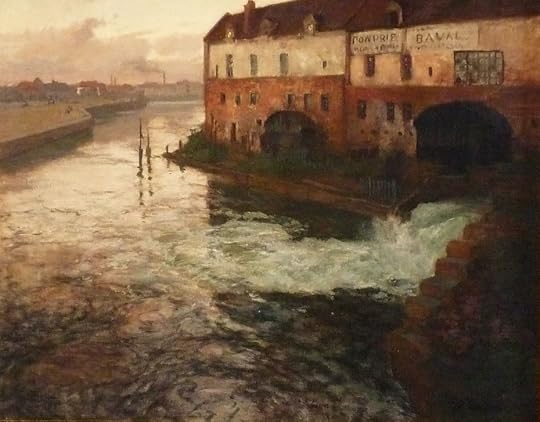
Top painting: Old Factory on the River Somme (Evening) 1896 by Frits Thaulow (Museum: Strasbourg Museum of Modern and Contemporary Art). From useum.org
Ce bine e să citești un roman de două ori! Vezi altfel. Ca să fiu sincer, prima dată nu mi-a plăcut, l-am comparat spontan cu romanele precedente (Pe vremea fluviului Amur și Testamentul francez) și mi s-a părut mult mai puțin reușit (și scris cu o prețiozitate inutilă). Acum aș renunța la „mult”. Notez că, dacă nu e la înălțimea romanelor dintîi (și nu e), rămîne o carte onorabilă și, mai ales, interesantă.
Poate că Makine a vrut prea mult și a complicat inutil acțiunea. Ba chiar a lungit-o. A vrut să ofere biografii complete: prințesa Arbelina își pierde mințile și agonizează într-un azil, copilul ei hemofilic se pierde în pustietățile Rusiei, soțul ei, „un oarecare prinț georgian”, e închis în lagăr și moare. Aș fi preferat (dar cine sînt eu ca să ofer sfaturi?) ca Andreï Makine să se rezume la episodul din iulie 1947. Întîmplarea e stranie și păstrează pe toată durata povestirii ei atenția cititorului și a Hoardei de Aur, comunitatea pestriță dintr-un tîrg situat nu departe de Paris, elita rusă în exil, formată din foști generali „albi”, conți și contese scăpătate, căpitani de „cavallerie” (cu 2 de l) și prințese ca Olga Arbelina, „o femeie de o frumusețe și o impudoare care-ți rănesc ochii”. Nimic nu rămîne secret. Aflăm biografiile fiecărui individ în parte de la paznicul cimitirului din orășelul Villiers-la-Forêt. În timp ce contra-ancheta crimei e realizată de un tînăr în „haine de student”, care aspiră să devină scriitor.
Sigur, nu e vorba de un roman polițist stricto sensu. E un roman despre incest și despre nesăbuința unei iubiri materne duse pînă în pînzele albe. Este, de asemenea un roman despre „egoismul visceral al oamenilor”. Cu această ocazie, am numărat cîte narațiuni despre incest am citit. Iată un răspuns provizoriu: povestirea Anna, soror de Marguerite Yourcenar, Alesul de Thomas Mann, Grădina de ciment de Ian McEwan etc. Mai sînt, cu siguranță, și altele, dar acum nu-mi vin în minte...
This would have been my last of the Makine novels that are available in English translation, had it not been for Lieutenant Schreiber's Country, which is a rather expensive recent hardback.
This is one of the books that most stands out from his ouevre as different - not least because it is a long way from Makine's personal experience and it is mostly set in a Russian emigre community in France just after the Second World War.
The heroine Olga Arbyelina (a princess by a now failed marriage) works as a librarian in the "Caravanserai", an old brewery which is now part old people's home and part cheap flats populated by Russian emigres, situated in a small town a short train trip from Paris. She lives with her son, a haemophiliac. At the start of the book she is suspected of murder after a suspicious death, but most of the book takes place in the previous year and explores the reasons for her involvement.
Much of the plot cannot be described without spoilers - . The shadow of haemophilia is never far from the surface, and the morality of the story is very complicated.
As always Makine's writing is very enjoyable to read, if a little more convoluted than in most of his books, perhaps because of the complexity of the plotting.
Sometimes, if you are lucky, a 2nd hand bookshop throws a gem like this at you. I will be hunting down other books by Andrei Makine.
The author was born in Siberia, a Russsian, though he writes in French. This is a dreamy, poetic novel that takes place primarily during the coldest winter ever recorded in a small village on the outskirts of Paris, where a beautiful, titled Russian immigrant lives with her 15 year old son. The year is 1946.
The claustophobic nature of their lives amongst the snow and ice in a little house at the edge of the woods, gives this book its unearthly feel. I would rather not say too much about the nature of this book but it is mentioned on the bookcover and in other reviews. It shows the skill of the writer to turn something otherwise horrific into something unbearably sad and beautiful. It will be a long time before I forget these two heart breaking characters.
Page 28 - In the distance the glowing window of the keeper's house also resembles a night-light, gradually growing broader as they approach, and admitting them, as a candle flame does if you stare at it for long enough, thereby entering its flickering, violent life.
Page 37 - "So she was thinking about me. It's one of those questions you can never ask: What do you think of me? And yet we spend our days picturing how other people see us, picturing ourselves living in their minds. . . . "
Page 52 - She wore mourning for a person who had never existed and who had been born by chance in conversation when, to conceal her loneliness, she had hinted at a distant loved one, an English fighter pilot, about whom she could not say very much in wartime, for obvious reasons. From one admission to the next this phantom had lived his invisible life, blossoming with a multitude of details, in the heart of the woman who had invented him, adding to his exploits, being promoted. . . .
Page 54 - In the bathroom she spent a moment studying the mirror. "In fact it's very simple," she told herself. "Hair like mine turns grey quite early. I should explain to everybody: you see, I have hair of this type but I'm not as old as my hair looks. . . ."
Page 194-5 The night was clear. The air was softer; scents, long imprisoned by the cold, were flowing readily, like the slightly bitter aroma of damp bark. The snow had been undermined by a multitude of invisible tricklings, still covert, that filled the night with an incessant peal of water drops. She felt she was moving forward across an endless musical instrument, snapping several strings at each sacrilegious step. . . . . . . Tilting her head back, she plunged in among the stars for a long time. A silent, unflagging wind descended from these nocturnal depths. . . . The shadow of the wood, the dark reflection of the water, the dim fields on the opposite bank. The sky from which spilled the powerful and constant wind. All this lived, breathed, and seemed to see her, to be focusing some kind of infinite gaze upon her. A gaze that understood everything but did not judge. It was there, facing her, about her, within her. Everything was said by this immense wordless, motionless presence. . . .
This book creeped me right out, and yet I couldn't just stop reading it. I don't think I'd recommend it to anybody, so I'll just go ahead and say it's about incest and the subsequent madness of the mother. The whole thing is written like being in a recurring dream, and the writing itself is decent, but I just can't really endorse it as a good book.
I am rusty. That's the only word I have for what I'm feeling right now. I used to love reading books like this before. I don't know how anymore, because this isn't one of those books that breeze through cursorily, nor is it a book that you can afford to dwell on for too long either. It's something far more... precious. All sinister connotations intended.
If you've read the blurb, you know what happens. The book itself will answer the question why it happened.
In case my shelving didn't make it clear enough, this is about a woman's shattered mind and discontinued concept of time. It's about losing the sight of what's real and what's not when you're protecting yourself--no, the ones you love--from something taboo. Something so disgusting that the only way to handle your own pleasure in it is to... break. Yes, I'm abusing the ellipses.
Parts of me loved this book, parts of me hated it. Parts of me want to recommend it to others, parts of me know better than that.
The author is French Russian.
Make up your own mind. I know my review is no help to anyone.
Am ales să îl descopăr pe Andrei Makine prin intermediul volumului Crima Olgăi Arbelina, a cărui copertă patru promite o proză dostoievskiană și proustiană ce se învârte în jurul unei anchete polițiste a unei crimei. Folosindu-se de un limbaj poetic sublim, cartea ne spune povestea Olgăi Arbelina, ce a fost exilată în Franța împreună cu fiul ei bolnav de hemofilie după revoluția bolșevică din 1917. Prințesă prin statut și maniere, aceasta își redescoperă destinul schimbat, care este pătat nu numai de această derogare, ci și de o relația incenstuoasă cu fiul ei. „Lumea este totuna cu răul, un rău mereu mai viclean decît poate bănui omul, iar binele este una din vicleniile lui.„
The writing (or the translation) is so confusingly poetic that more often than not I stopped in the middle of a phrase and went back to try and figure out what was going on. While I appreciate poetic prose most of the time, this particular book might have benefited from a little bit more grounding material, in my opinion. I didn't hate the book because of the horrifying crime - but it didn't help me love it in any way, either.
In Andreï Makine's 'The Crime of Olga Arbyelina' the text is sensual in every respect, and delivered with such intensity. A delight is taken in every sense, every mood, every sensation, even guilt, the narrator deploying it with pleasure against her forgiving self. This is a tale where the world is felt, where all is absorbed; and it is all so beautifully written. The number of near perfect, tart sentences I've jotted in my notebooks should on their own speak for the quality of the writing here. Reminded me, in attitudes to forbidden desire, of Violette le Duc. Although Makine is himself not French. Another wonder.
Don't let some of the negative reviews dissuade you, only when you get into the mind and the past of Olga Arbyelina, when you put yourself in her place, can you understand what her true crime really is :)
"Ea stia ca durerea, si fizica si morala, se datoreaza pe jumatate indignarii noastre in fata durerii, mirarii noastre in fata ei, refuzului nostru de a o accepta. Ca sa nu sufere, folosea intotdeauna acelasi siretlic: enumerarea. Da, trebuia sa constati, cu o privire cat se poate de indiferenta, prezenta obiectelor si a fiintelor reunite de o situatie dureroasa." "Da, toate crampeiele de bucurie si de teama care ne alcatuiesc si despre care nu vorbim niciodata." "Ceilalti ne fac sa traim in lumi surprinzatoare. Iar noi traim in ele, ei vin sa ne intalneasca acolo, le vorbesc acestor dubluri pe care ei insisi le-au invenat. De fapt, nu ne intalnim niciodata in viata asta." "Tolstoi umbla pe trotuarul din fata...Traversati!"
This is an intense and sometimes disturbing book, dealing with the desperate love a mother has for her fatally ill son. Because of the child's hemophilia he has been unable to have a normal childhood. His father abandoned him and his mother in Russia and they have moved to an isolated village in France. Olga, the mother, has royal ancestry and is held somewhat at arm's length by her fellow Russian emigres. This isolation, together with Olga's knowledge that her teenaged son will soon die, creates a surreal landscape where they play out a tragic and dark spiral of madness. Makine's prose can be gorgeous at times, with an uncanny ability to see the relationship from Olga's point of view. Readers of Russian literature will appreciate this engrossing story.
A Whiter Shade Of Pale – The poetic nature of the author’s style was completely wasted on me. The story, there seemed to be a story, was drawn with a very light pencil on a greyish background. Very hard to discern. I forced myself to read the book till the final page and I managed. But only because after 50 pages I switched to 5th gear. What happens, when it happens, does it really happen (‘A Dream Within A Dream’)? Who knows? Some other reviewers have pointed out what the story is about, I thank them.
J'ai été conquise par ce roman dès les premières pages : la narration et les descriptions sont magnifiques, et l'histoire semblait prometteuse. Malheureusement, le récit s'essouffle à partir de la moitié du livre; il m'a semblé y avoir beaucoup de longueurs et de redites. Il reste que c'est un très bon livre, magnifiquement écrit, mais qui ne m'a pas passionnée autant que je l'aurais pensé au départ.
Not sure what to make of it. A very odd and slow moving story and a slow read. Unfortunately because it took me so long to read it I didn't fully understand the ending which seemed to refer to something foreshadowed at the beginning I didn't remember. Alas.
I had to force myself to finish this book. It caught my interest at the begining but drug on and was hard for me to follow the story line. I would not recomend it to anyone but there are a lot of people who liked it???
Probably my least favorite Makine novel (have read all but one), but still glad I read it. Makine's super power as a literary writer is to connect the reader to something in the real world (usually something in the past, something nostalgic), via the thoughts and feelings of the protagonist. In ARBYELINA, however, we get into the head of the title character and run smack into - I think - Makine's mind itself.
His command of descriptive prose is strong as ever, with special attention in this book to the meaning and place of snow, ice and glass. However, he is so enamored of his commitment to mapping Princess Arbyelina's inner mental corn maze, that he neglects to take us past the map itself and connect it (and us) to the thing it could probably illuminate, to the thing that would make it relevant to the rest of us.
Complicating his task is the ultimate identity of Arbyelina as an unreliable narrator to herself. We know she lies to herself about a lot of important things, but I am not sure how that ends up affecting the story's end, which has a quasi-"Then I woke up" element to it (not literally, but ... rather, literarily).
In the end, we are spun around a bit, like a wheel circling the story's "crime", and it feels like the narrative itself would have been suitable as a novella, not a longer work. After circling the crime for the umteenth evening inside the strange house, I felt even more desperate than Olga herself to move beyond it and leave it behind, to pretend that everything was fine.
But, there are passages of great beauty and phrases of real power, as always with Makine. What they mean - if anything - is a viable question for critics to debate. And as always with Makine, the link from Russia, to its Revolution, to its emigrés, to the rest of its history and culture, are central to his work. The bread crumbs that may connect the characters to the larger-scale cartoon version of Russian history (hemophilia, anyone?) are pretty large crumbs, but whether they lead anywhere worth ending up, I honestly am not sure.
This story is either a hard hit or hard miss. For me, I thought it was great, the prose was lovely, made me reread it over and over just so I can experience the awe of reading such mastery of language, shining through in the translation. Really, I loved the writing. The content was, wow, a whirlwind. I will say, this story has more explicit, dark themes (not like "he's a ten but he runs you over with his car" type of dark, I mean, really, really dark taboo). I don't want to spoil because the appeal of the story is, well, the supposed crime. I will say that if you liked reading Lolita by Nabokov and have the maturity of an adult to understand the nuances of dark content, you might enjoy this. It starts off slow and I was bored until I wasn't- read the entire half in one go. Picked this up at a used bookstore, so glad I did, I nearly skipped it. I feel like I was plotting against the book by overlooking it, but I'm really glad I stuck through with it. It's weird, like, real weird. You will wanna take a break just so you can digest the content time to time. The way Andrei depicts the dark themes and Olga's reaction to them is enthralling, he doesn't try to skirt around it or play it safe. I finished this a month ago and I'm still grappling with the story's content because wow, it was just very intriguing.
I'm glazing this book but I'm giving it four stars- I wouldn't necessarily call myself a harsh reader, I will always find something I like about a work. However, it only gets knocked down one star because of how slow the beginning was. Ideally, it would be a 4.5, but I'd rather round down if I were to consider whether to recommend this book or not. Again, if you swear off books like Lolita or Tampa, you def won't like this, but I still think it's worth a read. Trying to understand the mindset of someone like Olga is confusing but so captivating.
This book is conceptually wild, but in my opinion not entirely successful. We start with a dead body - one of the older Sergei Golets, and next to him lies Princess Arbyelina, a refugee to France from Russia, whom he has pursued.
Most of the novel consists of a deep rewind into the life of Arbeylina, from her days a young girl participating in aristocratic soirees, to the dissolution of older society as the Russian Revolution came about. All scenes are depicted in a somewhat grotesque, dark, mysterious, dream-like manner - partly for affective reasons, but perhaps also this is how Makine wants to convey the tenuousness and unreliability of memory (and indeed, I think much of the time the narrator is unreliable).
So much of the writing (I hesitate to write narrative, since there isn't much story-telling!) is centered around smell, sight, color, sound, particularly of the woods and water and streams of Villiers-la-Forêt, where Princess Arbyelina has taken refuge after the Revolutions and purges in Russia.
I'm certainly all for art, non-linear portrayals of reality, experimental attitudes towards writing (and likely much of Makine's style pays tribute to writers, possibly, like Proust) but here I think the overwrought nature of the writing diminishes the aesthetic effects the writing is meant to convey.
.
The novel is worth a reread, but might not happen as frankly my enjoyment of the reading was equivocal. That said, this is a book I'm not likely to forget.
Très très mitigée sur ce roman. J'ai beaucoup aimé l'entrée en matière, le cimetière, la découverte du corps, le questionnement entre meurtre ou noyade. C'est extrêmement bien écrit, une plume très poétique, très évocatrice. On en attend forcément beaucoup de l'histoire d'Olga, pour savoir qui elle est, comment elle s'est retrouvée là, si elle peut être coupable... Mais alors quelle histoire ! Difficile de faire plus malsain, et ce n'est pas parce que c'est bien écrit que ça passe mieux. Les agissements d'un certain personnage ne sont pas spécialement remis en cause, c'est cela qui m'a paru gênant et même malsain qu'un homme ait pu penser cette histoire de femme crédible. C'est toujours présenté avec beaucoup de poésie, et franchement lire cela en mars 2025 juste après un certain procès qui met en lumière ce genre de faits, c'est difficile d'adhérer à ce type de récit (livre publié en 1998 mais quand même, ça ne faisait pas rêver en 1998 ce genre d'histoire, en tout cas pas les femmes). Surtout que la fin m'a laissé un sentiment de "tout ça pour ça" après quand même beaucoup de circonvolutions et pensées labyrinthiques. Heureusement d'autres éléments rattrapent le récit : le contexte historique très bien rendu, l'année 1947 notamment ou la situation des immigrés russes, l'hémophilie de l'enfant est aussi un thème intéressant et rare dans les romans, et le récit est habilement construit, avec des détails qui paraissent anodins, mais sur lesquels l'histoire revient de temps en temps pour finalement révéler qu'ils détiennent une des clés de l'histoire.
Romanzo complesso, raffinato, che ha la particolarità di tenere costantemente impegnato il lettore nello sforzo di rintracciare i vari significati – anticipati nel titolo – di quel "delitto" di cui la protagonista si rende colpevole. La vicenda di Olga Arbélina (il romanzo nasce da un aneddoto riportato all'autore) scaturisce da un nome su una lapide nel cimitero russo di Parigi, su cui uno scrittore russo esiliato si sofferma. Interrogato da quest'ultimo, il custode del cimitero, depositario della memoria storica della comunità russa parigina, risponde: «Lei è il primo a cui parlo di questa donna! (19)». La scena si sposta quindi nel 1946 e presenta la vicenda di una donna innocente e fatale al tempo stesso, madre e amante, principessa e reietta, che porta dentro di sé il germe della malattia del figlio, e della sua stessa rovina. Un romanzo potentemente introspettivo, in cui le emozioni della protagonista trovano riscontro nel paesaggio naturale – in particolare quello invernale, così "russo" anche se alle porte di Parigi – e portano il lettore al limite di quel processo di immedesimazione che è una delle sue principali aspettative.
Per approfondire: Emmanuelle Occelli, "Programmation et représentation dans la fabula du désir du lecteur", in "Cahiers de Narratologie" 11, 2004 (DOI: https://doi.org/10.4000/narratologie.14).
Primii pândesc cuvintele ca nişte simpli hoţi de confidenţe. Următorii apreciază la ele probabil altceva. De altfel, pot fi deosebiţi uşor: mult mai rari decât cei doar curioşi, ei vin singuri, îndrăznesc să se apropie ceva mai mult de bătrânul înalt care patrulează încet prin labirintul aleilor şi pleacă mai târziu decât primii.
Cuvintele pe care le murmură bătrânul sunt imediat risipite de vânt în lumina glacială a sfârşitului acestei după-amieze de iarnă. El se opreşte lângă o lespede de mormânt, se încovoaie ca să ia o creangă grea care brăzdează, ca o crăpătură, inscripţia cioplită în piatră poroasă. Vizitatorii curioşi îşi apleacă uşor capul spre vocea lui, prefăcându-se că examinează monumentele din preajmă… Cu o clipă în urmă aflau cum şi-a trăit ultimele ceasuri un scriitor cunoscut la vremea lui, dar uitat după aceea. A murit noaptea. Soţia lui, cu degetele ude de lacrimi, i-a închis ochii şi s-a întins lângă el, aşteptând dimineaţa. Apoi o altă poveste, surprinsă pe aleea paralelă, ale cărei lespezi de mormânt poartă date recente: un balerin, mort cu mult înainte de bătrâneţe, care şi-a primit sfârşitul repetând de mai multe ori, ca pe o formulă sacramentală, numele tânărului său amant care-l contaminase…
This is my least favourite Makine novel to date - the other four all merited 4 stars. It's not simply that the 'crime' itself is sordid, not to say repulsive. It's that we become aware of what it consists in quite early on, then watch over hundreds of pages of tortuous, impressionistic and fairly opaque prose Olga Arbyelina's slow awareness and complicity in it. Yes there are good things - the interior 'bitch' voice, the layering and return of specific, hallucinatory memories in a way that recalls Faulkner - but to be honest it was a relief to finally put the book down.