This concise Teach Yourself text provides a thorough, practical grounding in the fundamental principles of trigonometry, which any reader can apply to his or her own field. The text explores the use of calculators and contains worked examples and exercises (with answers) within each chapter.
Good at Maths? Bad at Maths? How do those questions make you feel? Perfectly equable? Self-satisfied? Or perhaps just a little on edge?
“Good at Maths” seems to be a snap judgement we make about people, especially children. It’s rather like the label we give someone we think “Good at Games”. We instantly then have an image of a fit, healthy, confident person. Hearing the words “Good at Maths” makes us think of someone bright, capable, quick and clever.
So what message is conveyed by the words “Bad at Maths”?
Adults will tend to say it of themselves deprecatingly, with a slight laugh, but isn’t this partly a defence? Who knows how early in their lives they were told they were “Bad at Maths”?
I’ll show my true colours. You’ve probably guessed already that I was not deemed “Good at Maths” at school. (Neither was I “Good at Games”, sadly, but that’s another story.) My parents and brother on the other hand, were. But they were good parents, and wanted me to be happy. They did not push, but my music teachers, both at school and for the piano, were puzzled. I was good at music, and that usually “went together” with being good at Maths, apparently. I was a bit of a daydreamer, so my parents spent hours at home helping me, and explaining all the fundamental principles and concepts.
Gradually I began to get better marks in tests, and dimly the light began to dawn. I even found parts of it fun. I liked problem-solving, I loved the satisfaction of having one correct solution, and I loved the arcane feeling, and the secret “codes” in algebraic formulae.
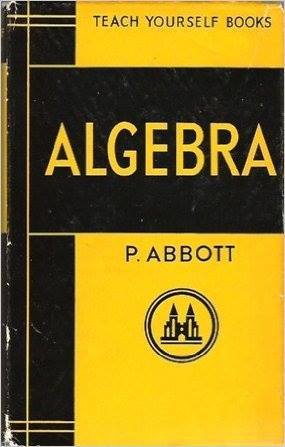
My Dad latched on to my sudden enthusiasm and bought me this as a reward, when I’d done particularly well some time:
I loved it! A book-loving child, although it all seemed a bit mysterious, I could understand part of it. And it all looked so interesting! It was shortly followed by:
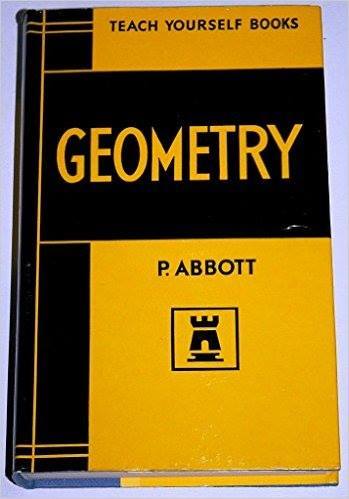
which I liked even better, being very drawn towards design and patterns. Most of this was Euclidian geometry, so perfect for me. We were thus set in a kind of pattern for the next three or four years, although the gifts always came out of the blue, when Dad felt it would give me a little boost. I found:
fascinating. This one and the one on Geometry were probably my favourites.
Teach Yourself Trigonometry was also in the mix somewhere. The “Teach Yourself” series are still all in print, even though I read this in the 1960s, and it was first published in 1940. All the Maths books were written by P. Abbott, and on the title page it says “P. Abbott B.A. formerly Head of the Mathematics Department and Head Master of the Secondary School, The Polytechnic, Regent Street, W.1” which seems rather quaint, as if his qualification for writing such a text book had to be verified. Yet clearly since these are still benchmark books, he must have produced exemplary work.
Teach Yourself Trigonometry is divided into 9 chapters:
1. Geometrical Foundations 8 2. Indices and Logarithms 7 3. The Trigonomical Ratios 13 4. Relations Between the Trigonomical Ratios 4 5. Ratios of Angles in the Second Quadrant 7 6. Trigonomical Ratios of Compound Angles 5 7. Relations Between the Sides and Angles of a Triangle 8 8. The Solution of Triangles 5 9. Practical Problems Involving the Solution of Triangles 5
The numbers I have placed at the end of each chapter heading relates to the number of subsections. Chapter One, “Geometrical Foundations” for instance, has these 8 subsections:
The Nature of Geometry Place Surfaces Angles and Their Measurement Geometrical Theorems; Lines and Triangles Quadrilaterals The Circle Solid Geometry Angles of Elevation and Depression
The text throughout includes many explanatory diagrams and examples. Applications are discussed. There are tasks to perform, with the explanations shown.
However, this is not an easy book, and although clearly set out, it presupposes some mathematical knowledge. Looking at it now, I wonder how I ever mastered some of this. (Yes, I did at least get my “O” level or what is now called a good grade in a GCSE). But I feel that for basic help, “Maths for Dummies”, or “Geometry (or Algebra) Demystified”, might be a better bet nowadays.
But those eyecatching yellow and black design covers will always hold a special place for me, though the books have been reissued over and over with new designs. And now a word to the wise ...
Be careful when you think of someone as “Bad at Maths”. It sticks. I remember a game of “Trivial Pursuit” one family Christmas. It was a friendly game - we were not a competitive family. Present were my husband (“Good at Maths”) and each of my parents (“Good at Maths”). A card was turned up for Jean. Uh-oh ... it was a Maths question. The room went still. I could feel my parents holding their breath, rooting for me. All of a sudden I felt insecure, thrown back to my childhood worries. But this was ridiculous. I was in my 30s - a professional. I was a deputy head teacher. I taught Mathematics as part of General Subjects every day, for goodness’ sake.
The question came. It was a question about cubed roots. My mind went blank. I had no idea what was being said to me. I felt the inevitable wave of kindness wash through the room.
When I was shown the card with the symbols, I knew straightaway, of course. This was a parlour game and a very easy question. But it was too late as the answer was right there, and I had already confirmed everyone’s prejudice, as well as my own.
So if you want to avoid this, maybe read a “Teach Yourself” book at your own pace, and forge through some new synapses for yourself. And please be careful who you judge as being “Bad at Maths”. I have a feeling we have already bred a generation who have convinced themselves they “Don’t Understand Computers”. Now which self-help books can we find to tackle that ...?
قوانين وقوانين وقوانين مرتية منظمة متقنة التنسيق، لكن لكل باحث في فلسفة الهندسة الرياضيات، فلا يعدو الأمر كونه تجميع قوانين مجردة لتسهيل الحفظ وفقط.أي أشبه بمذكرة قوانين جيدة عن حساب المثلثات
Teach Yourself Trigonometry revised by Hugh Neill 2003 edition
This is a review of the "black-n-white photo of ice climbers" paperback edition. The title page says by P. Abbott revised by Hugh Neill. However, it is nothing like the 1992 edition -- a total rewrite. Indeed, in the book's preface, written by Hugh Neill Nov 1997, he writes, "substantially revised and rewritten."
This textbook is a compact, 164 page college-level book that covers all core concepts of Trigonometry. Each section has 1-2 dozen exercises for the reader to solve using a scientific calculator. Answers to all exercises are in the back so the student can check their comprehension. Good figures appear throughout to illuminate concepts.
There are many rough edges and errata in the 2003 rewrite by Hugh Neill. I found the following errors myself. It reflects poorly on Contemporary Books, a division of the McGraw-Hill Companies, that errata are not maintained online.
Errata p. 72. Wrong answer in back. Answer in back is correct if 14.2 (not 14.1) is a term in the exercise. Errata p. 21. Figure incorrectly labeled with "m" (meters) when cm is intended per the answer in the back. Errata p 27. Extraneous "sin" when describing how to use a calculator accurately. Errata p. 57. Exercise 18 has typo in the solution, 76.63 not 72.63. Errata p. 57. Exercise 23 has solution in back to the problem sin 3X = -1, not the problem sin 3X = -0.5 as posed. Errata p. 163. Woefully incomplete index. Highly relevant words are omitted including "acute," "obtuse," and "scalene."
The mathematical symbol of a wavy equal sign to signify "approximately equal" does not exist anywhere in the text. Perhaps the typesetter did not have this symbol. This is most unfortunate for a mathematics text, because all irrational numeric solutions will necessarily be rounded. And most all trigonometric results are irrational.
Worse, the author commingles indefinite continuation notation and rounding. For example, on p. 60 we have "For the equation tanX = 0.3, the principal angle is 16.70... ." This is not accurate. A correct text will read "is approximately 16.70." Alternatively, a correct text will read "the principal angle is 16.6992..." But to round and employ indefinite continuation notation both is confusing and, well, irrational.
Based on the sloppiness of construction, editing, proofing, and typesetting, I do not recommend this text.
Review of Teach Yourself Trigonometry revised by Hugh Neill 2003 edition (ISBN13: 9780071421355) April 2021