Born in Rochester, NY, Sauer was a librarian and writer who attended the University of Rochester and the NY State Library School. She worked at the Rochester Public Library for 37 years, but her occasional vacation home in Nova Scotia gave her the setting for both Fog Magic and The Light at Tern Rock.
Greta lives in a village in Nova Scotia during the 1940s. This costal village has sea mists and fog that covers the community, sending them indoors, but not Greta, from a young age she is drawn to the fog, and explores the changed landscape finding that during these foggy hours it has changed more than expected.
Greta finds that an old part of the village, where the houses have burnt down leaving only cellar holes
This was a lovely magical book, for that reason we give 5 stars although it felt it could have been longer and if, like my daughter you like stories with tidy endings and all explained you might feel frustrated. My daughter thought I was joking when I said that was the end of the book but I can see that was the author's intention, to leave you wondering and not give all the answers.
We liked how Greta's 12th birthday present represented the ending of the past and the beginning of the future but did feel frustrated as we weren't sure if
When we had 3 or 4 more chapters left we both wrote down what we thought would happen, to read to each other after we had finished, although some general aspects of the book could be predicted I really enjoyed the fact that some parts were unexplained and unguessable. A minor downside for me was the idea that
I wonder if one day Greta will have a child drawn to fog? I do hope so.
My mother took care of Mrs. Sauer before her death and as a gift she gave her the three books she wrote, autographed. After my mother moved she passed these books onto me because she knew I enjoyed reading them growing up. It was a treat to re-read them now as an adult.
Fog Magic was one of my favorite books as a child. It's a wonderful "ghost story" that I think has gotten better since the first time I have read it.
Personally, with regard to the exquisite and delightful reading and emotional atmosphere that Julia L. Sauer creates in her Newbery honour winning Fog Magic (and yes, how her writing style so totally and wonderfully does remind me of Lucy Maud Montgomery, which is most definitely very high praise from me), Fog Magic is most certainly a five star book (for I do love that sense of magic created by the fog, the effortless time travelling scenarios and how Greta feels right at home in the past and how the past also always totally accepts and appreciates her, not to mention that Julia L. Sauer's descriptions of Nova Scotia, of the magic of the sea are indeed pure and utterly wonderful and just plain lovely, and yes, I would also have thought this if I had encountered Fog Magic as a child reader).
However, I do have to admit that from an organisational and constructive point of view, I do find that there could have been and likely should have been a bit more of a solid connection between the diverse presented episodes of Fog Magic, for indeed, I do find it a bit annoying that in Fog Magic aside from the two episodes (in the past) featuring Mrs. Stanton and her walk to Halifax for justice, most of Greta's "fog magic" time travel scenarios do not really seem to connect all that well to one another. And furthermore, that yes, the ending of Fog magic, with Greta simply being told that after one reaches twelve years of age, the fog magic leaves and one must accept growing up and leaving this all behind, well, for one, I have found the ending itself both a bit tacked on and just floating in space so to speak and that for two, and more importantly and personally, I have also found the ending of Fog Magic quite sad in many ways and even more than a trifle problematic (as Julia M. Sauer seems to kind of insinuate that the magic of the fog, that imagination etc. are only allowed for children, that once one reaches the age of twelve and is on the threshold of being a teenager, one must somehow grow up and leave the magic of childhood imagination behind).
“It’s the things you were born to that give you satisfaction in this world, Greta. [ . . . ] And maybe the fog’s one of them. Not happiness, mind! Satisfaction isn’t always happiness by a long sight; then again, it isn’t sorrow either. But the rocks and the spruces and the fogs of your own land are the things that nourish you. You can always have them no matter what else you find or what else you lose.”
Greta Addington is 10 and lives in Little Valley, Nova Scotia. Unlike most in her small coastal village, she has a particular affinity for the fog. It creates hardship for the men out on the boats, and it only makes life easier for lobster poachers, but for Greta it is “like the magic spell in old fairytales” or “a magic wall she can step through.”
One day Greta’s mother sends her out in the fog to find a cow that has strayed, and Greta discovers that it has wandered towards Blue Cove, a long-abandoned settlement where only cellar holes remain. On her way home in the mist along Old Post Road (made by the first settlers), she sees the outline of a building, which in fine weather is not there. She later asks her father about the building. It wasn’t there even in his day, he says, only an old cellar hole. But even if her father denies knowing anything about the structure, he does speak to Greta’s anxious mother about allowing the girl freedom to go out in the fog.
The next time Greta ventures down Old Post Road in the fog, she meets a brisk woman driving a surrey, who offers her a ride down the other side of the mountain to Blue Cove. As they descend the road that goes towards the sea, the foghorn in Tollerton stops sounding entirely. Indeed, the woman knows nothing about that warning signal when Greta asks her about it. As for Blue Cove, it is no longer an open clearing with many cellar holes but a quaint fishing settlement, very much alive.
Greta quickly meets Retha Morrill, a girl of about her own age (who seems to have been waiting for her), and Retha’s mother, Laura, who mysteriously comments that there is always a “Greta” among the Addingtons, and there is always an Addington child who loves the fog. So begin Greta’s fog-time visits to Blue Cove.
Greta quickly finds out that Blue Cove operates on a different time than Little Valley, though it does experience the same season. She also discovers that she knows the outcome of events that village folk can only guess at. Greta learns the origins of stories she knows from her own childhood—for instance, the story of Ann, an orphan girl, whose ghost is said to haunt the wood near Little Valley. Greta learns of shipwrecks and salvaging expeditions. She now understands the fascinating story behind Captain and Mrs. Cornwall’s gravestones in the cemetery. (Mrs. Cornwall had gone mad when her captain husband died of yellow fever on the return from Bombay and insisted on bringing his body home for burial.) One of the most fascinating stories is that of Anthony, a legless man with “a lean, dark, strange, and foreign face” who was found after a shipwreck and whose identity has never been established.
Greta visits Blue Cove over a period of two years, growing increasingly attached to this other, older, secret world, but as she approaches her twelfth birthday, she (like the Morrill family) knows that something is about to change. She is, however, able to make one final visit to Blue Cove before that day is through. She receives a gift from Mrs. Morrill and learns a secret from her father, all before she puts childish things away.
Julia Sauer’s book is an absolutely lovely piece of children’s literature, which I suspect many adults would enjoy as much as I did. It seems that Sauer, an American writer and children’s librarian summered on the Nova Scotia coast, near the town of Digby and heard many of the old stories about the place. Interestingly, the story of Anthony is based on the real story of “Jerome” a legless, foreign man, whose body washed ashore in Sandy Cove, near Digby, in September, 1863.
Ive read this a dozen times at least, it was favorite of my mothers and now a favorite of mine. Truly an escape, wonderment but not in a fantasy land, fairies and dragons kind of way. This small girls fascination with the fog takes her back in time...but not very far back, historically speaking, making it all the more tangible. Pick a foggy or rainy afternoon and read this.
Title: Fog Magic Author: Julia L. Sauer Publisher: Puffin Release Date: 1943 Rating: 5/5
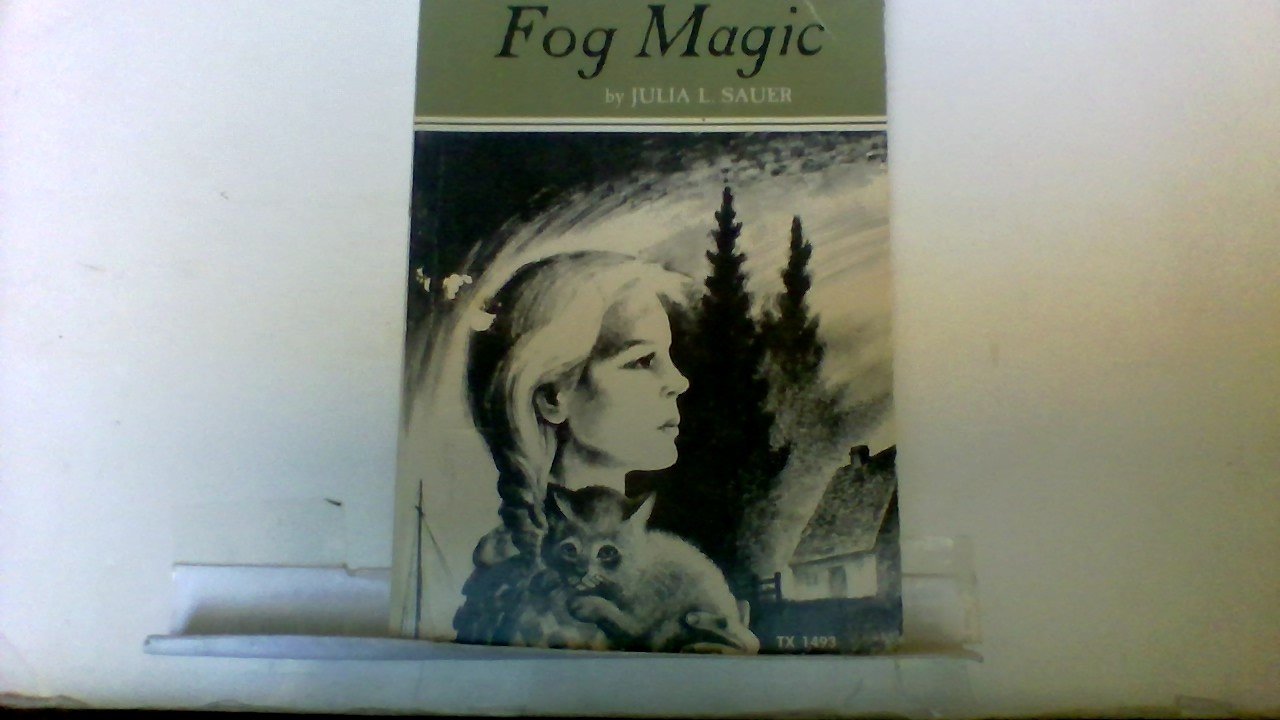
Cover Impressions: This is my favorite cover of this book and the one that I remember. It gets the old fishing village just right and has the beautiful, soft and ethereal quality of the fog.
Review: When I was a little girl I discovered this book on the shelf of my tiny school library. I read it at least twice a year for the rest of my time at that school. It was my go-to book when I was feeling sad or lonely (which, to be honest, was quite often) and I was the perfect book for a foggy, Newfoundland day. Recently, while perusing the shelves at my favorite second hand bookstore, I came across Fog Magic and just about squealed in delight. I am so happy to get to read this wonderful story again.
Fog Magic is the Newberry Award Winning book of Julia L. Sauer. It is set in rural Nova Scotia in a tiny fishing village. The main character is an eleven year old girl named Greta. Greta has always had an unexplainable fascination with the fog. From the time she could walk, her mother was constantly trying to stop her from wandering off into the mist. While walking one grey, foggy day, Greta discovers that the fog doesn't simply hide her from the world, it also reveals a new world to her. The fog allows her entrance to Blue Cove, a place that holds only remnants of a community in the bright sunshine but is alive with the hustle and bustle of life within the fog.
I always love the magic behind Fog Magic. I grew up in the fog, I saw how it will creep and sneak along the ground one day and roll in as if swallowing you up the next. I loved the idea that you could walk into the mist and come upon something that was never there by the light of the sun but could exist in that liminal space that fog can create. Sauer does an excellent job of describing the mystery of the fog and the rules of this world are fairly well defined. The fact that Greta can only reach Blue Cove through the fog and that time is different there allows the story to move quickly through a year without being bogged down with day to day details.
The story is a simple one, but is enchanting in its simplicity. We are able to see some of the key events in the lives of the people at Blue Cove and can really feel Greta's sense of other-worldliness in having prior knowledge of the outcome of these events but no way to change them. She develops a simple and sweet friendship with Retha and becomes close with her family, who appear to know more about this mystery that Greta does herself. I do wish that some of the minor mysteries, like what happened to make everyone leave Blue Cove or who Anthony really is, were answered as these are the questions that keep me wondering and wishing there was a sequel to this book.
This book will always be a favorite of mine and it makes me happy simply to see a copy resting on my shelves, awaiting the next grey, foggy day.
Notable Quotables: "Most of us live in two worlds - our real world and the one we build or spin ourselves out of the books we read, the heroes we admire, the things we hope to do."
On foggy days, 11-year-old Greta is able to travel back in time and visit the long-lost village of Blue Cove. There she meets Mrs. Morrill and her daughter, Retha, who become Greta's close friends. The visits continue for some months, giving Greta special glimpses into a past she has heard stories about her whole life. All the while, though, Greta's twelfth birthday approaches. On this day, everyone seems to know, Greta will grow too old to experience the fog magic.
Fog Magic is a coming-of-age story, which focuses on the beauty of imagination during childhood and the loss of wonder and innocence that comes with age and maturity. Though the book was originally published in the 1940s, it is not necessarily confined to that time period. Rather, the universality of the knowledge that all children grow up makes it a timeless read.
Setting plays a major role in this book, and Sauer does a beautiful job of bringing the real world and the world of Blue Cove perfectly to life. She also manages to explain the magic of the fog - its limitations and its function - in subtle cues without spelling it out step by step. This approach contributes to the haunting, ethereal mood of the entire book, and helps the magic maintain its air of mystery.
Like The Light at Tern Rock, Fog Magic is a short novel with very precise, evocative writing. The moral is less heavy-handed in Fog Magic, but it still conveys a valuable lesson to which young readers in every generation can relate. The age of this book makes it somewhat difficult to find, and more difficult yet to sell to kids, but for those readers who like quiet, complex reads, this will be a special find. Other Newbery honor books that are similar to this one include Bright Island by Mabel Robinson (because of the setting) and The Fledgling by Jane Langton (because of the magic).
Greta loves the fogs that come rolling in from the sea. There is something mysterious about them, no one likes them, the others find it a hindrance, the farmers cannot dry the hay, the housewives cannot find a place to air their clothes...but for Greta it is a time of happiness. For years she was just happy to see the fog rolling in and then one fine day she saw houses and later people...this was the beginning of her relationship with the people of the Blue Cove. She was one of the chosen ones... She loved the people who loved her in return... What I like about the book is that Sauer has not tied every loose end, much like life every loose end is not tied, that's the beauty of life. We will never know for example what really happened to Anthony. Why was he mutilated? Did he ever find what he wanted to? Or why did the village itself get destroyed? Was it fire? Many loose ends here and there for after all life really is full of untied loose ends.
This entire review has been hidden because of spoilers.
I love this enchanting and magical little book, and decided to treat myself to a first edition (1943) which arrived the day after Christmas, Boxing Day! It reminds me so much of Greenwillow, about another magical little village, another one of my favorite books (can one have too many "favorite" books?!) I lose myself in another world whenever I read these two books.
Despite the title and the magical device of the fog allowing time travel, this book isn't really much of a fantasy -- it is about everyday life, family relationships, and the bittersweet experience of growing up.
Reflections and lessons learned: “Most of us live in two worlds - our real world and the one we build or spin for ourselves out of the books we read the heroes we admire, the things we hope to do…”
I really did try with this one (probably falling asleep listening to it 5 times!), as I’m a fan of clouds, and fog and clouds are quite similar (creating moving art, covering up and highlighting things - pullback to reveal in a ‘tonight Matthew I will be… stylee) but I’m still confused by this short story - maybe just not enough to hold my interest or a wrong genre pick?
A long time ago when I was in 6th grade, I was digging through the bookshelf in our English classroom when I encountered this little gem.
It had old-fashioned cover art, on top of which a gray Newberry seal was printed. Because I was obsessed with dates back then, I checked the published date for this one and discovered it was 1943.
To me, that was obscenely old. That was during WWII! Because of its oldness, the gray medal, and its shortness (I was into giant 500-page fantasy books back then) I decided to give it a go.
It was an odd story - a girl walks freely between her island's past and present - but unpredictable and atmospheric and mysterious in that way that makes it feel anything can happen. At first I was bored due to the lack of plot (it takes the shape of a slice-of-life), but as Sauer dropped little clues that linked the two worlds together, I slowly became enmeshed in it, and began to feel like this was a "second world" for me to live in. The book places mysteries with such precision, it makes the story come alive (in life, there will always be things we don't know) and even when they aren't answered (which is all too often) it is extremely satisfying.
I recommend this to imaginative kids who love the mystery in the world. It is packed with anecdotes, subtle hints, and wonders, just like real life.
My favorite thing about Fog Magic is when the fog comes in, Greta saw a different world. When she discovered the fog had magic in it was when she was looking for the milk cow and thought she saw a house in the fork of the road. Then Greta found friends on the other side of the mountain called Blue Cove. Her new friends name was Retha and Mrs. Morrill. My favorite part of the book was when Retha and Greta were picking berries and it was time for Greta to go home and Mrs. Morrill gave Greta a piece of pie to take home with her. When she got home the pie was gone from the pale. All in all I really liked reading this book and imagining what it would be like to be in another world. My least favorite part of the book was about Captain Cornwall dieing of yellow fever. It made Greta and Retha really sad.
An only child who loves the fog and lives in Nova Scotia by the sea circa 1940 (although it could have been earlier; there are minimal references to cars and that's about it) ... it has to be good. But, it falls short. This reads like an early draft ready to be developed. A little more depth to the characters. A little more to the plot. As it stands, I doubt that it will be one of those books that stays with me for very many years.
p 24: "It's the things you were born to that give you satisfaction in this world, Greta. Leastwise, that's what I think."
I remember this book from when I was a little girl. I read it in school, and it had me going out on foggy days, hoping to find my own magical village. I never did find houses or friends in the fog, but I did do a lot of exploring and discovering, which was almost as good.
Just finished re-reading the book, and the richness of the story, as well as the life lesson, that each part of our lives is a season, and though things change as we grow, and we leave some things behind, new things will come into our lives.
This is a truly timeless book that I am thrilled to share with my daughter.
There's something peaceful and gentle about this book, much like the nature of the fog itself. While most of Greta's little seaside village grumbles when the fog rolls in, Greta is drawn to it. On her frequent walks, she often goes through a deserted village... only in the fog, it's not so deserted anymore. Somehow, through the mist of the fog, she has stepped back in time. The story is a wonderful escape, worthy of the awards it earned when it was first printed in 1943.
This is a lovely little book. I read it as a child and it stayed with me--every time I see fog I wonder if I could walk into it at just the right time and find a different world. I found it again in a box of books I had stored away and was glad to see it was as good as I remembered. It's well-written, and doesn't talk down to the young readers for whom it was intended. And any book that stays with you for 40+ years deserves 5 stars.
It's very old-style, a series of visits from a girl who lives in one island village to the families and village that existed on another part of the island two generations ago (it's now vanished). There's no violence or big action, just interactions between people.
And I can't really complain about why I didn't like it without spoiling the end. I apologize!
I found this book on my second grade teacher's shelf and absolutely fell in love. The story completely grabbed me -- enough so that I read it a second time later on and still think about to this day.
First published in 1932, this small book was captivating. A young girl, who lives on an island in Nova Scotia, loves the fog. Unlike the fishermen who need the light for their living, Julia cannot wait for the fog to toll in. Begging her mother to leave for a walk, Julia soon accomplishes her tasks and walks over the mountain, into a land where she is taken away to a place where in the day there are only markers of where houses where, now in the fog, she is drawn to a small village.
Going back in time, Julia meets another girl as a play mate. Told she must hurry home before dark, Julia lives in two worlds, that of long ago, and the world of her current life with her mother and father and small house in a fishing village.
I loved the writing which immediately allowed me to envision the land of far away. This is writing at it's best!
This is a cute old-fashioned timeslip story. If you like that sort of thing (think Tom's Midnight Garden, Charlotte Sometimes, or A Traveller In Time) then you'll probably like this as well! If that doesn't sound like your sort of thing, then maybe you'll find it a little slow.
Just a warning: this is called Fog Magic, but the fantasy is pretty low-key here. The magic simply involves going back (100 years?) in time. I'm sure that for modern readers, life in a 1940s or 19th century Nova Scotia fishing village seems equally foreign. I enjoyed it, but if you're looking for more fantasy than historical fiction, you may not appreciate this.
I don't know where I got it, but this book has been sitting on my bookshelf for years. I never had much of an interest in reading it until I became interested in children's timeslip stories. Most of these are impossible to get on Kindle, so I've been ordering used copies on Amazon. Since I owned this one already, I decided to give it a try. I'm glad I did.
One of the more interesting things about this book is its setting - a fishing village in Nova Scotia. It really reminded me of some of L.M. Montgomery's stories. Most of her stories are set in the farmlands of Prince Edward Island, but some are set in fishing villages. Obviously this book was written after Montgomery had written many of her stories and in a slightly different location, but I can absolutely see the similarities. The difference here is that Montgomery's view of fishing villages often was that they were filled with harshness, poverty,and vices - she was a middle/upper class minister's wife after all. Julia L. Sauer, on the other hand, is obviously charmed by them. It was refreshing to get this point of view.
The ending of Fog Magic was slightly disappointing and abrupt. There were so many questions left unanswered. We never learn how the magic works - why can Addingtons visit the past? How many have done so? Do they all go to the same time period, or do they travel a set amount of time into the past? Did meet Mrs. Morrill while she was a young girl or as a grown woman as Greta did? What is the mystery of Anthony? Does ghost really haunt the woods? It had even less explanations than your average old-fashioned children's fantasy. Despite all that, I actually appreciated it. Sometimes explanations of magic can be disappointing and slightly stupid (I wasn't particularly impressed by the explanation in Tom's Midnight Garden, for example). The vagueness just adds to the mystery of the story. As Mrs. Morrill says in the book, "Of course there's an answer [...] But that doesn't mean we need to know the answer."
A sweet, simple, magical story about a girl who loves the fog and discovers in it a way to time travel to a nearby community in the past. I enjoyed how a number of plot threads are so realistically left unresolved as an explicit theme of the book. I understand the ending is a sore point for some readers, and I think I can describe the problem vaguely enough to not spoil it badly, but I'll put some spoiler tags around this anyway: To me, the only real problems are that this is definitely a book for kids and, although I found it very pleasant, I have a feeling I won't remember specific characters or incidents from it within a year, because few stand out in their particulars.
2007 - My mother-in-law recommended this book after I noted how pretty the fog was while at her house for Christmas. It's a kid's novel, written in 1943. It's about a Nova Scotian girl who discovers that when the fog rolls into her fishing village, she can actually visit the neighboring village--which has been gone for decades and in her present life is just a bunch of cellar holes. It's a great story for those of us who love nostalgia (and fog).
I've loved this book for years, and it didn't let me down now either. While the end speeds up and comes too quickly, the book itself is still eerie and magical, and makes me want to live on Nova Scotia (or whatever island it's set on that's all foggy). Read this one with a girl who's a quiet, magic-lover.
Charming, short and sweet book. A good book if you want to be transported into the beautiful setting of Nova Scotia, with a bit of magic and time travel. I would have given it a higher rating if the book had a bit more of a cohesive plot. I felt there were a lot of loose ends by the end, and the ending was fine. A lot of the characters seemed a little flat.
I enjoyed the writing style, though. It was beautiful without being too frilly, and I loved the descriptions of the fog and the harbor.