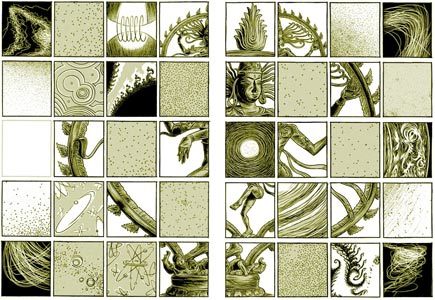
Wie bringt man 14 Milliarden Jahre Weltgeschichte in ein Buch? Diese Frage hat sich der Berliner Zeichner Jens Harder gestellt und beantwortet: Indem man auf 350 Seiten den Beginn unseres Universums mit dem Urknall, die Entstehung des Planeten Erde und die Evolution der Pflanzen- und Tierwelt in großartigen und detailreichen Bildern umsetzt. Mit Texten geht er sparsam um, nur an wenigen Stellen finden sich kurze Passagen. Dafür fädelt er auf diesen historischen Faden geschickt Darstellungen aus allerlei Schöpfungsmythen und verquickt so fast unmerklich Naturwissenschaft und menschliche Vorstellungswelt. Am Ende des Buches steht der Mensch und ein völlig hingerissener Leser, der gerade eben die Entstehung von allem nachvollziehen durfte!
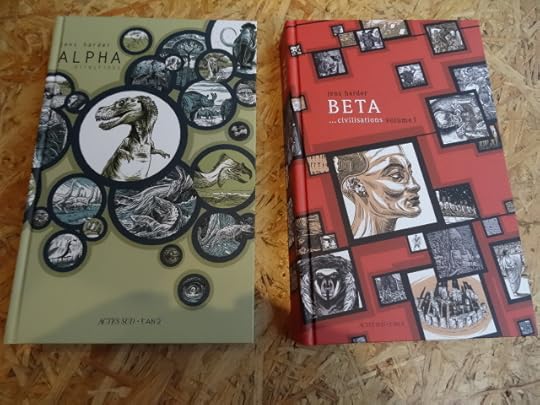
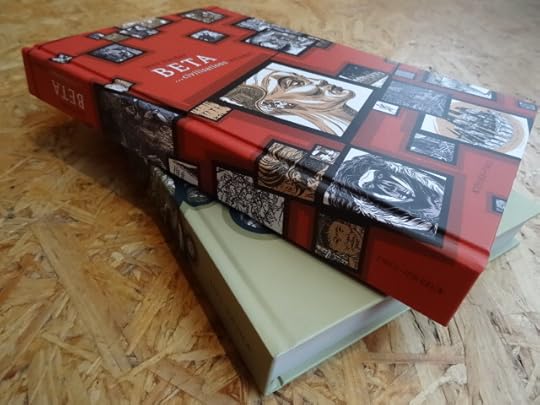
The complete wraparound cover art: BETA... Civilizations; click on the picture to go visit that GR page: After 'Intelligent Sentient' got me thinking about other examples of artbooks with segments of sequential art DNA spliced into their makeup, like Al Columbia’s ‘Pim and Francie’, Joe Sacco's 'The Great War', or Xavier Robel and Helge Reumann’s ‘Elvis Road’, it eventually reminded me of a two-volume-and-counting project that I've revisited dozens of times: ALPHA... Directions and BETA... Civilizations: Volume 1, by German cartoonist Jens Harder. Even more ambitious than Jason Lutes’ ‘Berlin’, Charles Burns’ ‘Black Hole’, or it's closest graphic novel equivalent, Bryan Talbot's 'Alice in Sunderland', Harder has worked tirelessly to shake the faith of devout librarians in the taxonomical omnipotence of the Dewey Decimal System... although I kind of doubt there's a librarian alive who wouldn't shrug and say 'close enough' instead of conscientiously sorting out the paradox. The 730-or-so beautifully composed pages present a clear-eyed but imaginative and symbol-rich history of everything; from the first quarks and electrons to the stellar nurseries, from the astronomical and geological melodrama of our solar system taking shape, to the alien elegance of the Cambrian and the first forays of life ashore; the tentative first steps and then the Great Dying of the Devonian, the ominous devastation that almost drove life back into the ocean… then there’s the fun of the dinosaurs, tracing the Darwinian lines of descent and extinction until human civilization appears… on the final page of ALPHA… Directions (Are the initials of ALPHA... Directions and BETA... Civilizations -- A.D./B.C. -- a coincidence? Hmmm. Yeah, probably).
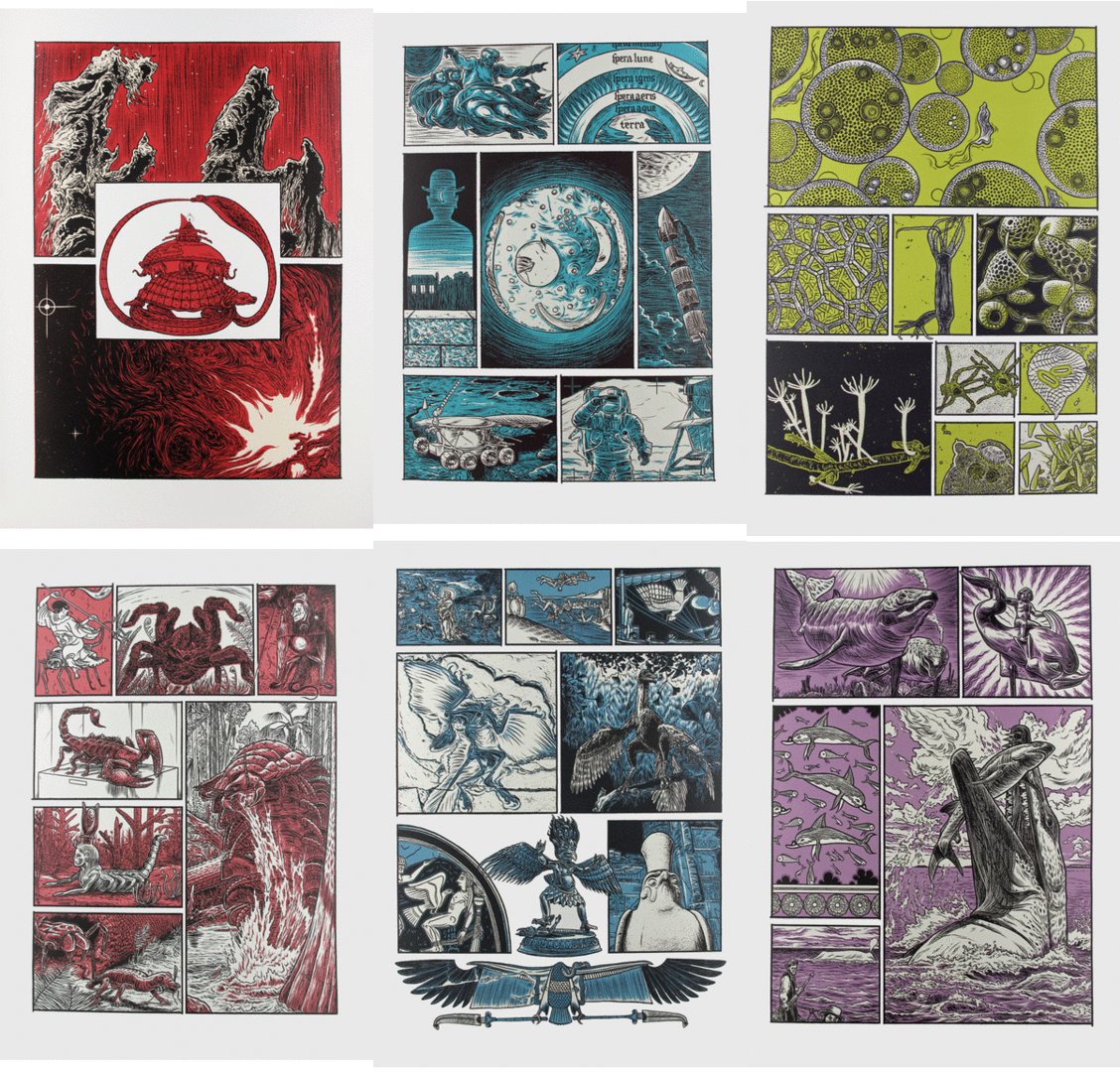
A series of lithographic editions by Harder from AD (Top), and original art pages from AD (Middle and Bottom): First of all, ALPHA… Directions and BETA… Civilizations are artbooks (they also have the interesting acronyms ‘AD’ and ‘BC’, so I’ll use those instead); that’s not all they are, but they are unquestionably glorious fucking artbooks. They share a deluxe over-sized hardcover format, lavishly produced by the excellent French publisher Actes Sud. Both are 8-inches wide and 12.5-inches tall, AD over 360-pages, BC over 370… with at least one more volume to come. The paper is a heavy, glossy, archival stock, and uses a picture-board cover without a dust-jacket. Each chapter is color-coded, using the same monochromatic tones for the artwork. Curiously, Harder shifted the colors for each edition, according to language. The English edition of ALPHA… Directions was finally released in October by Knockabout in the UK. Jens Harder is another artist right near the top of my list. Absolutely amazing work, related distantly to what I see in Frederick Peeters and Blutch, but with a colder, darker outlook showing itself at the edges. AD and BC are also Comics. They indisputably use panels inside a grid, right? Very comicky shit. The reader’s focus moves left-to-right, top to bottom, moving forward with the linear progression that mirrors our perception of time, as well as cause and effect -- all stuff Superman readers would approve of, assuming anyone is still reading Superman. He’s too good at everything. Fuck that Gary Stu motherfucker. But before a group of manga fans can coordinate their nascent telepathic Akira powers well enough to make my head explode, I’ll admit the story could have been orientated mirror-reverse and still be sequential art. AD/BC is closer to traditional sequential art than ‘Intelligent Sentient’, but the way Harder tells the story is just as unique… because the story is FUCKING HUGE. And while I’m still hanging on to the edge of this topic with white knuckles, FUCKING HUGE subject matter is also terra cognita for ‘comic books’; just ask Galactus… on second thought, we should probably avoid getting the attention of a god-monster who eats planets. Just leave a message with the little silver bitch on the surf board, always following him around like a smitten schoolgirl. I think he’s the big man’s secretary or herald or some shit. That's a classic 'Alpha'-'Beta' relationship right there. This particular BIG story, however, really sets AD and BC apart, being non-fiction and all. Artbook and Comicbook are both aspects of Jens Harder’s masterpiece: a book of Natural History that is closely related to Ernst Haeckels ‘Artforms in Nature’, Audubon’s ‘Birds of America’, and even Augustus Seba’s ‘Cabinet of Curiosities’ – all provide rich source material for Harder to work from – but combined with Darwin’s ‘On the Origin of Species’ and Hawking’s ‘A Brief History of Time’. The scope of this work would send many artists screaming into the night, but Harder deftly juggles the daunting array of academic disciplines: Theoretical Physics, Astro-Physics, Astronomy, Geology, Chemistry, Palaeontology, Biology, Archaeology, Anthropology, Botany, Ancient History, Art History, Literature, Cinema and Popular Culture. The story is 13.5 Billion years old. The story is about the stuff that happened after the birth of the universe, from the first inconceivably brief increments of Planck Time that set a crucial hierarchy in place: Gravity, Electro-Magnetism, the Weak Nuclear Force and the Strong Nuclear Force. The relationship between the Four is an exact and integral balance, a constant that cannot vary without making atomic structure impossible.
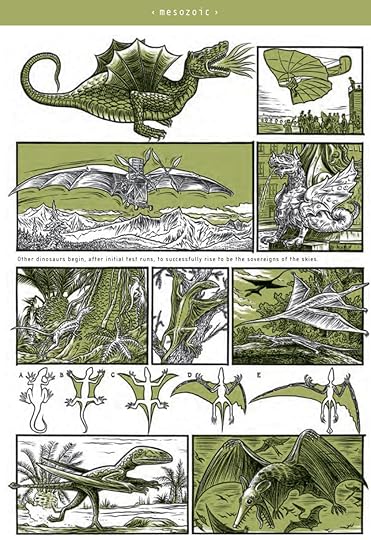
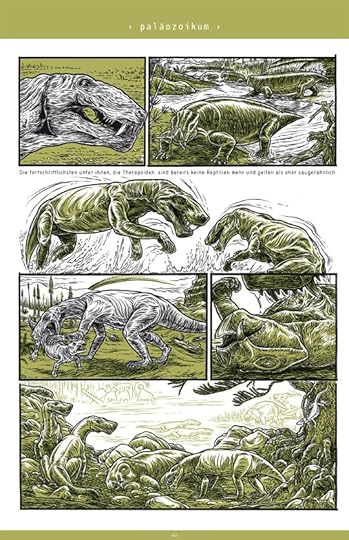
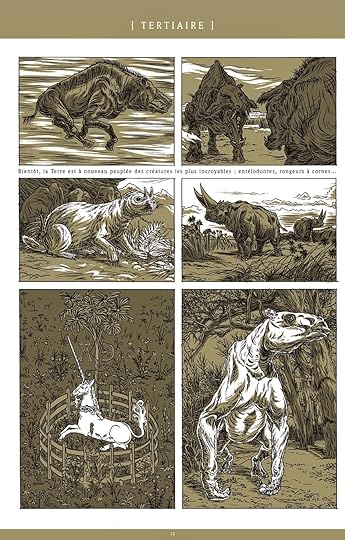
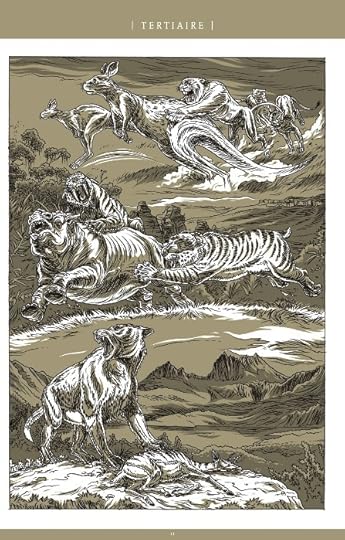
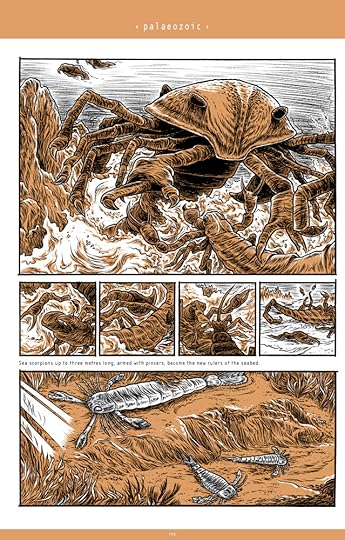
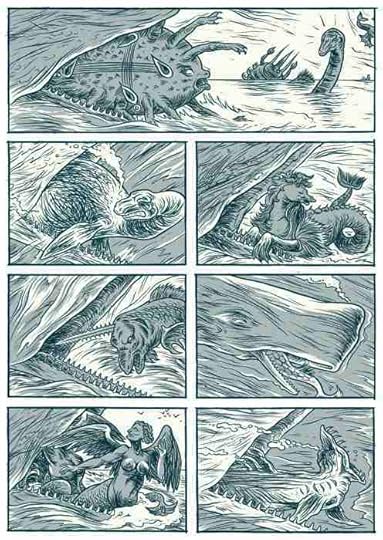
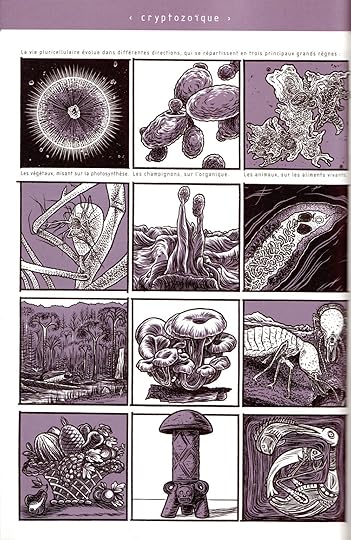
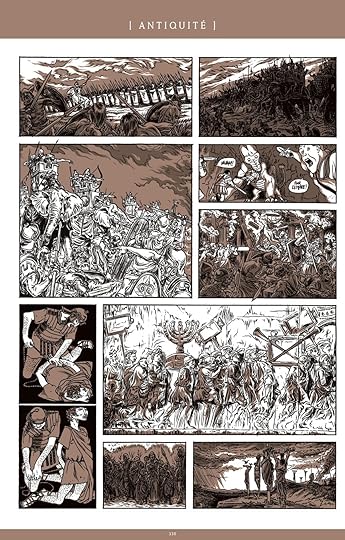
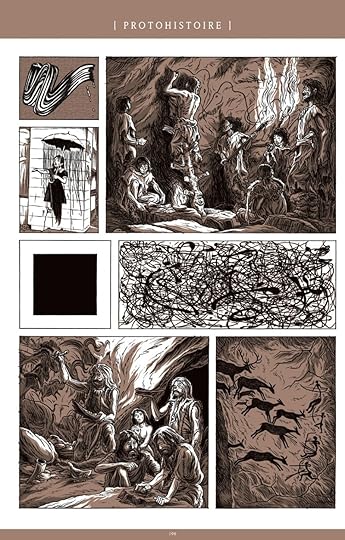
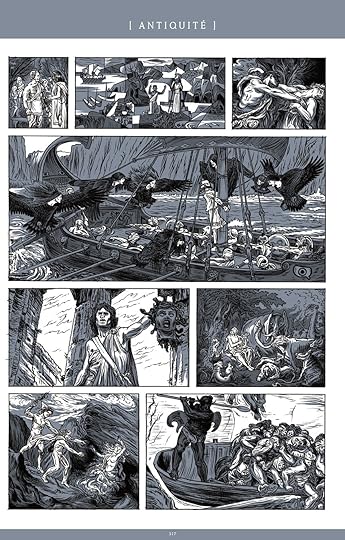
More original art pages from AD/BC; the color-coded title-bars indicating period and epoch, are done by computer, but the art is still drawn the old-fashioned way: [image error] From Jens Harder's breakthrough work, 'Leviathan': As AD/BC moves across billions of years to depict the birth of the Solar system and planet Earth, Harder settles in to the long march of Life, from single cell organism to the ubiquitous Trilobites and the other primitive ocean dwellers of the Pre-Cambrian and Cambrian. I love moss and mould and algae as much as the next guy, but Harder doesn’t pander to the lowest common denominator with the protozoa moneyshots and glamorous fungae cheesecake photos. This isn’t a text-book (or a slime-mould porno… sorry to disappoint). Every subject is seen from multiple perspectives; for example, illuminated manuscripts from the Middle Ages depicting the creation myth from the book of Genesis, juxtaposed against the billions-of-years-old collision that separated the flaming ball that would become our moon from the molten proto-planet that would become our Earth. Fundamentalist Christians are bothered by the hypothesis that the moon was once a part of the Earth, knocked loose in the chaotic demolition derby that characterized the infancy of our solar system. But if the Earth is male and the Moon is female, it’s very much like the creation of man and woman in the Garden and Eden, when God borrows a spare-rib from Adam and uses it to create Eve. Jens Harder’s artistic style is magnificent, relying on his own creative powers to interpret disparate source material. This creates a feeling of cohesion that photographs could never replicate. His monochromatic compositions make every page a powerful work of art in its own right, but the work as a whole… pure fucking genius. There are moments that approximate stream of consciousness association used very cleverly and deliberately throughout, imagery from past, present and future. Oh, right. No, not ‘future’. Forget I said anything about the future, because I’m too lazy to edit. Jim Woodring’s ‘Frank’ might sit next to a portrait of Sigmund Freud, which might sit next to a 16th Century woodcut of an early anatomist dissecting a human brain; a realistic drawing of a long extinct ocean predator like Megalodon moves to a steel-engraved plate from Mellville’s ‘Moby Dick’, then a still frame from ‘Jaws’… all of it perfectly, meticulously rendered in his unique style. Harder follows the vectors of both popular culture and human subconscious, and finds parallel trajectories, more often than not. This may be the most successful exploration of archetypal consciousness ever attempted, in the medium best suited for the task, and least often put to work… and that’s just a part of it, a fragment of the whole. If ‘ALPHA… Directions’ isn’t for you, as always, fair enough. I’m sure some people are going to justify their lack of interest by dismissing it as a random assortment of images scribbled into a high school textbook, with no real story or purpose, meow meow meow meow (See? It’s so easy to be a sarcastic dick. I do it all the time, so I know. None of that was true, but we’re inclined to believe the worst. It’s far more difficult to step outside our narrow definitions of ‘good’ and ‘bad’ when faced with a work that can’t be properly judged using standard criteria. For some, if it requires a bit of thought, fuck it, they’re gone. If that sounds like you, get back to the spinner-rack, motherfucker. :-D I bet Spiderman’s getting beat up by his own pajamas, or something equally invigorating. I’m just kidding, I love Spiderman. Alright, that’s a lie, but I don’t hate him… actually, that's a lie too. He's like Archie in a get-up that's way too boring and frustrating to draw, and my hatred for Archie is a pure and radiant thing). It’s a work of 19th Century Natural History, combined with a modern artbook; the Ernst Haeckel influence is melded with the structure of Sequential Art. What you end up with is far more than the sum of its parts. It’s not an ‘easy read’, but I’ve come back to both volumes many-a-time, usually as art monographs. If you don’t have the eyes to see this as the masterpiece it is, or you don’t find this exploration of art and natural history and science and comics all that interesting -- fair enough… and I’m sorry. That’s unfortunate. The windows of your soul have clearly been nailed shut and will soon be boarded over, to keep out junkies and squirrels.
Eisnein's No.31 Favorite Artist/Artbook*. Check Out No.32 Right HERE. Go Back to No.1 HERE.
What a headbanger, this is like one of those books that will make you smarter just if you have it in your house don’t even have to read it but if you do it’s a lot of very cool pix not too much writing from when the universe was just a little dot like a full stop like this full stop. until it’s the big thing that you see up in the sky so this book goes all the way from the big bong to the evolvement of the human beings from the dinosaurs and the microbes. The people that think that God did it will prolly not like this book but I bet they will secretly think its cool too. I see that if these pix are right from a long way off a microbe and a galaxy look quite the same, no coincidence, I think so, lol. I bet microbes are just little galaxies & if you can see inside there will be people in them too. Probaly people writing reviews on a microbe goodreads. I wished I had got this book last year, I would have past my exams better and not have to resit. It is so big you could pound someone unconscious easily. So you could use it on any home intruder. This artist has put in a lot of pix that are from movies I know, obvs J Park but also Ice Age and Creature from the Black lagoon and all those. This is when life has evolveled not with the microbes, there are no movies about fighting microbes that I have heard of although if there is I will not be surprised. When they make a movie like Bikini Bloodbath Carwash you know they will make anything.
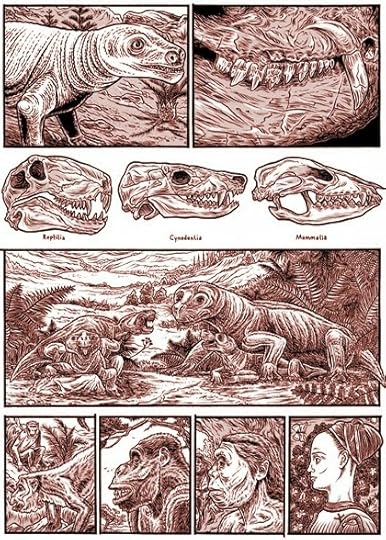
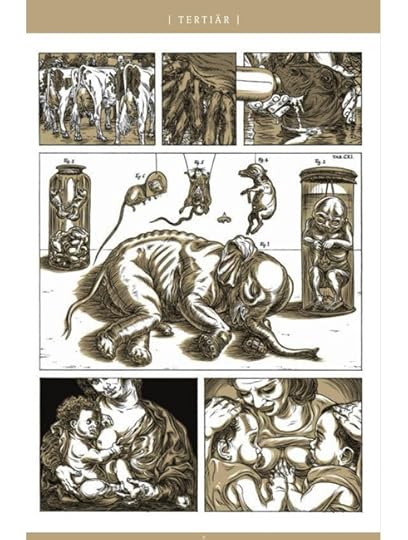
"Sex and death, effective catalysts, enter onto the scene. The new sexual reproduction deprives organisms of eternal life, however it gives them greater autonomy... The genetic information is no longer simply duplicated, but combined and constantly improved. Possibilities multiply and the pressure to succeed increases drastically..."
Jens Harder's ALPHA... Directions is a primarily visual, meticulously and often spectacularly illustrated journey from the Big Bang all the way to the beginning of human civilization, covering 14 billion years between two covers. It's an ambitious work of sequential art... that happens to feature the mother of all explosions - what's not to like? A truly mind-boggling reading experience - highly recommended (though the English translation needs some editing)!
Jens Harder tells the story of life from the Big Bang up to the rise of mammals. Told with thousands of panels, all illustrated by Harder but he freely swipes from scientific papers, historical illustrations and some contemporary swipes as well.
The text is pretty basic, reading a bit like a simplified Wikipedia page. Lots of typos too, hopefully there's some demand for a second edition. But it does its job.
It's a unique book and I'm very sad I can't seem to every see the second volume available in English any where.
Truly a work of art to be treasured. This is a book meant to be showcased in all it’s glory on your bookshelf. It’s a giant hardback with a beautiful cover, and every page within is frameable. I am truly in awe of it and so happy I sucked it up and bought a new copy, considering I buy the majority of my books used. It was totally worth it.
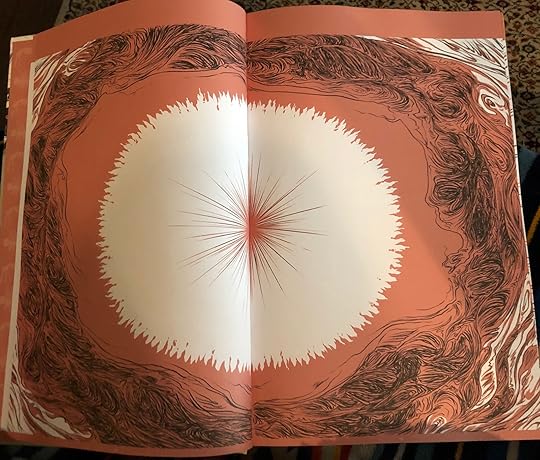
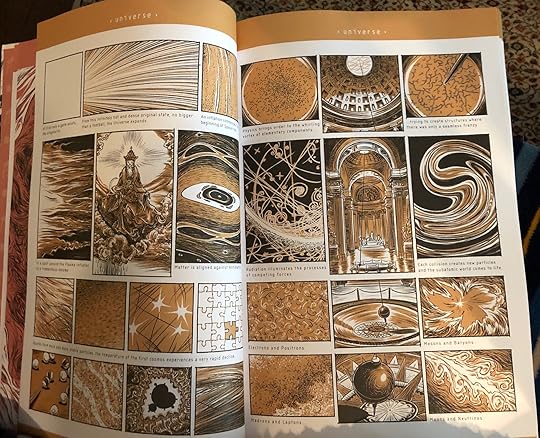
It starts off with a few full pages of simplistic yet powerful art depicting the birth of time and space. Here is one of these pages:
Sorry for the photo quality, my scanner is out of commission at the moment.
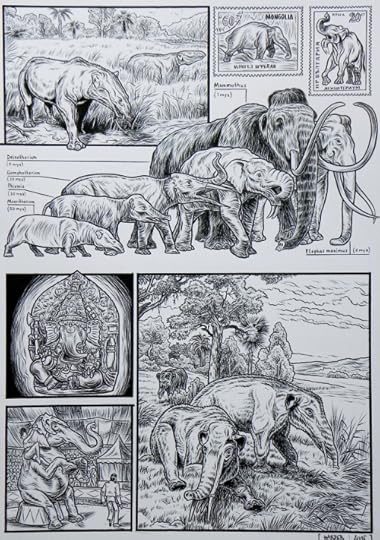
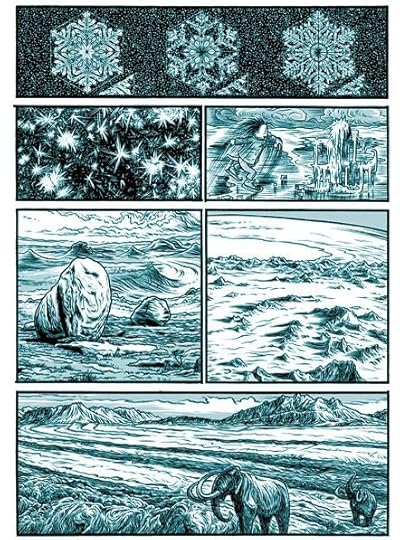
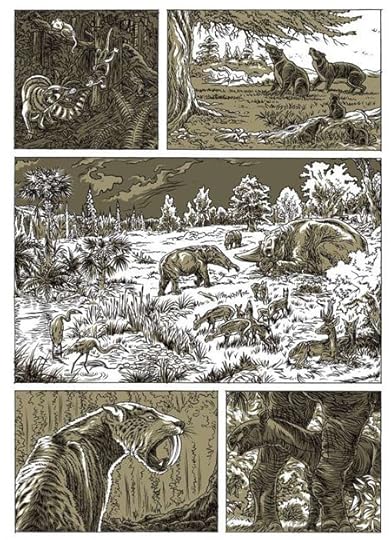
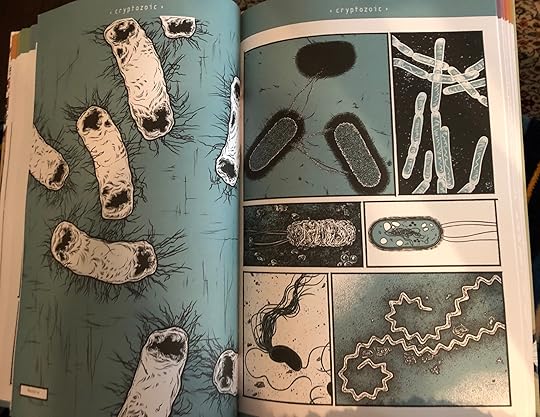
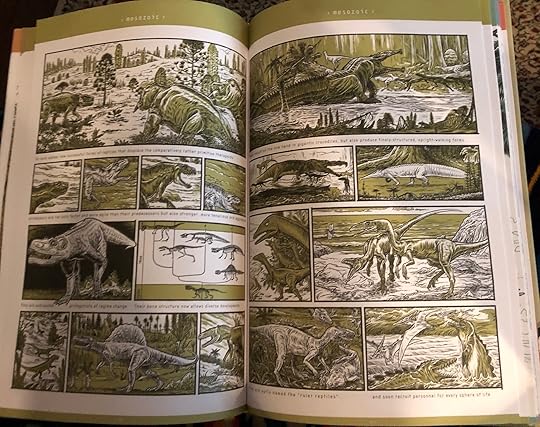
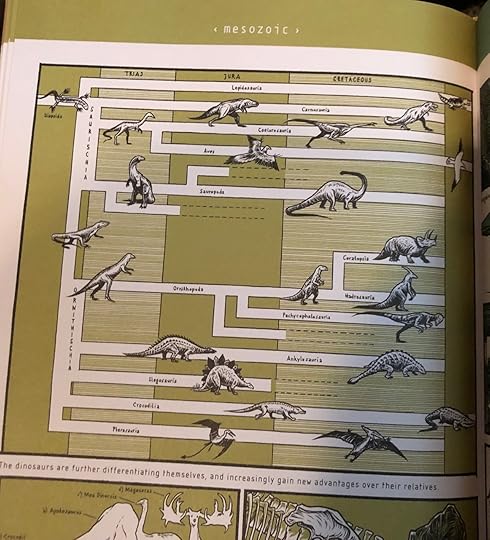
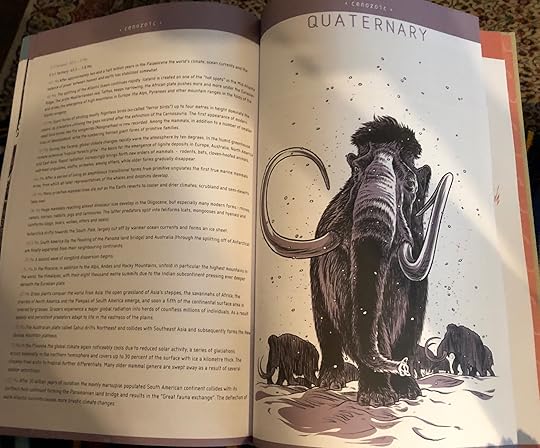
We continue through the ages with gorgeous full-page illustrations of major events in each era. Here are a few examples of what you’re going to get:
This book includes some of my favorite things: sequential art/comics, science, space, dinosaurs, an appendix, and brilliant writing. There are definitely more pictures than words, but the words are to the point and beautiful. I can only imagine the time, passion, and effort that went into creating this masterpiece.
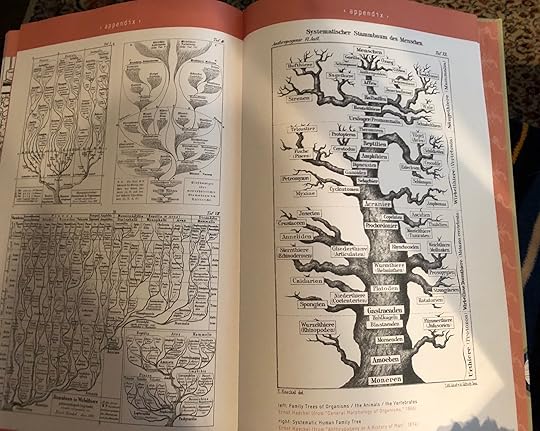
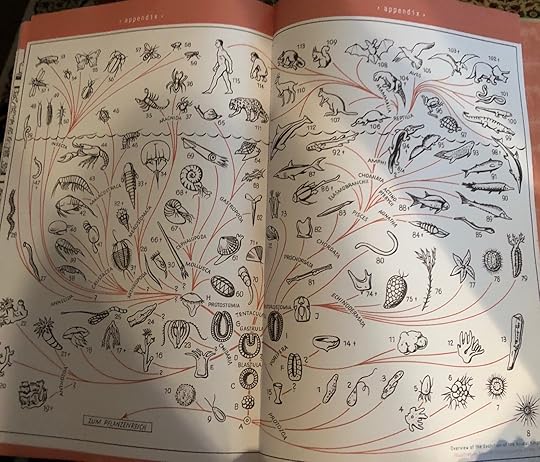
The appendix is actually one of my favorite sections in this book, and I’ll include a few pictures to show how awesome it is.
If you enjoy nonfiction books about science, art, and conversation pieces, consider buying this book for your collection. I’m scared to put it out on my coffee table on the off chance that I spill coffee on it, but it’ll have a nice place on my living room bookshelf. This is a book I'll enjoy reading again.
This is one of the coolest comics I've read in a long time.
Harder has attempted an incredibly feat: chronicle the first 13 billion years of the Earth is approx. 360 pages of comics. An ambitious endeavour, to say the least.
The production value alone of this book is amazing. It's gorgeous oversized hardback with thick, stock paper that really let's the art be its best self. And the art is amazing - I can't even begin the imagine the amount of research it took to accumulate the reference material necessary to produce this work. Harder draws everything from the Big Bang, to dinosaurs, to renderings of famous images/renderings of all of the above (and more).
The integration of images from other sources (ie. paintings, pop culture, ancient art) were well woven in too. It's visually interesting and adds a sort of.. texture to what you're looking at. Harder packs so much into a single page, making this a work worth revisiting.
My only criticism is that the translation work was... not good. Thankfully, the text takes a backseat for the art, but I often found myself rereading passages in an effort to decipher what Harder was trying to say. A bit of punctuation might have gone a long way in some places.
I hope BETA...Civilizations get translated into English (though I might try to get my hands on a copy of the French edition if I can).
This book is a STUNNER. It tells the story of the Earth from the Big Bang...in graphic novel form! It's only in German and French at the moment, but the illustrations are worth perusing in their own right.
My only critique of this otherwise stunning graphic novel is that Watson and Crick are pictured instead of Rosalind Franklin when DNA makes its appearance. However, given that these references are not explicitly named, it's not a big deal. It just leapt out at me when I saw that image because I think even in small cases like one panel of a 300+ page graphic novel, women still really, really need to be recognized for their contributions to the world.
Astounding, gorgeous, captivating, thought-provoking, bewildering...and that's just the first few pages. I "read" the Chinese version, even. It got me on a bit of an internet journey looking up stuff like "preparing trilobites" on youtube. Fascinating stuff.
FOR WHOM: Anyone with an interest in the history of our universe and of the human species. Together with BETA…civilisations volume 1, this visual take is unique in depth and breadth.
IDEA: How did we get here? Natural sciences address this important question, and by the mid-2010s we have accumulated about it much knowledge supported by a wealth of evidence. In his graphical series, auto-didact Jens Harder traces a handful of billions of years, from the Big Bang, through the formation of simple and then increasingly more complex anorganic matter, through the arrival of life, to humans and their civilization. This volume focuses on the former, covering a period until roughly 8 million years ago (first humanoids). In just around 2,000 images, Jens Harder tells the story of the universe as we currently know it.
PRO: +++ scientific and historical content of surprisingly high quality, matching the currently reputable theories. This is indeed the first comprehensive treatment I have seen in a popular material (so, other than textbooks and scientific writing) +++ covers nearly 15 billion years, from the formation of the universe to humankind +++ unique style, combines representations from different genres and eras; some have remarked there is nothing new, but they are missing the point: the new aspect is how these images composed, how existing parts are selected and put together. All drawings are a way of selecting and putting together image elements, and we recognize ways of doing this as personal styles or schools of painting, as in like Picasso or cubism, respectively; it just happens that Jens operates with larger blocks than usual. +++ The content is often built through one key element followed by repetition or detail around it. This works very well, in two main ways. The collection of images helps the reader (1) find at least one element from their immediate knowledge base, a glimpse of recognition that can lead to understanding the more difficult concepts in the book, and (2) see how our understanding of a technology or concept has evolved over time + drawing style (too?) dense, consistent, understandable + use of mute color palette works well most of the time
CONs - the writing is too narrow, which means many concepts remain touched only briefly. (The author quantifies the sparsity at about 7 million years per panel, but this is just the temporal and not the conceptual sparsity ) .
- the explanations at the end of chapters do not fully match the imagery presented in the chapter, and in particular major events or concepts included in the textual summary may not have received (proportional) attention in the imagery during the chapter
4.5+ Just a gorgeous book about the origins of the universe and what we know about life on Earth. This is definitely a book to own and pick up from time to time. It made me ask questions like, well how do scientists know that or why do they think that's how it was? I could spend the rest of my life on rabbit trails related to this book! The cultural and historical references are fun to fascinating and remind us how deeply influenced we are by imagined images of our past.
this is an incredible work of art, because it is halfway between a science textbook and a comic book. It tells the story of the universe from the big bang up until the time when humans began to evolve. It includes religious content as well as scientific, and also makes references to modern media. It is truly one of a kind.
L'univers s'est formé il y a des milliards d'année à l'issue du Big Bang. Peu à peu, des galaxies se sont formées, des soleils sont apparus et notre Voie Lactée s'est finalement créée, avec ses planètes et plus particulièrement la Terre. Mais avant qu'elle devienne ce qu'elle est actuellement, elle a connu nombres de changements et d'évolutions …
Je suis passionnée de sciences en tous genres alors quand j'ai repéré ce titre sur quelques blogs, j'ai de suite été intéressée, à tel point que j'ai du aller à la bibliothèque de l'Ecole Supérieure d'Art de la ville voisine pour pouvoir l'emprunter. J'avais peur de ne pas accrocher, de me perdre dans les explications, voire de m'ennuyer par moments d'où l'emprunt (vu le prix de vente, il vaut être sûr de soi quant à son niveau d'appréciation de cette oeuvre mais maintenant, je dois dire qu'il est amplement justifié !). L'auteur commence à nous narrer l'évolution de l'univers en commençant au tout début connu : le Big Bang, ce qui donne parfois une lecture un peu ardue, avec la création des atomes et des éléments de base et petit à petit, on voit la Terre se créer, la vie commencer à apparaître de façon invisible (à l'ère cryptozoïque), puis de façon visible et de plus en plus évoluée, malgré les nombreux cataclysmes qui ont stoppé, brièvement, cette évolution. Je n'ai pas forcément raffolé du graphisme au départ car je l'ai trouvé un peu lourd mais vu le sujet traité, il est quand même très réussi et je suis pleine d'admiration devant le travail titanesque effectué. Les différentes périodes sont illustrées par une évolution dans la couleur des bandeaux de haut de page, ce que j'ai trouvé bien pratique. De même, l'auteur insère régulièrement des vignettes semblant « hors sujet » au fil de sa narration : on retrouve des images de Jurassic Park au moment des dinosaures, ou bien des images religieuses pour illustrer comment les hommes se représentaient la Terre et son histoire à certaines périodes de l'humanité ou bien des images d'usines ou de plate-formes pétrolières quand il parle de la création des couches de carburants fossiles. C'est vraiment hyper bien fait et passionnant, éducatif à bien des niveaux. Bon, je reconnais que j'en parle très mal vu que le sujet est dense et riche donc je ne vais pas en faire en plus et ne peux que conseiller cette lecture à toute personne intéressée par le sujet. A noter qu'il y aura deux autres tomes à venir : un sur l'évolution proprement dite de l'Homme (de son apparition à nos jours) et un sur les futurs possibles de la Terre et je compte bien les lire quand ils paraitront !
Alpha …directions is a hugely important book, especially if you’re someone who struggles with the concept of deep time or the practicalities of slow and gradual change in living organisms. The book covers 14 billions years, and tells the story of Earth and the creatures upon it from the prelude of the Big Bang to the modern day.
Although not wordless, the text is sparse, and instead the duotone pages carry us the through the various periods of time, introducing the pinnacles and disasters that shaped the world at that point and its effect on life. Along the way he also uses imagery from art and religion to highlight the proceedings, putting the particular piece into context as either an additional illustration in part of the ongoing story, or using a particular beat in a creation story to contrast our understanding now. Film and popular culture are also used this way, with Harder reproducing complex works of paeleoart in his style to drive the narrative forward.
It’s an enormous book, 30mm thick, hardcover and deeper than an A4 sheet, so the scale of the work involved is fitting for the scale of the story it aims to tell. It’s oddly captivating, easy to follow and utterly absorbing.
Whether you like popular science, life on Earth or are just curious about understanding the process of change over time, this immersive and intricate book will satisfy your curiosity with scope and wonder.
In Alpha: Directions, Jens Harder presents the natural history of the universe and the Earth in graphic novel format. Starting from the Big Bang, Harder visually depicts the creation of the stars and other celestial bodies, leading towards the creation of Earth and the start of life with the beginning of the Cenozoic (~66 million years ago). Substantial swaths of Alpha is presented purely visually, but at times Harder injects descriptions of what's going on. The prose is to the point and at times a bit dry like reading a textbook might be, but it's pretty well condensed to not get tedious. Sure, it's not like Bill Bryson's "A Short History of Nearly Everything" which excels at getting the point across using wry humor, but Harder does a good job keeping the pace up without getting too bogged on details.
The illustrations throughout are splendid. Harder takes from scientific illustrations from encyclopedias and textbooks, but pieces everything together into jaw-dropping compositions. There's a broad array of designs throughout, from simplistic depictions of microorganisms to meticulously crafted geological maps, making Alpha a gorgeous medley of scientific literature from multiple fields of study. It's an ambitious comic for sure, and it succeeds in meeting the lofty goal of condensing the multiple millennia of history into to one beautiful book.
I didn't think this compilation of images would give me such a nostalgia flashback for dinosaur books but it really did. --- Eines vorneweg: Ich würde Jens Harder nicht als überragenden Zeichner ansehen. Er ist dennoch geübt genug, dass er das "Abzeichnen" problemlos schafft. Aber was er gut kann, ist das Kompilieren und Komponieren von Bildmaterialsammlungen, um daraus einen Zeitstrahl von Entwicklungen zu schaffen, das einerseits sehr naturwissenschaftlich geprägt ist, aber dann auch wieder das menschliche Element mit Götterbildern und Schöpfungsmythen einbringt. Nicht nur war Harder (wie ich auch) oft im Naturkundemuseum in Berlin und im Dinosaurierpark in Kleinwelka, er muss auch beinahe die gleichen Naturkundebücher zur Vorzeit besessen haben, denn bei den Dinosaurierbildern erkannte ich beinahe jedes Motiv wieder. Zwar würde ich mich nicht als Dino-Enthusiasten beschreiben, aber ich bekam doch tiefe Nostalgieanfälle dadurch, sehr unerwartet. Insgesamt ist es ein verdammt gutes und nützliches "bekannte Bilder"-Lexikon, was Jens Harder erschaffen hat. Nicht alles ist mehr 100% wissenschaftlich wahrscheinlich so geschehen und eine Neuauflage mit neueren Erkenntnissen wäre großartig, aber auch so ist der Bilband absolut empfehlenswert.
Asoziative Bilder, die Vorgänge aus grauer Urzeit näher bringen. Der Stil ist angelehnt an alte Drucke. Der Autor ist sich nicht zu schade für schlechte Witze (Bild eines VWs, wenn es um die Entstehung der Käfer geht, z. B.). Etwas schade ist, dass es keine Quellenangaben gibt, mit deren Hilfe man erfahren könnte, wo welche Theorien bebildert wurden. Mir fehlen sozusagen die Special Features, das Making Of. Denn am Ende eignet sich das Buch eben nicht als Wissensgrundlage, obwohl hier mit vielen Fachbegriffen hantiert wird. Das kommt nicht ganz in Einklang. Aber sehr ausdrucksstarker, sehr schöner Band.
The art styles and the drawings were just mind blowing. I especially loved how the author combined the "accurate" representations of the evolution with different representations of life and evolution in various cultures, religions and spirituality's of the world as well as elements of pop culture. That was brilliant.
Then I absolutely loved the phrasing of the explanations and the recaps at the end of the chapters… just perfect. The way the book was structured it was so accessible and understandable.
Overall this book was probably one of the best reads of my life and I would recommend it to anyone, it is a masterpiece !
L'évolution de la vie en un magnifique album. J'ai particulièrement aimé les références iconographiques qui font le parallèle entre les connaissances scientifiques et les mythes, entre la vie d'antan et celle plus proche de nous. Des anachronismes voulus, ponts entre un monde révolu et un monde qui l'est peut-être bientôt (impatiente de lire les deux autres tomes).
Jens Harder’s brushstrokes cut deep. This isn’t your usual coffee-table filler at the dentist’s office—this book plunges into space, time, the essence of matter, and the spark of life…without drowning you in words. “Show, don’t tell” is the mantra here, and it works beautifully. From quarks and protons to composed matter sipping coffee in an office while I write this review, Harder’s art strives to grasp the ungraspable—and succeeds. As a fellow artist, I can only stand in awe at this Herculean feat. Huge respect to the man who took on such a monumental labor.