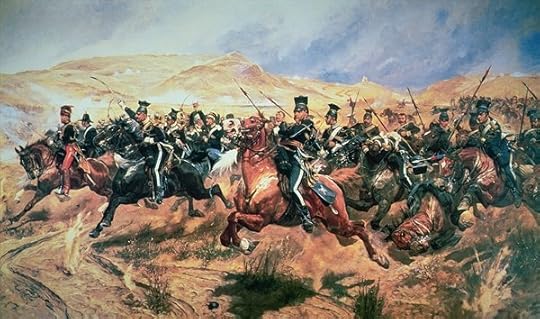
‘Half a league, half a league,
Half a league onward,
All in the Valley of Death
Rode the six hundred.
‘Forward, the Light Brigade!
Charge for the guns!’ he said:
Into the Valley of Death
Rode the six hundred.’
- Lord Alfred Tennyson
“I heard the words of the Light Brigade behind me”:
‘In the place of water we’ll drink ale,
And pay no reckoning on the nail,
No man for debt shall go to jail,
When he can Garryowen hail.’
- Irish drinking song widely used in English speaking military marches
“I’ve heard it from Afghanistan to Whitehall, from the African veldt to drunken parties in Rutland. I’ve heard it sounded in penny whistles by children and sounded out in a full throated chorus by Custer’s 7th on the day of Greasy Grass, and there were survivors of the Light Brigade singing it in their day too. It always sounds bitter to my ears when I think of the brave, deluded, pathetic bloody fools with their mangled bodies and lost limbs, all for a shilling a day and a pauper’s grave.”
- George MacDonald Fraser
“What I didn’t realize then was these people were slaves - bound European white slaves which isn’t easy to understand until you see it. Boris Godunov - whom most of you know as the fellow who takes an hour and a half to die in an opera - imposed serfdom on the Russian peasants, meaning they became the property of nobles and landowners who could buy and sell them, hire them out, starve, lash and imprison them, take their goods, beasts and women whenever they chose - anything short of maiming or killing them. They did those things too of course, but it was officially unlawful.”
- George MacDonald Fraser
************
Colonel Harry Flashman is relaxing in London ten years after being decorated as a hero and nearly sole survivor of the First Afghan War, and a stint as a slave trader in Africa and America. He sees trouble brewing in Turkey due to Russian expansionism and secures an office position in ordnance procurement to avoid combat duty. But as fate would have it he is selected by Lord Raglan, commanding officer for the Russian campaign to chaperone Wilhelm, a young nephew of Prince Albert, consort of Queen Victoria. Flash had met him in a bar earlier and abandoned him drunken in an alleyway.
War breaks out in 1853 and Wilhelm, who attends a military school, accompanies the expedition to Russia with Flash. As he is leaving he suspects his wife is having an affair with the 7th Earl of Cardigan, commander of the 11th Hussars cavalry, who later will lead the ill-fated Charge of the Light Brigade. Arriving at Varna in Bulgaria, British and French soldiers are sick with cholera and the generals don’t know why they have orders to attack Sevastopol in Crimea. Without good maps 60,000 men drift around the Black Sea in search of the siege location, landing in Alma where a great battle ensues.
In the fight Flash loses his royal charge and is sickened by champagne looted from Cossacks at Balaclava. At the next battle he’s nauseous and incontinent but ordered back to the front as Raglan’s messenger. He finagles the Light Brigade to recapture British cannon in hopes Cardigan will be killed, but is told to join in the charge. Raglan’s orders are jumbled and Cardigan leads the cavalry straight into Russian artillery. Famously they were shot to pieces, yet Flash and his rival survive. Reaching the gun battery he flees, only to be taken prisoner. The enemy is dumbfounded by the daring attack.
Flash enjoys passage as a privileged hostage across the frozen steppe on a horse drawn cart, reflecting on man’s precarious relationship to slavery. Hosted by a Count in a sprawling mansion he pursues his married daughter and sister. Beneath a civilized veneer the heart of a Cossack barbarian lurks. Flash describes scenes that belong in a Turgenev novel, and with his usual lingual facility is soon speaking Russian. Serf rebellions had begun, and Marx in London was known. Detained with Flash is a soldier and old classmate intent on learning military secrets of the house.
Apprised of Great Game intrigues that threaten the British Empire, a peasant uprising provides an opportunity for escape towards Sevastopol. However plans go awry, and Flash finds himself on a fraught expedition across the desert wastes of Central Asia in the clutches of a Russian cavalry unit. Only unforeseen events can save him and foil the Tsar’s plot. The author weaves Flashman within real life events and people. The historical background is credible in spite of the comical situations. He is a morally compromised character, but has a clear sense of the ironies during his time.
************
‘To learn the age old lesson day by day,
It is not in the bright arrival planned,
But in dreams men dream along the way,
They find the Golden Road to Samarkand.’
-James Elroy Flecker