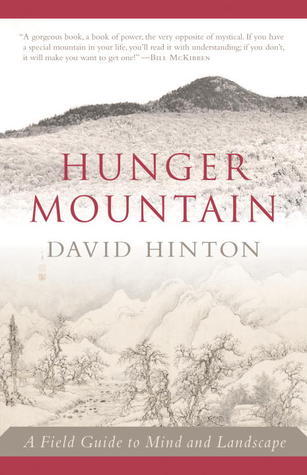
Few other [if any] books have disabused me of my Western thinking about language, metaphors, and literature. Hinton uses his hikes up Hunger Mountain to explore the nature of Chinese poetry, philosophy, and thought. There's a lot in this book that I've had the personal experience of [on hikes], but lacked the words to express: little revelations. Hinton basically gives us a way to talk about those things, but not through a Western metaphorical structure. In fact, Hinton explores Chinese poetry as viewing landscape and your identity as one thing, not two that must be merged through the unity of disparate parts. Some favorite lines...
-“Once we begin to telling stories, the center replaces the silent mystery with our constructions of it, and the center replaces the silent mystery with our constructions of it, and the result is a breach between consciousness and the empirical landscape”
-“Consciousness is made of the same tissue as the Cosmos. Things vanish into us just as they vanish into the Cosmos, and we call it forgetfulness”
-“After the most exhaustive scientific description, the most accurate philosophical account, of the most concise and imagistic poem, ten thousand things remain, in and of themselves, a mystery beyond me”
-“the birthplace of stars is now always everywhere, a quantum particle-burst blossoming out and flaring starlight where the mysterious fabric of gravity tightens”
-“The Cosmos is a tissue of generative ch’i-energy, and when the eye opens sky inside us, it conjures consciousness as an opening in that ontological absence"
-“Translation itself always opens for me that space between identities ... the ancients speak in my voice, and I in theirs”
-“Our words about the Cosmos are the Cosmos talking about itself. Our thoughts are the Cosmos contemplating itself”
-“The structures of self are all built from the primal ground through a network of metaphoric transference—words and concepts, images and knowledge and story. But it’s all silence here [on Hunger Mountain]”